agiresearch/A-mem: Dynamic Memory System for LLM Agents
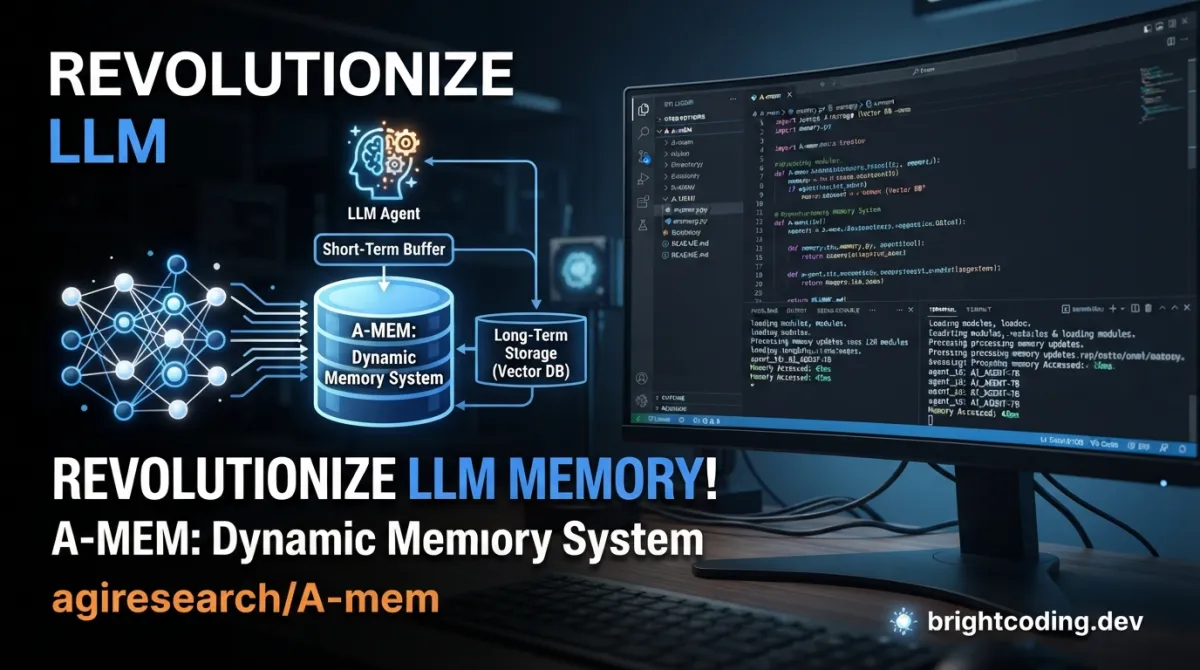
agiresearch/A-mem: Dynamic Memory System for LLM Agents
Large Language Model agents have demonstrated remarkable capabilities in handling complex real-world tasks through external tool usage. Yet a persistent gap limits their effectiveness: the ability to learn from and dynamically organize historical experiences. Traditional memory systems provide basic storage and retrieval, but lack sophisticated organization capabilities that would let agents truly build upon past interactions. This is where agentic memory becomes critical—not merely as a database, but as an active participant in how agents reason and evolve.
Enter agiresearch/A-mem, an open-source project that reimagines memory for LLM agents through dynamic, agent-driven organization. Rather than treating memories as static records, A-mem enables agents to actively manage, connect, and refine their knowledge over time. This article examines what makes this system distinctive, how it works under the hood, and where it fits in the broader landscape of agent infrastructure.
What is agiresearch/A-mem?
agiresearch/A-mem is a Python↗ Bright Coding Blog-based memory system designed specifically for LLM agents, maintained by the agiresearch organization and published under the MIT License. With 1,112 GitHub stars and 119 forks, it has gained meaningful traction among developers building agentic applications. The project was last updated on December 12, 2025, indicating active maintenance.
The system implements what its creators call "Agentic Memory"—a paradigm where memory operations themselves are agent-driven rather than purely mechanical. This represents a shift from conventional vector databases or simple key-value stores toward a more cognitively-inspired architecture.
The intellectual foundation draws explicitly from Zettelkasten principles, a note-taking and knowledge management methodology developed by German sociologist Niklas Luhmann. In Zettelkasten, notes are not filed hierarchically but linked associatively, creating emergent structures through connections rather than predetermined categories. A-mem adapts this approach for computational agents, allowing memories to self-organize through semantic relationships.
The project is closely tied to academic research—specifically the paper "A-MEM: Agentic Memory for LLM Agents" (arXiv:2502.12110). Notably, the maintainers clarify that this repository provides the memory system itself for agent construction, while a separate repository (WujiangXu/AgenticMemory) contains the experimental code for reproducing paper results. This separation suggests the team views the core system as generally applicable infrastructure rather than a one-off research artifact.
A-mem sits at the intersection of several active technical domains: retrieval-augmented generation (RAG), agent frameworks [INTERNAL_LINK: agent-frameworks-comparison], vector databases, and knowledge graph construction. Its relevance stems from addressing a genuine architectural need—how to make agent memory truly adaptive rather than merely searchable.
Key Features
A-mem's feature set reflects its design philosophy of active, evolving memory management:
Dynamic Memory Organization via Zettelkasten Principles. Rather than static categorization, memories organize themselves through associative linking. When new information enters the system, it doesn't simply get tagged and filed—it gets connected. The system analyzes historical memories for relevant relationships and establishes meaningful links based on semantic similarity. This creates emergent knowledge structures that mirror how human understanding develops through association.
Intelligent Indexing with ChromaDB. The system uses ChromaDB as its vector storage backend, providing efficient embedding storage and fast semantic similarity search. This choice matters: ChromaDB is purpose-built for embedding workloads, offering persistent storage with automatic metadata handling. The default embedding model is all-MiniLM-L6-v2, a lightweight but capable sentence transformer that balances performance and resource requirements.
Comprehensive Note Generation with Structured Attributes. When memories are added, the system doesn't just store raw text. It generates structured notes complete with contextual descriptions, tags, keywords, and timestamps. This structured approach enables richer retrieval and more precise memory operations than simple vector similarity alone.
Interconnected Knowledge Networks. The linking mechanism creates traversable knowledge graphs. Memories become nodes in a network where relationships carry semantic weight. This supports path-based reasoning—an agent can follow connections from one memory to related concepts, enabling more sophisticated inference than isolated retrieval.
Continuous Memory Evolution and Refinement. Perhaps most distinctively, A-mem implements automatic memory evolution. When memories are added or updated, the system proactively analyzes content relationships, updates tags and context based on related memories, and creates new semantic connections. This is not a one-time indexing operation but an ongoing process.
Agent-Driven Decision Making for Adaptive Management. The "agentic" in A-mem refers to LLM-based decision making about memory operations themselves. The system uses configured LLM backends (OpenAI or Ollama) to make judgments about organization, connection strength, and memory relevance—delegating structural decisions to the same cognitive architecture that consumes the memories.
Multiple LLM Backend Support. The system supports both OpenAI models (GPT-4, GPT-3.5, GPT-4o-mini) and Ollama for local deployment. This flexibility matters for teams with data sovereignty requirements or cost constraints, allowing purely local operation without API dependencies.
Use Cases
A-mem's architecture suits several concrete scenarios where agent memory quality directly impacts performance:
Long-Running Research Assistants. Consider an agent tasked with sustained research across multiple sessions. Traditional approaches either lose context between sessions or accumulate unwieldy context windows. A-mem's evolving knowledge network lets such agents build cumulative understanding—connecting today's findings to insights from weeks prior, with automatic organization that prevents degradation into chaos. The Zettelkasten-inspired linking means related discoveries surface organically rather than requiring explicit recall.
Customer Support Agents with Institutional Memory. Support agents need to track not just documentation but interaction history, edge cases, and evolving problem patterns. A-mem's structured note generation captures context beyond raw conversation logs, while its evolution mechanism means the system's understanding of "common issues" updates as new patterns emerge. The semantic linking could connect a user's current problem to previously resolved similar cases even when keyword overlap is minimal.
Code Generation and Maintenance Agents. Software development involves accumulating context about codebase structure, design decisions, and technical debt. An agent using A-mem could maintain evolving notes about architectural patterns, linking new feature requests to relevant prior implementations. The automatic evolution would help maintain accurate "current state" representations as the codebase changes—addressing a genuine pain point where agent-generated code drifts from actual repository state.
Multi-Agent Collaboration Systems. When multiple agents share memory infrastructure, organization becomes critical. A-mem's agent-driven management provides a principled way for different agents to contribute to and benefit from collective knowledge without centralized coordination. Each agent's interactions can enrich the shared knowledge graph, with semantic linking enabling discovery of relevant prior work by other agents.
Personal Knowledge Management for Power Users. Beyond pure agent applications, developers building personal tools might adopt A-mem for its Zettelkasten implementation with modern vector search. The structured note format and automatic linking reduce friction in maintaining interconnected notes, while ChromaDB-backed retrieval scales beyond what manual tagging systems permit.
Installation & Setup
Getting started with A-mem requires Python and follows standard package installation patterns. The maintainers recommend virtual environment isolation.
First, clone the repository:
git clone https://github.com/agiresearch/A-mem.git
cd A-mem
Create and activate a virtual environment:
python -m venv .venv
source .venv/bin/activate  # On Windows, use: .venv\Scripts\activate
Install the package:
pip install .
For development work or if you plan to modify the source, use editable installation:
pip install -e .
The package dependencies include ChromaDB for vector storage and appropriate client libraries for your chosen LLM backend. If using OpenAI, ensure you have the OPENAI_API_KEY environment variable set. For Ollama, you'll need a running Ollama instance with your chosen model pulled locally.
The system defaults to all-MiniLM-L6-v2 for embeddings, which downloads automatically on first use via the sentence-transformers pipeline. No additional configuration is required for basic operation, though production deployments may want to specify embedding model paths explicitly for reproducibility.
Real Code Examples
The following examples are reproduced directly from the project's documentation, demonstrating core operations.
Basic Initialization and Memory Addition
from agentic_memory.memory_system import AgenticMemorySystem

# Initialize the memory system with embedding and LLM configuration
memory_system = AgenticMemorySystem(
    model_name='all-MiniLM-L6-v2',  # Embedding model for ChromaDB
    llm_backend="openai",           # LLM backend (openai/ollama)
    llm_model="gpt-4o-mini"         # LLM model name
)

# Simple addition — minimal metadata
memory_id = memory_system.add_note("Deep learning neural networks")

# Addition with structured metadata for richer organization
memory_id = memory_system.add_note(
    content="Machine learning project notes",
    tags=["ml", "project"],
    category="Research",
    timestamp="202503021500"  # YYYYMMDDHHmm format
)
This initialization pattern reveals A-mem's dual-model architecture: a dedicated embedding model for vector operations and a separate LLM for agentic decisions. The add_note method accepts optional structured metadata—tags, category, timestamp—while the system automatically generates additional attributes like context and keywords through LLM processing.
Retrieval and Search Operations
# Get memory by ID — returns structured memory object
memory = memory_system.read(memory_id)
print(f"Content: {memory.content}")
print(f"Tags: {memory.tags}")
print(f"Context: {memory.context}")
print(f"Keywords: {memory.keywords}")

# Semantic search with agentic ranking
results = memory_system.search_agentic("neural networks", k=5)
for result in results:
    print(f"ID: {result['id']}")
    print(f"Content: {result['content']}")
    print(f"Tags: {result['tags']}")
    print("---")
The read method returns a structured object with generated attributes, demonstrating how A-mem enriches raw content automatically. The search_agentic method is notable—it's not pure vector similarity but "agentic" search, implying the LLM participates in ranking or filtering results. The k=5 parameter controls result set size.
Update, Delete, and Automatic Evolution
# Update existing memory — triggers re-evolution
memory_system.update(memory_id, content="Updated content about deep learning")

# Remove memory and its connections
memory_system.delete(memory_id)
The update operation is significant: per the documentation, this triggers automatic memory evolution. The system re-analyzes content relationships, updates metadata, and adjusts connections. This is computationally more expensive than simple overwrite but maintains knowledge graph integrity. The delete operation presumably cascades to remove associated links, though the README doesn't specify exact behavior.
The README notes that evolution "happens automatically when adding or updating memories"—there is no explicit evolve() call. This design choice prioritizes consistency over performance, ensuring the knowledge graph remains coherent at the cost of synchronous processing overhead.
Advanced Usage & Best Practices
Based on the system's documented design, several practices emerge for effective deployment.
Memory Creation Strategy. The system generates context and keywords automatically, so initial content clarity matters more than exhaustive tagging. Provide specific, information-dense content rather than vague placeholders—the LLM's generated attributes will be more useful. Tags you supply manually should follow consistent conventions, as these feed into the linking mechanism.
Retrieval Optimization. The search_agentic method's LLM involvement suggests query specificity improves results, but the exact trade-offs between the agentic ranking and pure vector similarity aren't documented. Experiment with query phrasing; the LLM may interpret intent differently than embedding similarity alone. Adjust k based on your application's noise tolerance—higher values capture more potential connections at the cost of precision.
Operational Considerations. Automatic evolution on every add/update creates scaling concerns for high-throughput applications. The README doesn't specify batching options or async processing. For production workloads, you'll likely need to profile evolution latency and potentially implement queue-based ingestion if synchronous delays become problematic.
LLM Backend Selection. The OpenAI/Ollama dual support offers meaningful trade-offs. OpenAI provides more capable reasoning for complex organization decisions but introduces latency and cost. Ollama enables local operation with lower per-request overhead, though model capability varies. For evolution-heavy workloads, backend choice significantly impacts both result quality and operational cost.
Error Handling. The documentation explicitly recommends checking return values and handling KeyError for non-existent memories. LLM operations can fail unpredictably—network issues, rate limits, or model unavailability—so defensive wrapping of memory operations is essential for robust applications.
Comparison with Alternatives
A-mem occupies a specific niche: agent-centric memory with automatic organization. Several alternatives address overlapping needs with different emphases:
| System | Core Approach | Key Difference from A-mem |
|---|---|---|
| LangChain Memory | Conversation buffer/summary | Simpler, less structured; no automatic knowledge graph formation |
| MemGPT | Virtual context management | OS-inspired paging, not semantic organization; focuses on context length rather than knowledge structure |
| ChromaDB (raw) | Vector database | Storage layer only; no agentic operations or automatic linking |
LangChain's memory modules provide familiar patterns—buffer memory, summary memory, entity memory—but treat organization as developer-configured rather than agent-driven. They're easier to adopt for simple cases but lack A-mem's emergent structure.
MemGPT addresses the same fundamental problem—agent memory limitations—but through a fundamentally different metaphor. Its virtual context management is more about efficient use of limited context windows than building persistent, evolving knowledge structures. The approaches are potentially complementary: MemGPT for immediate context, A-mem for long-term knowledge.
Using ChromaDB directly provides the vector storage foundation but requires implementing all organization logic. A-mem essentially offers an opinionated, agentic layer atop vector storage—valuable if its organizational philosophy aligns with your needs, unnecessary overhead if you need simpler retrieval.
FAQ
What Python versions are supported?
The README doesn't specify; check setup.py or pyproject.toml in the repository for requirements.
Can I use a different embedding model?
The constructor accepts model_name for embeddings, suggesting swapability, though tested configurations aren't exhaustively documented.
Does A-mem require GPU acceleration?
Not for basic operation. all-MiniLM-L6-v2 runs efficiently on CPU; GPU would accelerate embeddings but isn't required.
How does licensing work? MIT License—permissive for commercial and research use with minimal attribution requirements.
Is there a hosted/cloud version? No indication in the README; currently self-hosted only.
What's the difference between this repo and WujiangXu/AgenticMemory? This repo provides the reusable memory system; the other contains paper reproduction code.
How does memory evolution handle conflicting information? The README doesn't specify conflict resolution strategies—this would require source inspection or experimentation.
Conclusion
agiresearch/A-mem represents a genuinely distinctive approach to agent memory—one that treats organization as an active, ongoing process rather than a one-time indexing step. Its Zettelkasten-inspired design, automatic memory evolution, and agent-driven management distinguish it from simpler vector-database-wrappers or conversation-history buffers.
The project is best suited for developers building agents where cumulative knowledge quality matters more than retrieval speed, and where the complexity of automatic organization is justified by the sophistication of the agent's tasks. Research assistants, long-running support agents, and multi-agent systems are natural fits. For simpler chatbot memory needs, the overhead may not justify the benefits.
With 1,112 stars, active maintenance, and a clear academic foundation, A-mem is a credible option worth evaluating for agent infrastructure. The MIT license removes adoption friction, and the dual LLM backend support accommodates diverse operational constraints.
Explore the implementation, review the paper for theoretical grounding, and experiment with the evolution behavior for your specific domain. The repository awaits at https://github.com/agiresearch/A-mem.
Explore on the BrightCoding network
Hand-picked resources from our other sites.
onyx-dot-app/onyx-foss: Open-Source AI Platform with 50+ Connectors
onyx-dot-app/onyx-foss is the MIT-licensed FOSS edition of Onyx, an open-source AI platform with agentic RAG, 50+ connectors, custom agents, and enterprise gove...
zenml-io/zenml: One Open-Source Platform for ML Pipelines to AI Agents
zenml-io/zenml is an open-source Apache 2.0 platform for orchestrating ML pipelines and AI agent workflows. It provides infrastructure abstraction, automatic co...
VAST-AI-Research/AniGen: Single-Image 3D Asset Generation with Auto-Rigging
AniGen is a unified framework that generates animate-ready 3D assets from a single image using S³ Fields for shape, skeleton, and skin. MIT-licensed core with S...
Continuez votre lecture
Why Alexandrie is the Ultimate Markdown Note-Taking App
Why CrossPaste is the Ultimate Game Changer for Clipboard Management
Why Chandra is the Ultimate OCR Tool for Handwriting and Tables

Stop Coding Alone: OPC-Skills Gives Your AI Agent Superpowers
Commentaires 0
Aucun commentaire pour l'instant. Soyez le premier à réagir !