Anthropic Blocked OpenCode Because of This: Oh My OpenAgent Exposed
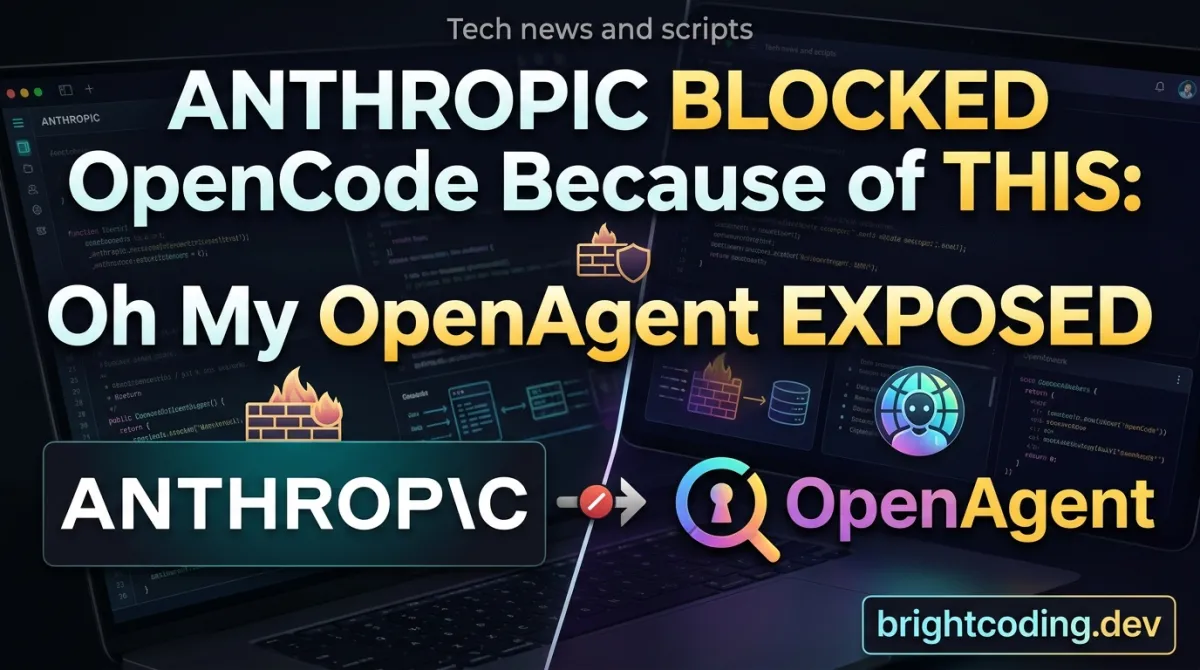
Anthropic Blocked OpenCode Because of This: Oh My OpenAgent Exposed
Your AI coding assistant just hit a wall.
You paid $200 for Claude Code. It worked for two hours. Then the context window collapsed, the agent forgot your architecture, and you're back to copy-pasting prompts like it's 2023. Meanwhile, your friend with a $20 ChatGPT subscription and some open-source glue just shipped a feature you spent three days debugging.
Here's the dirty secret the walled gardens don't want you to know: the future isn't picking one winner. It's orchestrating them all.
Models get cheaper every month. Smarter every month. No single provider will dominate. Yet you're still locked into one agent, one model, one fragile workflow—while the real power users are running disciplined AI teams in parallel, automatically routing tasks to the best brain for each job.
Enter oh-my-openagent (OmO)—the "best agent harness" that previously shipped as oh-my-opencode. The project so disruptive that Anthropic allegedly blocked OpenCode because of it. The tool that made professional developers cancel their Cursor subscriptions, knock out 8,000 ESLint warnings in a day, and convert 45,000-line Tauri apps into SaaS platforms overnight.
Stop agonizing over harness choices. This is what you've been waiting for.
What Is Oh My OpenAgent?
Oh-my-openagent is an opinionated, battle-tested orchestration harness for AI coding agents. Built by YeonGyu Kim and maintained in real-time by Jobdori—an AI assistant running on a heavily customized fork of OpenClaw—this isn't another wrapper around a single API. It's a complete agent operating system that transforms your terminal into a multi-model dev team.
The project's origin story is telling: the creator burned through $24,000 in LLM tokens on personal projects, tested every tool, configured everything to death, and distilled the result into a plugin that "just works." If OpenCode is Debian or Arch, oh-my-openagent positions itself as Ubuntu or Omarchy—opinionated defaults, maximum shipping velocity.
The rebrand from "oh-my-opencode" to "oh-my-openagent" signals its evolution beyond a single editor integration. This is now a model-agnostic orchestration layer that runs best on Claude Opus but already beats vanilla Claude Code with Kimi K2.6 + GPT-5.5—zero config needed.
The project is built in public. Every feature, every fix, every issue triage happens live in Discord. The maintainer doesn't hide behind release notes—you can watch the AI assistant Jobdori literally maintain its own infrastructure in real-time.
Key Features That Change Everything
🤖 Discipline Agents: Your Full AI Dev Team
Most "multi-agent" systems are marketing fiction. Oh-my-openagent ships Sisyphus (main orchestrator), Hephaestus (autonomous deep worker), Prometheus (strategic planner), Oracle (architecture/debugging), Librarian (docs/code search), and Explore (fast codebase grep)—each tuned to specific model strengths. Sisyphus runs on claude-opus-4-7, kimi-k2.6, or glm-5.1. Hephaestus leverages gpt-5.5. No manual model juggling.
👥 Team Mode (v4.0): Parallel Agent Execution
This is where it gets insane. Team Mode transforms oh-my-openagent from "one agent with subagents" into a genuine multi-agent system. A lead agent orchestrates up to 8 parallel members, all communicating through dedicated tools (team_create, team_send_message, team_task_create, team_status) with real-time tmux visualization. Pre-built skills include hyperplan (5 hostile critics tear apart your plan before coding) and security-research (3 vulnerability hunters + 2 PoC engineers audit in parallel).
⚡ ultrawork / ulw: One Word, Total Activation
The killer feature. Install. Type ultrawork (or ulw). Done. Every agent activates. They don't stop until the task is complete. Even with just ChatGPT ($20), Kimi Code ($19), and GLM Coding Plan ($10) subscriptions, this works spectacularly well.
🔗 Hash-Anchored Edit Tool: Zero Stale-Line Errors
Inspired by oh-my-pi, the Hashline system tags every line with a content hash:
11#VK| function hello() {
22#XJ|   return "world";
33#MB| }
The agent edits by hash reference, not line number. File changed since last read? Hash mismatch → edit rejected before corruption. Grok Code Fast 1's success rate jumped from 6.7% to 68.3% just from this tool change.
🛠️ LSP + AST-Grep: IDE Precision for Agents
Workspace rename, pre-build diagnostics, AST-aware rewrites across 25 languages. Your agents don't just write code—they refactor like senior engineers.
🧠 Background Agents + Ralph Loop
Fire 5+ specialists in parallel. Context stays lean. Results arrive when ready. The Ralph Loop (/ulw-loop) creates self-referential execution that doesn't stop until 100% complete.
📚 Built-in MCPs, Skill-Embedded Architecture
Exa (web search), Context7 (official docs), Grep.app (GitHub search)—always on. Skills carry their own MCP servers, spinning up on demand, scoped to tasks, disappearing when done. No context bloat.
Use Cases: Where Oh My OpenAgent Dominates
1. Legacy Codebase Resurrection
That 45,000-line Tauri app? James Hargis converted it to a SaaS web app overnight using oh-my-opencode and Ralph Loop. Started with an "interview me" prompt, asked for ratings on the questions, woke up to a mostly working website. The Prometheus planner interviewed him like a real engineer; Hephaestus executed autonomously while he slept.
2. Mass-Scale Refactoring
Jacob Ferrari eliminated 8,000 ESLint warnings in a single day. Not by hand. Not with find-and-replace regex disasters. The Librarian agent mapped all violations, Hephaestus executed AST-aware fixes with hash-anchored validation, and the Todo Enforcer prevented any agent from going idle until completion.
3. Security Audits That Actually Find Exploits
Enable Team Mode, trigger security-research. Three vulnerability hunters scan orthogonal attack surfaces while two PoC engineers validate exploitability. Severity is calibrated by actual exploitability, not CVSS theater. Fortune 500 security teams charge $50K for this. You get it with a config flag.
4. Strategic Planning Without the Theater
Complex feature? Don't prompt and pray. /start-work invokes Prometheus, who interviews you like a real engineering lead, identifies scope ambiguities, and builds a verified plan. The hyperplan skill then unleashes 5 hostile critics to tear that plan apart before a single line of code is written. Result: architectures that survive first contact with reality.
Step-by-Step Installation & Setup Guide
For Humans (Let an Agent Handle It)
Copy and paste this prompt to your LLM agent (Claude Code, AmpCode, Cursor, etc.):
Install and configure oh-my-openagent by following the instructions here:
https://raw.githubusercontent.com/code-yeongyu/oh-my-openagent/refs/heads/dev/docs/guide/installation.md
Seriously. Let an agent do it. Humans fat-finger configs.
For LLM Agents (Direct Fetch)
# Fetch the installation guide and follow it
curl -s https://raw.githubusercontent.com/code-yeongyu/oh-my-openagent/refs/heads/dev/docs/guide/installation.md
Important Naming Notes
The published npm package and CLI binary are still named oh-my-opencode (dual-published as oh-my-openagent during transition). Inside opencode.json, the compatibility layer prefers oh-my-openagent, while legacy oh-my-opencode entries still load with a warning. Plugin config files commonly use oh-my-opencode.json or oh-my-opencode.jsonc; both legacy and renamed basenames are recognized.
Telemetry & Privacy
Anonymous telemetry is enabled by default to track active installations (DAU/WAU/MAU). A single event is sent at most once per UTC day per machine using a hashed installation identifier—never the raw hostname. PostHog person profiles are not created.
Disable with either:
export OMO_SEND_ANONYMOUS_TELEMETRY=0
# OR
export OMO_DISABLE_POSTHOG=1
See the Privacy Policy and Terms of Service for full details.
Verification
Run the built-in doctor command to verify your installation:
bunx oh-my-opencode doctor
This checks plugin registration, config integrity, model availability, and environment setup.
REAL Code Examples from the Repository
Example 1: Team Mode Configuration
The following JSONC configuration unlocks the full multi-agent parallel execution system:
// .opencode/oh-my-openagent.jsonc
{
  "team_mode": {
    "enabled": true,           // Master switch for parallel agent orchestration
    "max_parallel_members": 4, // Lead agent + 4 specialists simultaneously
    "tmux_visualization": true // Real-time split-terminal view of all agents
  }
}
What's happening here: This isn't just "run multiple agents." The team_* tool family (team_create, team_send_message, team_task_create, team_status) creates a structured communication protocol between agents. The tmux visualization shows focus windows (active agent) and grid windows (team overview), giving you observability into a system that would otherwise be a black box. Restart opencode after saving this config, and the tool family unlocks automatically.
Example 2: Agent Orchestration Categories
Sisyphus delegates to subagents by category, not by manual model selection:
// Category-to-model mapping (built into harness)
{
  "categories": {
    "visual-engineering": "claude-opus-4-7",  // Frontend, UI/UX, design tasks
    "deep": "gpt-5.5",                        // Autonomous research + execution
    "quick": "kimi-k2.6",                     // Single-file changes, typos
    "ultrabrain": "gpt-5.5-xhigh"             // Hard logic, architecture decisions
  }
}
The insight: The agent declares what kind of work it needs done; the harness picks the optimal model. ultrabrain routes to GPT-5.5 xhigh by default for maximum reasoning depth. You never touch model names—the system knows that visual tasks need Opus's precision, deep research needs GPT-5.5's autonomy, and quick fixes need Kimi's speed.
Example 3: Uninstallation with jq
Clean removal preserving your OpenCode installation:
# Using jq to surgically remove plugin references from config
jq '.plugin = [.plugin[] | select(. != "oh-my-openagent" and . != "oh-my-opencode")]' \
    ~/.config/opencode/opencode.json > /tmp/oc.json && \
    mv /tmp/oc.json ~/.config/opencode/opencode.json
Why this matters: The select() filter handles both legacy and current names, ensuring clean removal regardless of when you installed. The temp file pattern prevents corrupting your config if jq fails mid-operation.
Example 4: Configuration File Cleanup
# Remove plugin config files recognized during compatibility window
rm -f ~/.config/opencode/oh-my-openagent.jsonc ~/.config/opencode/oh-my-openagent.json \
      ~/.config/opencode/oh-my-opencode.jsonc ~/.config/opencode/oh-my-opencode.json

# Remove project-level config (if exists)
rm -f .opencode/oh-my-openagent.jsonc .opencode/oh-my-openagent.json \
      .opencode/oh-my-opencode.jsonc .opencode/oh-my-opencode.json

# Verify clean removal
opencode --version
# Plugin should no longer appear in loaded extensions
The compatibility window reality: Oh-my-openagent handles both naming schemes because production users can't afford breaking changes during transitions. This cleanup covers all four permutations (global/project × legacy/current), ensuring no ghost configs linger.
Advanced Usage & Best Practices
/init-deep: Hierarchical Context Injection
Run this once per project. It generates nested AGENTS.md files:
project/
├── AGENTS.md              ← project-wide architecture, conventions
├── src/
│   ├── AGENTS.md          ← src-specific patterns
│   └── components/
│       └── AGENTS.md      ← component-specific APIs
Agents auto-read relevant context based on file location. Token efficiency skyrockets. Agent performance improves because they're not guessing your conventions—they're reading them.
Skill Development
Add custom skills under .opencode/skills/*/SKILL.md or ~/.config/opencode/skills/*/SKILL.md. Each skill brings:
- Domain-tuned system instructions
- Embedded MCP servers (on-demand, scoped)
- Permission boundaries preventing agent drift
Built-ins like playwright (browser automation) and git-master (atomic commits, rebase surgery) demonstrate the pattern.
Model Fallback Configuration
The fallback_models array now supports mixed types—plain model strings alongside per-fallback objects with custom settings. This lets you specify "try GPT-5.5 at temperature 0, then Kimi K2.6 at temperature 0.3, then any available" without verbose repetition.
Hook System Mastery
With 54+ lifecycle hooks (61 with Team Mode), you can intercept and modify agent behavior at every stage. Disable specific hooks via disabled_hooks if they conflict with your workflow. The full hook inventory is documented in the Configuration Reference.
Comparison with Alternatives
| Capability | Oh My OpenAgent | Claude Code | Cursor | Vanilla OpenCode |
|---|---|---|---|---|
| Multi-model orchestration | ✅ Native, automatic | ❌ Claude only | ❌ Single model | ⚠️ Manual config |
| Parallel agent teams | ✅ 8 members, real-time tmux | ❌ Sequential only | ❌ Not supported | ❌ Not supported |
| Hash-anchored edits | ✅ Zero stale-line errors | ❌ Line-number based | ❌ Line-number based | ❌ Line-number based |
| LSP + AST-Grep integration | ✅ Full IDE precision | ⚠️ Partial | ⚠️ Partial | ❌ Not integrated |
| Skill-embedded MCPs | ✅ On-demand, scoped | ❌ Global MCPs | ❌ Global MCPs | ❌ Manual setup |
| Claude Code compatibility | ✅ Full (hooks, skills, MCPs) | N/A | ❌ Different system | ⚠️ Partial |
| Cost efficiency | ✅ $49/month multi-model | ❌ $200/month single model | ❌ $20/month single model | ✅ Free, manual |
| Autonomous deep workers | ✅ Hephaestus, no hand-holding | ⚠️ Requires prompting | ⚠️ Requires prompting | ❌ Not available |
| Strategic planning | ✅ Prometheus interview mode | ❌ Ad-hoc | ❌ Ad-hoc | ❌ Not available |
| Open source | ✅ SUL-1.0 license | ❌ Proprietary | ❌ Proprietary | ✅ MIT |
The verdict: Claude Code is a polished prison. Cursor is a fast IDE with AI sprinkled on top. Vanilla OpenCode is powerful but raw. Oh-my-openagent is the distilled expertise of someone who spent $24K to find what actually ships—then automated it.
FAQ
Is oh-my-openagent free to use?
The harness itself is open source under SUL-1.0 license. You bring your own API keys and subscriptions (ChatGPT, Kimi Code, GLM, etc.). The creator recommends ~$49/month in subscriptions versus $200/month for Claude Code alone.
Why did Anthropic allegedly block OpenCode because of this project?
According to the maintainer and this tweet, oh-my-openagent demonstrated that open orchestration could match or exceed Claude Code's capabilities at fraction of the cost—undermining the $200/month Claude Code subscription model. The "Legitimate Craftsman" naming of Hephaestus is intentional irony.
Can I use this without technical expertise?
The installation is designed for agents to perform, not humans. Paste the installation prompt into Claude Code, Cursor, or AmpCode. The ultrawork command requires zero configuration knowledge. However, advanced features like custom skills benefit from engineering familiarity.
What's the difference between oh-my-opencode and oh-my-openagent?
They're the same project in transition. The npm package remains oh-my-opencode during the rename. Config files recognize both oh-my-openagent and oh-my-opencode basenames. Use oh-my-openagent for new installations.
How does Team Mode handle agent conflicts?
The team_* tool family provides structured communication: team_send_message for async updates, team_task_create for work delegation, team_status for health checks. The lead agent resolves conflicts through the same protocol. Real-world testing shows this outperforms unconstrained multi-agent chaos.
Is my code sent to third parties?
Anonymous telemetry tracks installation counts only (hashed identifier, no hostname, no code). Built-in MCPs (Exa, Context7, Grep.app) only activate when explicitly invoked by agents. Review the Privacy Policy for full details.
What happens when models update?
The maintainer actively tests new models and updates category mappings. The project's Discord shows real-time evaluation: which model has sharpest logic, who's the debugging god, who dominates frontend. Updates ship continuously.
Conclusion
The AI coding landscape is fracturing. New models launch weekly. Prices drop monthly. Locking into one provider is technical debt with a monthly subscription.
Oh-my-openagent represents a different philosophy: ruthless pragmatism. The creator burned $24,000 and countless hours so you don't have to. The result is a harness that installs in one command, activates with one word (ultrawork), and orchestrates the best models for each task without configuration hell.
The testimonials aren't marketing fluff—they're developers who canceled Cursor, who shipped overnight what took weeks, who found a development experience in "a completely different dimension." When Henning Kilset says "You guys should pull this into core and recruit him," and mysticaltech calls it a revolution—you pay attention.
This isn't about hype. It's about shipping.
Stop agonizing over harness choices. Install oh-my-openagent. Type ultrawork. Get back to building.
The future is open. The future is orchestrated. And it's waiting in your terminal right now.
Want to watch this evolve in real-time? Join the Discord where Jobdori, the AI assistant maintainer, literally builds its own infrastructure live. Or follow @justsisyphus for updates.
Outils recommandés
Tags
Explore on the BrightCoding network
Hand-picked resources from our other sites.
withoneai/cli: One CLI to Connect AI Agents to 400+ APIs
withoneai/cli is a TypeScript CLI that connects AI agents to 400+ platforms through a unified proxy. Install with npx, authenticate once per platform, and execu...
Stop Letting LLMs Guess Your Genome: ClawBio Exposed
ClawBio is the first bioinformatics-native AI agent skill library, built on OpenClaw. It encodes expert analytical decisions into versioned, reproducible skills...
rothgar/awesome-tuis: A Curated Directory of Terminal User Interface Applications
rothgar/awesome-tuis is a community-maintained GitHub repository cataloging 200+ terminal user interface applications across 12 categories. With 19,759 stars, i...
Continuez votre lecture
Why Alexandrie is the Ultimate Markdown Note-Taking App

Why CrossPaste is the Ultimate Game Changer for Clipboard Management
Why Chandra is the Ultimate OCR Tool for Handwriting and Tables
Stop Coding Alone: OPC-Skills Gives Your AI Agent Superpowers
Commentaires 0
Aucun commentaire pour l'instant. Soyez le premier à réagir !