ClassroomIO: Why Devs Are Ditching Moodle for This OSS LMS
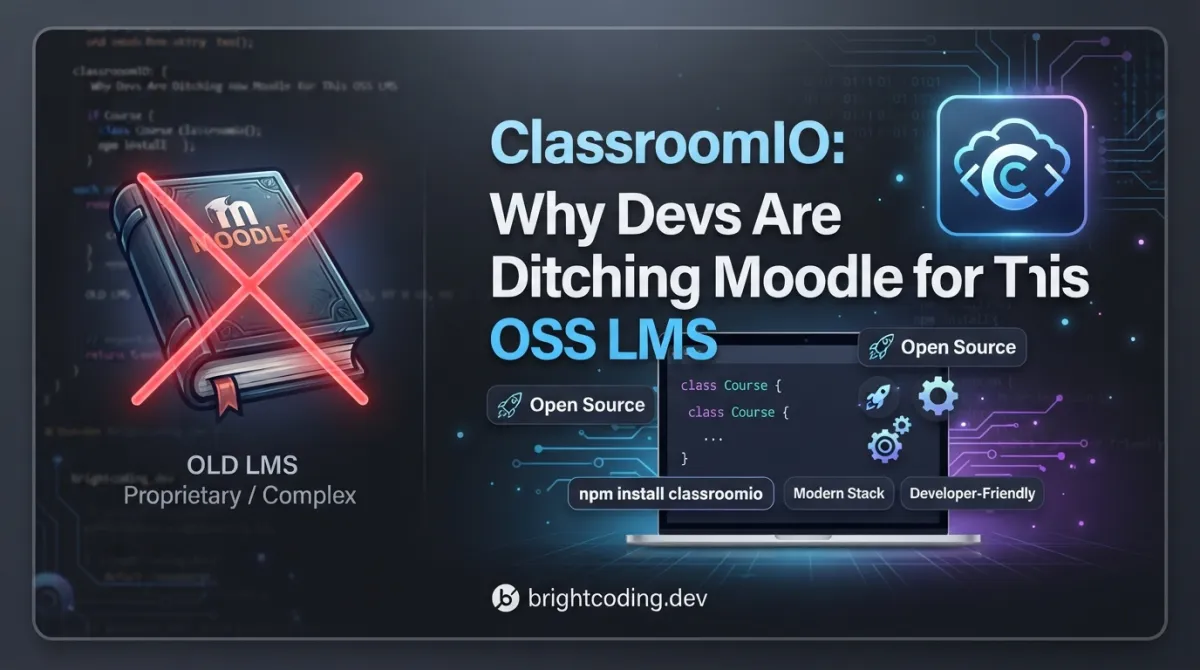
What if your learning management system didn't fight you at every deployment? What if—instead of wrestling with PHP configs, legacy plugins, and hosting bills that multiply like rabbits—you could spin up a modern, mobile-first education platform using the exact stack you already love?
Here's the uncomfortable truth most developers discover too late: traditional LMS platforms are technical debt machines disguised as education software. Moodle, the 800-pound gorilla of open-source learning, was revolutionary—in 2002. EdX requires a small army to maintain. Thinkific and Teachable? Great until you need to customize literally anything, then you're paying enterprise prices for basic API access.
Enter ClassroomIO—the open-source education platform that's making senior engineers actually want to build LMS features again. Built on SvelteKit, powered by Supabase, and styled with TailwindCSS, this isn't your professor's crusty old courseware. This is the LMS that speaks fluent modern web development↗ Bright Coding Blog.
In this deep dive, I'll expose why bootcamps, ed-tech startups, and internal training teams are migrating en masse. You'll get the full technical breakdown, real deployment commands, and code examples straight from the repository. By the end, you'll understand why "self-hosted LMS" no longer has to mean "soul-crushing maintenance."
What Is ClassroomIO? The Open Source Education Platform Explained
ClassroomIO is an open-source learning management system designed specifically for companies, bootcamps, and educators who refuse to compromise on modern developer experience. Created by Rotimi Best and actively maintained by a growing community, it positions itself as **"A Simple and Beautiful Alternative to Moodle LMS, EdX, Thinkific and Teachable."
The project lives at classroomio/classroomio on GitHub and represents a fundamental architectural bet: what if an LMS was built with the same care as a modern SaaS product?
The Technical Foundation
Unlike legacy platforms bolted onto decade-old frameworks, ClassroomIO is constructed on a deliberately modern stack:
| Layer | Technology | Why It Matters |
|---|---|---|
| Frontend Framework | SvelteKit | Server-side rendering, minimal JS payload, reactive without virtual DOM overhead |
| Backend/Database | Supabase | PostgreSQL↗ Bright Coding Blog with real-time subscriptions, auth, storage—no custom backend required |
| Styling | TailwindCSS | Utility-first, design-system friendly, minimal CSS bloat |
| Package Management | pnpm | Fast, disk-space efficient monorepo handling |
This isn't novelty for novelty's sake. SvelteKit's server-side rendering means course content is instantly crawlable by search engines—a massive SEO advantage over client-rendered alternatives. Supabase's real-time capabilities enable live features that would require complex WebSocket infrastructure elsewhere. And the monorepo structure (classroomio-com, api, dashboard, docs) mirrors how professional engineering teams actually organize production applications.
Why It's Trending Now
The timing isn't accidental. Three forces are converging:
- The Great LMS Migration: Companies burned by SaaS price hikes are desperately seeking self-hosted alternatives
- SvelteKit's Maturation: Version 1.0+ stability has made it production-viable for complex applications
- Supabase's Enterprise Adoption: The "Firebase alternative" has proven itself at scale, reducing backend fear
ClassroomIO rides all three waves simultaneously.
Key Features: What Makes ClassroomIO Technically Superior
Let's dissect the capabilities that separate ClassroomIO from "yet another open-source project." These aren't bullet points for marketing decks—they're architectural decisions with real engineering implications.
📚 Advanced Course Management
The core course engine supports unlimited courses with nested lessons, assignments, grading workflows, and certificate generation. But here's what the feature list doesn't reveal: the assignment grading system is designed for async collaboration. Teachers can leave inline feedback, students resubmit iteratively, and all state changes propagate through Supabase's real-time channels. No page refreshes. No "save and reload" anxiety.
👨👩👦 Multi-Teacher Management with Role Granularity
Organization owners invite teachers and assign them to specific courses—not blanket admin access. This maps to real-world training scenarios where you want subject-matter experts without exposing student data across programs. The permission model leverages Supabase Row Level Security (RLS), meaning authorization is enforced at the database level, not merely the application layer.
🤖 AI Integration (OpenAI-Powered)
This is where ClassroomIO gets genuinely clever. The OpenAI integration doesn't just generate fluff content—it produces structured lesson outlines, assignment prompts, and even grading rubrics derived from your existing notes. For bootcamps spinning up new cohorts weekly, this collapses days of curriculum prep into hours. The implementation uses streaming responses for progressive content reveal, keeping the UI responsive during generation.
💬 Integrated Forum (Community-Driven Support)
Students ask questions in dedicated course communities where peers and instructors collaborate. This isn't a bolted-on Discourse instance—it's native to the platform, with notifications tied to the same real-time infrastructure. The engagement data feeds back into course improvement loops.
💻 Dedicated Student Dashboard
Every learner gets a personalized dashboard aggregating all enrolled courses, pending assignments, and progress metrics. The mobile-first design isn't an afterthought; course materials are genuinely accessible across devices without separate app builds.
🔒 Full Self-Hosting Capability
The entire stack deploys to your infrastructure. No vendor lock-in, no data residency concerns, no surprise pricing tiers. For GDPR-conscious European companies or HIPAA-adjacent healthcare training, this isn't nice-to-have—it's mandatory.
Real-World Use Cases: Where ClassroomIO Actually Wins
Theory is cheap. Let's examine four concrete scenarios where ClassroomIO outperforms alternatives.
1. Technical Bootcamps Running Multiple Cohorts
The Pain: You're running 4 concurrent cohorts of your React course, each with different start dates, TAs, and slightly modified curriculum. Moodle's course duplication is clunky; Teachable forces you into their pricing tiers per "product."
The ClassroomIO Solution: Single UI, multiple classes and cohorts. Clone course structures, assign different teachers per cohort, and students see only their instance. The monorepo's dashboard app handles this multi-tenancy natively.
2. Corporate Training with Compliance Requirements
The Pain: Your company needs to train 2,000 employees annually on security protocols. SaaS LMS vendors want $15/seat/month. Your CISO won't approve cloud data residency.
The ClassroomIO Solution: Self-host on your VPC. Total cost: infrastructure only. Audit logs via PostgreSQL. Custom certificate templates for compliance documentation. The api service handles PDF generation for completion certificates.
3. Open Source Projects Needing Contributor Education
The Pain: Your popular library has terrible onboarding. New contributors struggle with architecture concepts. YouTube videos get outdated immediately.
The ClassroomIO Solution: Host living documentation as structured courses. Update lessons as APIs evolve. Use the forum for Q&A instead of fragmented GitHub issues. The docs project in the monorepo can even mirror your existing documentation structure.
4. Individual Educators Building Sustainable Income
The Pain: You want to sell courses without giving 30% to platforms or building custom infrastructure.
The ClassroomIO Solution: Self-host with minimal overhead. Stripe integration potential via the api layer. Own your student relationships entirely. The AI content generation accelerates your production pipeline dramatically.
Step-by-Step Installation & Setup Guide
Ready to deploy? Here's the complete path from repository clone to running instance, extracted directly from the official documentation.
Prerequisites
Ensure your environment meets these requirements:
- Node.js ≥22.x (Non-negotiable—lower versions will fail)
- Supabase CLI for local database and auth services
- docker↗ Bright Coding Blog.com/engine/install/">Docker (Supabase local dev requires containerization)
- NPM (for initial tooling, though pnpm is the primary package manager)
- pnpm for dependency management and monorepo commands
Quick Start: Gitpod (Zero Local Setup)
For immediate exploration without local configuration:

Clicking this button provisions a fully configured workspace with all dependencies pre-installed. Ideal for evaluating the platform or contributing without Docker wrestling.
Local Development Setup
For production deployments or serious development, follow this precise sequence:
1. Fork and Clone
# Replace with your forked repository URL
git clone https://github.com/classroomio/classroomio.git
cd classroomio
2. Node Version Management
# If you have nvm installed (recommended):
nvm use

# If the required version isn't installed:
nvm install && nvm use
Critical: ClassroomIO requires Node ≥22.x. The .nvmrc file in the repository pins the exact version. Skipping this step guarantees cryptic dependency errors later.
3. Install Dependencies
pnpm i
Note: The project uses pnpm workspaces for monorepo management. Using npm install directly will not respect workspace boundaries and will fail.
4. Environment Configuration
Navigate to both apps/dashboard and apps/api, then duplicate environment templates:
cp apps/dashboard/.env.example apps/dashboard/.env
cp apps/api/.env.example apps/api/.env
You'll populate these after starting Supabase.
5. Start Supabase Locally
Ensure Docker is running, then:
supabase start
You'll receive output resembling:
supabase local development setup is running.

     API URL: http://127.0.0.1:54321
 GraphQL URL: http://127.0.0.1:54321/graphql/v1
       DB URL: postgresql://postgres:postgres@127.0.0.1:54322/postgres
   Studio URL: http://127.0.0.1:54323
 Inbucket URL: http://127.0.0.1:54324
   JWT secret: super-secret-jwt-token-with-at-least-32-characters-long
     anon key: eyJhbGciOiJIUzI1NiIsInR5cCI6IkpXVCJ9.eyJpc3MiOiJzdXBhYmFzZS1kZW1vIiwicm9sZSI6ImFub24iLCJleHAiOjE5ODM4MTI5OTZ9.CRXP1A7WOeoJeXxjNni43kdQwgnWNReilDMblYTn_I0
service_role key: eyJhbGciOiJIUzI1NiIsInR5cCI6IkpXVCJ9.eyJpc3MiOiJzdXBhYmFzZS1kZW1vIiwicm9sZSI6InNlcnZpY2Vfcm9sZSIsImV4cCI6MTk4MzgxMjk5Nn0.EGIM96RAZx35lJzdJsyH-qQwv8Hdp7fsn3W0YpN81IU
Extract these values into your .env files:
# apps/dashboard/.env
PUBLIC_SUPABASE_URL=http://127.0.0.1:54321
PUBLIC_SUPABASE_ANON_KEY=eyJhbGciOiJIUzI1NiIsInR5cCI6IkpXVCJ9.eyJpc3MiOiJzdXBhYmFzZS1kZW1vIiwicm9sZSI6ImFub24iLCJleHAiOjE5ODM4MTI5OTZ9.CRXP1A7WOeoJeXxjNni43kdQwgnWNReilDMblYTn_I0
PRIVATE_SUPABASE_SERVICE_ROLE=eyJhbGciOiJIUzI1NiIsInR5cCI6IkpXVCJ9.eyJpc3MiOiJzdXBhYmFzZS1kZW1vIiwicm9sZSI6InNlcnZpY2Vfcm9sZSIsImV4cCI6MTk4MzgxMjk5Nn0.EGIM96RAZx35lJzdJsyH-qQwv8Hdp7fsn3W0YpN81IU
The Studio URL (http://127.0.0.1:54323) provides a GUI for database inspection— invaluable for debugging RLS policies and table structures.
6. Launch All Services
pnpm dev
This concurrently starts:
| Service | Local URL | Description |
|---|---|---|
| classroomio-com | http://localhost:5174 | Marketing/landing site |
| api | http://localhost:3002 | Backend services (PDF, video, email) |
| dashboard | http://localhost:5173 | Core LMS application |
| docs | http://localhost:3000 | Documentation site |
7. Running Individual Services
For focused development on specific components:
# Landing page only
pnpm dev --filter=@cio/classroomio-com

# API services only
pnpm dev --filter=@cio/api

# LMS dashboard only
pnpm dev --filter=@cio/dashboard

# Documentation only
pnpm dev --filter=@cio/docs
8. First Login
Navigate to http://localhost:5173/login and authenticate with the seeded demo account:
- Email:
admin@test.com - Password:
123456
For additional demo accounts and role-specific testing, consult the official contributor documentation.
REAL Code Examples from the Repository
Let's examine actual implementation patterns from the ClassroomIO codebase, with detailed technical commentary.
Example 1: Monorepo Structure and Package Filtering
The project uses pnpm workspaces with explicit package naming. Here's how the filtering syntax works in practice:
# Start only the dashboard application
pnpm dev --filter=@cio/dashboard
Technical Explanation: The @cio/ prefix is the organization's npm scope, preventing naming collisions in the registry and enabling clean internal dependency references. This pattern allows the dashboard app to import shared components from other workspace packages using @cio/shared-ui style imports. The --filter flag instructs pnpm to build the dependency graph for only the specified package and its required dependencies, dramatically reducing startup time during focused development.
Example 2: Supabase Environment Configuration
The .env configuration for Supabase reveals the security architecture:
# Public-facing Supabase URL - exposed to browser
PUBLIC_SUPABASE_URL=http://127.0.0.1:54321

# Anonymous key for client-side operations (RLS-enforced)
PUBLIC_SUPABASE_ANON_KEY=eyJhbGciOiJIUzI1NiIsInR5cCI6IkpXVCJ9...

# Service role key - SERVER ONLY, bypasses RLS
PRIVATE_SUPABASE_SERVICE_ROLE=eyJhbGciOiJIUzI1NiIsInR5cCI6IkpXVCJ9...
Security Analysis: The naming convention (PUBLIC_ vs PRIVATE_) is enforced by SvelteKit's environment handling. PUBLIC_ variables are embedded in client bundles; PRIVATE_ variables are accessible only in server contexts (API routes, server hooks). The anon key operates with Row Level Security policies applied—users can only access their own data. The service_role key bypasses RLS entirely and must never reach the browser. This dual-key pattern is Supabase's standard security model, and ClassroomIO's explicit separation prevents accidental privilege escalation.
Example 3: Local Supabase Initialization Output
The supabase start command produces structured output that feeds directly into configuration:
# Example output from supabase start
     API URL: http://127.0.0.1:54321
 GraphQL URL: http://127.0.0.1:54321/graphql/v1
       DB URL: postgresql://postgres:postgres@127.0.0.1:54322/postgres
   Studio URL: http://127.0.0.1:54323
 Inbucket URL: http://127.0.0.1:54324
Infrastructure Insight: This reveals ClassroomIO's complete backend topology. The API URL is the Supabase REST/Realtime gateway. GraphQL URL exposes PostgREST's GraphQL layer (optional but available). The DB URL allows direct PostgreSQL connections for migrations or external tooling. Studio URL is the administrative GUI. Inbucket URL captures outbound emails during development—critical for testing the notification system without real email delivery. This local setup mirrors production Supabase deployments, ensuring environment parity.
Example 4: NVM Version Management Workflow
The documented Node version handling demonstrates disciplined environment control:
# Install the exact version specified in .nvmrc, then activate it
nvm install && nvm use
Developer Experience Note: The && chaining ensures both commands execute successfully. The .nvmrc file in the repository root pins a specific Node version (≥22.x), eliminating "works on my machine" discrepancies. For teams, this integrates with CI/CD pipelines—GitHub Actions can read .nvmrc directly. The alternative (nvm use alone) fails if the version isn't locally installed, which is why the documentation provides the install-then-use fallback.
Example 5: Service-Specific Development Commands
The filtered development commands reveal the Turborepo-influenced task running:
# Launch only documentation site
pnpm dev --filter=@cio/docs
Build System Implication: Under the hood, pnpm workspaces with --filter calculate the minimal set of packages to build and watch. For @cio/docs, this likely excludes the heavy dashboard dependencies (SvelteKit app with Supabase client, rich text editors, etc.), reducing memory footprint and build time. This granularity is essential for contributor onboarding—new documentation writers needn't understand the full LMS architecture to iterate on guides.
Advanced Usage & Best Practices
Production Deployment Patterns
For production, migrate from supabase start to a managed Supabase project or self-hosted Supabase infrastructure. The environment variables remain structurally identical—only the endpoint URLs change. This migration path is deliberately smooth.
Database Migration Strategy
Supabase CLI generates TypeScript types from your schema. Commit these generated files to version control for type-safe client usage. Run supabase gen types typescript --local > src/lib/database.types.ts after schema changes.
AI Feature Optimization
The OpenAI integration supports prompt customization. For specialized domains (medical training, legal compliance), fine-tune the system prompts in the api service to generate domain-appropriate content without manual curriculum rewriting.
Performance: SvelteKit's Edge Advantage
Leverage SvelteKit's edge-deployable adapters (adapter-vercel, adapter-netlify, adapter-node) for global low-latency course delivery. Static course content can be pre-rendered at build time; dynamic student data hydrates client-side via Supabase subscriptions.
Security Hardening
- Enable Supabase's CAPTCHA on auth endpoints for public-facing instances
- Implement custom RLS policies for multi-tenant isolation if running multiple organizations
- Rotate
PRIVATE_SUPABASE_SERVICE_ROLEregularly and store in secrets manager (HashiCorp Vault, AWS Secrets Manager)
Comparison with Alternatives: The Brutal Truth
| Criteria | ClassroomIO | Moodle | EdX | Thinkific/Teachable |
|---|---|---|---|---|
| Tech Stack | SvelteKit, Supabase, Tailwind | PHP, MySQL | Python↗ Bright Coding Blog, Django, React | Proprietary/Closed |
| Self-Hosting | Full control, modern DevOps↗ Bright Coding Blog | Possible, painful | Complex, resource-heavy | Impossible |
| Customization | Source code access, component-level | Plugin architecture, legacy patterns | Theming limited | API access at enterprise tiers |
| Mobile Experience | Native mobile-first responsive | Responsive afterthought | App-required for decent UX | Acceptable |
| AI Integration | Built-in OpenAI, extensible | Third-party plugins only | Limited experimental | Add-on costs |
| Developer Experience | Hot reload, TypeScript, modern tooling | XDebug, PHP quirks | Heavy container orchestration | N/A (no code access) |
| Community/Forum | Integrated natively | Bolt-on or plugin | External integration | External integration |
| Real-time Features | Supabase subscriptions | Polling or complex WebSocket setup | Complex architecture | Not available |
| Deployment Complexity | Docker + pnpm (minutes) | LAMP stack + manual config (hours) | Kubernetes expertise required | Zero (but locked in) |
The Verdict: Choose ClassroomIO when you need modern developer experience with full data ownership. Choose Moodle only if you're maintaining legacy systems with sunk costs. Choose SaaS platforms only if you genuinely prefer renting to owning—and paying exponentially as you scale.
FAQ: What Developers Actually Ask
Is ClassroomIO production-ready for enterprise use?
The platform is actively used by multiple bootcamps and training organizations. For enterprise deployment, conduct your own security audit and consider managed Supabase for database reliability. The open-source nature means you control the roadmap.
How does ClassroomIO handle video content delivery?
The api service includes video processing capabilities. For production scale, integrate with dedicated CDN providers (Cloudflare Stream, Mux, or AWS CloudFront) and configure the upload pipeline accordingly.
Can I customize the student dashboard extensively?
Absolutely. The dashboard app is standard SvelteKit—you can modify any component, add routes, or integrate additional data sources. The TailwindCSS configuration is fully customizable for brand alignment.
What are the hosting costs for self-deployment?
Base costs: compute for the Node.js applications (~$20-50/month on modest VPS), plus Supabase (free tier sufficient for thousands of users, or ~$25/month for managed). Compare to $299+/month for Teachable's basic features or Moodle's hosting complexity.
How active is the community and development?
Join the Discord community for real-time support. The repository shows consistent commits, and the maintainer is responsive to feature requests via Twitter. The roadmap includes forms, course templates, analytics, and messenger bot integrations.
Is there a hosted version if I don't want to self-host?
Yes—app.classroomio.com offers a managed SaaS option. Self-hosting remains available for those requiring data sovereignty.
Can I migrate from Moodle or Teachable?
There's no automated importer yet, but the PostgreSQL schema is straightforward. Community contributions for import tools are welcomed, and the structured course/lesson/assignment model maps logically from most LMS platforms.
Conclusion: The LMS You Actually Want to Maintain
Here's what it comes down to: ClassroomIO is the first open-source LMS that doesn't punish you for choosing open source.
Instead of legacy PHP nightmares, you get SvelteKit's developer bliss. Instead of proprietary black boxes, you get Supabase's transparent PostgreSQL foundation. Instead of mobile apps that never ship, you get responsive-first design that actually works.
The monorepo architecture mirrors professional-grade applications. The AI integration accelerates content creation without replacing educator judgment. The self-hosting capability ensures your student data stays yours.
For bootcamps scaling cohorts, companies building internal academies, or educators seeking independence from platform rent-seeking, ClassroomIO represents a genuine alternative—not a compromise.
Your next step is simple: star the repository, spin up the Gitpod instance for a five-minute evaluation, or run the local setup if you're ready to dive deep. The demo account (admin@test.com / 123456) awaits at localhost:5173.
The future of education infrastructure is open source, modern, and developer-friendly. ClassroomIO is already building it. The only question is whether you'll help shape it.
Found this breakdown valuable? Share it with your engineering team, and consider contributing to the ClassroomIO project — whether that's code, documentation, or spreading the word.
Outils recommandés
Explore on the BrightCoding network
Hand-picked resources from our other sites.
Stop Paying for V0! Build Free with Libra AI
Discover Libra AI, the open-source alternative to V0 and Lovable. Built on Cloudflare Workers with multi-model AI integration, complete code ownership, and zero...
EvilCharts: Why Developers Are Ditching Boring Charts for This
EvilCharts combines shadcn/ui's design system with Recharts' power to deliver stunning animated visualizations for React and Next.js. Learn installation, real c...
Best Free Software Alternatives to Paid Tools
Free alternatives to expensive software: office suites, design tools, project management, password managers, and more
Continuez votre lecture
The Ultimate Guide to Self-Hosted Workflow Automation Executors: Take Control of Your Automation Empire

AI Research Assistant: How Real-Time Web Scraping is Revolutionizing Knowledge Work in 2025

🎮 The Ultimate Guide to Open Source JavaScript Games: 100+ Free Games & Dev Tools You Can Use Today

Stop Coding Alone: OPC-Skills Gives Your AI Agent Superpowers
Commentaires 0
Aucun commentaire pour l'instant. Soyez le premier à réagir !