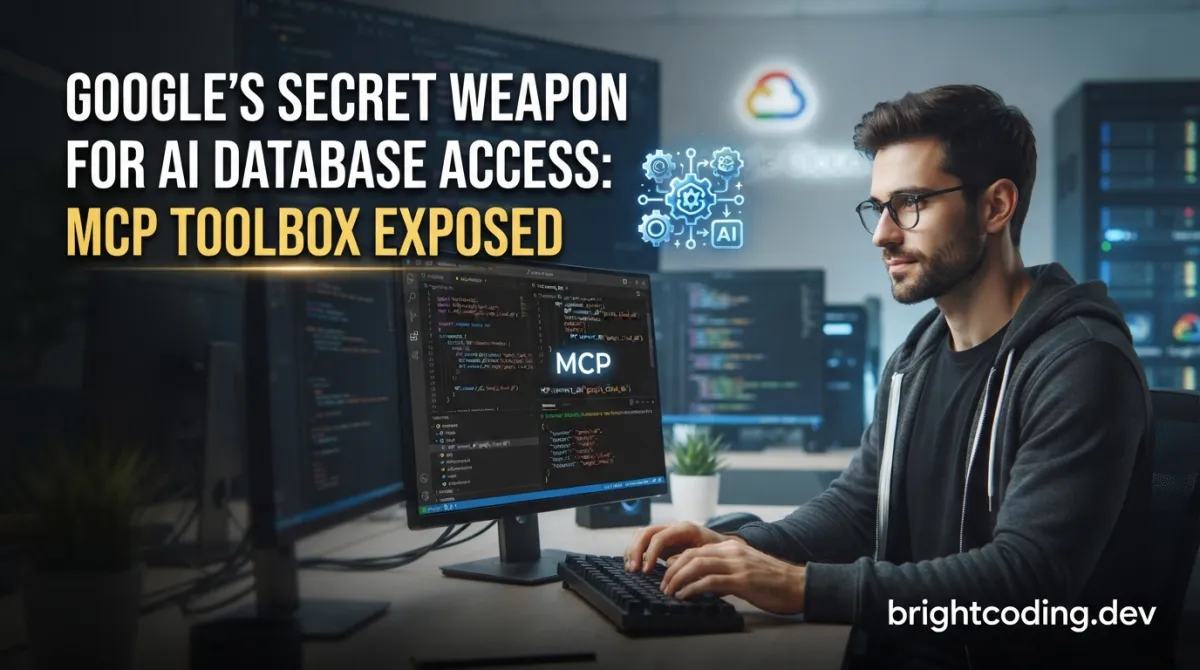
Google's Secret Weapon for AI Database Access: MCP Toolbox Exposed
What if your AI assistant could query your production database in plain English—without you writing a single line of connection code? No ORM setup. No API layers. No security nightmares. Just... talk to your data.
Sound impossible? That's exactly what developers building AI agents thought until they discovered the MCP Toolbox for Databases—Google's open-source project that's quietly becoming the standard for AI-to-database connectivity. Originally launched as genai-toolbox, this tool has exploded in popularity, earning top trending status on GitHub and spawning official SDKs for Python↗ Bright Coding Blog, JavaScript↗ Bright Coding Blog, Go, and Java.
Here's the painful truth most AI developers learn the hard way: connecting LLMs to databases is a security and engineering minefield. Raw SQL generation? Injection risks. Hand-rolled APIs? Maintenance hell. Context-switching between your IDE and database client? Productivity poison. MCP Toolbox obliterates all three problems with a single, elegant architecture built on the Model Context Protocol (MCP)—the emerging standard for AI tool interoperability.
In this deep dive, I'll expose exactly how MCP Toolbox works, why Google renamed it from genai-toolbox, and how you can have your AI assistant querying PostgreSQL↗ Bright Coding Blog, BigQuery, or AlloyDB in under 10 minutes. Whether you're building with LangChain, LlamaIndex, Google's ADK, or vanilla code, this is the connection layer you've been missing.
What is MCP Toolbox for Databases?
MCP Toolbox for Databases is an open-source Model Context Protocol (MCP) server that bridges AI agents, IDEs, and applications directly to enterprise databases. Born inside Google Cloud's database engineering team and originally branded as "Gen AI Toolbox for Databases," the project predated the MCP standard itself—only to be renamed in 2025 to reflect its native MCP compatibility.
Repository Update Notice: The original
genai-toolboxrepository has been officially renamed tomcp-toolbox. Update your remotes with:git remote set-url origin https://github.com/googleapis/mcp-toolbox.git
The project's dual-purpose architecture is what makes it genuinely unique in the crowded AI tooling landscape:
Purpose 1: Ready-to-Use MCP Server (Build-Time) — Instantly connect Gemini CLI, Claude Code, Codex, Google Antigravity, or any MCP-compatible client to your databases using prebuilt generic tools. Query data, explore schemas, and generate database-aware code without boilerplate.
Purpose 2: Custom Tools Framework (Run-Time) — Build production-hardened, specialized AI tools with predefined logic, structured queries, semantic search, and NL2SQL capabilities—all with enterprise-grade security baked in.
This isn't a toy project. With 15+ database engines supported, official SDKs in four languages, integrated IAM authentication, OpenTelemetry observability, and connection pooling out of the box, MCP Toolbox is engineered for production workloads at Google Cloud scale. The fact that it's completely open-source under Apache 2.0? That's the cherry on top.
Key Features That Make Developers Switch
Let's dissect what makes MCP Toolbox genuinely different from the half-baked database connectors cluttering GitHub.
Prebuilt Generic Tools: Zero-Configuration Database Access
The --prebuilt=<database> flag is a revelation. One command, and your MCP client gains instant access to standard tools like list_tables, execute_sql, and schema introspection. No YAML configuration. No connection string juggling. The Google Antigravity MCP Store even offers one-click installation for the most popular databases.
Custom Tools Framework: Production-Grade Control
When prebuilt tools aren't enough, the tools.yaml configuration system lets you define precisely what your AI can and cannot do. Restricted access patterns, parameterized queries, and semantic search configurations ensure your AI agent operates within strict guardrails. This is where MCP Toolbox transforms from a convenience tool into a security architecture.
Universal SDK Ecosystem
Google didn't just ship a server—they built a complete client ecosystem:
- Python SDK: Core, LangChain/LangGraph, and LlamaIndex integrations
- JavaScript/TypeScript SDK: Core, LangChain, Genkit, and ADK support
- Go SDK: Core, LangChain Go, Genkit, Go GenAI, OpenAI Go, and ADK Go
- Java SDK: Maven Central distribution for enterprise JVM stacks
Enterprise-Grade Infrastructure
- Connection Pooling: Eliminates connection storms under AI agent concurrency
- Integrated IAM Authentication: Google Cloud-native security without custom auth layers
- OpenTelemetry Observability: Full metrics and tracing export to any OTLP backend
- Dynamic Configuration Reloading: Update tools without server restarts (
--disable-reloadto opt out) - Interactive Toolbox UI: Test tools and authorized parameters with
--uiflag
Agent Skills Generation
The skills-generate command converts toolsets into portable Agent Skill packages compliant with the agentskills.io specification—distributable and installable directly into Gemini CLI.
4 Real-World Use Cases Where MCP Toolbox Dominates
1. AI-Powered IDE Database Exploration
Imagine asking Claude Code: "Show me all tables with user data that haven't been indexed, then generate migration scripts to add B-tree indexes." With MCP Toolbox's prebuilt PostgreSQL tools, this isn't a fantasy—it's a standard workflow. The AI queries your schema, analyzes pg_stat_user_tables, and generates optimized SQL without you leaving your editor.
2. Production AI Agents with Structured Query Safety
Building a customer support bot that needs order history? Raw NL2SQL is a data breach waiting to happen. Instead, define a custom tool in tools.yaml:
kind: tool
name: get-orders-by-email
type: postgres-sql
source: production-pg
parameters:
  - name: email
    type: string
    description: Customer email address (must match JWT claim)
statement: SELECT id, total, status FROM orders WHERE email = $1 AND created_at > NOW() - INTERVAL '90 days';
Your AI can only execute this exact parameterized query—no arbitrary SQL, no data exfiltration.
3. Multi-Database Analytics Pipelines
Modern data stacks span BigQuery for warehousing, AlloyDB for transactional workloads, and Elasticsearch for search. MCP Toolbox unifies all three behind a single MCP server, letting your AI agent join insights across systems without you managing multiple connection libraries.
4. Rapid Prototyping with Semantic Search
Need to build a documentation Q&A bot? Configure a semantic search tool against your vectorized knowledge base in minutes, then iterate through the Toolbox UI before deploying to production.
Step-by-Step Installation & Setup Guide
Quick Start: Prebuilt Tools (Fastest Path)
For instant gratification with any MCP-compatible client:
{
  "mcpServers": {
    "toolbox-postgres": {
      "command": "npx",
      "args": [
        "-y",
        "@toolbox-sdk/server",
        "--prebuilt=postgres",
        "--stdio"
      ]
    }
  }
}
Set your database connection environment variables (see Prebuilt Tools Reference), restart your IDE, and start querying.
Production Installation: Binary Method
For reliable, version-pinned deployments:
Linux (AMD64):
export VERSION=1.2.0
curl -L -o toolbox https://storage.googleapis.com/mcp-toolbox-for-databases/v$VERSION/linux/amd64/toolbox
chmod +x toolbox
macOS (Apple Silicon):
export VERSION=1.2.0
curl -L -o toolbox https://storage.googleapis.com/mcp-toolbox-for-databases/v$VERSION/darwin/arm64/toolbox
chmod +x toolbox
macOS (Intel):
export VERSION=1.2.0
curl -L -o toolbox https://storage.googleapis.com/mcp-toolbox-for-databases/v$VERSION/darwin/amd64/toolbox
chmod +x toolbox
Windows (PowerShell):
$VERSION = "1.2.0"
curl.exe -o toolbox.exe "https://storage.googleapis.com/mcp-toolbox-for-databases/v$VERSION/windows/amd64/toolbox.exe"
Alternative Installation Methods
Docker↗ Bright Coding Blog (Containerized Production Deployments):
export VERSION=1.2.0
docker pull us-central1-docker.pkg.dev/database-toolbox/toolbox/toolbox:$VERSION
Homebrew (macOS/Linux):
brew install mcp-toolbox
Compile from Source (Go 1.22+ required):
go install github.com/googleapis/mcp-toolbox@v1.2.0
Configuration: Creating Your tools.yaml
Create a tools.yaml file defining your data sources, tools, toolsets, and prompts:
# Define your database connection
kind: source
name: my-pg-source
type: postgres
host: 127.0.0.1
port: 5432
database: toolbox_db
user: toolbox_user
password: my-password
---
# Define a parameterized, safe query tool
kind: tool
name: search-hotels-by-name
type: postgres-sql
source: my-pg-source
description: Search for hotels based on name.
parameters:
  - name: name
    type: string
    description: The name of the hotel.
statement: SELECT * FROM hotels WHERE name ILIKE '%' || $1 || '%';
---
# Group tools into reusable sets
kind: toolset
name: hospitality-tools
tools:
    - search-hotels-by-name
Running the Server
Binary:
./toolbox --config "tools.yaml"
Docker (with volume mount for config):
docker run -p 5000:5000 \
  -v $(pwd)/tools.yaml:/app/tools.yaml \
  us-central1-docker.pkg.dev/database-toolbox/toolbox/toolbox:0.24.0 \
  --config "/app/tools.yaml"
NPM (development convenience):
npx @toolbox-sdk/server --config tools.yaml
Pro Tip: Toolbox enables dynamic configuration reloading by default. Edit
tools.yamlwithout restarting the server—perfect for iterative development.
Enable the interactive testing UI:
./toolbox --ui
REAL Code Examples from the Repository
Let's examine production-ready patterns straight from Google's official documentation.
Example 1: Python Core SDK — Loading Tools for Any Framework
The Python Core SDK provides framework-agnostic tool loading that works with custom agents or any AI framework:
from toolbox_core import ToolboxClient

# Initialize client pointing to your running Toolbox server
async with ToolboxClient("http://127.0.0.1:5000") as client:

    # Load an entire toolset by name—returns callable tools ready for your agent
    # These tools include full schema information for LLM function calling
    tools = await client.load_toolset("hospitality-tools")

    # Pass 'tools' directly to your LLM or agent framework
    # Each tool has: name, description, parameter schema, and execute() method
What's happening here? The ToolboxClient establishes an HTTP connection to your MCP Toolbox server, discovers all tools in the hospitality-tools toolset, and hydrates them as Python objects. Each tool object encapsulates its own parameter validation, authentication requirements, and execution logic. This means your AI agent gets self-describing, type-safe tools without hardcoding SQL or connection details.
Example 2: JavaScript LangChain Integration — Bridging to a Major Framework
When you need to use Toolbox tools inside LangChain or LangGraph applications, the pattern requires mapping Toolbox's generic tool format to LangChain's expected structure:
import { ToolboxClient } from '@toolbox-sdk/core';

// Point to your Toolbox server
const URL = 'http://127.0.0.1:5000';
let client = new ToolboxClient(URL);

// Load the complete toolset from the server
const toolboxTools = await client.loadToolset('toolsetName');

// Map each Toolbox tool to LangChain's tool format
// This preserves name, description, and JSON schema for LLM function calling
const getTool = (toolboxTool) => tool(currTool, {
    name: toolboxTool.getName(),
    description: toolboxTool.getDescription(),
    schema: toolboxTool.getParamSchema()
});

// Result: array of fully compatible LangChain tools
const tools = toolboxTools.map(getTool);
The critical insight: MCP Toolbox is framework-agnostic at the server level but provides idiomatic SDKs for popular frameworks. This JavaScript example demonstrates the adapter pattern—Toolbox handles database security and execution, while you handle framework integration. The getParamSchema() method ensures your LLM receives proper JSON Schema for reliable function calling.
Example 3: Go with Genkit — Google's AI Framework
For teams building with Google's Genkit framework in Go, Toolbox provides a dedicated conversion package:
package main

import (
  "context"
  "log"

  "github.com/firebase/genkit/go/genkit"
  "github.com/googleapis/mcp-toolbox-sdk-go/core"
  "github.com/googleapis/mcp-toolbox-sdk-go/tbgenkit"
)

func main() {
  // Initialize Genkit with your AI configuration
  ctx := context.Background()
  g := genkit.Init(ctx)

  // Connect to Toolbox server
  URL := "http://127.0.0.1:5000"
  client, err := core.NewToolboxClient(URL)
  if err != nil {
    log.Fatalf("Failed to create client: %v", err)
  }

  // Load a specific tool by name
  tool, err := client.LoadTool("get-orders-by-email", ctx)
  if err != nil {
    log.Fatalf("Failed to load tool: %v", err)
  }

  // Convert to Genkit-native tool using the tbgenkit adapter
  // This handles schema translation, streaming config, and error mapping
  genkitTool, err := tbgenkit.ToGenkitTool(tool, g)
  if err != nil {
    log.Fatalf("Failed to convert tool: %v\n", err)
  }

  log.Printf("Successfully converted tool: %s", genkitTool.Name())
  // genkitTool is now usable in Genkit flows with full type safety
}
Why this matters: The tbgenkit package isn't just a wrapper—it's a semantic bridge that translates Toolbox's parameter schemas into Genkit's expected format, handles streaming responses, and maps error conditions appropriately. This level of framework-specific optimization is what separates MCP Toolbox from generic database proxies.
Example 4: Custom Tool Configuration — Security-First SQL
The tools.yaml declarative format is where MCP Toolbox's security architecture shines:
kind: tool
name: get-orders-by-email
type: postgres-sql
source: production-pg
description: Retrieve customer orders by email address.
parameters:
  - name: email
    type: string
    description: Customer email (validated against JWT sub claim)
    # Toolbox can enforce that this matches authenticated user identity
statement: |
  SELECT
    o.id,
    o.total,
    o.status,
    o.created_at
  FROM orders o
  WHERE o.email = $1
    AND o.created_at > NOW() - INTERVAL '90 days'
  ORDER BY o.created_at DESC
  LIMIT 100;
Security architecture decoded: This tool is injection-proof by design—the $1 parameterized placeholder is processed server-side, not string-interpolated. The LIMIT 100 prevents unbounded result sets from overwhelming your LLM context window. The created_at filter implements automatic data retention policies. When combined with Toolbox's IAM integration, you can enforce that the email parameter matches the authenticated user's JWT subject claim—row-level security without database RLS configuration.
Advanced Usage & Best Practices
Telemetry for Production Monitoring
Don't fly blind. Export traces and metrics to any OTLP-compatible backend:
./toolbox --config tools.yaml --telemetry-otlp=https://your-collector.example.com:4317
Google Cloud Monitoring, Agnost AI, Jaeger, or Prometheus—all work out of the box.
Agent Skills Distribution
Package your toolsets as portable skills for team distribution:
toolbox --config tools.yaml skills-generate \
  --name "analytics-suite" \
  --toolset "hospitality-tools" \
  --description "Revenue analytics and customer lookup tools"

# Install into Gemini CLI for instant team access
gemini skills install ./skills/analytics-suite
Performance Optimization
- Connection Pooling: Already enabled—tune via source configuration for your database's max_connections
- Toolset Segregation: Create separate toolsets per agent role to minimize LLM context usage
- Dynamic Reload: Keep enabled in production for zero-downtime configuration updates
- Container Deployment: Use the official image with proper resource limits and health checks
Security Hardening
- Never commit
tools.yamlwith plaintext passwords—use environment variable substitution - Restrict tool
statementcomplexity—avoid tools that could trigger long-running queries - Leverage IAM integration for Google Cloud databases instead of static credentials
- Enable audit logging at the database level to trace AI agent query patterns
Comparison with Alternatives
| Feature | MCP Toolbox | LangChain SQL Tools | Direct API Wrappers | Managed DB Services |
|---|---|---|---|---|
| Setup Time | Minutes with prebuilt tools | Hours (custom chains) | Days (engineering) | Weeks (procurement) |
| Security Model | Parameterized + IAM | Developer-implemented | Developer-implemented | Vendor-dependent |
| MCP Standard | ✅ Native | ❌ Adapters needed | ❌ Custom protocols | ❌ Proprietary |
| Database Coverage | 15+ engines | Limited by integration | Single database | Vendor-locked |
| Observability | OpenTelemetry built-in | Manual instrumentation | Manual instrumentation | Variable |
| Multi-Language SDKs | Python, JS, Go, Java | Python-first | Per-language rewrite | REST/limited |
| Dynamic Reloading | ✅ Zero-downtime | Requires restart | Requires deployment | Scheduled maintenance |
| Cost | Free (Apache 2.0) | Free (MIT) | Engineering time | $$$ per query |
The verdict: LangChain SQL tools work for prototypes but require significant security engineering for production. Direct API wrappers reinvent wheels that MCP Toolbox already perfected. Managed services offer convenience at the cost of flexibility and pricing unpredictability. MCP Toolbox occupies the sweet spot: open-source freedom with enterprise-grade architecture.
FAQ: Your Burning Questions Answered
What happened to genai-toolbox?
Google renamed the repository from genai-toolbox to mcp-toolbox to align with the Model Context Protocol standard that the project now natively implements. Update your git remotes and bookmarks—the old URL redirects automatically.
Which databases are supported?
Google Cloud databases (AlloyDB, BigQuery, Cloud SQL variants, Spanner, Firestore, Knowledge Catalog) plus PostgreSQL, MySQL↗ Bright Coding Blog, SQL Server, Oracle, MongoDB, Redis, Elasticsearch, CockroachDB, ClickHouse, Couchbase, Neo4j, Snowflake, Trino, and more. Check the full list.
Do I need Google Cloud to use MCP Toolbox?
Absolutely not. While Google Cloud databases get first-class integration, Toolbox works with any standard PostgreSQL, MySQL, or other supported database anywhere—self-hosted, AWS RDS, Azure, or local development instances.
How does MCP Toolbox prevent SQL injection?
All custom tools use server-side parameterized queries—user inputs are bound as parameters, never concatenated into SQL strings. Combined with statement whitelisting (AI can only execute predefined tools), injection is structurally impossible.
Can I use this with my existing LangChain/LlamaIndex agents?
Yes—official SDKs provide drop-in integrations. The Python toolbox-langchain and toolbox-llamaindex packages, plus JavaScript equivalents, let you load Toolbox tools as native framework tools in under 10 lines of code.
What's the difference between prebuilt and custom tools?
Prebuilt tools (--prebuilt=postgres) offer instant generic database access for exploration. Custom tools (tools.yaml) provide production-safe, domain-specific operations with precise security controls. Most teams start with prebuilt, then migrate critical paths to custom.
Is there a managed version?
Yes—Google Cloud MCP Servers offer a fully managed experience for Google Cloud databases. Compare options in the official FAQ.
Conclusion: The Database-AI Bridge Is Here
MCP Toolbox for Databases isn't just another database connector—it's a fundamental rethinking of how AI agents interact with structured data. By embracing the Model Context Protocol standard, Google has created infrastructure that outlives any single framework or LLM provider.
The progression from genai-toolbox to mcp-toolbox signals something important: this isn't a Google-only experiment, it's industry-standard infrastructure. The dual architecture—prebuilt tools for velocity, custom tools for safety—means it scales with your maturity from prototype to production.
I've watched dozens of AI projects stall at the database integration phase. The security concerns, the framework incompatibilities, the maintenance burden—they kill momentum. MCP Toolbox eliminates that friction with open-source code backed by Google's engineering rigor.
Your next step is simple:
- Star and clone the repository:
https://github.com/googleapis/mcp-toolbox - Try the 5-minute prebuilt setup with your database
- Graduate to custom
tools.yamlconfigurations for production agents
The future of AI isn't just smarter models—it's models that securely, reliably, and effortlessly connect to the world's data. MCP Toolbox is that connection. Stop writing database boilerplate. Start building intelligent agents that actually know your data.
Ready to connect your AI to your database? Explore the full documentation, join the Discord community, and grab the code from GitHub today.
Outils recommandés
Explore on the BrightCoding network
Hand-picked resources from our other sites.
Stop Scraping Finance Data Manually! FinNLP Does It All
FinNLP by AI4Finance Foundation automates LLM training pipelines for financial data. Learn how to collect news, social media, and SEC filings across US and Chin...
Stop Paying for Screen Annotation! DrawPen Is Free and Insane
Discover DrawPen, the free open-source screen annotation tool for macOS, Windows & Linux. Learn installation, keybindings, real code examples, and why developer...
stainlu/openclaw-managed-agents: Open-Source Alternative to Claude Managed Agents
stainlu/openclaw-managed-agents is an open-source managed AI agent framework and API alternative to Claude Managed Agents. Run any model on any cloud with Docke...
Continuez votre lecture
Why Alexandrie is the Ultimate Markdown Note-Taking App
Why CrossPaste is the Ultimate Game Changer for Clipboard Management
Why Chandra is the Ultimate OCR Tool for Handwriting and Tables

Stop Coding Alone: OPC-Skills Gives Your AI Agent Superpowers
Commentaires 0
Aucun commentaire pour l'instant. Soyez le premier à réagir !