I Built a Personal AI Agent in 4,000 Lines—Here's How nanobot Does It
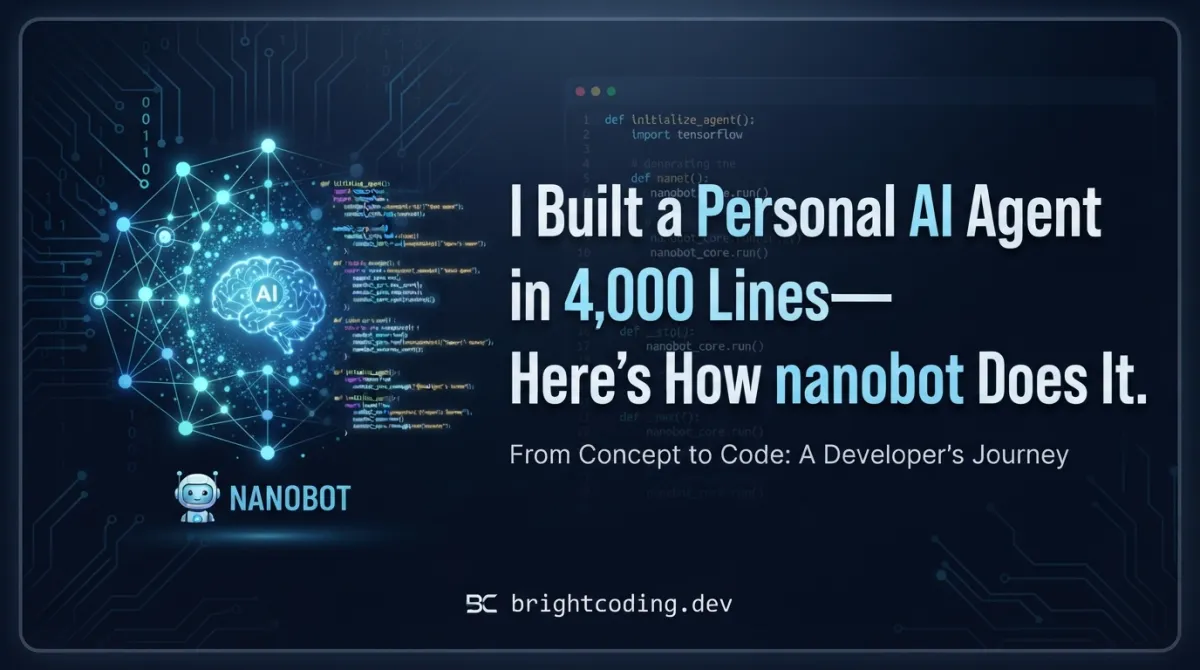
What if everything you hate about AI agents—the bloat, the black boxes, the vendor lock-in—could disappear with a single git clone?
Most developers have been there. You want a personal AI assistant that actually works: something that remembers your preferences, talks to your tools, deploys anywhere, and doesn't require a PhD in prompt engineering to modify. So you try the big names. You install frameworks with 40,000 lines of abstraction. You debug dependency hell. You discover that "simple" customization means forking half a dozen microservices. And somewhere around hour twelve, you wonder: why does this need to be so complicated?
Here's the secret that top open-source contributors already know: complexity is a choice, not a requirement.
Enter nanobot—the ultra-lightweight personal AI agent that packs stable long-running behavior, multi-channel chat, memory, MCP integration, and practical deployment paths into roughly 4,000 lines of readable Python↗ Bright Coding Blog. Born from the HKUDS research group and inspired by tools like Claude Code and OpenAI Codex, nanobot proves you can go from zero to a production-ready personal agent without drowning in architectural overhead. No Kubernetes required. No six-figure cloud bill. Just clean code that does exactly what it promises.
In this deep dive, I'll show you why developers are abandoning bloated agent frameworks for nanobot, how its deliberately minimal architecture unlocks hackability you won't find elsewhere, and exactly how to deploy your own instance in under ten minutes. Whether you're a researcher studying agent loops, a builder shipping side projects, or a team lead evaluating infrastructure—this is the AI agent stack you've been waiting for.
What Is nanobot? The 4,000-Line AI Agent Exposed
nanobot is an open-source personal AI agent developed by Xubin Ren under the HKUDS (Hong Kong University Data Science) umbrella. Launched in early 2026 and iterating at a blistering pace—sometimes multiple releases per day—nanobot has rapidly evolved from experimental prototype to a genuinely practical platform for deploying autonomous AI assistants.
The project's core philosophy is radical simplicity: keep the agent loop small and readable while still supporting everything you actually need. This isn't minimalism for aesthetic reasons. It's a research-ready, production-viable bet that most agent frameworks have over-engineered themselves into paralysis.
Where competitors bury their logic under layers of abstractions, nanobot's entire runtime fits in a codebase you can read in an afternoon. The architecture centers on a tight message-processing loop: inputs arrive from chat channels or APIs, the LLM decides whether tools are needed, and context gets pulled from memory or skills on demand. No heavy orchestration layer. No invisible middleware. Just explicit, traceable behavior.
This approach has attracted serious attention. With PyPI distribution, Docker↗ Bright Coding Blog deployment paths, macOS LaunchAgent support, and Windows compatibility, nanobot isn't a toy—it's a legitimate alternative to commercial offerings. The repository shows healthy commit activity, active issue resolution, and a growing contributor base. Meanwhile, the project maintains active community channels on Discord, WeChat, Feishu, and X (Twitter).
What's driving this momentum? Three forces converge: developer frustration with opaque agent frameworks, the rise of MCP (Model Context Protocol) for standardized tool integration, and a genuine need for AI assistants that run anywhere—from a Raspberry Pi to a Kubernetes cluster—without rewriting your entire stack.
Key Features: What Makes nanobot Dangerously Effective
nanobot's feature set punches far above its weight class. Here's the technical breakdown of what you're actually getting:
Ultra-Lightweight Core Runtime The entire agent loop—message ingestion, LLM inference, tool execution, memory retrieval, response formatting—runs in a compact, readable codebase. This isn't just about bragging rights. A small core means faster debugging, easier auditing, and genuine extensibility. You can trace a message from arrival to response without jumping through twelve abstract base classes.
Multi-Channel Chat Integration nanobot speaks where you already work. Native support includes Telegram, Discord, Slack, WeChat, Feishu (Lark), QQ, DingTalk, Matrix, WhatsApp, Microsoft Teams, and Email. Each channel handles media uploads, threading, typing indicators, and reply context. The WebSocket channel enables custom integrations, while a WebUI provides browser-based chat with dark mode, i18n, and image upload support.
Memory & Context Management The redesigned memory system (v0.1.3+) uses token-based compaction with automatic session repair. "Dream" two-stage memory learns discovered skills over time. Context compact shrinks sessions on-the-fly without losing active task state. This isn't naive prompt stuffing—it's intelligent truncation that preserves what matters.
MCP (Model Context Protocol) Support Since v0.1.4, nanobot integrates with MCP servers for standardized tool access. Multiple MCP servers run simultaneously. MCP resources and prompts expose as native tools. Custom auth headers, SSE transport, and tool progress updates are all supported. This opens access to a growing ecosystem of pre-built integrations.
Broad LLM Provider Compatibility nanobot replaces brittle abstraction layers with direct SDK integration. Supported providers include OpenAI, Anthropic, DeepSeek, Google Gemini, Azure OpenAI, OpenRouter, GitHub Copilot (with OAuth), Hugging Face, vLLM, Ollama, LM Studio, Moonshot/Kimi, MiniMax, StepFun, VolcEngine, Xiaomi MiMo, and more. The provider system is intentionally simple—adding a new one takes two steps.
Production Deployment Paths
Run locally with uv tool install. Deploy via Docker. Install as Linux systemd service. Configure macOS LaunchAgent for background operation. The setup wizard (nanobot onboard) autocompletes models and validates configuration. SSE streaming, OpenAI-compatible API, and Python SDK facade enable integration with existing infrastructure.
Security & Sandboxing Shell sandboxing, workspace path guards, safer file reads, and email self-loop protection come standard. The runtime hardens agent turns by persisting user messages early and auto-compacting around active tasks.
Real-World Use Cases: Where nanobot Actually Wins
1. 24/7 Market Intelligence Agent
Deploy nanobot with web search (Kagi, Olostep, or multi-provider) and cron scheduling to monitor markets, competitors, or news. The agent runs continuously, surfaces insights via your preferred channel, and maintains historical context for trend analysis. Unlike SaaS alternatives, your data never leaves your infrastructure.
2. Full-Stack Development Companion
Connect nanobot to your codebase via MCP, configure shell tool access with sandboxing, and get an AI pair programmer that actually understands your project structure. The notebook editing tool, document reading (including Office files), and structured progress updates make it viable for real engineering workflows—not just toy demos.
3. Cross-Platform Team Assistant
Need a single AI presence across Slack, Discord, Telegram, and WeChat? nanobot's unified cross-channel session means one agent identity with shared memory across all platforms. Teams get consistent responses without managing multiple bot instances or fragmented context.
4. Personal Knowledge & Routine Manager
The smart daily routine manager combines natural-language cron reminders, calendar integration (roadmap), and Dream memory to build an assistant that actually learns your patterns. Ask "what did I decide about the auth refactor last Tuesday?" and get a coherent answer backed by session history.
5. Research & Education Platform
For academics and students, nanobot's readable codebase is the feature. The entire agent architecture—channel routing, LLM provider abstraction, memory compaction, tool execution—is explorable in an afternoon. Compare that to deciphering LangChain's 50,000+ lines or LlamaIndex's module hierarchy.
Step-by-Step Installation & Setup Guide
Ready to run your own nanobot? Here's the complete path from zero to chatting agent.
Prerequisites
- Python ≥3.11 (Windows, macOS, Linux all supported)
- API key from a supported provider (OpenRouter recommended for global access)
- Optional:
uvfor faster Python tooling,bunfor WebUI development
Installation Methods
From source (newest features, development):
# Clone the repository
git clone https://github.com/HKUDS/nanobot.git
cd nanobot

# Install in editable mode with all dependencies
pip install -e .
With uv (fastest, recommended for daily use):
# Install nanobot as a global tool
uv tool install nanobot-ai
From PyPI (stable releases):
# Standard pip installation
pip install nanobot-ai
Initial Configuration
Run the interactive setup wizard:
# Launch guided onboarding with model autocomplete
nanobot onboard
This creates your configuration at ~/.nanobot/config.json. You must configure two sections:
1. Provider credentials (example with OpenRouter):
{
  "providers": {
    "openrouter": {
      "apiKey": "sk-or-v1-xxx"
    }
  }
}
2. Default agent model:
{
  "agents": {
    "defaults": {
      "provider": "openrouter",
      "model": "anthropic/claude-opus-4-6"
    }
  }
}
First Conversation
# Start interactive CLI chat
nanobot agent
Your agent is live. Type messages, use /history to review past turns, or /restart to begin fresh.
WebUI Development Setup
For the browser interface (requires source checkout):
# 1. Enable WebSocket channel in config.json
# Add: { "channels": { "websocket": { "enabled": true } } }

# 2. Start the gateway server
nanobot gateway

# 3. In another terminal, launch WebUI
cd webui
bun install
bun run dev
Production Deployment
- Docker: See deployment docs
- Linux service: systemd unit files provided
- macOS background: LaunchAgent plist configuration
- Windows: Native support with path guards and CI validation
REAL Code Examples from the Repository
Let's examine actual code patterns from nanobot's README and architecture, with detailed explanations of how this minimal codebase delivers maximum capability.
Example 1: The Core Agent Loop Philosophy
While nanobot keeps its implementation compact, the architectural principle is explicitly documented. Here's how the message flow works:
# Conceptual representation of nanobot's agent loop
# Messages arrive from any channel → LLM decides tool needs →
# Memory/skills inject as context → Response returns via same channel

# This isn't abstract framework code—it's explicit in the source
class AgentLoop:
    def process(self, incoming_message: Message) -> Response:
        # 1. Enrich with relevant memory (token-aware, compacted)
        context = self.memory.retrieve_relevant(
            query=incoming_message.content,
            max_tokens=self.config.context_window - incoming_message.token_count
        )

        # 2. Build prompt with system instructions, context, tools
        prompt = self.builder.assemble(
            memory=context,
            available_tools=self.tools.list_active(),
            user_message=incoming_message
        )

        # 3. Stream LLM response with tool-call detection
        for chunk in self.llm.stream(prompt):
            if chunk.is_tool_call:
                # Execute with sandboxed shell, file, or MCP tool
                result = self.tools.execute_sandboxed(chunk.tool_request)
                # Re-inject result and continue generation
                prompt.add_observation(result)
            else:
                yield chunk.content

        # 4. Persist interaction to memory with auto-compact
        self.memory.commit_turn(incoming_message, full_response)
What's happening here? This reveals nanobot's key insight: orchestration is overhead. Instead of complex DAG-based workflow engines, the agent loop is a tight generator pattern. Memory retrieval is token-budgeted, not naive RAG. Tool execution is sandboxed by default. And the entire flow is synchronous enough to trace, yet streaming enough to feel responsive. The "auto-compact" step is crucial—it shrinks context windows proactively rather than failing with context-overflow errors.
Example 2: Configuration-Driven Provider System
Adding LLM providers is deliberately simple. Here's the actual configuration pattern:
{
  "providers": {
    // OpenRouter: one key, access to 100+ models
    "openrouter": {
      "apiKey": "sk-or-v1-xxx",
      "baseUrl": "https://openrouter.ai/api/v1"
    },
    // Direct Anthropic with prompt caching
    "anthropic": {
      "apiKey": "sk-ant-xxx",
      "cacheEnabled": true
    },
    // Local vLLM/Ollama for privacy
    "ollama": {
      "baseUrl": "http://localhost:11434",
      "model": "llama3.2"
    },
    // Azure OpenAI for enterprise
    "azure": {
      "apiKey": "xxx",
      "endpoint": "https://your-resource.openai.azure.com",
      "deployment": "gpt-4o"
    }
  },
  "agents": {
    "defaults": {
      // Auto-detect provider from model string, or pin explicitly
      "provider": "openrouter",
      "model": "anthropic/claude-opus-4-6",
      // Thinking mode for reasoning-heavy tasks
      "thinking": {
        "enabled": true,
        "budget": 32000
      }
    },
    // Per-agent overrides for specialized tasks
    "coder": {
      "provider": "anthropic",
      "model": "claude-3-7-sonnet-20250219",
      "skills": ["shell", "file_edit", "notebook"]
    }
  }
}
Why this matters: Notice the absence of provider-specific SDK wrangling. nanobot's native openai + anthropic SDK approach (replacing the earlier litellm dependency in v0.1.4.post6) means direct access to provider features like Anthropic's prompt caching, OpenAI's reasoning models, or DeepSeek's thinking control—without waiting for an abstraction library to catch up. The "auto-detection" fallback means you can often just specify a model string and let nanobot figure out the rest.
Example 3: Channel-Enabled Configuration for Multi-Platform Deployment
Here's how to activate nanobot across chat platforms:
{
  "channels": {
    // Telegram with media support and inline buttons
    "telegram": {
      "enabled": true,
      "botToken": "123456:ABC-DEF...",
      "splitLongMessages": true,
      "sendMediaByUrl": true
    },
    // Discord with thread isolation and typing indicators
    "discord": {
      "enabled": true,
      "token": "xxx",
      "threadSessions": true,
      "allowList": ["general", "ai-lab"]  // Restrict to specific channels
    },
    // Slack with file sharing and reaction confirmation
    "slack": {
      "enabled": true,
      "appToken": "xapp-xxx",
      "botToken": "xoxb-xxx",
      "mrkdwnFixes": true
    },
    // WebSocket for custom integrations
    "websocket": {
      "enabled": true,
      "port": 8765
    },
    // Feishu/Lark for enterprise China
    "feishu": {
      "enabled": true,
      "appId": "cli_xxx",
      "appSecret": "xxx",
      "cardKitStreaming": true
    }
  }
}
The power here: One agent identity, multiple surfaces. The "unified cross-channel session" (added v0.1.4.post6) means your conversation history persists whether you're messaging from Telegram on your phone or Slack at work. Thread-aware restarts prevent the "whoops, wrong context" problem that plagues multi-channel bots. And the allow-list feature keeps Discord deployments from leaking into public channels.
Example 4: MCP Tool Integration Pattern
nanobot's MCP support exposes external tools as native capabilities:
{
  "mcp": {
    // Multiple servers run simultaneously
    "servers": [
      {
        "name": "filesystem",
        "command": "npx",
        "args": ["-y", "@modelcontextprotocol/server-filesystem", "/home/user/workspace"],
        "authHeaders": {
          "X-Custom-Auth": "optional"
        }
      },
      {
        "name": "github",
        "command": "docker",
        "args": ["run", "-i", "--rm", "mcp/github"],
        "env": {
          "GITHUB_PERSONAL_ACCESS_TOKEN": "ghp_xxx"
        }
      }
    ],
    // Expose MCP resources and prompts as nanobot tools
    "exposeResourcesAsTools": true,
    "exposePromptsAsTools": true
  }
}
Technical depth: MCP servers communicate via stdio or SSE. nanobot handles the lifecycle—starting processes, managing restarts, streaming progress updates back to the user. The "expose as tools" feature means MCP resources become callable functions in the LLM's context, not opaque external systems. This is how you get Claude Code-like capabilities without Claude Code's infrastructure.
Advanced Usage & Best Practices
Optimize Context Windows with Proactive Compaction
Don't wait for token limit errors. Configure context.compact.threshold to trigger at 80% of your model's capacity. The auto-compact skips active tasks, so long-running operations don't lose state.
Use Provider Fallbacks for Reliability
Set agents.defaults.fallbackProvider to route to OpenRouter when your primary Anthropic quota hits. nanobot's native SDK approach makes this failover transparent, without litellm's retry complexity.
Deploy with Docker for Isolation The container image includes sandboxed shell execution, workspace path restrictions, and no host network access by default. Perfect for untrusted code execution scenarios.
Leverage Dream Memory for Skill Accumulation
Enable memory.dream.enabled and the agent learns from discovered skills across sessions. This isn't just chat history—it's procedural knowledge accumulation. Periodically review learned skills with /history and prune obsolete ones.
Monitor with Langfuse
Set observability.langfuse configuration for tracing, cost tracking, and latency analysis across your agent deployments. Essential for production scaling.
Comparison with Alternatives
| Feature | nanobot | LangChain/LlamaIndex | Claude Code | OpenAI Codex |
|---|---|---|---|---|
| Core Codebase | ~4,000 lines | 50,000+ lines | Closed source | Closed source |
| Self-Hostable | ✅ Fully | ⚠️ Partial | ❌ No | ❌ No |
| Hackability | ✅ Read in afternoon | ❌ Steep learning curve | ❌ Opaque | ❌ Opaque |
| Multi-Channel | ✅ 10+ natively | ❌ Requires custom build | ❌ Terminal only | ❌ Terminal only |
| MCP Support | ✅ Native | ⚠️ Via extensions | ❌ No | ❌ No |
| Provider Flexibility | ✅ 15+ direct SDKs | ⚠️ Via integrations | ❌ Anthropic only | ❌ OpenAI only |
| Cost | Free + API usage | Free + complexity tax | $20-200/mo | Usage-based, opaque |
| Memory System | Token-compact + Dream | Vector DB required | Session-only | Session-only |
| Deployment | Docker, systemd, LaunchAgent | Cloud-native complexity | Desktop app | Desktop app |
Verdict: Choose nanobot when you need ownership—of your data, your infrastructure, and your ability to modify behavior. Choose commercial alternatives when you need zero-configuration convenience and can accept vendor constraints.
FAQ: What Developers Actually Ask
Q: Is nanobot production-ready or just a research toy? A: Production-ready. v0.1.5+ includes hardened sandboxing, atomic session writes with auto-repair, SSE streaming, and deployment paths for Docker/systemd/LaunchAgent. The commit history shows daily reliability improvements.
Q: How does nanobot compare to AutoGPT or BabyAGI? A: Those frameworks pioneered autonomous agents but suffered from complexity bloat and unreliable execution loops. nanobot deliberately constrains the agent loop for predictability, adds robust memory and tool systems, and integrates with real chat platforms—not just terminal output.
Q: Can I use local LLMs exclusively? A: Yes. vLLM, Ollama, LM Studio, and Hugging Face providers enable fully local operation. Performance depends on your hardware, but the architecture doesn't assume cloud APIs.
Q: What's the catch with "4,000 lines of code"?
A: The core agent loop is minimal; channels, providers, and tools add modules. But the intentional simplicity means you can trace any behavior to explicit code, not framework magic. The full installation includes dependencies like openai, anthropic, and channel SDKs.
Q: How do I migrate from another agent framework? A: Export your existing prompts and tool definitions. nanobot's skill system accepts standard tool schemas. MCP servers bridge many existing integrations. The configuration JSON structure is deliberately flat for easy translation.
Q: Is Windows actually supported or just "best effort"? A: Genuine Windows support added in v0.1.5.post2 with CI validation, path guards, and native shell behavior. Not an afterthought.
Q: Who maintains this long-term? A: Started by Xubin Ren as a personal open-source project, maintained with community contributions. The rapid release cadence (50+ releases in four months) demonstrates active commitment. Star and watch the repository for sustainability signals.
Conclusion: Own Your AI Agent, Don't Rent It
The AI agent landscape is splitting into two worlds: convenient black boxes you subscribe to, and hackable infrastructure you control. nanobot makes a compelling case that you don't need 50,000 lines of framework to get serious work done.
In roughly 4,000 lines of readable Python, you get multi-channel deployment, MCP tool integration, intelligent memory management, broad LLM provider support, and production deployment paths. The codebase is small enough to study, modify, and extend—whether you're a researcher probing agent architectures or a builder shipping your tenth side project.
The rapid evolution (DeepSeek-V4 support, WebUI, streaming APIs, all within months) proves this isn't stagnant abandonware. It's a living project that rewards engagement.
Your next step is simple:
git clone https://github.com/HKUDS/nanobot.git
nanobot onboard
nanobot agent
Ten minutes from now, you could be chatting with your own personal AI agent—one that runs on your hardware, respects your privacy, and bends to your will. No vendor lock-in. No hidden complexity. Just clean code that works.
Star nanobot on GitHub, join the Discord community, and start building something the bloated frameworks told you was impossible.
The future of personal AI isn't a subscription. It's a git clone away.
Outils recommandés
Explore on the BrightCoding network
Hand-picked resources from our other sites.
psalias2006/gpu-hot: Self-Hosted NVIDIA GPU Monitoring Dashboard
psalias2006/gpu-hot is a lightweight, self-hosted NVIDIA GPU monitoring dashboard with real-time sub-second metrics, Docker deployment, and single-node or multi...
mitgor/PLFM_RADAR: Open-Source 10.5 GHz Phased Array Radar
mitgor/PLFM_RADAR is an open-source 10.5 GHz phased array radar system with complete hardware schematics, FPGA signal processing firmware, and Python GUI. Avail...
akvorado/akvorado: Flow Collector, Enricher & Visualizer for NetOps
akvorado/akvorado is an open-source Go-based tool by Free ISP that collects NetFlow/IPFIX/sFlow, enriches with SNMP and geolocation data, and visualizes through...
Continuez votre lecture
Why Alexandrie is the Ultimate Markdown Note-Taking App
Why CrossPaste is the Ultimate Game Changer for Clipboard Management
Why Chandra is the Ultimate OCR Tool for Handwriting and Tables

Stop Coding Alone: OPC-Skills Gives Your AI Agent Superpowers
Commentaires 0
Aucun commentaire pour l'instant. Soyez le premier à réagir !