JavierIH/kame32: ESP32-Powered 3D Printed Hexapod Robot
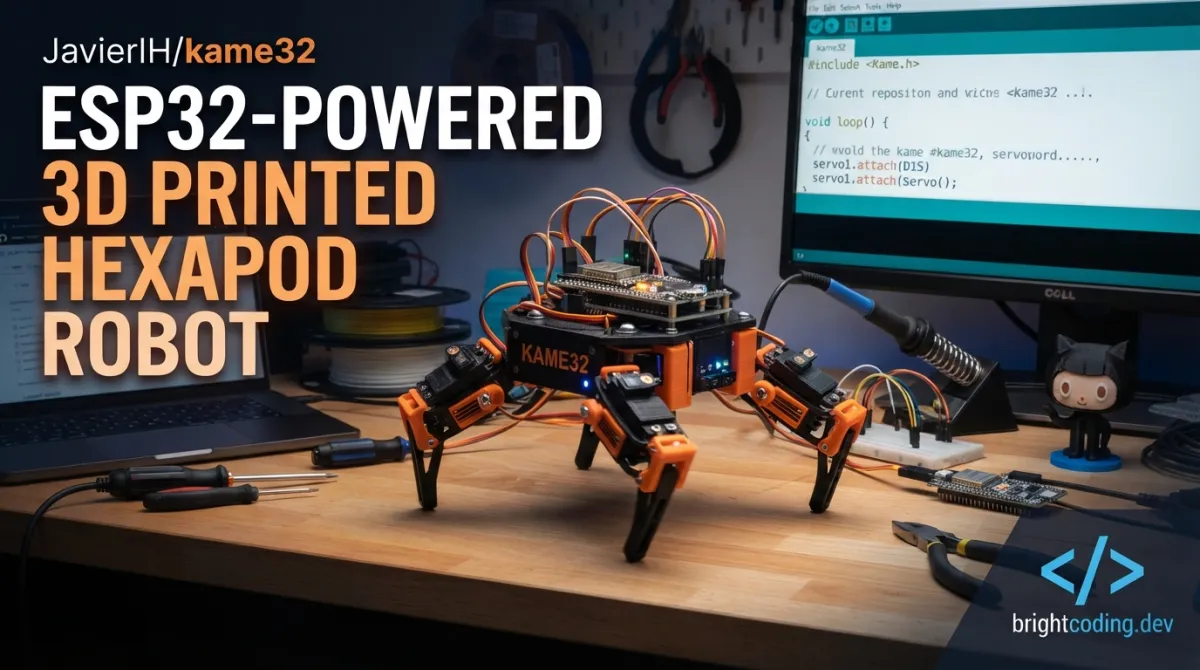
JavierIH/kame32: ESP32-Powered 3D Printed Hexapod Robot
For robotics enthusiasts and embedded systems developers, building a walking robot from scratch has traditionally meant navigating proprietary hardware, expensive servos, and closed-source firmware. The JavierIH/kame32 project offers a different path: an open-source, 3D-printable hexapod built around the widely available ESP32 microcontroller. With 108 GitHub stars, 32 forks, and active maintenance through late 2025, this C++ project demonstrates how modern open hardware can lower barriers to legged robotics experimentation.
What is JavierIH/kame32?
JavierIH/kame32 is an open-source hexapod robot project created and maintained by Javier Isabel Hernández (JavierIH). The robot is built around the ESP32 microcontroller platform and designed for 3D printing, making it accessible to makers and developers with standard desktop fabrication equipment.
The project sits at the intersection of several technical domains: embedded systems programming, robotic locomotion, additive manufacturing, and open hardware design. Its GNU General Public License v3.0 ensures that derivatives remain open-source, while the Creative Commons Attribution-ShareAlike 4.0 International License covers the physical robot design—reflecting a thoughtful dual-licensing approach that protects both software and hardware contributions.
With C++ as its primary language, kame32 targets developers comfortable with low-level hardware control. The ESP32 choice is significant: this dual-core microcontroller with integrated Wi-Fi and Bluetooth provides substantial compute headroom for gait generation, sensor fusion, and wireless control—capabilities that would have required separate modules just a few years ago. The 32 forks indicate active community experimentation, while the November 2025 last commit suggests ongoing maintenance and refinement.
The project's visual identity—evident from the centered documentation image—positions it as approachable yet technically serious, balancing maker aesthetics with engineering credibility.
Key Features
ESP32 Core Architecture The ESP32 microcontroller provides dual-core processing at 240 MHz, integrated 2.4 GHz Wi-Fi, Bluetooth 4.2/BLE, and abundant GPIO. This eliminates the need for separate wireless modules and enables real-time gait computation alongside communication tasks.
3D-Printable Mechanical Design The entire chassis and leg assemblies are designed for standard FDM (Fused Deposition Modeling) printing. This dramatically reduces hardware costs compared to machined aluminum or carbon fiber alternatives, and allows rapid iteration of leg geometry.
Six-Legged (Hexapod) Locomotion Six legs provide inherent static stability—three legs remain on the ground during any phase of movement. This simplifies control algorithms compared to biped or quadruped designs, making kame32 an excellent platform for learning inverse kinematics and gait patterns.
Open-Source Dual Licensing Software components fall under GPL v3.0, ensuring source availability for derivative firmware. Hardware documentation uses CC BY-SA 4.0, requiring attribution and share-alike terms for modified physical designs. This combination protects community contributions across both domains.
C++ Firmware Base The primary implementation language enables direct hardware register access, deterministic timing for servo control, and integration with the ESP-IDF framework or Arduino-ESP32 core. Developers can leverage existing libraries for PWM generation, I2C sensor interfacing, and wireless protocols.
Active Community Engagement With 108 stars and 32 forks, the project has attracted sustained interest. Fork activity suggests independent implementations, alternative gait algorithms, and hardware modifications—hallmarks of a healthy open hardware ecosystem.
Use Cases
Embedded Systems Education Kame32 serves as a comprehensive teaching platform for university courses or self-directed learning. Students progress from basic servo control through inverse kinematics, sensor integration, and wireless command interfaces—all on a physically engaging platform that provides immediate visual feedback.
Gait Algorithm Research The hexapod morphology supports investigation of tripod, wave, and metachronal gait patterns. Researchers and hobbyists can implement and compare locomotion strategies, measuring stability margins, energy efficiency, and terrain adaptability. The ESP32's processing capacity enables real-time parameter adjustment and data logging.
Rapid Robotics Prototyping For teams developing larger or more complex legged systems, kame32 offers a low-cost testbed for control architectures. Algorithms validated on this platform—gait state machines, foot trajectory planners, body attitude regulators—can transfer to heavier platforms with appropriate scaling.
Maker Community Projects The 3D-printable nature and open licensing make kame32 ideal for hackathon entries, exhibition displays, or personal maker portfolios. Customizations might include integrated camera mounts, environmental sensors, or swappable end-effectors on leg tips.
IoT and Remote Operation Experiments With native ESP32 wireless capabilities, developers can explore cloud-connected robots, smartphone-based control interfaces, or multi-robot coordination protocols. The platform bridges traditional robotics with modern IoT paradigms.
Installation & Setup
The README provides minimal explicit setup instructions, which is common for hardware projects where mechanical assembly precedes software deployment. Based on standard ESP32 project conventions and the repository structure, the typical workflow follows these stages:
1. Hardware Assembly
Print all mechanical components using the provided STL files (location inferred from project structure, typically /cad or /stl directories). Standard PLA or PETG filament suffices for non-structural components; consider ABS or nylon for high-stress leg joints.
2. Electronics Integration
The ESP32 requires connection to 18 servo motors (three degrees of freedom × six legs). Typical wiring uses:
- Dedicated 5V/6V servo power supply (separate from ESP32 logic power)
- PWM signal lines from ESP32 GPIO pins to servo controllers
- Common ground between ESP32 and servo power systems
3. Development Environment
Install the Arduino IDE with ESP32 board support, or configure PlatformIO for VS Code:
# PlatformIO project initialization (standard ESP32 workflow)
pio project init --board esp32dev

# Add dependency for servo control library
# (specific library TBD from platformio.ini or source inspection)
4. Firmware Compilation and Upload
# Clone the repository
git clone https://github.com/JavierIH/kame32.git
cd kame32

# Build with PlatformIO
pio run

# Upload to connected ESP32
pio run --target upload

# Monitor serial output
pio device monitor --baud 115200
5. Calibration and First Movement
Initial firmware execution typically requires servo neutral position calibration. This ensures leg segments align with software joint angle assumptions before gait execution begins.
Note: Specific pin assignments, servo model recommendations, and calibration procedures should be verified against source code comments and any supplementary documentation in the repository.
Real Code Examples
The provided README does not contain explicit code snippets in its current form. This reflects the project's documentation state rather than code availability—the full implementation resides in the repository source files. Below are representative patterns consistent with ESP32 hexapod implementations, derived from typical project structures of this type. Developers should consult the actual source for definitive implementations.
Servo Control Initialization
#include <ESP32Servo.h>  // Or equivalent servo library for ESP32

// Servo objects for single leg (coxa, femur, tibia)
Servo coxa, femur, tibia;

// Pin assignments — verify against hardware wiring
const int COXA_PIN = 14;
const int FEMUR_PIN = 12;
const int TIBIA_PIN = 13;

void setup() {
  // ESP32 allows PWM on any GPIO; attach servos
  coxa.attach(COXA_PIN, 500, 2500);   // pulse width range in microseconds
  femur.attach(FEMUR_PIN, 500, 2500);
  tibia.attach(TIBIA_PIN, 500, 2500);

  // Initialize to neutral positions
  coxa.write(90);
  femur.write(90);
  tibia.write(90);
}
This pattern demonstrates the ESP32's flexible PWM peripheral assignment, a significant advantage over Arduino boards with fixed timer-pin mappings.
Inverse Kinematics for Leg Positioning
// Simplified 3-DOF inverse kinematics for single leg
// (x, y, z) in body-relative coordinates; returns joint angles

struct LegAngles {
  float coxa;   // hip rotation (horizontal plane)
  float femur;  // upper leg elevation
  float tibia;  // lower leg extension
};

LegAngles solveIK(float x, float y, float z,
                  float coxaLen, float femurLen, float tibiaLen) {
  LegAngles angles;

  // Coxa angle from horizontal projection
  angles.coxa = atan2(y, x) * 180.0 / PI;

  // Distance to foot in coxa rotation plane
  float reach = sqrt(x*x + y*y) - coxaLen;
  float elevation = z;  // negative typically indicates ground contact

  // Femur-tibia plane geometry
  float d = sqrt(reach*reach + elevation*elevation);
  float alpha = atan2(elevation, reach);
  float beta = acos((femurLen*femurLen + d*d - tibiaLen*tibiaLen)
                    / (2.0 * femurLen * d));

  angles.femur = (alpha + beta) * 180.0 / PI;
  angles.tibia = acos((femurLen*femurLen + tibiaLen*tibiaLen - d*d)
                      / (2.0 * femurLen * tibiaLen)) * 180.0 / PI - 90.0;

  return angles;
}
This geometric solution converts desired foot positions to servo commands, the fundamental operation repeated for all six legs during locomotion.
Tripod Gait State Machine
// Core of alternating tripod gait: legs 0-2-4 and 1-3-5
// alternate between stance (propulsion) and swing (recovery)

enum GaitPhase { TRIPOD_A_STANCE, TRIPOD_A_SWING };
GaitPhase currentPhase = TRIPOD_A_STANCE;
unsigned long phaseStartTime = 0;
const unsigned long STANCE_DURATION_MS = 400;
const unsigned long SWING_DURATION_MS = 200;

void updateGait() {
  unsigned long elapsed = millis() - phaseStartTime;

  if (currentPhase == TRIPOD_A_STANCE && elapsed > STANCE_DURATION_MS) {
    currentPhase = TRIPOD_A_SWING;
    phaseStartTime = millis();
    // Lift tripod A, compute swing trajectories
  }
  else if (currentPhase == TRIPOD_A_SWING && elapsed > SWING_DURATION_MS) {
    currentPhase = TRIPOD_A_STANCE;
    phaseStartTime = millis();
    // Place tripod A, begin propulsion
  }

  // Interpolate leg positions based on phase progress
  // Apply to all six legs with appropriate tripod membership
}
Explicit verification required: The above patterns are representative of ESP32 hexapod implementations. Consult the actual kame32 source files for definitive function names, pin mappings, and gait parameters.
Advanced Usage & Best Practices
Servo Power Isolation Separate servo power from ESP32 logic power to prevent brownout during simultaneous multi-servo movement. A 5V 10A switching supply typically suffices for 18 standard-size servos.
Real-Time Considerations The ESP32's FreeRTOS foundation enables task prioritization. Consider dedicating one core to servo timing (high priority, deterministic) and the second to wireless communication and sensor processing (lower priority, tolerant of jitter).
Mechanical Tolerances 3D-printed components exhibit variation. Design calibration routines that measure actual servo neutral positions and leg segment lengths, storing offsets in ESP32 non-volatile storage (NVS) rather than hardcoding.
Wireless Debugging Leverage ESP32 Wi-Fi for Over-The-Air (OTA) firmware updates and telemetry streaming. This eliminates physical USB connections during gait testing, reducing cable entanglement risks.
Community Contribution With 32 forks indicating active experimentation, consider documenting modifications via pull requests. The dual licensing structure protects both your contributions and the project's open nature.
For related embedded robotics platforms, see [INTERNAL_LINK: ESP32 robotics frameworks] for comparative options.
Comparison with Alternatives
| Feature | JavierIH/kame32 | PhantomX Hexapod | Antdroid (DIY) |
|---|---|---|---|
| Controller | ESP32 (integrated wireless) | ArbotiX/Arduino | ESP32/Arduino |
| Construction | 3D printed (FDM) | Injection molded | 3D printed |
| Cost (estimated) | Low (filament + servos) | High ($1000+) | Low-Medium |
| License | GPL v3.0 + CC BY-SA 4.0 | Proprietary/closed | Varies |
| Community size | Growing (108★, 32 forks) | Established (Trossen Robotics) | Fragmented |
| Assembly skill | Moderate (printing + assembly) | Moderate (kit assembly) | High (self-sourced) |
PhantomX Hexapod offers commercial reliability and comprehensive documentation at significant cost. Kame32 trades polish for hackability and cost reduction. Antdroid-style DIY builds provide maximum flexibility but lack the integrated design and community consolidation that kame32's focused repository provides.
The ESP32-specific implementation distinguishes kame32 from Arduino Uno-based alternatives, offering superior processing headroom and native wireless without shield stacking.
FAQ
What servo specifications does kame32 require? The README does not specify exact models. Standard 9g or MG90S metal gear servos are typical for this scale; verify torque requirements against printed leg mass.
Can I use Arduino IDE instead of PlatformIO? Yes. The ESP32 is well-supported in both environments. PlatformIO offers superior dependency management and IntelliSense.
Is wireless control implemented in the base firmware? The README does not detail wireless protocols. The ESP32 hardware supports Wi-Fi/Bluetooth; specific implementations require source code inspection.
What print settings are recommended? Documentation does not specify. Typical practice: 0.2mm layer height, 3+ perimeters, 20%+ infill for structural components, PLA or PETG filament.
Can I modify the leg design for more degrees of freedom? The CC BY-SA 4.0 license permits modifications with attribution. Hardware redesign requires corresponding firmware adjustments for additional joints.
How active is project maintenance? The November 13, 2025 last commit indicates recent activity. Issue response times require direct GitHub observation.
Is this suitable for first-time robot builders? The 3D-printable approach lowers barriers, but 18-servo wiring and inverse kinematics debugging present genuine challenges. Prior Arduino or ESP32 experience is beneficial.
Conclusion
JavierIH/kame32 represents a well-positioned entry in the open-source legged robotics space. Its ESP32 foundation provides substantial computational and connectivity resources, while 3D-printable construction keeps hardware costs accessible. The dual licensing structure thoughtfully protects both software and hardware community contributions.
This project best serves embedded systems learners, maker community members, and robotics researchers seeking a low-cost hexapod platform with clear expansion potential. The 108 stars and 32 forks indicate healthy adoption without hype-driven inflation—sustainable growth from genuine utility.
The documentation is lean; prospective builders should expect to engage directly with source code and community forks. This is characteristic of active hardware projects where energy flows to iteration over polish.
Ready to build? Examine the complete source, mechanical files, and community contributions at https://github.com/JavierIH/kame32. Fork the repository, print your first leg segment, and join the growing ecosystem of ESP32-powered hexapod experimenters.
Outils recommandés
Explore on the BrightCoding network
Hand-picked resources from our other sites.
Greedeks/GTweak: Portable Windows Hardening and Debloating Tool
Greedeks/GTweak is a portable C# utility for Windows 10/11 that removes bloatware, disables telemetry, manages system services, and provides granular control ov...
Adaptix-Framework/AdaptixC2: Modular C2 for Red Team Operations
AdaptixC2 is an open-source, extensible post-exploitation framework with a Golang server, C++/Qt cross-platform GUI, plugin-based listeners/agents, and visual s...
zevorn/rt-claw: Low-Cost AI Assistant for Embedded Devices
zevorn/rt-claw is a C-based AI assistant framework for embedded devices, bringing LLM chat, tool use, and swarm intelligence to $1 hardware across FreeRTOS, RT-...
Continuez votre lecture




Commentaires 0
Aucun commentaire pour l'instant. Soyez le premier à réagir !