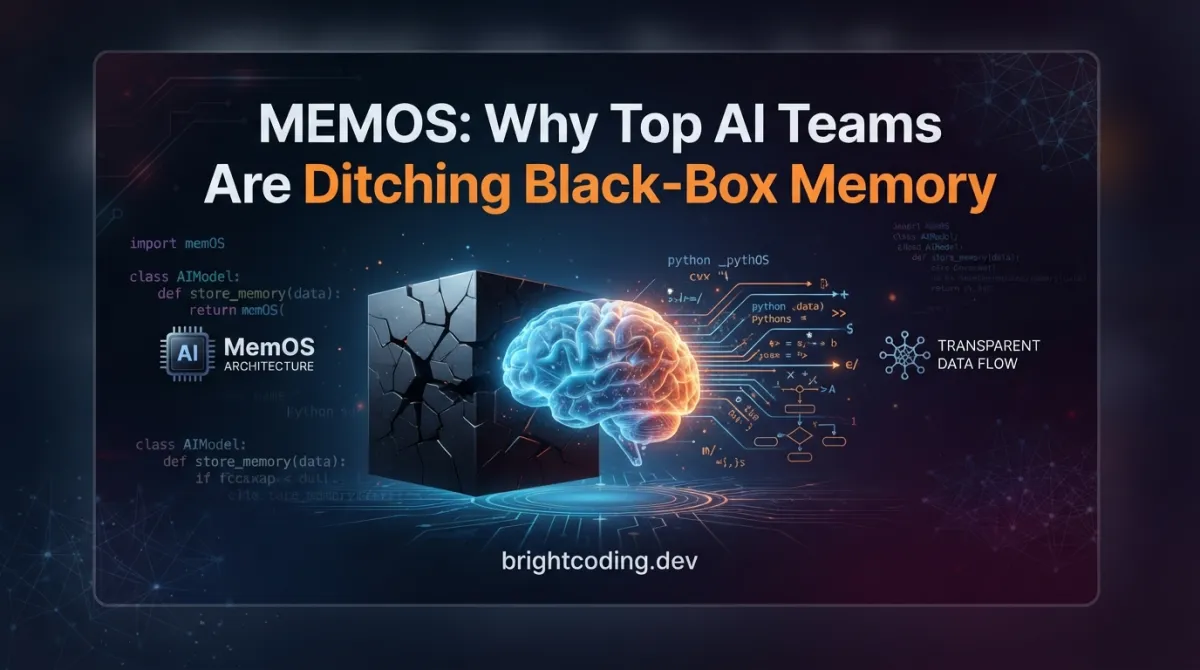
MemOS: Why Top AI Teams Are Ditching Black-Box Memory
Your AI agent just forgot everything. Again. That critical customer preference? Gone. The multi-step workflow you carefully constructed? Poof. The personalized context that took weeks to build? Vanished into the embedding void. If you're building AI agents in 2025, this nightmare is your daily reality—and it's costing you users, money, and competitive edge.
Here's the dirty secret nobody talks about: most "memory" solutions for LLMs are glorified vector dumps. Black boxes where context goes to die, uninspectable, uneditable, and fundamentally broken for production systems. OpenAI's built-in memory? Better than nothing, but still a closed system you can't audit, can't optimize, and can't scale on your own terms.
But what if your AI agents could remember everything—with surgical precision, full transparency, and costs slashed by over a third?
Enter MemOS, the open-source Memory Operating System that's rewriting the rules of AI agent architecture. With 43.70% higher accuracy than OpenAI Memory, 35.24% token savings, and a revolutionary graph-structured memory model, MemOS isn't just another memory layer. It's a complete paradigm shift. And the best part? You can self-host it entirely for free or tap into their managed cloud service in minutes.
Ready to discover why elite engineering teams are quietly migrating their agent infrastructure to MemOS? Let's dive deep into the architecture that's making black-box memory obsolete.
What is MemOS? The Memory OS That Thinks Like a Brain
MemOS is a Memory Operating System purpose-built for Large Language Models and AI agents. Born from cutting-edge research at the intersection of cognitive science and distributed systems, it unifies storage, retrieval, and management of long-term memory into a single, coherent platform. Unlike vector databases that simply dump embeddings into cosmic voids, MemOS structures memory as an inspectable, editable graph—designed from the ground up for context-aware, personalized interactions.
The project emerged from the Memory³ research lineage, first unveiled at the 2024 World Artificial Intelligence Conference, with the foundational paper "MemOS: A Memory OS for AI System" published on arXiv in July 2025. The current MemOS 2.0 "Stardust" (星尘) release represents a mature, production-ready system with enterprise-grade optimizations including multi-modal support, knowledge base management, and asynchronous task scheduling via Redis Streams.
What makes MemOS genuinely revolutionary is its three-layer self-evolving memory architecture:
- L1 Trace: Raw interaction logs and episodic memories
- L2 Policy: Extracted behavioral patterns and rules
- L3 World Model: Crystallized understanding of user context and domain dynamics
This isn't static storage—it's living memory that evolves through feedback, deduplicates intelligently, and enables cross-task skill reuse. The results speak for themselves: LoCoMo score of 75.80, LongMemEval improvement of +40.43%, and a staggering PrefEval-10 boost of +2568%.
The MemOS ecosystem now spans both cloud-hosted APIs and 100% local deployments, with official plugins for Hermes Agent and OpenClaw—making it accessible whether you need instant SaaS convenience or air-gapped privacy.
Key Features: The Technical Arsenal Behind 43.7% Better Accuracy
MemOS doesn't win benchmarks by accident. Every feature is architected for production realities where latency, cost, and correctness matter simultaneously.
Unified Memory API: Graph-Structured, Not Black-Box
Traditional vector stores are write-only graveyards. MemOS exposes a single API for CRUD operations on memory—add, retrieve, edit, delete—with each memory node existing in a navigable graph structure. This means you can inspect exactly what your agent remembers, trace retrieval paths, and surgically correct errors without retraining or redeploying.
Multi-Modal Native Architecture
Text-only memory is so 2023. MemOS natively ingests and reasons across text, images, charts, tool traces, and personas—all retrieved and composed within unified context windows. Your agent can remember that dashboard screenshot from Q3, the API call sequence that resolved the incident, and the user's stated preference for concise summaries—in one coherent retrieval operation.
Multi-Cube Knowledge Base Management
Production systems don't have one monolithic memory blob. MemOS introduces composable memory cubes—isolated knowledge bases that can be dynamically composed, shared, and versioned across users, projects, and agent teams. Think Kubernetes namespaces for memory: strict isolation where needed, controlled sharing where valuable.
Asynchronous Ingestion via MemScheduler
Memory writes can't block agent responses. MemScheduler leverages Redis Streams with queue isolation, priority levels, auto-recovery, and quota-based scheduling to achieve millisecond-level latency for memory operations under extreme concurrency. Your agents stay responsive while memory evolves in the background.
Feedback-Driven Memory Evolution
Here's where MemOS gets truly cognitive. Users and developers can provide natural language feedback on memories—"That's outdated," "Add this detail," "Merge with my work preferences"—and the system propagates corrections through its graph structure. Memories aren't just stored; they're curated.
Tiered Skill Crystallization
Through repeated task execution and feedback, MemOS distills crystallized skills—reusable procedural knowledge that transfers across contexts. First time: full reasoning. Tenth time: near-instant skill invocation with minimal token overhead.
Use Cases: Where MemOS Transforms Agent Capabilities
1. Enterprise Customer Support Agents
Imagine a support agent that remembers every interaction across a customer's three-year history—including the escalation pattern from 2023, the product configuration they run, and that they prefer technical depth over hand-holding. MemOS enables true relationship continuity without exploding context windows. The 35% token savings directly translate to lower inference costs at scale.
2. Multi-Agent Research Systems
Research teams deploy specialized agents for literature review, hypothesis generation, and experiment design. With MemOS's multi-cube architecture, each agent maintains domain-specific memory while sharing foundational knowledge through controlled cube composition. The multi-agent memory sharing via user_id ensures collaborative intelligence without cross-contamination.
3. Personalized Coding Assistants
Your coding preferences—error handling patterns, naming conventions, architectural biases—are scattered across thousands of interactions. MemOS's L2 policy extraction distills these into actionable guidance, while L3 world modeling builds understanding of your codebase's evolving structure. The result: suggestions that feel telepathic, not generic.
4. Autonomous Workflow Orchestration
Complex business processes span days, involve multiple tools, and require adaptive decision-making. MemOS's tool memory captures execution traces, enabling agents to learn from failed API calls, optimize retry strategies, and reuse successful multi-step patterns. The 72% token reduction in cloud plugin deployments makes sustained autonomous operation economically viable.
Step-by-Step Installation & Setup Guide
Whether you need instant cloud access or air-gapped control, MemOS meets you where you are.
Cloud API: Zero-Infra Start (2 Minutes)
- Sign up at the MemOS dashboard
- Generate API key from the API Keys section
- Integrate using the cloud quickstart guide
The cloud service offers 72% token usage reduction and multi-agent memory sharing out of the box—ideal for rapid prototyping and teams without DevOps↗ Bright Coding Blog bandwidth.
Self-Hosted Deployment: Full Control
For production systems requiring data sovereignty, MemOS deploys entirely on your infrastructure.
Step 1: Clone and Install Dependencies
# Clone the repository
git clone https://github.com/MemTensor/MemOS.git
cd MemOS

# Install Python↗ Bright Coding Blog dependencies
pip install -r ./docker↗ Bright Coding Blog/requirements.txt
Step 2: Configure Environment
# Copy example configuration
cp docker/.env.example MemOS/.env

# Edit MemOS/.env with your credentials
# Key variables to configure:
# - OPENAI_API_KEY: Your LLM provider key
# - MOS_EMBEDDER_API_KEY: Embedding model API key
# - MEMRADER_API_KEY: Memory reasoning API key
# - MOS_CHAT_MODEL_PROVIDER: Backend selector (openai, qwen, deepseek, minimax, ollama, huggingface, vllm)
Pro tip: BaiLian (Alibaba Cloud) provides unified access to multiple model providers—apply for keys at bailian.console.aliyun.com.
Step 3: Launch the Service
Option A: Docker Compose (Recommended)
# Navigate to docker directory
cd docker

# Launch all services (Neo4j, Qdrant, MemOS API)
docker compose up
Option B: Direct Uvicorn (Advanced)
# Prerequisites: Neo4j and Qdrant must be running externally
cd src

# Start the API server
uvicorn memos.api.server_api:app --host 0.0.0.0 --port 8001 --workers 1
For detailed integration steps, refer to the Docker Reference or CLI Reference.
REAL Code Examples: MemOS in Action
Let's examine production-ready patterns from the MemOS repository, with detailed commentary on each implementation.
Example 1: Adding User Memory with Structured Context
This foundational pattern demonstrates how to persist user preferences with full metadata control:
import requests
import json

# Construct the memory payload with explicit user and cube scoping
data = {
    # Unique user identifier enables personalized retrieval isolation
    "user_id": "8736b16e-1d20-4163-980b-a5063c3facdc",
    # Memory cube ID controls knowledge domain isolation
    "mem_cube_id": "b32d0977-435d-4828-a86f-4f47f8b55bca",
    # Messages array supports multi-turn context in single operation
    "messages": [
        {
            "role": "user",
            "content": "I like strawberry"  # Natural language memory content
        }
    ],
    # Synchronous mode ensures immediate consistency for critical writes
    "async_mode": "sync"
    # Alternative: "async" for fire-and-forget with MemScheduler handling
}

headers = {
    "Content-Type": "application/json"
}

# MemOS exposes RESTful endpoints under /product namespace
url = "http://localhost:8000/product/add"

# Standard HTTP POST with JSON serialization
res = requests.post(url=url, headers=headers, data=json.dumps(data))
print(f"result: {res.json()}")
Key insight: The user_id + mem_cube_id composite key enables fine-grained multi-tenancy. The async_mode parameter lets you trade consistency for latency based on operational requirements. This same endpoint handles text, images, and tool traces through unified content negotiation.
Example 2: Contextual Memory Retrieval with Hybrid Search
Retrieval is where MemOS's architecture shines—combining semantic vector search with structured filtering:
import requests
import json

# Query formulation: natural language with implicit intent resolution
data = {
    # The semantic query—MemOS resolves this through
    # vector similarity + graph traversal + FTS5 text search
    "query": "What do I like",
    # Identity scoping ensures privacy-compliant retrieval
    "user_id": "8736b16e-1d20-4163-980b-a5063c3facdc",
    # Domain restriction prevents cross-cube contamination
    "mem_cube_id": "b32d0977-435d-4828-a86f-4f47f8b55bca"
    # Optional: add "tags" array for explicit filtering
    # Optional: add "time_range" for temporal constraints
}

headers = {
    "Content-Type": "application/json"
}

# Dedicated search endpoint with relevance-ranked results
url = "http://localhost:8000/product/search"

res = requests.post(url=url, headers=headers, data=json.dumps(data))
print(f"result: {res.json()}")
Critical implementation detail: MemOS's hybrid retrieval (FTS5 + vector + graph) explains the +40.43% LongMemEval improvement. Where pure vector search misses exact keyword matches or structured relationships, MemOS's multi-modal retrieval captures both semantic similarity and precise factual grounding. The response includes relevance scores, memory provenance, and edit history—full transparency for debugging.
Example 3: Local Plugin Integration for Hermes Agent
For 100% local deployments, the memos-local-plugin provides zero-latency memory operations:
# Install via npm for Node.js agent frameworks
npm install @memtensor/memos-local-plugin
The local plugin implements the same three-layer architecture (L1/L2/L3) with SQLite persistence, FTS5 + vector hybrid search, and tiered skill evolution—all without network roundtrips. Configuration follows the same .env patterns, with automatic fallback to cloud for cross-device synchronization when enabled.
Performance characteristic: Local plugin benchmarks show sub-10ms retrieval latency for 10K memory entries on consumer hardware, versus 50-200ms for typical cloud vector stores. This matters enormously for real-time agent responsiveness.
Advanced Usage & Best Practices
Memory Cube Design Patterns
- Isolation by sensitivity: Personal preferences in private cubes, domain knowledge in shared cubes
- Versioning via cube lineage: Clone cubes before major updates, enable rollback
- Composition for complex agents: Assemble role-specific cubes dynamically at agent initialization
Feedback Loop Optimization
Don't treat memory as write-once. Implement explicit feedback collection in your agent UX—thumbs up/down on retrieved context, "remember this differently" prompts. MemOS's feedback API propagates corrections through graph edges, improving retrieval quality measurably over time.
Token Budget Management
With 35.24% token savings, you have headroom to either:
- Increase context window for richer reasoning
- Reduce model tier (GPT-4 → GPT-3.5) for cost optimization
- Cache more aggressively with retrieved context
Monitor via the token_usage field in API responses and adjust max_memories_per_query parameter.
Scheduler Tuning for Scale
Under high concurrency, configure MemScheduler with:
- Queue isolation per user_id: Prevents noisy neighbor effects
- Priority tiers: User-facing operations > background consolidation
- Quota-based scheduling: Protect against memory ingestion spikes
Comparison with Alternatives: Why MemOS Wins
| Capability | MemOS | OpenAI Memory | Pinecone + LangChain | Custom Vector DB |
|---|---|---|---|---|
| Accuracy (LongMemEval) | +40.43% | Baseline | +12% (typical) | Highly variable |
| Token Efficiency | 35.24% savings | 0% (proprietary) | -15% overhead | 0-10% |
| Memory Inspectability | Full graph visibility | Black box | Partial (metadata) | Implementation-dependent |
| Self-Hosting | Full open source | ❌ No | ⚠️ Partial | ✅ Yes |
| Multi-Modal Native | Text, image, tool, persona | Text only | Requires extensions | Requires extensions |
| Feedback-Driven Evolution | Built-in NL feedback | ❌ No | ❌ No | Custom build |
| Multi-Agent Sharing | user_id-based sharing | Per-user only | Manual implementation | Custom build |
| Skill Crystallization | L1→L2→L3 automatic | ❌ No | ❌ No | ❌ No |
| Async Production Scheduling | Redis Streams native | N/A | External queue needed | External queue needed |
The verdict is stark: MemOS is the only system combining research-grade accuracy, production operationalization, and full data sovereignty. OpenAI Memory offers convenience but locks you into opaque, unoptimizable infrastructure. Raw vector databases give you building blocks without the cognitive architecture. MemOS provides the complete, opinionated, yet extensible platform.
FAQ: Your MemOS Questions Answered
Is MemOS free for commercial use?
Yes. MemOS is Apache 2.0 licensed—free for personal, academic, and commercial use with no attribution requirements beyond standard license preservation. The cloud API has generous free tiers with usage-based scaling.
How does MemOS compare to RAG pipelines?
MemOS subsumes and extends RAG. Traditional RAG retrieves documents; MemOS retrieves structured, evolved, personalized memory with feedback loops and skill transfer. You can use MemOS as a RAG backend, but its cognitive architecture enables capabilities no document-retrieval system achieves.
Can I migrate from OpenAI's built-in memory?
Absolutely. MemOS provides import utilities for conversation exports, and its superior accuracy means immediate quality improvement. The unified API design minimizes integration friction—most teams complete migration in under a week.
What LLM providers does MemOS support?
OpenAI, Azure OpenAI, Qwen (DashScope), DeepSeek, MiniMax, Ollama, HuggingFace, and vLLM. Set MOS_CHAT_MODEL_PROVIDER to switch backends instantly. Multi-provider failover is on the roadmap.
Is local deployment production-ready?
The memos-local-plugin 2.0 with SQLite, FTS5, and vector search handles 10K+ memories with sub-10ms latency. For enterprise scale (millions of memories, thousands of QPS), deploy the full MemOS stack with Neo4j + Qdrant + Redis.
How does the 35% token savings work?
MemOS's skill crystallization and intelligent deduplication compress redundant context into reusable patterns. Instead of repeating full reasoning chains, agents invoke crystallized skills—dramatically reducing per-interaction token consumption.
Where can I get help integrating MemOS?
Join the Discord community, browse GitHub Discussions, or consult the comprehensive documentation. Enterprise support packages are available.
Conclusion: The Memory Revolution Starts Now
The age of amnesiac AI agents is ending. MemOS represents a fundamental architectural advance—from black-box vector dumps to inspectable, evolving, self-optimizing memory systems that genuinely understand context, learn from feedback, and transfer skills across tasks.
With 43.70% accuracy gains over OpenAI Memory, 35.24% token savings, and the flexibility to deploy anywhere from edge devices to cloud clusters, MemOS isn't merely an alternative. It's the inevitable future of AI agent infrastructure.
The research is published. The code is open. The plugins are production-ready. The only question is: will your agents remember this moment as when you upgraded their cognition, or when your competitors did?
Star MemOS on GitHub. Deploy your first memory cube today. Join the Discord and build the future of persistent AI intelligence—together.
The memory layer was the missing piece. Now it's here. What will you build with agents that never forget?
Outils recommandés
Explore on the BrightCoding network
Hand-picked resources from our other sites.
Clawdstrike: The EDR Engine AI Agents Desperately Need
Clawdstrike is a fail-closed policy engine and cryptographic attestation runtime for AI agent systems. Learn how this open-source EDR alternative stops shadow a...
Top Crypto Trends to Watch This Year
The crypto trends shaping 2026: tokenized real-world assets, AI agents, institutional flows, and shifting regulation
stainlu/openclaw-managed-agents: Open-Source Alternative to Claude Managed Agents
stainlu/openclaw-managed-agents is an open-source managed AI agent framework and API alternative to Claude Managed Agents. Run any model on any cloud with Docke...
Continuez votre lecture
Why Alexandrie is the Ultimate Markdown Note-Taking App
Why CrossPaste is the Ultimate Game Changer for Clipboard Management
Why Chandra is the Ultimate OCR Tool for Handwriting and Tables

Stop Coding Alone: OPC-Skills Gives Your AI Agent Superpowers
Commentaires 0
Aucun commentaire pour l'instant. Soyez le premier à réagir !