NoizAI/skills: Why Developers Are Ditching Robotic TTS Forever
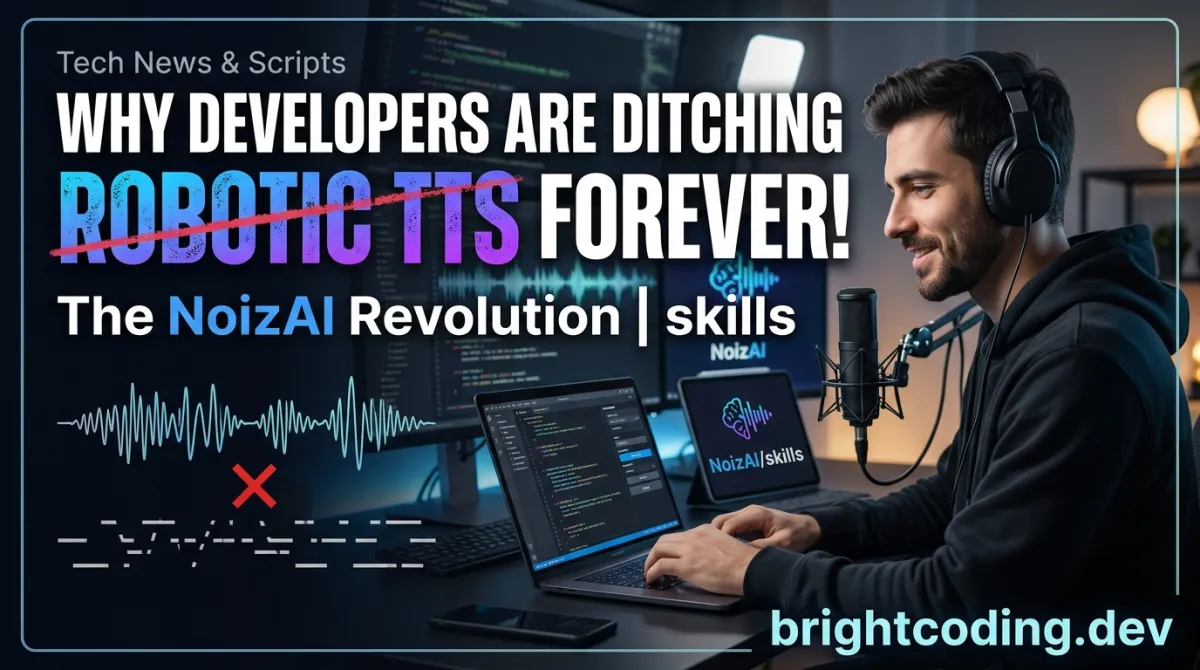
NoizAI/skills: Why Developers Are Ditching Robotic TTS Forever
Your AI bot sounds like a dying GPS from 2008. Admit it—that monotone, lifeless voice makes users cringe and abandon conversations faster than you can say "text-to-speech." You've tried ElevenLabs, wasted hours tweaking OpenAI's Whisper, maybe even hacked together some Python↗ Bright Coding Blog pipeline that breaks every third Tuesday. What if your bot could actually feel human? Not just "less robotic," but genuinely companion-like—with natural fillers, emotional warmth, and speaking styles that make users forget they're talking to code.
The secret weapon top AI engineers are quietly deploying? NoizAI/skills. This isn't another wrapper around a cloud API. It's a local-first, modular skill system that transforms any intelligent bot into a voice-enabled companion with production-ready TTS, voice cloning, video translation, and even automated podcast generation. And the kicker? One command installs everything. No Docker↗ Bright Coding Blog nightmares. No dependency hell. Just npx skills add and your bot starts speaking with soul.
Ready to unmute your creation? Let's dive deep into why NoizAI/skills is becoming the underground favorite for developers who refuse to settle for synthetic-sounding AI.
What is NoizAI/skills?
NoizAI/skills is the central repository for managing voice and audio "skills" that inject human-like personality into AI bots. Created by the team at Noiz AI, this open-source project addresses a critical gap in the AI ecosystem: most text-to-speech solutions prioritize accuracy over authenticity, delivering technically correct audio that emotionally disconnects users.
The repository operates on a skill-based architecture—think of it as a plugin system where each capability (TTS, voice cloning, sound effects, video translation) is a self-contained module you install independently. This modular approach means you ship only what you need, keeping your bot lean while maintaining extensibility.
Why it's trending now: The AI companion market is exploding. Character.AI hit 20 million monthly users. Replika generates $100M+ annually. But here's what most developers miss: voice is the intimacy layer that transforms transactional bots into relational ones. NoizAI/skills cracked the code on "companion-like" audio generation—those subtle "umms," thoughtful pauses, and emotional inflections that make synthetic speech feel genuinely present. With local-first execution, it also solves the privacy nightmare that sends enterprise teams running from cloud-only solutions.
The project's GitHub star trajectory tells the story. Developers aren't just starring and forgetting—they're cloning, contributing, and building production systems around these skills.
Key Features That Separate NoizAI/skills from the Pack
🔒 Secure and Local-First Execution
Your data never leaves your machine. In an era where sending conversation logs to third-party APIs creates compliance nightmares, NoizAI/skills runs entirely locally for core functionality. Sensitive text, voice samples, and generated assets stay under your control. This isn't just a privacy checkbox—it's architectural philosophy.
🧠 Character-Style Controls
This is where NoizAI/skills destroys generic TTS solutions. The characteristic-voice skill provides granular tuning for:
- Fillers: Natural "hmm," "uh," "you know" insertions that break robotic perfection
- Emotion mapping: Calm, excited, melancholic, hyped—presets that reshape prosody
- Speaking presets: Breaking news anchor, mindful therapist, podcast host, startup founder pitching VCs
Most TTS engines optimize for clarity. NoizAI optimizes for believability—and that difference is everything in companion AI.
🎙️ Production-Ready Voice Pipeline
From rapid prototyping to broadcast-quality output:
- Kokoro backend: Fully local, zero API costs, runs on consumer hardware
- Noiz API backend: Cloud-enhanced with emotion control, faster inference, and reference-audio voice cloning
- Timeline-aligned rendering: Precise duration control for lip-sync and video workflows
- Multi-format export: WAV, MP3, FLAC for any downstream pipeline
📤 One-Command Platform Delivery
Generate speech and instantly deploy as native voice messages to Feishu, Telegram, or Discord—zero integration code required. The skill system handles platform-specific formatting, compression, and delivery protocols. Your bot speaks, users hear it in their native chat environment. Friction eliminated.
6 Real-World Use Cases Where NoizAI/skills Dominates
1. AI Companion Apps That Users Actually Bond With
The difference between a chatbot users try once and one they return to daily? Emotional presence. Characteristic-voice skills let your companion bot sigh when sympathetic, perk up when excited, and use thoughtful fillers that signal active listening. The chat-with-anyone skill even lets users converse with AI versions of real people or fictional characters, automatically sourcing reference audio from online speech samples.
2. Automated Podcast & News Generation
The daily-news-caster skill fetches real-time news and generates dual-host conversational podcasts with distinct voices, natural banter, and audio production. Media companies are using this to prototype shows in hours, not weeks. Solo creators build daily briefing products without recording equipment.
3. Video Localization at Scale
The video-translation skill replaces original audio with translated TTS while preserving video content. For creators with global audiences, this means one recording session → unlimited language versions. The timeline-aligned rendering ensures dubbed audio matches original mouth movements closely enough for professional use.
4. Game Development & Interactive Fiction
Sound effects on demand (sound-fx skill: 1-30 second generations from text descriptions), character voices with consistent personalities, and dynamic dialogue that responds to player emotion. Indie studios replace expensive voice actor contracts with infinitely iterable AI voices.
5. Accessibility & Assistive Technology
Screen readers that don't sound like punishment. Voice assistants for elderly users that feel patient, not patronizing. The emotional tuning isn't a gimmick here—it's the difference between adoption and abandonment for users who rely on voice interfaces daily.
6. Enterprise Bot Deployments with Compliance Requirements
Financial services, healthcare, legal—industries where sending client data to cloud TTS APIs triggers compliance review cycles. Local-first execution means your legal team sleeps soundly while your bot still sounds human.
Step-by-Step Installation & Setup Guide
Prerequisites
- Node.js 18+ with
npxavailable - Bash environment (Linux, macOS, or WSL2 on Windows)
- For local TTS: ~4GB free RAM for Kokoro backend
- For enhanced features: Noiz API key (free tier available)
Step 1: Explore Available Skills
# List all skills with full documentation
npx skills add NoizAI/skills --list --full-depth
This command fetches the skill catalog from GitHub, displaying descriptions, documentation links, and installation commands for each module.
Step 2: Install Your First Skill
# Install TTS skill with automatic confirmation
npx skills add NoizAI/skills --full-depth --skill tts -y

# Or install the complete skill collection
npx skills add NoizAI/skills --full-depth
The --full-depth flag ensures complete skill documentation and dependencies are pulled. The -y flag auto-confirms prompts for CI/CD pipelines.
Step 3: Configure API Key (Recommended)
For enhanced emotion control, faster inference, and voice cloning:
# Set your Noiz API key (get free key at developers.noiz.ai/api-keys)
bash skills/tts/scripts/tts.sh config --set-api-key YOUR_KEY
The key persists to ~/.noiz_api_key and loads automatically in subsequent sessions. Alternative: Pass --backend kokoro to any command for fully local execution.
Step 4: Verify Installation with Characteristic Voice
# Generate a comfort-style voice sample
bash skills/characteristic-voice/scripts/speak.sh \
  --preset comfort \
  -t "Hmm... I'm right here." \
  -o comfort.wav
Success? You'll hear a warm, companion-like voice with natural hesitation—nothing like sterile TTS output.
Step 5: Local Development Setup
For contributors or custom skill authors:
# Clone the repository
git clone https://github.com/NoizAI/skills.git
cd skills

# Install from local directory with full depth
npx skills add . --list --full-depth
See CONTRIBUTING.md for skill authoring conventions and PR requirements.
REAL Code Examples from the Repository
Example 1: Quick TTS with Local Kokoro Backend
The repository's core TTS functionality supports both cloud and local execution. Here's the fundamental pattern from the installation documentation:
# Install TTS skill specifically
npx skills add NoizAI/skills --full-depth --skill tts -y

# Configure for local-only operation (no API key needed)
bash skills/tts/scripts/tts.sh \
  --backend kokoro \
  --text "Your bot finally sounds like a real person." \
  --output natural_voice.wav
What's happening here? The npx skills add command uses Node's package execution to dynamically install the TTS skill module. The --backend kokoro flag routes to the local neural TTS engine—Kokoro is a lightweight, high-quality open-source TTS model that runs on CPU without GPU requirements. This is your zero-cost, zero-latency, privacy-maximum option for prototyping and production alike.
Example 2: Characteristic Voice with Emotional Presets
This example from the README's Quick Verify section demonstrates the signature capability—companion-like speech generation:
bash skills/characteristic-voice/scripts/speak.sh \
  --preset comfort \
  -t "Hmm... I'm right here." \
  -o comfort.wav
Breakdown of the magic:
--preset comfort: Loads a predefined emotional/behavioral profile—this one combines slower pace, softer dynamics, and filler insertion patterns associated with reassuring presence-t "Hmm... I'm right here.":The input text includes intentional filler "Hmm..." which the system preserves and enhances rather than "cleaning up"-o comfort.wav: Outputs to standard WAV for maximum compatibility
The critical insight: Most TTS systems strip imperfections. NoizAI/skills curates them. The "comfort" preset knows when to insert breath sounds, how to pace the "..." pause, and how to make "I'm right here" feel like someone settling in beside you rather than announcing presence.
Example 3: Skill-Specific Installation for Targeted Deployments
The modular architecture shines when you need surgical precision in your bot's capabilities:
# Install only video translation for a localization pipeline
npx skills add NoizAI/skills --full-depth --skill video-translation -y

# Install sound effects generation for game audio
npx skills add NoizAI/skills --full-depth --skill sound-fx -y

# Install chat-with-anyone for character AI applications
npx skills add NoizAI/skills --full-depth --skill chat-with-anyone -y
Why this matters: Each skill is self-contained with its own dependencies, documentation, and update cycle. Your production bot doesn't inherit bloat from unused capabilities. The --skill flag ensures you ship minimal attack surface and maximum performance. When the daily-news-caster team pushes podcast generation improvements, your TTS-only deployment stays stable.
Example 4: API Key Configuration for Enhanced Capabilities
# Persist API key for automatic loading
bash skills/tts/scripts/tts.sh config --set-api-key YOUR_KEY

# The key is stored at ~/.noiz_api_key and automatically detected
# No need to pass --api-key on every command
Security note: The configuration script creates ~/.noiz_api_key with restrictive permissions (typically 600). This pattern follows CLI best practices—sensitive credentials live in your user's home directory, not in repository code or environment variables that leak into logs. For team deployments, consider wrapping this in your secret management system while maintaining the same file path convention.
Advanced Usage & Best Practices
Optimize Voice Cloning with Clean Reference Audio
The chat-with-anyone skill automatically finds and extracts speech samples, but quality in = quality out. For best results with manual voice cloning, provide 10-30 seconds of clean, single-speaker audio without background music or cross-talk. The TTS skill's timeline-aligned rendering then matches this reference with sub-second precision.
Layer Skills for Complex Productions
Combine daily-news-caster (content generation) → characteristic-voice (emotional styling) → tts (rendering) → platform delivery for fully automated podcast pipelines. Each skill outputs standard audio formats that chain together seamlessly.
Fallback Strategy for API Reliability
Production deployments should implement backend fallback:
# Attempt Noiz API first, fallback to Kokoro
bash skills/tts/scripts/tts.sh --text "$INPUT" --output out.wav \
  || bash skills/tts/scripts/tts.sh --text "$INPUT" --output out.wav --backend kokoro
Monitor Git Clone Trends for Community Health
The repository publishes clone trend data—use this to gauge ecosystem momentum before betting your product roadmap on the platform.
Comparison with Alternatives
| Capability | NoizAI/skills | ElevenLabs | OpenAI TTS | Coqui TTS |
|---|---|---|---|---|
| Local execution | ✅ Full | ❌ Cloud only | ❌ Cloud only | ✅ Full |
| Companion-like fillers | ✅ Native | ⚠️ Manual prompt | ❌ No | ❌ No |
| Voice cloning | ✅ Reference audio | ✅ Excellent | ⚠️ Limited | ⚠️ Moderate |
| Emotion presets | ✅ Built-in | ⚠️ Style params only | ❌ 6 basic voices | ❌ Manual config |
| Video translation | ✅ Skill included | ❌ Separate product | ❌ No | ❌ No |
| Sound effects | ✅ Text-to-SFX | ❌ No | ❌ No | ❌ No |
| Platform delivery | ✅ One-command | ❌ API only | ❌ API only | ❌ Manual |
| Cost model | Free/local + API tier | $5-330/mo | $0.015/1K chars | Free |
| Open source | ✅ Yes | ❌ No | ❌ No | ✅ Yes |
The verdict: ElevenLabs wins on raw voice quality for premium use cases. OpenAI TTS is simplest for basic needs. But NoizAI/skills is the only solution that combines local privacy, companion-like personality, modular architecture, and full audio production pipeline in one ecosystem. For AI companion products, indie creators, and privacy-conscious enterprises, the choice becomes obvious.
FAQ: What Developers Ask About NoizAI/skills
Is NoizAI/skills completely free to use?
The core system and Kokoro backend are free and open-source. The Noiz API (enhanced emotion control, faster inference, advanced voice cloning) offers a free tier with paid upgrades. You can build production systems without spending a dollar using local execution only.
Can I run this on my laptop, or do I need cloud GPUs?
Consumer hardware handles most skills beautifully. Kokoro TTS runs on CPU with 4GB RAM. For batch video translation or real-time applications, cloud GPU acceleration helps—but it's optional, not mandatory.
How does voice cloning work without training my own model?
The chat-with-anyone skill uses reference-audio inference: it extracts speaker characteristics from existing audio samples and applies them during generation, no fine-tuning required. The TTS skill supports the same pattern with your own reference files.
Is the generated audio truly unique, or will my bot sound like others?
Highly customizable. Between backend selection (Kokoro vs. Noiz), emotion presets, filler density, speaking rate, and reference audio, the combinatorial space ensures distinctive output. Character-style controls provide differentiation that cloud TTS APIs can't match.
What platforms can receive voice messages?
Native integration for Feishu, Telegram, and Discord is built-in. The audio outputs standard formats (WAV/MP3/FLAC) that work with any platform accepting file uploads. Additional platform adapters are community-contributed as new skills.
How do I contribute a new skill?
Fork the repository, follow the directory conventions in CONTRIBUTING.md, and submit a PR. The skill architecture is designed for extensibility—your module plugs into the same npx skills add system as official skills.
Is this production-ready for customer-facing applications?
Yes, with appropriate testing. The TTS and characteristic-voice skills are actively used in production companion apps. Start with Kokoro backend for stability, migrate to Noiz API for enhanced features once your traffic justifies it.
Conclusion: Your Bot Deserves a Voice Worth Hearing
The AI voice landscape is littered with technically functional solutions that emotionally fail. NoizAI/skills represents a fundamental shift—from speech synthesis to presence engineering. The difference isn't incremental; it's the gap between a GPS announcing directions and a friend saying "let's figure this out together."
The local-first architecture protects your users' privacy. The modular skill system keeps your deployments lean. The characteristic-voice capabilities create genuine emotional connection at scale. And with one-command installation via npx skills add, you can hear the difference in your own bot within minutes.
Stop shipping robotic voices that users tolerate. Start building companion-like audio that users crave.
👉 Star NoizAI/skills on GitHub — install your first skill today, join the Discord community for support, and unmute what your bot was meant to become.
Last updated: 2024 | Skills version: Check repository for latest release
Explore on the BrightCoding network
Hand-picked resources from our other sites.
Stop Overpaying for Tax Software! Use UsTaxes Instead
Discover UsTaxes, the free open-source tax filing app that keeps your data private. File federal returns via web or desktop without paying a dime. Learn install...
Greedeks/GTweak: Portable Windows Hardening and Debloating Tool
Greedeks/GTweak is a portable C# utility for Windows 10/11 that removes bloatware, disables telemetry, manages system services, and provides granular control ov...
Textualize/textual: Cross-Platform Terminal UIs with Pure Python
Textualize/textual is a 36,621-star MIT-licensed Python framework for building terminal and web user interfaces with a simple, modern API. Features include CSS-...
Continuez votre lecture
Why Alexandrie is the Ultimate Markdown Note-Taking App

Why CrossPaste is the Ultimate Game Changer for Clipboard Management

Why Chandra is the Ultimate OCR Tool for Handwriting and Tables
Stop Coding Alone: OPC-Skills Gives Your AI Agent Superpowers
Commentaires 0
Aucun commentaire pour l'instant. Soyez le premier à réagir !