NSA's Ghidra: The Secret Reverse Engineering Tool Now Open Source
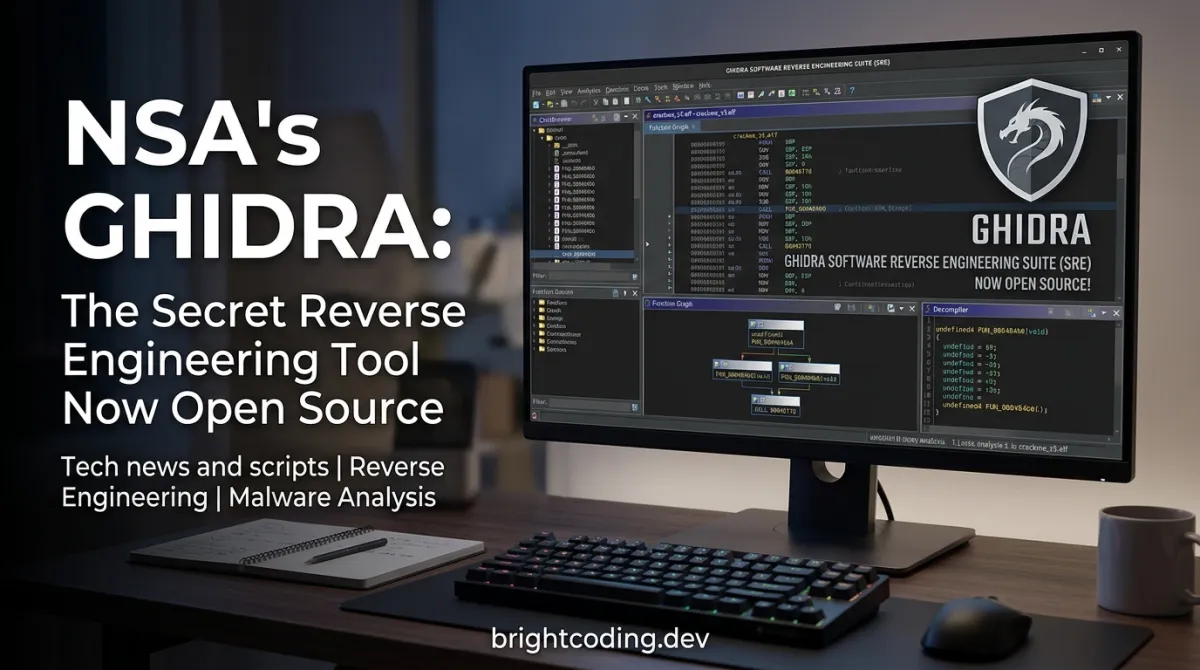
NSA's Ghidra: The Secret Reverse Engineering Tool Now Open Source
What if the most powerful reverse engineering tool on the planet was sitting in a government vault for twenty years—and you could never touch it?
That was the reality for cybersecurity professionals until 2019, when the National Security Agency did something unprecedented: they open-sourced Ghidra, their classified software reverse engineering framework. The same tool their elite analysts used to dissect nation-state malware, uncover zero-day vulnerabilities, and protect critical infrastructure suddenly became available to anyone with a laptop and curiosity.
Here's the painful truth that keeps security researchers awake at night: reverse engineering is brutally hard. You're staring at raw machine code—ones and zeros that might as well be ancient Sumerian. Commercial tools like IDA Pro cost thousands of dollars annually. Free alternatives feel like using a butter knife for brain surgery. The learning curve is a cliff. The tooling ecosystem is fragmented. And when you're racing against attackers who already know your system's weaknesses, every minute spent wrestling with inadequate tools is a minute the bad guys exploit.
Ghidra changes everything.
This isn't hyperbole. Within days of its public release, Ghidra became the most-starred repository in NSA history. Security researchers, malware analysts, vulnerability hunters, and curious developers flooded to github.com/NationalSecurityAgency/ghidra, desperate to understand what the world's most secretive intelligence agency had built. What they discovered was staggering: a full-featured, extensible, and completely free reverse engineering platform that rivals—and in some ways surpasses—tools costing ten thousand dollars per seat.
If you've ever wanted to peer inside compiled binaries, understand how malware operates, or simply master the dark art of software analysis, this is your moment. The playing field has been leveled. The secret weapon is yours.
What is Ghidra?
Ghidra is a software reverse engineering (SRE) framework created and maintained by the National Security Agency Research Directorate. Born from two decades of internal development, it represents one of the most significant releases of government-developed technology to the public domain in cybersecurity history.
The framework encompasses a comprehensive suite of high-end software analysis tools designed to analyze compiled code across multiple platforms—Windows, macOS, and Linux. Its core capabilities span disassembly, assembly, decompilation, graphing, and scripting, augmented by hundreds of additional specialized features. Unlike single-purpose tools, Ghidra functions as an integrated ecosystem where each component amplifies the others.
Why did the NSA release it? The answer reveals something fascinating about modern cybersecurity strategy. In supporting its cybersecurity mission, Ghidra was engineered specifically to solve scaling and teaming problems on complex SRE efforts. When you're analyzing sophisticated nation-state malware with teams of analysts, you need collaborative workflows, consistent analysis environments, and extensible platforms that adapt to novel threats. By open-sourcing Ghidra, the NSA effectively crowdsources improvement to a tool they depend upon while simultaneously raising the defensive capabilities of the broader community.
The framework supports an extensive array of processor instruction sets and executable formats—far beyond what most commercial alternatives handle natively. It operates in both user-interactive modes for deep manual analysis and automated modes for scalable processing pipelines. Perhaps most powerfully, users can develop custom extension components and scripts using Java or Python↗ Bright Coding Blog, transforming Ghidra from a tool into a platform.
Ghidra's timing was impeccable. Released at RSA Conference 2019, it arrived precisely when the security community was grappling with binary analysis at scale. IoT devices were exploding. Supply chain attacks were escalating. The need for accessible, powerful reverse engineering had never been greater. The NSA didn't just release a tool—they released twenty years of institutional knowledge about how to analyze software at the highest levels.
Key Features That Make Ghidra Insane
Decompilation That Actually Works. Ghidra's decompiler transforms machine code back into readable C-like pseudocode. This isn't glorified disassembly—it's sophisticated static analysis that reconstructs control flow, identifies data types, and recognizes common compiler patterns. For analysts staring at millions of instructions, this capability reduces analysis time from weeks to days. The decompiler runs as an integrated component, not a separate tool, enabling seamless switching between assembly and high-level views.
Multi-User Collaboration. Here's where Ghidra diverges dramatically from competitors. It supports shared, server-based repositories where multiple analysts can simultaneously work on the same binary. Comments, labels, data type definitions, and analysis results propagate across teams in real-time. For incident response teams or vulnerability research groups, this eliminates the nightmare of merging individual analysis efforts or losing critical insights when analysts rotate.
Extensible Architecture. Ghidra was built for customization. Its plugin architecture allows deep integration of new analyzers, loaders for novel file formats, and processors for obscure architectures. The Script Manager provides access to hundreds of built-in automation scripts, while the API enables creation of entirely new capabilities. This extensibility explains why Ghidra has rapidly accumulated community-contributed support for everything from vintage gaming consoles to modern embedded systems.
Cross-Platform and Cross-Architecture. Windows PE files, Linux ELF binaries, macOS Mach-O, raw firmware images—Ghidra ingests them all. Its processor module library covers x86, x64, ARM, MIPS, PowerPC, SPARC, and dozens more, including many specialized embedded architectures that commercial tools ignore. This universality makes Ghidra indispensable for IoT security research, embedded systems analysis, and historical malware investigation.
Integrated Analysis Environment. Ghidra consolidates capabilities that previously required juggling multiple tools. The CodeBrowser window unifies disassembly, decompilation, function graphing, data type editing, and cross-reference analysis. The Symbol Tree provides navigable program structure. The Memory Map reveals loaded segments and permissions. The Defined Strings window surfaces embedded text. Everything connects—click a function call in decompiled code, jump instantly to its implementation, trace its callers, examine its data flows.
Headless Automation. Beyond the GUI, Ghidra runs headlessly for integration into CI/CD pipelines, automated malware processing workflows, and large-scale binary analysis operations. Python and Java APIs enable complete programmatic control, from initial import through final report generation.
Real-World Use Cases Where Ghidra Dominates
Malware Analysis and Incident Response. When a new ransomware strain hits your network, speed is everything. Ghidra enables rapid unpacking, string extraction, capability identification, and C2 infrastructure extraction. The decompiler reveals encryption routines and network protocols without manual assembly reconstruction. Collaborative repositories allow geographically distributed response teams to share findings in real-time. One analyst identifies the persistence mechanism; another immediately sees it and pivots to detection engineering.
Vulnerability Research and Exploit Development. Security researchers use Ghidra to identify vulnerabilities in closed-source software. The decompiler exposes dangerous function patterns—unchecked string copies, integer overflows, use-after-free conditions. The graphing capabilities visualize complex control flow, revealing paths to vulnerable code. Patch diffing compares vulnerable and patched binaries to pinpoint exact fixes, accelerating exploit development or defensive signature creation.
Firmware and Embedded Systems Security. IoT devices ship with opaque firmware that's rarely updated and frequently vulnerable. Ghidra's broad architecture support enables analysis of MIPS-based routers, ARM-based cameras, and obscure proprietary processors. Researchers extract cryptographic keys, identify backdoors, and map attack surfaces in devices where source code will never be available. The ability to define custom memory-mapped hardware registers transforms Ghidra into a virtual hardware debugger.
Legacy Software Maintenance and Migration. Organizations running critical 30-year-old software with lost source code face existential risk. Ghidra decompiles these binaries into maintainable pseudocode, enabling understanding, documentation, and gradual modernization. The scripting API automates extraction of business logic for reimplementation. This isn't theoretical—financial institutions and government agencies use Ghidra precisely for this purpose.
Academic Research and Education. Reverse engineering education was historically gated by expensive tooling. Ghidra democratizes access, enabling universities to teach binary analysis at scale. Its extensibility supports research into novel decompilation techniques, automated vulnerability discovery, and program analysis algorithms. The open-source nature allows students to inspect and modify the tools they use, creating a generation of analysts who understand their tools at the deepest levels.
Step-by-Step Installation & Setup Guide
Getting Ghidra running takes minutes, not hours. The NSA designed the installation process for rapid deployment across diverse environments—remember, this tool was built for analysts who might need to spin up capabilities anywhere in the world.
Prerequisites
Ghidra requires JDK 21 64-bit. The NSA specifically recommends Eclipse Temurin distributions, though any compatible JDK works. Verify your installation:
java -version
# Expected: openjdk version "21" or later, 64-bit
Official Release Installation (Recommended)
This path provides the stable, pre-built distribution suitable for most users.
Step 1: Download the Release
Navigate to the Ghidra releases page. Locate the official multi-platform release file named ghidra_<version>_<release>_<date>.zip under the Assets dropdown. Critical: Do not download the "Source Code" archives—these won't run without building.
Step 2: Extract the Archive
# Linux/macOS
unzip ghidra_11.2_PUBLIC_20240926.zip -d /opt/

# Windows: Use Explorer or PowerShell
Expand-Archive -Path ghidra_11.2_PUBLIC_20240926.zip -DestinationPath C:\Tools\
Important: Extract to a fresh directory. Never extract atop an existing installation—this causes classpath conflicts and unpredictable failures.
Step 3: Launch Ghidra
# Linux/macOS
cd /opt/ghidra_11.2_PUBLIC
./ghidraRun

# Windows
cd C:\Tools\ghidra_11.2_PUBLIC
ghidraRun.bat
For Python-centric workflows, launch PyGhidra instead:
# Linux/macOS
./support/pyghidraRun

# Windows
support\pyghidraRun.bat
Building from Source (For Developers)
Building Ghidra unlocks the latest features and enables core development. This requires additional tooling.
Install Build Dependencies:
| Component | Version | Purpose |
|---|---|---|
| JDK | 21 64-bit | Compilation runtime |
| Gradle | 8.5+ | Build automation (wrapper available) |
| Python | 3.9–3.14 | Build scripts and PyGhidra |
| GCC/Clang + make | Latest | Native components (Linux/macOS) |
| Visual Studio 2017+ | Community | Native components (Windows) |
Windows Visual Studio Components Required:
- MSVC (Microsoft Visual C++)
- Windows SDK
- C++ ATL
Download and Prepare Source:
# Clone the repository
git clone https://github.com/NationalSecurityAgency/ghidra.git
cd ghidra

# Or download and extract the master archive
unzip ghidra-master.zip
cd ghidra-master
Fetch Dependencies:
# With Gradle installed
gradle -I gradle/support/fetchDependencies.gradle

# Or use the provided wrapper (requires internet)
./gradlew -I gradle/support/fetchDependencies.gradle
Build Distribution:
# Create development build
gradle buildGhidra

# Resulting archive: build/dist/ghidra_<version>_DEV_<date>.zip
Prepare Development Environment (for core hacking):
# Install Eclipse IDE for Java Developers, then:
gradle prepdev eclipse buildNatives
Import into Eclipse via File → Import → General → Existing Projects into Workspace, selecting your ghidra directory with Search for nested projects enabled. The provided Ghidra run configuration enables debugging.
For troubleshooting, consult GhidraDocs/GettingStarted.md in any installation, or the Developer Guide for build-specific issues.
REAL Code Examples: Ghidra in Action
The true power of Ghidra emerges through its scripting APIs. These aren't toy examples—they're patterns derived from actual repository documentation and common professional workflows.
Example 1: Basic Python Script with PyGhidra
PyGhidra enables native Python 3 integration, eliminating Java boilerplate for many tasks. This pattern initializes a Ghidra program and iterates functions—foundational for automated analysis:
# pyghidra_script.py - Demonstrates basic program analysis via PyGhidra
import pyghidra

# Establish connection to running Ghidra or launch headlessly
# 'program' becomes the active ProgramDB instance
with pyghidra.open_program("/path/to/malware.exe") as flat_api:
    # Access the underlying Ghidra program for advanced operations
    program = flat_api.getCurrentProgram()

    # Retrieve the function manager - core API for code structure analysis
    function_manager = program.getFunctionManager()

    # Iterate all defined functions in the binary
    for function in function_manager.getFunctions(True):  # True = forward iteration
        # getEntryPoint() returns Address object; toString() gives hex string
        entry = function.getEntryPoint()
        print(f"Function: {function.getName()} @ {entry}")

        # Access decompiled C-pseudocode for this function
        # Requires running in GUI context or with decompiler setup
        results = flat_api.decompile(function)
        if results.decompileCompleted():
            # getDecompiledFunction() returns the high-level representation
            pseudo_code = results.getDecompiledFunction().getC()
            print(f"  Decompiled length: {len(pseudo_code)} chars")
This pattern scales to automated malware triage: enumerate functions, flag suspicious names, extract decompilation for sandbox-detection routines, and generate YARA rules from identified decryption loops.
Example 2: Java Script for Automated String Extraction
Ghidra's native scripting uses Java or Jython (Python 2.7). This Java script demonstrates extracting and categorizing defined strings—critical for initial malware assessment:
// FindInterestingStrings.java - Ghidra Script for IOC extraction
//@category Strings
//@keybinding Ctrl Shift S

import ghidra.app.script.GhidraScript;
import ghidra.program.model.data.StringDataType;
import ghidra.program.model.listing.Data;
import ghidra.program.model.symbol.Symbol;
import ghidra.program.model.symbol.SymbolType;
import java.util.regex.Pattern;

public class FindInterestingStrings extends GhidraScript {
    // Patterns indicating potential C2, paths, or registry keys
    private static final Pattern IOC_PATTERN = Pattern.compile(
        "(https?://|ftp://|\\\\[a-zA-Z]|C:\\\\|HKEY_|\\d{1,3}\\.\\d{1,3}\\.\\d{1,3}\\.\\d{1,3})"
    );

    @Override
    protected void run() throws Exception {
        // Access the program's listing (code/data organization)
        var listing = currentProgram.getListing();

        // Get all defined data items in the default memory space
        DataIterator dataIter = listing.getDefinedData(true);

        int suspiciousCount = 0;

        while (dataIter.hasNext() && !monitor.isCancelled()) {
            Data data = dataIter.next();

            // Check if this data item is a string type
            if (data.getDataType() instanceof StringDataType ||
                data.getDataType().getName().contains("string")) {

                String value = data.getValue().toString();

                // Apply IOC pattern matching
                if (IOC_PATTERN.matcher(value).find()) {
                    printf("SUSPICIOUS: 0x%s -> %s\n",
                           data.getAddress(),
                           value.substring(0, Math.min(value.length(), 100)));
                    suspiciousCount++;

                    // Create bookmark for analyst attention
                    currentProgram.getBookmarkManager().setBookmark(
                        data.getAddress(),
                        "ANALYSIS",
                        "IOC",
                        "Potential indicator: " + value
                    );
                }
            }
            // Progress reporting for large binaries
            monitor.incrementProgress(1);
        }

        popup("Analysis complete. Found " + suspiciousCount + " suspicious strings.");
    }
}
Scripts install via Window → Script Manager, then execute immediately or bind to hotkeys. The @keybinding annotation above enables Ctrl+Shift+S invocation. This pattern extends to automated report generation, YARA rule extraction, and threat intelligence enrichment.
Example 3: Headless Analysis Pipeline
For scalable operations, Ghidra runs without GUI. This pattern—derived from repository documentation—enables CI/CD integration:
#!/bin/bash
# headless_analysis.sh - Automated batch processing for malware corpus

GHIDRA_DIR="/opt/ghidra_11.2_PUBLIC"
SCRIPT_DIR="/opt/ghidra-scripts"
PROJECTS_DIR="/data/ghidra-projects"
SAMPLES_DIR="/data/malware-samples"

# Ensure project directory exists
mkdir -p "${PROJECTS_DIR}"

# Process each sample in the corpus
for sample in "${SAMPLES_DIR}"/*; do
    sample_name=$(basename "${sample}")
    project_name="batch_$(date +%Y%m%d)"

    echo "[+] Analyzing: ${sample_name}"

    # Headless invocation syntax:
    # analyzeHeadless <project_location> <project_name>
    #   -import <file> [-scriptPath <path>] [-postScript <script>]
    "${GHIDRA_DIR}/support/analyzeHeadless" \
        "${PROJECTS_DIR}" \
        "${project_name}" \
        -import "${sample}" \
        -scriptPath "${SCRIPT_DIR}" \
        -postScript "ExtractIOCs.java" \
        -postScript "GenerateFunctionGraphs.java" \
        -deleteProject  # Clean up after extraction

    # Capture exit code for pipeline health monitoring
    if [ $? -ne 0 ]; then
        echo "[-] Failed: ${sample_name}" >> /var/log/ghidra-failures.log
    fi
done
The -deleteProject flag enables ephemeral analysis—critical for containerized deployments where persistent storage is undesirable. Output scripts write to specified directories for downstream SIEM ingestion or threat intelligence platform integration.
Example 4: Gradle Build Customization
For developers extending Ghidra, the build system reveals the architecture. This snippet from the repository demonstrates dependency fetching—a prerequisite for any custom module:
// From gradle/support/fetchDependencies.gradle - Shows Ghidra's build architecture
// This script downloads proprietary dependencies not in public repositories

apply plugin: 'java'

// Custom task to retrieve NSA-internal or licensed components
// that cannot be redistributed directly
task fetchDependencies {
    description = 'Downloads required dependencies into repository'
    group = 'build setup'

    doLast {
        // Dependency definitions map artifacts to download URLs
        // or internal repository coordinates
        def dependencies = [
            'dex2jar': 'https://github.com/pxb1988/dex2jar/releases/download/v2.1/dex-tools-2.1.zip',
            'hfsexplorer': 'https://sourceforge.net/projects/catacombae/files/HFSExplorer/0.23.1/hfsexplorer-0.23.1-bin.zip',
            // Additional proprietary format parsers...
        ]

        dependencies.each { name, url ->
            println "Fetching: ${name} from ${url}"
            // Download logic with retry, checksum verification,
            // and placement in gradle dependencies directory
            downloadDependency(name, url)
        }
    }
}

// buildGhidra task depends on successful dependency resolution
task buildGhidra(dependsOn: [fetchDependencies, ':assembleAll']) {
    description = 'Creates full Ghidra distribution archive'
    group = 'build'
}
Understanding this build structure enables creation of custom processor modules, loaders for proprietary formats, and analysis plugins that compile against Ghidra's internal APIs.
Advanced Usage & Best Practices
Version Control Your Analysis. Ghidra's shared projects enable team collaboration, but individual analysts should export analysis artifacts—function signatures, data types, scripts—to Git repositories. The Ghidra project format isn't merge-friendly; treat .gpr files as ephemeral and scripts as source code.
Master the Type System. The decompiler's output quality depends heavily on accurate data type definitions. Invest time in defining structures, enums, and function signatures. Import header files when analyzing known libraries. The payoff in decompilation readability is transformative—vague undefined4 parameters become meaningful struct sockaddr_in* pointers.
Script for Scale. Any analysis you perform twice should be scripted. Ghidra's script manager supports Java, Python (via Jython), and JavaScript↗ Bright Coding Blog. PyGhidra enables modern Python 3 for new development. Maintain a personal script library; the compound productivity gains over months are staggering.
Integrate with Your Stack. Ghidra's headless mode and XML export capabilities enable pipeline integration. Export function graphs for visualization in Gephi. Extract call graphs for import into Neo4j. Generate reports for consumption by SOAR platforms. The tool doesn't exist in isolation—it amplifies your entire workflow.
Stay Current on Security Advisories. The NSA explicitly warns of known vulnerabilities in certain Ghidra versions. Monitor the Security Advisories page. Remember: you're running a tool designed to analyze untrusted binaries. Any vulnerability in the analyzer becomes a vector for the analyzed. Containerize, sandbox, and isolate Ghidra installations processing unknown samples.
Ghidra vs. The Competition: Why Analysts Are Switching
| Feature | Ghidra | IDA Pro | Binary Ninja | radare2 |
|---|---|---|---|---|
| Cost | Free (Apache 2.0) | $1,819–$4,599/year | $299–$999 | Free (LGPL) |
| Decompiler Quality | Excellent, integrated | Excellent, extra cost | Good, integrated | Fair, experimental |
| Collaboration | Native multi-user | Requires Teams ($$$) | Limited | None |
| Extensibility | Java/Python plugins | C++/Python SDK | Python/C++ API | C/Python plugins |
| Architecture Support | 30+ processors | 50+ processors | 15+ architectures | 20+ architectures |
| Learning Curve | Moderate | Moderate | Gentle | Steep |
| Automation | Headless + full API | IDAPython limited | Good API | Excellent scripting |
| Source Availability | Full source | Closed | Partial (UI) | Full source |
The Verdict: IDA Pro remains the gold standard for sheer capability and ecosystem maturity, but its pricing excludes individuals, students, and smaller organizations. Ghidra delivers 90% of IDA's functionality at zero cost, with superior collaboration and full source transparency. Binary Ninja excels for quick triage but lacks depth for complex analysis. radare2 rewards terminal-centric power users but frustrates with instability and documentation gaps.
For new analysts, Ghidra eliminates the cost barrier. For teams, collaboration features justify migration alone. For researchers, source access enables unprecedented tool customization. The NSA didn't just release a tool—they disrupted an entire market.
Frequently Asked Questions
Is Ghidra really from the NSA?
Yes. Ghidra was developed by the NSA Research Directorate and released publicly in March 2019. The repository is officially maintained by the National Security Agency at github.com/NationalSecurityAgency/ghidra.
Is Ghidra safe to use? Are there backdoors?
The source code is fully open and auditable. Security researchers worldwide have analyzed it extensively. However, the NSA explicitly discloses known vulnerabilities—always check Security Advisories and keep updated.
Can Ghidra replace IDA Pro completely?
For many use cases, yes. For specialized scenarios—certain obfuscators, niche architectures, or mature plugin dependencies—IDA may still be necessary. Most analysts find Ghidra sufficient for 80-90% of tasks.
What programming languages does Ghidra support for scripting?
Java (native), Python 2.7 (via Jython in-script), and Python 3 (via PyGhidra). JavaScript is also supported. For new development, PyGhidra with Python 3 is recommended.
How does Ghidra's decompiler compare to Hex-Rays?
Ghidra's decompiler produces comparable output for most code patterns, with superior handling of certain compiler optimizations. Hex-Rays occasionally excels with heavily obfuscated or unusual constructs. The gap narrows with each Ghidra release.
Can I use Ghidra for commercial purposes?
Yes. Ghidra is released under Apache License 2.0, permitting commercial use, modification, and distribution with appropriate attribution.
What are the system requirements?
JDK 21 64-bit is mandatory. RAM requirements scale with target binary size—4GB minimum, 16GB+ recommended for large firmware or malware samples. Any modern CPU suffices; decompilation benefits from multiple cores.
Conclusion: The Future of Reverse Engineering Is Open
Ghidra represents more than a tool release—it signals a fundamental shift in cybersecurity capability distribution. For twenty years, elite reverse engineering was gated by expensive proprietary software and esoteric knowledge. The NSA's decision to open-source their internal framework demolished these barriers, creating opportunities for individual researchers, small security teams, and global communities to achieve analysis capabilities previously reserved for well-funded government operations.
The framework isn't perfect. The learning curve remains steep. Certain edge cases still favor commercial alternatives. But Ghidra's trajectory is undeniable: actively maintained, rapidly improving, and powered by one of the largest security-focused open-source communities in existence.
If you've ever been curious about reverse engineering, intimidated by costs, or frustrated by tool limitations, your excuse no longer exists. Download Ghidra today from the official repository. Work through the tutorials in GhidraDocs/GettingStarted.md. Write your first script. Decompile your first binary. Join the community transforming how we understand software at its most fundamental level.
The same tool used to dissect Stuxnet, analyze WannaCry, and protect national infrastructure is now yours to master. What will you discover?
Star the repository. Start analyzing. The binary world awaits.
Tags
Explore on the BrightCoding network
Hand-picked resources from our other sites.
Stop Waiting 15 Minutes for SIEM Alerts—DetectFlow Cuts It to 0.005s
DetectFlow by SOC Prime revolutionizes threat detection by applying Sigma rules to streaming events with 0.005s latency—180,000x faster than SIEM. Learn deploym...
Stop Letting AI Agents Betray You: AgentSeal Exposed
AgentSeal is the open-source security toolkit that scans AI agents for dangerous skills, poisoned MCP configs, and prompt injection vulnerabilities. With 225+ a...
JumpServer: The PAM Platform for DevOps Team
JumpServer is an open-source PAM platform revolutionizing secure infrastructure access. Learn how to deploy this powerful bastion host solution in minutes and m...
Continuez votre lecture

Username Reconnaissance: The Ultimate 2025 Guide to Scanning Social & Developer Platforms Like a Pro
Build a Secure SSH Workspace with SFTP & Terminals

403-Bypass-lab: The Essential Web Security Training Ground

Stop Coding Alone: OPC-Skills Gives Your AI Agent Superpowers
Commentaires 0
Aucun commentaire pour l'instant. Soyez le premier à réagir !