OCS2: The Secret Weapon Behind Real-Time Robot Control
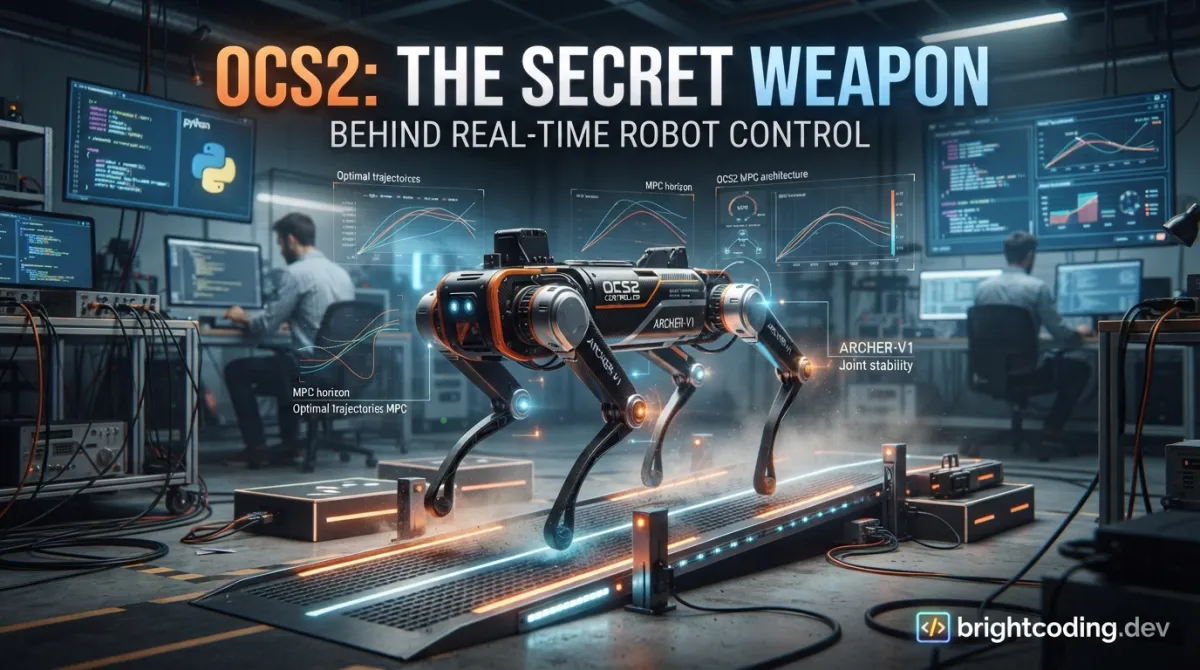
OCS2: The Secret Weapon Behind Real-Time Robot Control
What if your robot could think ten steps ahead—calculating the perfect trajectory in milliseconds—while balancing on one leg, dodging obstacles, and adapting to terrain changes in real time? Sounds like science fiction? It's not. It's happening right now in robotics labs worldwide, and the engine powering this revolution isn't some proprietary black box locked behind corporate walls. It's OCS2, an open-source C++ toolbox that is quietly becoming the backbone of next-generation robotic control.
Here's the painful truth most roboticists learn the hard way: traditional control methods break down when systems become complex. PID controllers? Too reactive. Pure trajectory optimization? Too slow for real-time deployment. The gap between "theoretically optimal" and "actually deployable on hardware" has killed more robotics projects than funding cuts ever will. But what if you had a framework that bridged that gap effortlessly—offering multiple state-of-the-art solvers, automatic differentiation, ROS integration, and enough robotics tooling to go from URDF to running MPC in hours, not months?
That framework exists. It's called OCS2 (Optimal Control for Switched Systems), developed by the legged robotics group at ETH Zurich. And if you're serious about real-time model predictive control for robots, you need to know about it—before your competitors do.
What is OCS2?
OCS2 is a C++ toolbox for formulating and solving nonlinear optimal control problems, with laser-focused optimization for real-time Model Predictive Control (MPC) in robotics. Born from the rigorous research environment at ETH Zurich's legged robotics group—one of the world's premier centers for dynamic locomotion—OCS2 represents years of distilled expertise in getting complex optimization to run fast enough for actual robots.
The name reveals its academic pedigree: Optimal Control for Switched Systems. "Switched systems" refers to dynamical systems that can switch between different modes of operation—think of a walking robot transitioning from single support to double support, or a manipulator changing contact states. This isn't just theoretical elegance; it's the mathematical reality of virtually every interesting robotics problem.
Why is OCS2 trending now? Three converging forces: the explosion of legged robots entering commercial applications (Boston Dynamics Spot, ANYmal, humanoids), the maturation of MPC from academic curiosity to industrial necessity, and the critical mass of frustrated developers realizing that cobbling together custom solvers for every project is technical debt incarnate. OCS2 offers a principled, tested, and actively maintained alternative that has already proven itself on hardware with "limited onboard computation power"—a constraint that describes nearly every real deployment scenario.
The project maintains dual ROS branches: main for ROS 1 and ros2 for ROS 2, signaling serious commitment to modern robotics infrastructure. With BSD 3-Clause licensing, it's genuinely open for commercial adoption without legal anxiety.
Key Features That Separate OCS2 from the Pack
OCS2 isn't a monolithic solver—it's a complete ecosystem for optimal control. Let's dissect what makes it special:
Multiple Battle-Tested Solvers: OCS2 doesn't force you into a single algorithmic paradigm. You get SLQ (continuous-time constrained Differential Dynamic Programming), iLQR (discrete-time constrained DDP), SQP (multiple-shooting with HPIPM/BLASFEO for QP subproblems), SLP (sequential linear programming via PIPG), and IPM (multiple-shooting nonlinear interior-point method). Each shines in different regimes: DDP-family methods for fast approximate solutions, SQP for handling complex constraints, IPM for high-accuracy offline solutions.
Switched-System Native Support: Most MPC frameworks treat mode switches as afterthoughts. OCS2 builds them into the problem formulation with mode schedules and jump maps, enabling single- and multi-domain optimal control problems. This is essential for legged locomotion, manipulation with contact changes, and hybrid systems generally.
Constraint Handling Without Compromise: Hard constraints via Augmented Lagrangian methods, soft constraints through relaxed barrier methods—choose your philosophy without changing frameworks. This flexibility matters when you're balancing safety requirements against computational tractability.
Automatic Differentiation That Actually Works: OCS2 provides analytic derivative interfaces plus CppAD-based automatic differentiation, with optional CppADCodeGen for generating optimized C code. Stop hand-deriving Jacobians for complex kinematic chains. Let the computer do what computers do best.
Robotics Tooling from URDF to MPC: Through Pinocchio integration, OCS2 converts URDF models into centroidal dynamics, kinematics, and self-collision constraints (via HPP-FCL). The distance from "I have a robot description" to "I have running MPC" collapses from weeks to days.
ROS Integration for Real Deployment: Messages, nodes, visualization, plotting tools—everything needed to bridge simulation to hardware. The ocs2_ros_interfaces and ocs2_msgs packages aren't afterthoughts; they're designed by people who've actually deployed on robots.
MPC-Net for Learning: The ocs2_mpcnet module enables training learned policies from MPC solutions—bridging optimization and machine learning for scenarios where even fast MPC isn't fast enough.
Real-World Use Cases Where OCS2 Dominates
1. Dynamic Legged Locomotion
The flagship application. ANYmal and similar quadrupeds must plan footsteps, balance, and adapt to terrain while running optimization at 50-1000 Hz. OCS2's DDP solvers achieve the computational speeds necessary, while switched-system support handles gait transitions naturally. The centroidal dynamics formulation through Pinocchio makes whole-body control tractable.
2. Aerial Manipulation and Quadrotor Control
Quadrotors with suspended loads or manipulators face coupled nonlinear dynamics with tight actuator constraints. OCS2's multiple-shooting SQP handles these constraints rigorously, while ROS integration enables seamless state estimation fusion and command streaming.
3. Mobile Manipulation with Collision Avoidance
Self-collision constraints and environment collision checking via HPP-FCL integration allow safe operation in cluttered spaces. The relaxed barrier methods provide smooth gradients for optimization even near obstacles—critical for convergence in tight scenarios.
4. Ballbot and Underactuated Systems
These systems demand precise balance control where small errors cascade catastrophically. OCS2's iLQR variant with discrete-time formulation matches naturally with digital controllers, and the automatic differentiation eliminates error-prone manual linearization.
5. Learned Policy Deployment (MPC-Net)
When computation budgets are absolutely constrained—embedded systems, swarms, high-DOF humanoids—train a neural network to imitate OCS2's MPC policy. The ocs2_mpcnet tooling provides the data pipeline and deployment infrastructure.
Step-by-Step Installation & Setup Guide
Getting OCS2 running requires attention to ROS version and dependencies. Here's the complete path:
ROS 1 Installation (main branch)
The official documentation provides the authoritative instructions:
# Clone the repository
git clone https://github.com/leggedrobotics/ocs2.git
cd ocs2

# Ensure you're on the main branch for ROS 1
git checkout main

# Follow the detailed installation guide at:
# https://leggedrobotics.github.io/ocs2/
The documentation covers dependency installation including:
- Pinocchio: For URDF parsing and rigid body dynamics
- CppAD/CppADCodeGen: For automatic differentiation
- HPIPM/BLASFEO: For high-performance QP solutions in SQP
- HPP-FCL: For collision checking
- ROS 1 packages: Standard desktop-full installation plus robot-specific dependencies
ROS 2 Installation (ros2 branch)
# Clone and switch to ROS 2 branch
git clone https://github.com/leggedrobotics/ocs2.git
cd ocs2
git checkout ros2

# Follow the ROS 2-specific installation document
cat installation.md
The ROS 2 branch provides installation.md with updated dependency versions and build instructions using colcon instead of catkin_make.
Building the Workspace
For ROS 1:
# After installing all dependencies per documentation
cd ~/catkin_ws/src
cp -r /path/to/ocs2 .
cd ..
catkin build ocs2  # or catkin_make if preferred

# Source the workspace
source devel/setup.bash
For ROS 2:
cd ~/ros2_ws/src
cp -r /path/to/ocs2 .
cd ..
colcon build --packages-up-to ocs2

# Source the workspace
source install/setup.bash
Verifying Installation
Test with one of the robotic examples:
# For ROS 1: launch a double integrator MPC example
roslaunch ocs2_double_integrator_ros double_integrator_mpc.launch

# For ROS 2 (after sourcing):
ros2 launch ocs2_double_integrator_ros double_integrator_mpc.launch.py
REAL Code Examples from the Repository
Let's examine actual patterns from OCS2's codebase and documentation, with detailed explanations.
Example 1: Defining a Basic Optimal Control Problem
This pattern shows how OCS2 structures problems through its modular cost/dynamics/constraint interfaces:
#include <ocs2_core/Types.h>
#include <ocs2_oc/oc_problem/OptimalControlProblem.h>

// Create the optimal control problem structure
ocs2::OptimalControlProblem problem;

// Define system dynamics - typically from URDF/Pinocchio for robots
// The dynamics must inherit from ocs2::SystemDynamicsBase or use AD wrappers
problem.dynamicsPtr = std::make_unique<YourSystemDynamics>();

// Set up cost function components
// State cost: penalizes deviation from desired state
problem.costPtr->add("stateCost", std::make_unique<YourStateCost>());

// Control cost: penalizes control effort (regularization)
problem.costPtr->add("controlCost", std::make_unique<YourControlCost>();

// Final cost: terminal cost for MPC stability
problem.finalCostPtr->add("terminalCost", std::make_unique<YourTerminalCost>());

// Constraint setup using Augmented Lagrangian or barrier methods
problem.equalityConstraintPtr->add("constraintName", std::make_unique<YourConstraint>());
What's happening here? OCS2 uses a composable design where you assemble problems from reusable components. The OptimalControlProblem class acts as a container; you inject dynamics, costs, and constraints as polymorphic pointers. This separation of concerns means you can swap solvers without rewriting problem definitions, or reuse problem components across different robot instances.
Example 2: Configuring and Running an MPC Loop
This demonstrates the runtime MPC infrastructure from ocs2_mpc:
#include <ocs2_mpc/MPC_BASE.h>
#include <ocs2_mpc/MPC_Settings.h>

// MPC algorithm settings
ocs2::mpc::Settings mpcSettings;
mpcSettings.mpcDesiredFrequency_ = 100.0;  // Target 100 Hz control rate
mpcSettings.bufferWindowSize_ = 10;        // State trajectory buffer for smoothing

// Instantiate specific solver (SLQ in this case)
auto mpcPtr = std::make_unique<ocs2::SLQ_MPC>(
    mpcSettings,              // Algorithm settings
    std::move(problem),       // The OCP defined above
    initializer               // Initial controller guess
);

// Prepare for run: set initial state and reference trajectory
mpcPtr->getSolverPtr()->setInitialState(initialState);
mpcPtr->getSolverPtr()->getReferenceManager().setTargetTrajectories(targetTrajectories);

// Main control loop - typically runs in real-time thread
while (robotIsRunning) {
    // Get current measured state from sensors/estimation
    ocs2::vector_t currentState = getCurrentStateFromSensors();

    // Run MPC optimization - this is the computational bottleneck
    // Returns optimal state-input pair for current time
    auto optimalControl = mpcPtr->run(currentState, currentTime);

    // Extract and apply first control input (receding horizon principle)
    ocs2::vector_t controlInput = optimalControl.inputTrajectory.front();
    sendToActuators(controlInput);

    // Sleep to maintain desired frequency
    maintainControlFrequency();
}
Critical insight: The run() method encapsulates the entire optimization solve. For real-time performance, this must complete within your control period (10ms for 100Hz). OCS2's DDP solvers achieve this through efficient Riccati recursion, warm-starting from previous solutions, and careful C++ implementation. The bufferWindowSize parameter enables output smoothing when solver timing varies—essential for hardware where jitter causes instability.
Example 3: Python↗ Bright Coding Blog Interface for Rapid Prototyping
For researchers preferring Python, ocs2_python_interface exposes selected functionality:
import ocs2_python_interface as ocs2

# Load pre-configured MPC from C++ bindings
mpc_interface = ocs2.MpcInterface("path/to/config/files")

# Set current observation (state + time)
observation = ocs2.SystemObservation()
observation.time = current_time
observation.state = current_state_vector

# Compute optimized trajectory
optimized_trajectory = mpc_interface.getMpcSolution(observation)

# Access state and input trajectories
state_trajectory = optimized_trajectory.stateTrajectory
input_trajectory = optimized_trajectory.inputTrajectory

# Forward integrate for simulation/prediction
next_state = mpc_interface.flowMap(current_time, current_state, optimal_input)
Why this matters: The Python interface enables rapid algorithm iteration, visualization, and integration with machine learning pipelines. You get C++ performance in the critical MPC solve, with Python flexibility for everything else. The flowMap access lets you verify dynamics consistency or generate training data for MPC-Net applications.
Example 4: URDF-Based Robot Setup with Pinocchio
#include <ocs2_pinocchio_interface/PinocchioInterface.h>
#include <ocs2_pinocchio_interface/urdf.h>

// Load robot model from URDF
const std::string urdfPath = "path/to/robot.urdf";
ocs2::PinocchioInterface pinocchioInterface(urdfPath);

// Extract centroidal dynamics (momentum-based whole-body control)
auto centroidalModel = ocs2::createCentroidalModel(
    pinocchioInterface,
    centroidalModelInfo  // Contains contact points, terrain info, etc.
);

// Build self-collision constraints from URDF geometry
ocs2::PinocchioGeometryInterface geomInterface(pinocchioInterface, urdfPath);
auto collisionConstraints = ocs2::createSelfCollisionConstraints(
    pinocchioInterface,
    geomInterface,
    minimumDistance  // Safety margin between collision bodies
);
The power here: Going from CAD/URDF to running whole-body MPC without manual dynamics derivation. Pinocchio's analytical derivatives combined with CppAD automatic differentiation give exact gradients for optimization. The centroidal model formulation—tracking linear/angular momentum while optimizing contact forces—is the secret sauce behind dynamic quadruped/humanoid locomotion.
Advanced Usage & Best Practices
Warm-Starting is Non-Negotiable: Always initialize your solver with the previous solution shifted forward in time. OCS2's MPC infrastructure handles this automatically, but custom implementations must respect this. A cold-started MPC solve takes 5-10x longer—often the difference between real-time feasibility and failure.
Solver Selection Guide: Use SLQ/iLQR for unconstrained or lightly-constrained problems where speed matters most. Switch to SQP when hard inequality constraints dominate (torque limits, friction cones, obstacle avoidance). Reserve IPM for offline trajectory optimization generating reference motions or training data.
Automatic Differentiation Strategy: Start with CppAD for development flexibility. When performance is critical, use CppADCodeGen to generate optimized C code for your specific robot's dynamics. The code generation eliminates AD overhead at the cost of longer compile times.
Constraint Formulation Matters: Augmented Lagrangian methods converge faster for moderate constraint violations but require careful penalty parameter scheduling. Relaxed barrier methods provide smoother optimization landscapes but need tighter initial feasibility. For collision constraints, the relaxed barrier often wins due to gradient smoothness near obstacles.
ROS 2 Migration: If starting fresh, use the ros2 branch. The real-time improvements in ROS 2 (DDS middleware, executor control) align better with deterministic MPC timing requirements.
Comparison with Alternatives
| Feature | OCS2 | Acado | Crocoddyl | CasADi + IPOPT |
|---|---|---|---|---|
| Primary Language | C++ | C++ | C++/Python | C++/Python |
| Real-time MPC Focus | ✅ Native | ⚠️ Possible | ✅ Yes | ❌ No |
| Switched Systems | ✅ Built-in | ❌ No | ⚠️ Limited | ❌ Manual |
| ROS Integration | ✅ Extensive | ❌ None | ⚠️ Community | ❌ None |
| Solver Variety | 5+ solvers | 2-3 | DDP-family | General NLP |
| URDF/Pinocchio | ✅ Native | ❌ No | ✅ Pinocchio | ❌ Manual |
| Auto-Diff + CodeGen | ✅ CppAD/CppADCodeGen | ❌ Symbolic only | ❌ Analytic only | ✅ CasADi codegen |
| Self-Collision | ✅ HPP-FCL | ❌ No | ⚠️ Basic | ❌ Manual |
| Learning Integration | ✅ MPC-Net | ❌ No | ❌ No | ⚠️ Manual |
| License | BSD-3 | LGPL | BSD-2 | LGPL |
Why OCS2 wins for robotics: The integrated toolchain from URDF to deployed MPC, combined with switched-system support and multiple solver options, eliminates integration hell. Acado excels at embedded applications but lacks robotics infrastructure. Crocoddyl offers excellent DDP performance for locomotion but narrower solver choice and less mature ROS support. CasADi is unmatched for general optimization prototyping but requires substantial engineering for real-time MPC deployment.
Frequently Asked Questions
Q: Is OCS2 suitable for commercial products? A: Absolutely. The BSD 3-Clause license permits commercial use with minimal restrictions. Multiple companies have deployed OCS2-based controllers in products.
Q: What compute hardware do I need for real-time MPC? A: OCS2 runs on standard x86_64 CPUs (Intel i7 class or better for complex robots). The ANYmal robot runs OCS2 MPC on embedded Intel NUC-class computers. For simpler systems (double integrator, cartpole), even Raspberry Pi-class hardware suffices.
Q: Can I use OCS2 without ROS?
A: Yes, the core solvers (ocs2_core, ocs2_ddp, ocs2_sqp, etc.) are ROS-agnostic. Only ocs2_ros_interfaces and example nodes require ROS. You can integrate core OCS2 into any C++ application.
Q: How does OCS2 compare to reinforcement learning for robot control?
A: They're complementary. OCS2 provides guaranteed constraint satisfaction and interpretable behavior—critical for safety. RL excels at handling unmodeled effects. MPC-Net (ocs2_mpcnet) specifically bridges both: use OCS2 to generate expert demonstrations, train a neural policy for speed, with optional OCS2 fallback for safety-critical situations.
Q: What robots are officially supported in examples? A: Double integrator, cartpole, ballbot, quadrotor, mobile manipulator, and legged robot. Each includes complete ROS nodes and visualization. The modular design makes adapting to new robots straightforward.
Q: Is Python support first-class or limited?
A: The ocs2_python_interface exposes selected functionality for prototyping and integration. For maximum performance and full feature access, C++ remains primary. The Python bindings are actively maintained and sufficient for most research workflows.
Q: How active is development? A: Very active. The ROS 2 branch represents significant ongoing investment. The repository sees regular commits for bug fixes, new examples, and solver improvements. The ETH Zurich legged robotics group uses OCS2 daily in their research, ensuring practical relevance.
Conclusion
OCS2 isn't just another optimal control library—it's a complete robotics control infrastructure forged in the crucible of real hardware deployment. From its multiple battle-tested solvers to seamless URDF-to-MPC pipelines, from switched-system native support to ROS 2 readiness, it addresses every pain point that makes roboticists wake up in cold sweats.
The robotics industry is at an inflection point. Robots are leaving cages and entering unstructured human environments. The control strategies that worked in factories won't suffice for homes, hospitals, and disaster zones. Model Predictive Control isn't the future—it's the present, and OCS2 is the most complete open-source toolkit for wielding it effectively.
If you're building legged robots, dynamic manipulators, or any system where constraints, contacts, and real-time optimization intersect, stop reinventing wheels. Stop debugging custom solvers at 2 AM. Stop explaining to your PI why the demo failed because your DDP implementation has a subtle bug in the Riccati backward pass.
Clone OCS2. Build an example. Feel the difference of using tools designed by people who've actually made robots walk.
👉 Get started now: https://github.com/leggedrobotics/ocs2
The main branch for ROS 1, ros2 for the future. Your robots will thank you—with stable, dynamic, beautiful motion.
Cite OCS2 in your research:
@misc{OCS2,
  title  = {{OCS2}: An open source library for Optimal Control of Switched Systems},
  note   = {[Online]. Available: \url{https://github.com/leggedrobotics/ocs2}},
  author = {Farbod Farshidian and others}
}
Explore on the BrightCoding network
Hand-picked resources from our other sites.
Serial-Studio/Serial-Studio: Open-Source Telemetry Dashboard for Hardware
Serial-Studio/Serial-Studio is an open-source telemetry dashboard with 7,043 GitHub stars that combines serial monitoring, live visualization, and data logging...
Stop Wasting GPU Hours! LingBot-VLA Cuts Training Time by 2.8×
LingBot-VLA is a pragmatic Vision-Language-Action foundation model with 20,000 hours of pre-training data, 2.8× faster training than alternatives, and state-of-...
Adaptix-Framework/AdaptixC2: Modular C2 for Red Team Operations
AdaptixC2 is an open-source, extensible post-exploitation framework with a Golang server, C++/Qt cross-platform GUI, plugin-based listeners/agents, and visual s...
Continuez votre lecture
Why Alexandrie is the Ultimate Markdown Note-Taking App

Why CrossPaste is the Ultimate Game Changer for Clipboard Management

Why Chandra is the Ultimate OCR Tool for Handwriting and Tables

Stop Coding Alone: OPC-Skills Gives Your AI Agent Superpowers
Commentaires 0
Aucun commentaire pour l'instant. Soyez le premier à réagir !