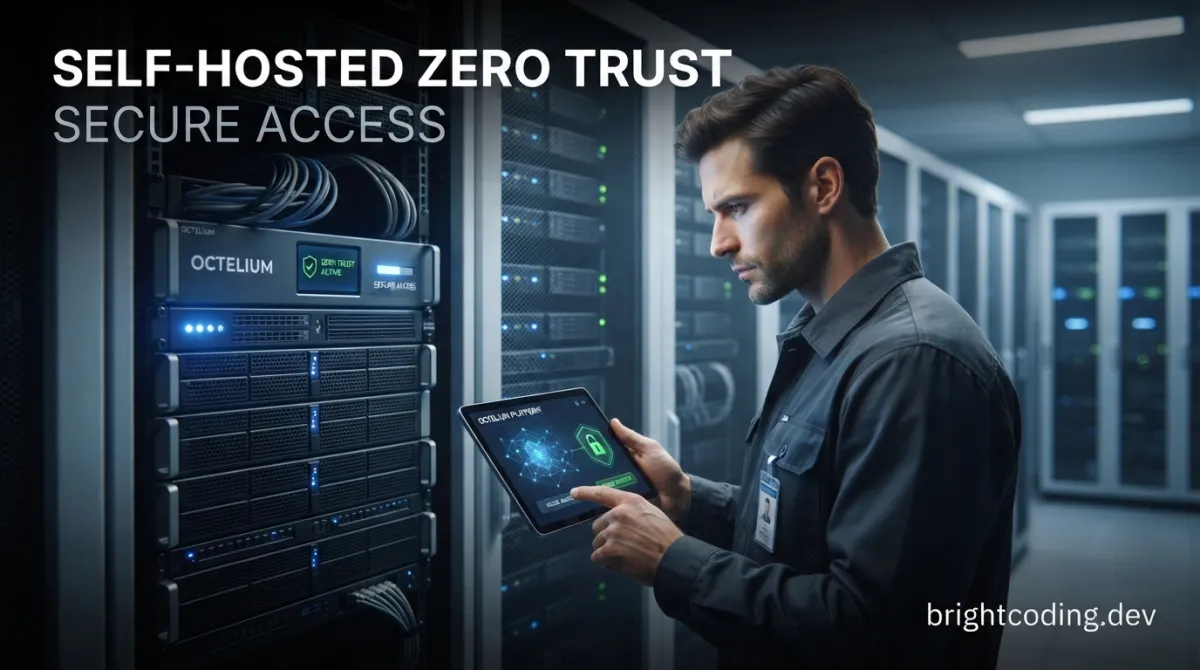
octelium/octelium: Self-Hosted Zero Trust Platform for Secure Access
octelium/octelium: Self-Hosted Zero Trust Platform for Secure Access
Developers and platform engineers face a growing fragmentation problem: remote access VPNs, API gateways, tunneling tools, and deployment platforms each require separate infrastructure, separate authentication systems, and separate operational overhead. The result is credential sprawl, inconsistent security postures, and the quiet accumulation of technical debt across access layers. octelium/octelium addresses this directly by unifying these capabilities into a single, self-hosted, open-source platform built on Kubernetes and zero trust principles.
This article examines what octelium/octelium actually delivers, how it works under the hood, and where it fits in modern infrastructure stacks. With 3,926 GitHub stars and active development as of July 2026, the project represents a substantive attempt to consolidate secure access patterns that teams currently patch together from multiple vendors.
What is octelium/octelium?
octelium/octelium is a free and open-source, self-hosted unified zero trust secure access platform written primarily in Go and licensed under a dual structure: Apache 2.0 for client components and GNU AGPLv3 for cluster-side components. The project is developed by George Badawi through Octelium Labs LLC, with no external VC funding—a point the maintainers emphasize to distinguish it from "open core" projects designed to funnel users toward a paid SaaS.
The platform's architecture centers on identity-aware proxies operating at the application layer (L7), rather than traditional layer-3 VPN approaches. This enables per-request access decisions based on identity, context, and policy rather than coarse network segmentation. It supports both client-based access via WireGuard and QUIC tunnels (through a lightweight zero-config CLI) and clientless access for web-based resources, resembling BeyondCorp-style deployments.
Built atop Kubernetes, octelium/octelium scales automatically with cluster resources. The design explicitly avoids requiring infrastructure changes at upstream targets—resources can remain behind NAT, on localhost, or in private networks without public gateways or firewall modifications. This "no changes needed" positioning distinguishes it from many zero trust implementations that demand agent installation or network reconfiguration across every endpoint.
The project's scope is deliberately broad: it functions as a remote access VPN, ZTNA platform, ngrok/Cloudflare Tunnel alternative, API gateway, AI/LLM gateway, MCP gateway infrastructure, PaaS for containerized applications, Kubernetes ingress alternative, and homelab infrastructure. This versatility is either its greatest strength or its central risk, depending on whether teams need a unified solution or prefer best-of-breed point tools.
Key Features
Identity-Aware L7 Proxies with Dynamic Policy Enforcement
The core of octelium/octelium is its attribute-based access control (ABAC) system using policy-as-code written in CEL (Common Expression Language) and OPA (Open Policy Agent). Policies evaluate on a per-request basis, enabling dynamic routing to different upstreams, credentials, and contexts without static configuration. Notably, the system has no built-in "admin" user—zero standing privileges are enforced by default, addressing a common attack vector in access platforms.
Secretless Access Patterns
For HTTP APIs, SSH, Kubernetes clusters, PostgreSQL↗ Bright Coding Blog/MySQL↗ Bright Coding Blog databases (including MariaDB, CockroachDB), and mTLS-protected protocols, octelium/octelium can broker authentication without distributing long-lived credentials to users. This eliminates credential rotation overhead and reduces exposure from leaked keys or passwords. The layer-7 awareness enables credential injection based on the requesting identity's authorized context.
Continuous Strong Authentication
The platform unifies authentication for humans and workloads. Human users authenticate via OIDC or SAML 2.0 identity providers, with built-in MFA support through FIDO2/WebAuthn/Passkey, TOTP, and TPM 2.0. Workloads authenticate via OIDC-based assertions without static secrets. This dual support is critical for modern infrastructure where service-to-service access requires the same rigor as human access.
OpenTelemetry-Native Observability
Every request generates identity-based, L7-aware audit logs exported via OTLP to existing SIEM and log management infrastructure. This avoids the common pattern of access platforms creating proprietary logging formats that require custom integration work.
Cordium: Remote Sandbox Access
Through Cordium, a companion open-source project, octelium/octelium supports clientless access via isolated, reproducible sandboxes accessible through web terminals, SSH, CLI, and gRPC APIs. This enables access without installing client software on user machines—a significant operational simplification for contractors, temporary access, or locked-down environments.
PaaS-Style Container Deployment
Managed containers can be deployed, scaled, and exposed as Services with private client-based access, public BeyondCorp-style access, or public anonymous access. This provides Vercel/Netlify-like deployment workflows while retaining full infrastructure control.
Use Cases
Modern Remote Access VPN Replacement
Organizations running OpenVPN Access Server, Twingate, or Tailscale can migrate to octelium/octelium for zero-config WireGuard/QUIC client access combined with granular L7 policies. The key differentiator is the shift from network-level access ("can reach this subnet") to application-level access ("can execute this specific API call under these conditions").
Self-Hosted ngrok/Cloudflare Tunnel Alternative
For developers needing public ingress to local or private services, octelium/octelium provides programmable secure tunnels with identity-based or anonymous clientless access. Unlike ngrok's SaaS model, this runs entirely on infrastructure you control, with policy-driven access rather than simple URL-based tunneling.
API and AI Gateway Consolidation
Teams currently maintaining separate Kong Gateway or Apigee deployments for microservices, plus emerging AI gateway tools for LLM routing, can unify these functions. The AI gateway specifically handles identity-based access control, routing, and visibility across any LLM provider—relevant as organizations struggle with shadow AI usage and ungoverned API keys to services like OpenAI or Anthropic.
MCP and A2A Infrastructure for Agent Architectures
The platform provides authentication, secure remote access, and L7-aware policy enforcement for Model Context Protocol (MCP) gateways and Agent2Agent (A2A) architectures. This addresses an emerging need as agent-based systems require machine-to-machine access patterns that traditional human-centric IAM systems handle poorly.
Homelab and Personal Infrastructure
For individual operators, octelium/octelium consolidates remote access to devices behind NAT (laptops, IoT, Raspberry Pis, routers), public hosting for personal projects, and deployment of resource-intensive containers like Ollama LLM runtimes or databases. The single-node Kubernetes requirement (2GB RAM, 20GB disk minimum) makes this accessible on inexpensive VPS instances.
Installation & Setup
The quickest path to a running cluster uses the provided installation script on a Linux VM or VPS. The requirements are modest: 2GB RAM, 20GB disk, and a recent distribution (Ubuntu 24.04 LTS, Debian 12+, or equivalent).
First, install the CLI tools:
# Linux and macOS
curl -fsSL https://octelium.com/install.sh | bash

# Windows PowerShell
iwr https://octelium.com/install.ps1 -useb | iex

# Or via Homebrew
brew install octelium/tap/octelium
Then deploy your first cluster:
# Download the cluster installation script
curl -o install-cluster.sh https://octelium.com/install-cluster.sh
chmod +x install-cluster.sh

# Replace <DOMAIN> with your actual domain
./install-cluster.sh --domain <DOMAIN>
The script provisions a single-node Kubernetes cluster with octelium/octelium components. For production workloads requiring high availability, multi-node clusters are supported but require additional configuration not covered in the quick-start path.
For experimentation without infrastructure commitment, the playground repository supports GitHub Codespace deployment, enabling full cluster interaction in a browser-based environment.
Real Code Examples
The README provides explicit installation commands rather than extensive configuration examples. This reflects the project's current documentation state—management is primarily intended through the octeliumctl CLI with declarative, Kubernetes-style patterns.
CLI Installation (Cross-Platform)
# One-line installation for Linux/macOS
curl -fsSL https://octelium.com/install.sh | bash
This downloads and installs the octelium, octeliumctl, and octops CLI binaries. The octeliumctl tool serves as the primary management interface, analogous to kubectl for cluster operations.
Cluster Installation Script
curl -o install-cluster.sh https://octelium.com/install-cluster.sh
chmod +x install-cluster.sh
./install-cluster.sh --domain <DOMAIN>
The --domain flag is required and configures TLS certificate provisioning and DNS routing. The script handles Kubernetes cluster initialization, component deployment, and initial service configuration. Post-installation, management follows the patterns documented in the management guide.
Homebrew Installation
brew install octelium/tap/octelium
This provides native package management integration for macOS users and simplifies updates through standard brew upgrade workflows.
The limited explicit code examples in the README suggest users should consult the documentation site for service-specific configurations—API gateway definitions, policy rules, container deployments, and identity provider integrations.
Advanced Usage & Best Practices
GitOps-Aligned Configuration Management
Cluster configurations can be stored in Git and applied declaratively through octeliumctl. This enables version-controlled infrastructure, reproducible deployments, and integration with existing CI/CD pipelines. Teams should treat octelium/octelium configuration with the same rigor as Kubernetes manifests.
Policy Testing Before Production
The CEL and OPA policy engine supports evaluation against request contexts. Test policies against representative identity and device posture claims before enforcing them on production services. The enterprise tier includes UI-based policy builders and testers; open-source users should validate through octeliumctl or direct OPA tooling.
Network Stack Considerations
The platform supports WireGuard via kernel implementation, TUN, or unprivileged gVisor-based userspace networking, plus experimental QUIC tunnels. For environments where kernel modules are unavailable (containers, restricted VMs), gVisor provides functional equivalence with modest performance overhead. Evaluate QUIC experimentally for latency-sensitive workloads where UDP traversal is favorable.
Dual-Stack IPv6 Handling
octelium/octelium handles IPv6 private networking transparently regardless of upstream support, avoiding NAT64/DNS64 complexity. This is particularly valuable for homelab operators or organizations with mixed IPv4/IPv6 infrastructure.
Licensing Awareness for Commercial Use
The AGPLv3 cluster-side license requires careful legal review for commercial deployments, particularly regarding network interaction and derivative works. Octelium Labs offers commercial licensing as an alternative; organizations should evaluate this early rather than retrofit compliance.
Comparison with Alternatives
| Aspect | octelium/octelium | Tailscale | Cloudflare Tunnel | Teleport |
|---|---|---|---|---|
| Hosting Model | Self-hosted (your Kubernetes) | SaaS with self-hosted option | SaaS | Self-hosted or SaaS |
| Primary Protocol | WireGuard/QUIC | WireGuard | HTTP/2 over QUIC | SSH, Web, DB protocols |
| Access Layer | L7 (application) | L3 (network) | L7 (HTTP) | L7 (multiple protocols) |
| Policy Engine | CEL + OPA, per-request | ACL-based | Cloudflare Access rules | RBAC with session controls |
| Secretless Access | Yes (built-in) | Limited | No | Yes (certificate-based) |
| PaaS/Container Deploy | Built-in | No | No | No |
| AI/LLM Gateway | Built-in | No | No | No |
| License | Apache 2.0 (client) / AGPLv3 (server) | BSD-3 (client) / proprietary (coordination) | Proprietary | Apache 2.0 (community) / proprietary (enterprise) |
Trade-offs to consider: Tailscale offers simpler setup for pure network connectivity but lacks application-layer policy granularity. Cloudflare Tunnel requires SaaS dependency and doesn't provide container deployment or AI gateway functions. Teleport focuses more narrowly on infrastructure access (SSH, Kubernetes, databases) without the broader PaaS and API gateway consolidation. octelium/octelium's breadth is its differentiator—and its complexity cost.
FAQ
Is octelium/octelium production-ready?
The project states it is approaching v1.0 with stabilized architecture and APIs, but teams should evaluate against their risk tolerance for pre-1.0 software.
Can I use this without Kubernetes expertise?
Single-node deployment is automated, but ongoing management assumes familiarity with Kubernetes concepts. The learning curve is nontrivial for teams without existing cluster experience.
Does the AGPLv3 affect my applications behind octelium/octelium?
Network use of AGPL software typically doesn't trigger copyleft requirements for separate applications, but consult legal counsel for your specific deployment model.
Is external contribution accepted?
Currently, the project is not open to pull requests. Bug reports and feature requests are welcomed through issues.
How does pricing work?
The open-source platform is free. Enterprise features (web dashboard, SIEM integrations, SCIM 2.0, secret encryption) are source-available with free personal/evaluation use and commercial terms for production.
What identity providers are supported?
Any OIDC or SAML 2.0 provider, plus GitHub OAuth2. Workload identity uses OIDC assertions.
Can I run this entirely air-gapped?
Yes, as a fully self-hosted solution without cloud control plane dependencies.
Conclusion
octelium/octelium offers a genuinely ambitious unification of access patterns that infrastructure teams currently cobble together from multiple tools. Its zero trust architecture, secretless access capabilities, and broad protocol support address real operational pain points—particularly for teams managing both human and machine access across diverse environments.
The project is best suited for: platform teams seeking to consolidate VPN, gateway, and deployment infrastructure; organizations with strong self-hosting requirements; and operators of AI/ML infrastructure needing governed access to LLM APIs and agent architectures. The Kubernetes dependency and AGPLv3 licensing are meaningful considerations that will filter its applicability.
For teams aligned with its architecture, octelium/octelium represents a credible alternative to fragmented commercial solutions—with the transparency and control that open-source infrastructure promises. Evaluate it through the GitHub repository or the playground Codespace before committing production workloads.
[INTERNAL_LINK: zero-trust-architecture-guide]
Outils recommandés
Explore on the BrightCoding network
Hand-picked resources from our other sites.
0xchamin/mcptube: YouTube Knowledge Engine with Vision + Wiki
mcptube transforms YouTube videos into a persistent, compounding knowledge base using transcripts, vision analysis, and a wiki engine. Built as an MCP server fo...
jitsi/jitsi-meet: Open-Source Video Conferencing You Control
jitsi/jitsi-meet is an Apache 2.0-licensed open-source video conferencing platform with 29,602 GitHub stars. It offers browser-based HD meetings, mobile SDKs, s...
PatchMon/PatchMon: Outbound-Only Linux Patch Management
PatchMon/PatchMon is an open-source Linux patch management platform with outbound-only agents, multi-OS support, and a single Go binary deployment. AGPL v3 lice...
Continuez votre lecture
Why Alexandrie is the Ultimate Markdown Note-Taking App
Why CrossPaste is the Ultimate Game Changer for Clipboard Management
Why Chandra is the Ultimate OCR Tool for Handwriting and Tables

Stop Coding Alone: OPC-Skills Gives Your AI Agent Superpowers
Commentaires 0
Aucun commentaire pour l'instant. Soyez le premier à réagir !