This Open Source LLM Is Quietly Beating ChatGPT
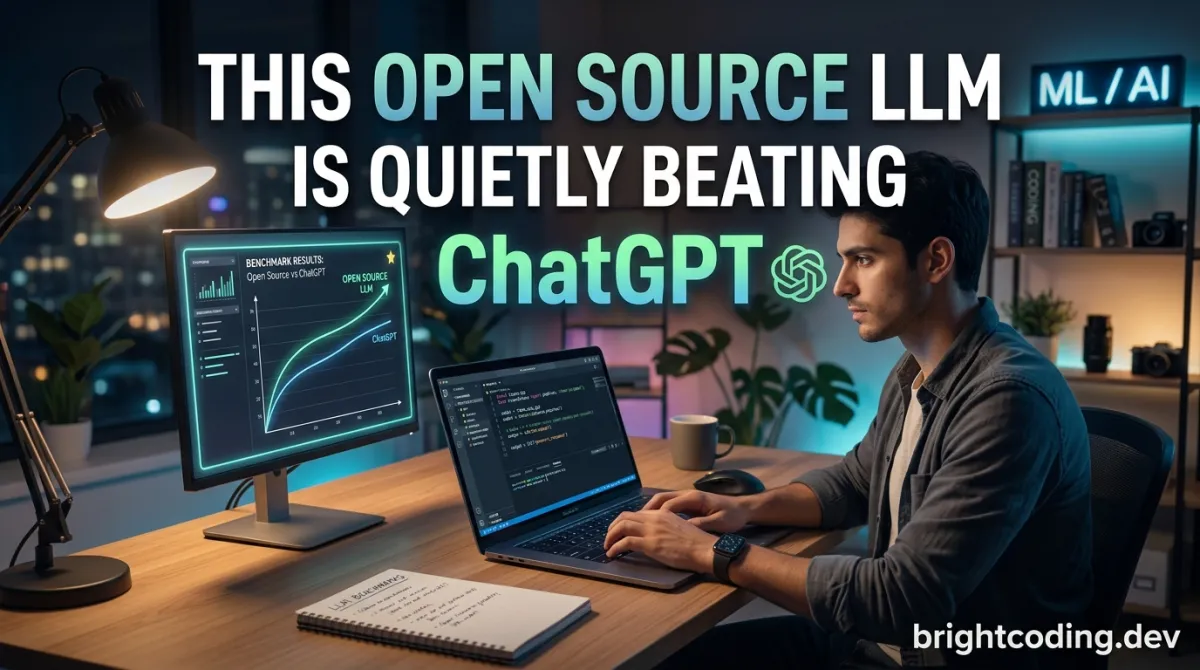
This Open Source LLM Is Quietly Beating ChatGPT
Let me start with a confession: for two years, I was a loyal ChatGPT customer. Monthly subscription, daily use, the works. Then a colleague told me to try a specific open source model, and within a week I'd canceled the subscription for most of my work. Not because it's the best model at everything — it isn't. Because it's better than ChatGPT at a specific, boring, high-value thing: cheap, private, high-volume text work.
The model is Llama 3.3 [VERIFY — the Llama line continues to iterate; check the latest release], and if you haven't tried it since the early 70B parameter days, you're missing what the open source scene looks like in 2026. Here's the honest case for it, the honest case against it, and how to run it for free.
TL;DR — Key Takeaways
- Recent open source models match or beat flagship proprietary models on many routine tasks — at a tiny fraction of the cost.
- Llama's real superpower isn't "smarter" — it's price per good answer and full control of your data.
- Running it locally costs nothing after hardware; the catch is your time and a willingness to tinker.
- On hard reasoning, long-context, and agentic tasks, flagship proprietary models still hold an edge.
- The smart play is hybrid: local for volume, cloud for the hard 10%.
What "Quietly Beating" Actually Means
Before we go further, let's deflate the headline, because you deserve honesty. "Quietly beating ChatGPT" does not mean open source models dominate every leaderboard. It means this: on the tasks that make up most real-world usage — summarization, extraction, classification, drafting, question-answering over your own documents — open source models like Llama are now competitive, while being a fraction of the cost and running entirely on your hardware.
When a model is competitive on quality and 10–50x cheaper per token, the economic choice is obvious. That's the quiet part. The benchmarks are roughly even; the unit economics are a landslide.
The 2026 Open Source Landscape
Here's what's on the table right now [VERIFY — new models ship constantly; treat this as a snapshot]:
- Llama (Meta) — the generalist workhorse. Broad community support, runs on almost anything, quantizes beautifully.
- Mistral — compact models with strong European sensibilities; great for on-device and edge deployments.
- Qwen (Alibaba) — often the top of the open leaderboards for reasoning and coding in recent releases, and it's forcing the entire field to move faster.
- DeepSeek — the value champion that shook the industry's pricing assumptions in 2025, with distilled models that run on consumer hardware.
- Ollama and LM Studio — the tools that made running all of these genuinely easy for a normal person.
The pattern across all of them: they've absorbed years of RLHF and distillation tricks from the open literature, and the quality gap to proprietary flagships keeps shrinking.
Where It Beats ChatGPT (the Honest List)
1. Price Per Good Answer
ChatGPT's subscription is $20/month — a steal for the best model on Earth, a ripoff if you only need routine work. A local model costs your hardware and electricity. If you're making 10,000 requests a month for content classification or draft generation, the local model wins by an order of magnitude.
Real example: a content team ran a tagging pipeline on 50,000 articles. The proprietary API quote was thousands of dollars a year. A fine-tuned local model handled it for the electricity cost and the one-time labor of setup. [VERIFY]
2. Privacy and Data Control
This is the one that quietly converts enterprise engineers. When your data must not leave the building — client records, medical text, trade secrets — a local model is the only answer that doesn't require a legal review of someone else's terms of service.
Real example: a freelance contractor in the legal space runs Llama locally for contract-summary drafts. Zero client data ever touches a third-party server, which is a non-negotiable in that line of work.
3. Customization and Full Control
You can't fine-tune ChatGPT. You can fine-tune a local model on your own writing style, your own corpus, your own domain's jargon. A model trained on your last 200 support tickets will sound like your support team. No proprietary tool offers that level of ownership.
4. It's Actually Free to Try
Run it yourself with Ollama, no credit card, no signup, no trial timer. If it doesn't beat your current setup for your specific task, you've lost an afternoon, not a subscription fee. That's the lowest-cost experiment in AI.
Where It Does NOT Beat ChatGPT
Straight talk time. The proprietary flagships still win here:
- The hardest reasoning tasks. Advanced math, complex multi-step logic, nuanced creative writing — the frontier models still lead. [VERIFY]
- Huge context windows. Feeding an entire codebase or a 200-page document still favors the big cloud models.
- Agentic tool use. Models that reliably call tools, browse, and act on your behalf are more mature on the proprietary side.
- Zero-friction UX. ChatGPT is open a tab, type, done. A local model needs setup, hardware, and occasional debugging.
The classic mistake is replacing ChatGPT with a local model for everything and being disappointed. The right move is the split: use local for volume and privacy, use cloud for the hard 10%.
The Comparison Table
| Open Source LLM (local) | ChatGPT (flagship) | |
|---|---|---|
| Cost | Hardware + ~$0 marginal | $20/month + API fees |
| Data privacy | Fully on your hardware | Stored/sent per vendor terms |
| Benchmark quality | Competitive, near parity | Leading edge [VERIFY] |
| Fine-tuning | Full control | Not available |
| Setup | Requires effort | Zero |
| Support | Community | Vendor |
| Best for | High volume, sensitive data | Hard reasoning, agentic work |
The Part Nobody Tells You
Running a local LLM well is a skill, and the articles love to skip the unglamorous parts:
Quantization is a knife's edge. Shrinking the model to fit your GPU degrades quality, and the degradation shows up in exactly the tasks you care about most. You'll spend time finding the sweet spot between "fits in memory" and "sounds like a human."
Context length is a trap. A model can accept 128k tokens and still lose the plot by token 20k. Your fancy document-analysis pipeline needs prompt design, not just a big number.
Hardware is the real cost. A decent setup starts around a used 24GB GPU (roughly $600–900) or a rented instance. On a laptop with 16GB of shared memory, you'll run small models that occasionally embarrass you.
Version churn is exhausting. A model that was state-of-the-art in January is "fine, I guess" by April. Staying current means re-testing your workflows against new releases.
Conclusion
Is an open source LLM quietly beating ChatGPT? For routine text work at scale, for privacy-critical use, and for anyone allergic to monthly fees — yes, honestly, it is. For the hardest tasks, no, and pretending otherwise helps nobody.
The practical path: keep your subscription, spend one weekend with Ollama and a good open model, and build one pipeline for the task you do most. When the result is good enough — and it often is — you'll have a permanent, private, near-free tool that no subscription can match.
Here's your experiment: pick your most repetitive writing task and run it through a local Llama model for a week. Same prompts you'd give ChatGPT. Judge it on output, not benchmarks. Then tell me what happened — I read every reply.
If this article saved you a subscription, share it with someone else who's questioning theirs. And subscribe for more no-hype AI breakdowns.
Meta description: Open source models like Llama are now competitive with ChatGPT on cost, privacy, and routine tasks. Here's where they win, where they don't, and how to run one free.
Alternative headlines:
- "I Canceled ChatGPT After Testing This Open Source Model"
- "The Open Source LLM That Beats ChatGPT on Price Per Answer"
- "Local Models, Big Savings: Where Open Source LLMs Now Win"
Outils recommandés
Explore on the BrightCoding network
Hand-picked resources from our other sites.
DeepSeek V4.1 Flash: The Complete 2026 Guide to Pricing, Peak Hours, and Money-Saving Tips
DeepSeek V4.1 Flash just dropped — and it's rewriting the rules of AI economics. With a 552B MoE architecture, flagship-level benchmarks, and a peak/off-peak pr...
Understanding Open Source LLMs: A Complete 2026 Guide
Here's a question that separates the people who actually use AI from the ones who just read about it: what does "open source LLM" really mean, and why shou...
10 Powerful Open Source LLMs That Rival ChatGPT
The free-weight revolution is over — and open weights won. In 2026, you can run a model locally that would have sounded like science fiction three years ag...
Continuez votre lecture


Commentaires 0
Aucun commentaire pour l'instant. Soyez le premier à réagir !