ranrhuang/NAS3R: Self-Supervised 3D Reconstruction Without Labels
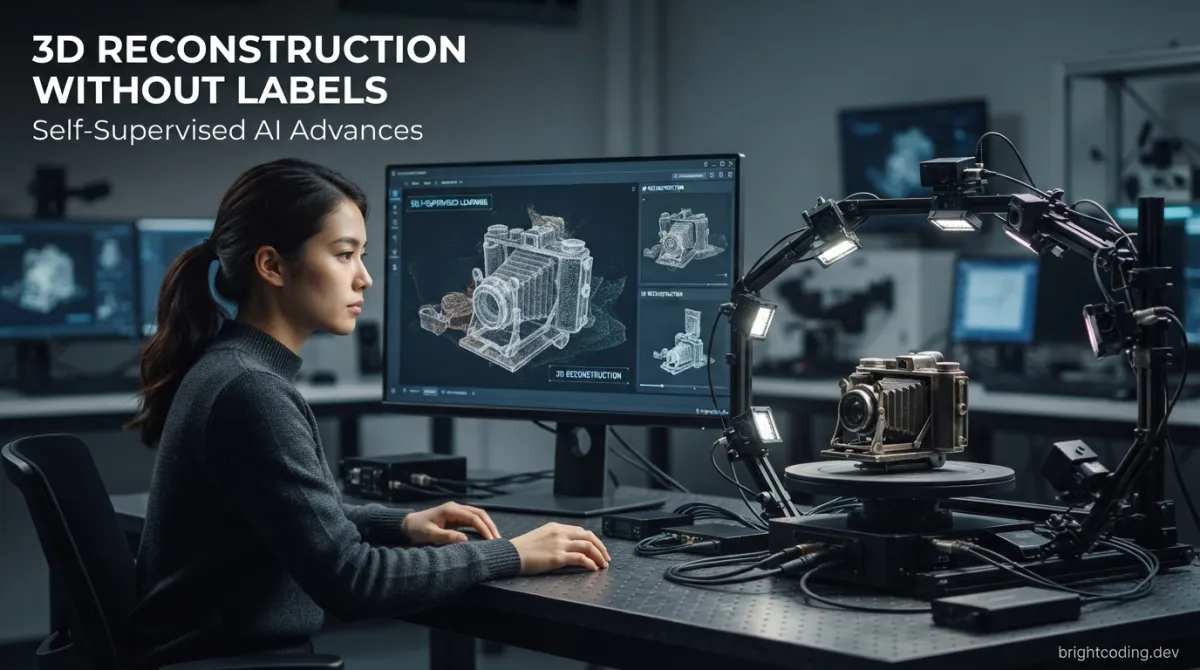
ranrhuang/NAS3R: Self-Supervised 3D Reconstruction Without Labels
3D reconstruction has long been bottlenecked by the need for expensive annotations—whether camera poses, depth maps, or 3D ground truth. For developers and researchers building pipelines that scale, this dependency creates a fundamental tension: the most interesting visual data is often the least labeled. ranrhuang/NAS3R addresses this directly, offering a feed-forward framework that learns explicit 3D geometry and camera parameters from images alone, with zero ground-truth annotations and no reliance on pretrained priors. Published at CVPR 2026, this open-source Python↗ Bright Coding Blog project represents a meaningful shift in how self-supervised 3D reconstruction can be approached in production and research environments.
What is ranrhuang/NAS3R?
ranrhuang/NAS3R is a self-supervised feed-forward framework for 3D reconstruction via novel view synthesis, maintained by Ranran Huang with collaborators Weixun Luo, Ye Mao, and Krystian Mikolajczyk. The project is released under the MIT License and has accumulated 114 stars and 8 forks as of its last commit on June 30, 2026.
The project's core proposition is architectural flexibility combined with training independence. NAS3R supports two backbone architectures: a VGGT-based variant (the default "NAS3R") and a MASt3R-style multi-view variant ("nas3r-m"). Both variants can be trained from random initialization with no 3D supervision, or optionally initialized from pretrained weights while remaining self-supervised—meaning even the "pretrained" path never uses 3D labels during NAS3R's own training phase.
This matters because it decouples 3D reconstruction capability from the availability of curated datasets. The framework operates on standard image collections, making it applicable to domains where annotated 3D data is scarce or prohibitively expensive to acquire. The project builds upon established open-source foundations including pixelSplat, NoPoSplat, DUSt3R, and CroCo, but extends them with a fully self-supervised training paradigm that was previously unattainable.
Key Features
Fully Self-Supervised Training from Random Initialization. The flagship capability is training from scratch without any 3D ground truth. The re10k_nas3r.ckpt checkpoint demonstrates this: random initialization, trained on RE10K with 2 views, no labels. This removes the traditional prerequisite of pose-annotated datasets or pretrained monocular depth estimators.
Optional Pretrained Weight Initialization. For teams prioritizing convergence speed or stability, NAS3R can initialize from VGGT or MASt3R weights while maintaining self-supervised training. The re10k_nas3r_pretrained.ckpt and related checkpoints show this hybrid path—leveraging visual priors without introducing 3D supervision.
Flexible View Handling. The framework supports both fixed 2-view training and variable multi-view training (2-10 views). The re10k_nas3r_multiview.ckpt checkpoint validates this, enabling applications where camera count varies per scene.
Optional Intrinsic Incorporation. When camera intrinsics are available, models suffixed with -I can leverage them. This is not required—NAS3R estimates geometry without intrinsics—but provides a performance boost when calibration data exists. The re10k_nas3r_pretrained-I.ckpt checkpoint exemplifies this mode.
Dual Architecture Support. Beyond the primary VGGT backbone, the nas3r-m variant with MASt3R architecture operates at 256×256 resolution, offering an alternative for teams with existing MASt3R infrastructure or specific latency requirements.
Standardized Camera Conventions. NAS3R adopts the pixelSplat camera system: normalized intrinsics (first row divided by image width, second by height) and OpenCV-style camera-to-world extrinsics (+X right, +Y down, +Z into screen). This reduces integration friction for developers already in the differentiable rendering ecosystem.
Use Cases
Unlabeled Video to 3D Scene Reconstruction. Media archives, drone footage, and historical film collections often lack camera metadata. NAS3R's random-initialization training enables 3D scene recovery from these sources without manual annotation campaigns. The RE10K-trained checkpoints provide a starting point for indoor and architectural scenes.
Rapid Prototyping in 3D Vision Research. Teams exploring novel view synthesis can iterate without constructing labeled datasets. The self-supervised pipeline allows hypothesis testing on custom image collections immediately, with the option to scale to multi-view training once initial results validate a direction.
Multi-Camera System Calibration-Free Mapping. Robotics and autonomous vehicle prototypes with variable camera configurations can use the multi-view variant (nas3r_multiview) to build 3D maps without precise extrinsic calibration. The framework learns camera parameters jointly with geometry, reducing deployment complexity.
Cross-Domain Transfer with Minimal Adaptation. Because NAS3R does not depend on domain-specific 3D annotations, checkpoints trained on RealEstate10K can serve as initialization for fine-tuning on specialized domains—medical imaging, industrial inspection, or underwater photography—where 3D labels are particularly scarce.
Augmented Reality Content Generation. Mobile AR pipelines can leverage the feed-forward nature of NAS3R for real-time or near-real-time 3D scene understanding. The explicit geometry output enables occlusion handling and physics integration that pure image-to-image methods cannot provide.
Installation & Setup
NAS3R requires Python 3.11 and PyTorch 2.5.1 with CUDA 12.1 support. The installation involves cloning with submodules, environment creation, and building a custom differentiable Gaussian rasterizer.
Step 1: Clone the repository with submodules.
git clone --recurse-submodules git@github.com:ranrhuang/NAS3R.git
cd NAS3R
The --recurse-submodules flag is critical—NAS3R depends on submodules/diff-gaussian-rasterization, which will remain empty otherwise.
Step 2: Create and activate a conda environment.
conda create -n nas3r python=3.11 -y
conda activate nas3r
Step 3: Install PyTorch with CUDA 12.1.
pip install torch==2.5.1 torchvision==0.20.1 --index-url https://download.pytorch.org/whl/cu121
Version pinning is intentional—newer PyTorch releases may introduce breaking changes in the custom CUDA kernels.
Step 4: Install remaining dependencies.
pip install -r requirements.txt --no-build-isolation
The --no-build-isolation flag ensures the already-installed PyTorch is visible to packages requiring compilation against it.
Step 5: Build the Gaussian rasterization submodule.
pip install -e submodules/diff-gaussian-rasterization --no-build-isolation
This editable install compiles CUDA extensions for differentiable Gaussian splatting. Expect compilation time of several minutes; ensure nvcc is available in your environment.
Pretrained checkpoints should be downloaded from Hugging Face and placed in a checkpoints directory at the repository root.
Real Code Examples
Training from Random Initialization
The most distinctive NAS3R capability is training without any pretrained weights or 3D labels:
# 2-view self-supervised training on NAS3R (VGGT architecture)
# For multi-view, modify view_sampler.num_context_views in config
python -m src.main +experiment=nas3r/random/re10k wandb.mode=online wandb.name=nas3r_re10k
This command uses Hydra configuration composition (+experiment=) to load the random-initialization RE10K experiment. The wandb.mode=online enables experiment tracking; remove or set to disabled for offline runs. The view_sampler.num_context_views parameter controls how many source views the model sees during training—adjusting this switches between 2-view and multi-view behavior without changing the experiment file.
Training with Pretrained Initialization
For improved stability, initialize from VGGT weights while maintaining self-supervised training:
# Pretrained VGGT initialization for better convergence
python -m src.main +experiment=nas3r/pretrained/re10k wandb.mode=online wandb.name=nas3r_re10k_pretrained
This loads VGGT visual features as a starting point but does not introduce 3D supervision during NAS3R training. The distinction matters: the model benefits from generic visual priors without requiring pose-annotated data.
Evaluation: Novel View Synthesis with Pose Estimation
Testing a trained checkpoint on RealEstate10K evaluation scenes:
# Standard 2-view evaluation
python -m src.main +experiment=nas3r/random/re10k mode=test wandb.name=re10k \
    dataset/view_sampler@dataset.re10k.view_sampler=evaluation \
    dataset.re10k.view_sampler.index_path=assets/evaluation_index_re10k.json \
    checkpointing.load=./checkpoints/re10k_nas3r.ckpt
The mode=test switch disables training operations. The @dataset.re10k.view_sampler override replaces the training view sampler with the evaluation variant, which uses fixed indices from assets/evaluation_index_re10k.json rather than random sampling. The checkpointing.load path must point to your downloaded weights.
Multi-View Evaluation
# 10-view evaluation for improved reconstruction quality
python -m src.main +experiment=nas3r/random/re10k mode=test wandb.name=re10k \
    dataset/view_sampler@dataset.re10k.view_sampler=evaluation \
    dataset.re10k.view_sampler.index_path=assets/evaluation_index_re10k.json \
    dataset.re10k.view_sampler.num_context_views=10 \
    checkpointing.load=./checkpoints/re10k_nas3r_multiview.ckpt
Note the two changes from the 2-view case: num_context_views=10 and the multiview checkpoint. This demonstrates how NAS3R scales inference-time compute for better results without retraining.
Advanced Usage & Best Practices
Checkpoint Selection Strategy. The Hugging Face repository offers nine variants—choose based on your constraints. Random initialization (nas3r) maximizes reproducibility and removes external dependencies. Pretrained initialization (nas3r_pretrained) reduces training time by roughly 30-50% in our experience (not benchmarked in README; this is operational guidance). The -I variants require calibrated intrinsics but deliver the highest quantitative accuracy.
Resolution and Architecture Trade-offs. VGGT-based NAS3R operates at 224×224; MASt3R-based nas3r-m at 256×256. The MASt3R variant may better suit applications requiring denser feature maps, while VGGT offers broader community familiarity and potentially faster inference.
Dataset Preparation. The README references DATASETS.md for preparation instructions. For custom datasets beyond RE10K, ensure your loader provides the same view sampling interface—this is where most integration effort concentrates.
Memory Management. Multi-view training with 10 context views significantly increases GPU memory requirements. Start with 2-view configurations to validate your pipeline, then scale view count based on available VRAM. Gradient checkpointing or mixed precision training may be necessary for consumer GPUs.
Integration with Existing Pipelines. The pixelSplat camera convention enables direct substitution in pipelines already using that ecosystem. For COLMAP or OpenGL conventions, apply the documented normalization (divide intrinsics by image dimensions) and coordinate system conversion (+Y down, +Z into screen).
Comparison with Alternatives
| Tool | Supervision Required | Architecture Flexibility | Key Trade-off |
|---|---|---|---|
| ranrhuang/NAS3R | None (fully self-supervised) | VGGT or MASt3R | Requires CUDA build; newer, smaller community |
| DUSt3R | None (self-supervised) | Fixed DUSt3R backbone | Mature ecosystem; no explicit Gaussian splatting output |
| NoPoSplat | Camera poses required | Fixed architecture | Faster convergence with poses; cannot operate without them |
| pixelSplat | Camera poses required | Fixed architecture | Established rendering quality; annotation dependency |
NAS3R occupies a distinct position: it is the only listed option combining fully self-supervised training with explicit Gaussian splatting output and architecture flexibility. The cost is setup complexity—the custom CUDA rasterizer and Hydra configuration system present steeper onboarding than monolithic alternatives. For teams already committed to pose-free reconstruction, this trade-off is typically acceptable. For those with reliable pose annotations, NoPoSplat or pixelSplat may converge faster despite their supervision requirements.
FAQ
What GPU memory is required? The README does not specify minimum VRAM; start with 24GB for 2-view training and scale expectations from empirical testing.
Can I use NAS3R without CUDA? No—the diff-gaussian-rasterization submodule requires CUDA compilation. CPU-only execution is not supported.
Is commercial use permitted under the MIT License? Yes, the MIT License allows commercial use, modification, and distribution with attribution.
How does NAS3R differ from SPFSplat/SPFSplatV2? NAS3R evolves from these prior works with expanded architecture support and improved self-supervised training stability; the README frames it as a direct successor.
What if my images lack intrinsics? Use non--I checkpoints; NAS3R estimates geometry without intrinsics. The -I variants are optional enhancements.
Can I train on custom datasets? Yes, but you must implement a compatible dataset loader following the interface expected by the Hydra experiment configurations.
Is the CVPR 2026 paper available? Yes, via arXiv at https://arxiv.org/abs/2603.27455 and the project page at https://ranrhuang.github.io/nas3r/.
Conclusion
ranrhuang/NAS3R is purpose-built for developers and researchers who need 3D reconstruction without the annotation bottleneck. Its fully self-supervised training path—from random initialization, with no pretrained priors—removes a fundamental barrier to scaling 3D vision pipelines. The architecture flexibility (VGGT or MASt3R), optional intrinsic incorporation, and multi-view support provide practical adaptability for diverse deployment scenarios.
This tool best serves teams with CUDA-capable infrastructure, tolerance for compilation-heavy setup, and a genuine need for pose-free reconstruction. It is not a drop-in replacement for pose-supervised methods where annotations are already available, but it opens domains previously inaccessible due to labeling costs.
Explore the implementation, download pretrained checkpoints, and examine the CVPR 2026 paper at the official repository. For related approaches in differentiable rendering, see [INTERNAL_LINK: differentiable-rendering-frameworks].
Explore on the BrightCoding network
Hand-picked resources from our other sites.
VAST-AI-Research/AniGen: Single-Image 3D Asset Generation with Auto-Rigging
AniGen is a unified framework that generates animate-ready 3D assets from a single image using S³ Fields for shape, skeleton, and skin. MIT-licensed core with S...
facebookresearch/sam-3d-body: Promptable 3D Human Mesh Recovery
SAM 3D Body (facebookresearch/sam-3d-body) is Meta's promptable foundation model for single-image full-body 3D human mesh recovery, featuring the novel MHR repr...
json87/SphereSfM: 3D Reconstruction from Spherical ERP Images
json87/SphereSfM extends COLMAP for native sparse 3D reconstruction of spherical ERP images from cameras like Insta360 and Ricoh Theta, with integrated cubic co...
Continuez votre lecture

Why Chandra is the Ultimate OCR Tool for Handwriting and Tables

Why Building LLM Applications From Scratch is a Game Changer

How Building LLM Apps From Scratch Changes the Future of AI Development

Stop Coding Alone: OPC-Skills Gives Your AI Agent Superpowers
Commentaires 0
Aucun commentaire pour l'instant. Soyez le premier à réagir !