reBot-DevArm: The Open Source Robot Arm Top AI Labs Are Secretly Using
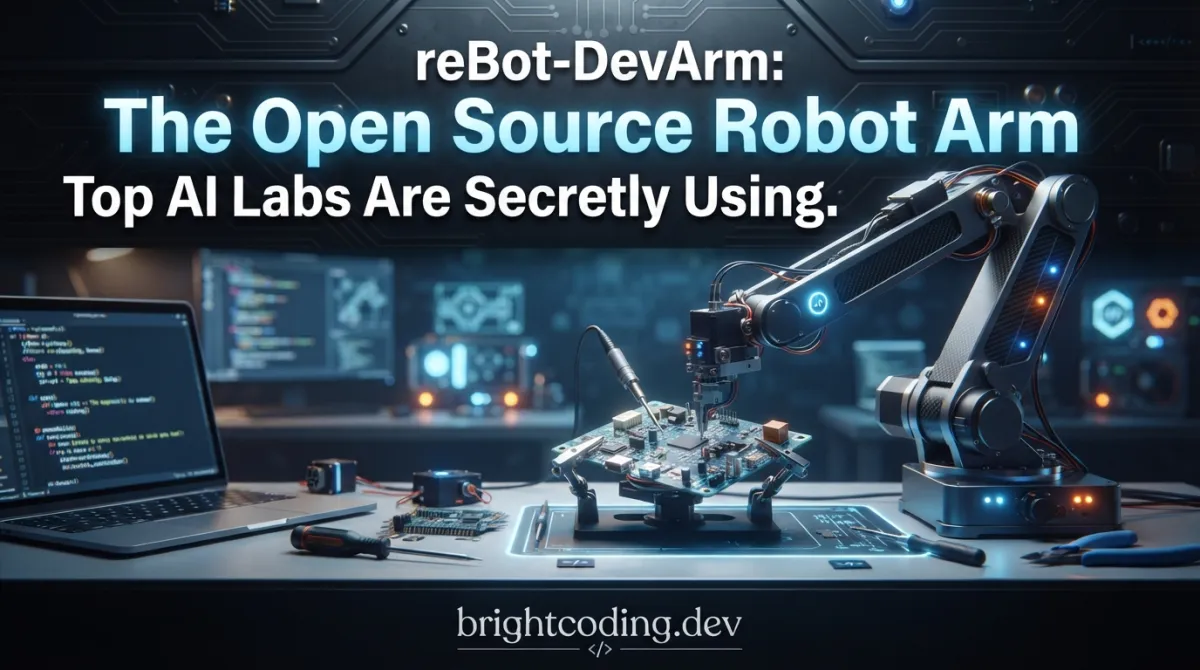
What if I told you that building a production-grade robotic arm for embodied AI costs less than a high-end gaming laptop? That the same hardware stack powering cutting-edge imitation learning research is sitting on GitHub, waiting for you to hit clone? Here's the kicker—most developers still believe robotics requires six-figure budgets, proprietary black boxes, and years of mechanical engineering experience. They're wrong. Dead wrong.
The robotics revolution isn't coming. It's already here, and it's wearing an open source badge.
Meet reBot-DevArm, the 100% open source robotic arm that's making Silicon Valley research labs nervous. Created by Seeed Studio's AI Robotics Team, this isn't another toy servo project or locked-down industrial relic. We're talking full CERN-OHL-W-2.0 hardware blueprints, Apache-2.0 software, ROS2 integration, NVIDIA Isaac Sim simulation, and native Hugging Face LeRobot support—all for a fraction of what you'd spend on a single Franka Emika Panda joint motor.
The painful truth? Developers have been trapped between two terrible options: cheap 3D-printed arms that shake like leaves, and industrial systems that cost more than a Tesla. reBot-DevArm shatters that false choice. With 6+1 DOF, 1.5kg payload, <0.2mm repeatability, and a 650mm reach, this is the Goldilocks zone for embodied AI research, automation prototyping, and serious robotics education.
Ready to see what the hype is about? Let's dismantle this machine piece by piece.
What is reBot-DevArm?
reBot-DevArm is Seeed Studio's flagship open source robotic arm ecosystem, designed from the ground up to democratize embodied AI development. The project encompasses two hardware variants—the B601-DM (Damiao motor-powered) and B601-RS (Robstride motor-powered)—sharing identical mechanical architectures but optimized for different motor ecosystems and price points.
This isn't vaporware or a barebones GitHub repo with a single STL file. Seeed Studio has executed what they call "True Open Source"—a radical transparency that extends from the microscopic (every screw specification with purchase links) to the macroscopic (complete STEP files, assembly videos, performance benchmarks, and multi-framework software integration).
The project's lineage traces directly to the explosion of imitation learning and teleoperation research sparked by projects like Mobile ALOHA and SO-ARM100. But where those projects focused narrowly on specific research goals, reBot-DevArm ambitiously builds the full-stack infrastructure: hardware you can manufacture, software you can extend, and a community you can join. The B601-DM variant has already achieved mature ecosystem integration, while the B601-RS is rapidly catching up with planned releases throughout 2026.
What's driving the buzz? Timing and licensing. In May 2026, Seeed Studio made a pivotal move—transitioning from CC BY-SA NC to full CERN-OHL-W-2.0 for hardware and Apache-2.0 for software. This means 100% commercial compliance. You can build these arms, sell them, modify them, close-source your additions—no legal minefields, no attribution anxiety. For startups and researchers needing to ship products, this is liberation.
The arm itself is a desktop-class 6-DOF manipulator with a 7th DOF for the gripper, weighing approximately 4.5kg with a 650mm maximum reach. The <0.2mm repeatability places it firmly in the "useful for real tasks" category, not the "vague gesturing" zone of cheaper alternatives. Power comes from a standard DC 24V supply, making integration straightforward for anyone with basic electronics experience.
Key Features That Separate reBot-DevArm from the Pack
Let's cut through the marketing and examine what makes this arm technically special:
🔧 Complete Hardware Transparency Every single component is documented. Sheet metal source files, 3D-printed part STLs, machined component references with pricing, and a BOM that specifies screws down to the thread pitch. This isn't just openness—it's manufacturing-grade reproducibility. You could literally walk into a machine shop with these files and produce a clone.
🧠 Multi-Framework Software Stack The software ecosystem is where reBot-DevArm flexes hardest. Native support spans:
- ROS1/ROS2 (Humble): Full kinematics, trajectory planning, and gravity compensation
- Pinocchio: Lightning-fast analytical derivatives for dynamics and control
- LeRobot: Direct integration with Hugging Face's end-to-end robot learning framework
- NVIDIA Isaac Sim: USD model import with simulated teleoperation pipelines
- Python↗ Bright Coding Blog SDK: Unified motor control across Damiao, Robstride, Mota, Gaoqing, Hexfellow, and more
📷 Production-Ready Perception Optional wrist camera mounts support Intel RealSense D435i/D405, Orbbec Gemini 305/2, and generic UVC cameras. The depth camera integration includes visual grasping demonstrations using YOLO—not theoretical, but implemented and documented.
🎮 Teleoperation Infrastructure Compatible with the Star Arm 102-LD leader arm for intuitive kinesthetic teaching. This is the same paradigm that powers data collection for imitation learning breakthroughs—now accessible without corporate R&D budgets.
⚡ Edge Compute Flexibility Designed to pair with NVIDIA Jetson (reComputer series), Raspberry Pi 4B/5, or Seeed XIAO ESP32. Whether you need CUDA-accelerated inference or a lightweight wireless node, the architecture accommodates.
🛡️ Legally Clean Commercial Use The dual licensing (CERN-OHL-W-2.0 hardware + Apache-2.0 software) is genuinely rare in robotics. Most "open" hardware projects use restrictive licenses that poison commercial derivatives. Seeed Studio explicitly removed that barrier.
Use Cases: Where reBot-DevArm Actually Wins
1. Imitation Learning Research
Collect real-world demonstration data with the leader arm, train policies in LeRobot, deploy on the physical arm. The full pipeline—from kinesthetic teaching to policy inference—is documented and functional. Research groups can replicate ACT, Diffusion Policy, or custom architectures without hardware engineering becoming the bottleneck.
2. Pick-and-Place Automation Prototyping
With 1.5kg payload and sub-millimeter repeatability, the arm handles genuine industrial tasks: PCB assembly, small parts sorting, packaging operations. The ROS2 MoveIt2 integration (in progress for B601-RS, completed for B601-DM) provides collision-aware motion planning out of the box.
3. Robotics Education at Scale
Universities and bootcamps face a brutal choice: expensive closed systems that students can't modify, or cheap systems that teach bad habits. reBot-DevArm offers pedagogical depth—students disassemble, reconfigure, simulate, and simulate-to-reality transfer on the same platform they'll encounter in research and industry.
4. Sim-to-Real Validation
The Isaac Sim integration enables synthetic data generation and policy validation before physical deployment. For startups burning cash on physical iterations, this slashes development cycles. The USD model import means your simulated arm is your physical arm, dimensionally identical.
5. Custom End-Effector Development
Open STEP files for the wrist flange and published gripper designs (with soft finger TPU variants) make end-effector customization trivial. Add force sensors, custom tools, or entirely new manipulation paradigms without fighting proprietary interfaces.
Step-by-Step Installation & Setup Guide
Getting started with reBot-DevArm depends on your chosen variant and ecosystem. Here's the complete pathway for the most mature configuration: B601-DM with ROS2 Humble on Ubuntu 22.04.
Hardware Assembly
Before software, build the physical arm. Seeed Studio provides:
- Ultra-detailed assembly video: Getting Started with reBot Arm B601-DM
- Complete BOM with purchase links: reBot Arm B601-DM BOM
- Performance testing benchmarks: Performance Testing
The assembly follows standard robotics practices: base first, then shoulder, elbow, wrist roll/pitch/yaw, finally gripper. All structural components use M3-M6 fasteners with documented torque specifications.
Software Environment Setup
Step 1: Install ROS2 Humble
# Standard ROS2 Humble installation on Ubuntu 22.04
sudo apt update && sudo apt install -y curl gnupg lsb-release
sudo curl -sSL https://raw.githubusercontent.com/ros/rosdistro/master/ros.key -o /usr/share/keyrings/ros-archive-keyring.gpg
echo "deb [arch=$(dpkg --print-architecture) signed-by=/usr/share/keyrings/ros-archive-keyring.gpg] http://packages.ros.org/ros2/ubuntu $(lsb_release -cs) main" | sudo tee /etc/apt/sources.list.d/ros2.list > /dev/null
sudo apt update
sudo apt install -y ros-humble-desktop ros-humble-moveit
source /opt/ros/humble/setup.bash
Step 2: Install MotorBridge SDK
The unified motor control SDK abstracts multiple motor protocols:
# Clone and install MotorBridge for unified motor control
pip install motorbridge
# Or install from source for latest features
git clone https://github.com/Seeed-Projects/motorbridge.git
cd motorbridge && pip install -e .
Step 3: Clone reBot-DevArm ROS2 Integration
# Create workspace and clone integration packages
mkdir -p ~/rebot_ws/src && cd ~/rebot_ws/src
git clone https://github.com/Seeed-Projects/reBot-DevArm.git
cd reBot-DevArm/software/ros2  # Navigate to ROS2-specific code
Step 4: Build and Configure
# Build the workspace
cd ~/rebot_ws
colcon build --symlink-install --cmake-args -DCMAKE_BUILD_TYPE=Release
source install/setup.bash

# Configure CAN interface for Damiao motors (typical setup)
sudo ip link set can0 up type can bitrate 1000000
# Add user to can group for non-sudo access
sudo usermod -aG can $USER
Step 5: Launch and Verify
# Launch the complete arm controller with RViz visualization
ros2 launch rebot_b601_dm_bringup arm_controller.launch.py

# In another terminal, test basic joint control
ros2 topic pub /joint_commands sensor_msgs/JointState "{name: ['joint1', 'joint2', 'joint3', 'joint4', 'joint5', 'joint6'], position: [0.0, 0.5, -0.3, 0.0, 0.0, 0.0]}" --once
For LeRobot integration, follow the dedicated guide at Getting Started with LeRobot-based reBot Arm, which handles dataset recording, training, and deployment pipelines.
REAL Code Examples from the Repository
Let's examine actual implementation patterns from the reBot-DevArm ecosystem, with detailed technical commentary.
Example 1: Basic Motor Control via Python SDK
The MotorBridge SDK provides unified access to heterogeneous motors. Here's how you initialize and command the Damiao motors on B601-DM:
#!/usr/bin/env python3
"""
reBot-DevArm Basic Motor Control Example
Demonstrates unified motor initialization and position control
"""

from motorbridge import MotorBridge, MotorType
import time

# Initialize bridge with CAN interface for Damiao motors
# MotorBridge auto-detects motor types when possible
bridge = MotorBridge(
    interface="can0",           # Linux CAN interface
    motor_type=MotorType.DAMIAO, # Explicit type for B601-DM
    baudrate=1000000            # 1Mbps CAN-FD standard
)

# Connect to all motors on the arm
# Default IDs: 1-6 for arm joints, 7 for gripper
motor_ids = [1, 2, 3, 4, 5, 6, 7]
bridge.connect(motor_ids)

# Read current joint positions (radians)
positions = bridge.get_positions(motor_ids)
print(f"Current positions: {positions}")

# Command smooth motion to home configuration
# Using built-in trapezoidal velocity profiling
home_positions = [0.0, 0.0, 0.0, 0.0, 0.0, 0.0, 0.0]  # All joints zeroed
duration = 3.0  # 3-second motion duration

bridge.move_to_positions(
    motor_ids=motor_ids,
    target_positions=home_positions,
    duration=duration,
    blocking=True  # Wait for motion completion
)

# Verify arrival
final_positions = bridge.get_positions(motor_ids)
print(f"Final positions: {final_positions}")
print(f"Position error: {[f-p for f,p in zip(final_positions, home_positions)]}")

bridge.disconnect()
What's happening here? The MotorBridge abstraction is crucial—it normalizes across Damiao's proprietary CAN protocol, Robstride's variant, and others. The move_to_positions call with blocking=True handles the low-level trajectory generation, sending interpolated setpoints at the motor's control frequency. Without this SDK, you'd be manually constructing CAN frames and implementing S-curve profiling.
Example 2: ROS2 Joint Trajectory Execution
For production robotics, you need ROS2's ecosystem. Here's trajectory execution with the Pinocchio-based controller:
#!/usr/bin/env python3
"""
reBot-DevArm ROS2 Trajectory Execution
Demonstrates MoveIt-compatible trajectory following with Pinocchio dynamics
"""

import rclpy
from rclpy.node import Node
from trajectory_msgs.msg import JointTrajectory, JointTrajectoryPoint
from sensor_msgs.msg import JointState
import pinocchio as pin  # Fast analytical dynamics
import numpy as np

class ReBotTrajectoryExecutor(Node):
    def __init__(self):
        super().__init__('rebot_trajectory_executor')

        # Publisher for joint commands to low-level controller
        self.cmd_pub = self.create_publisher(
            JointState, '/joint_commands', 10
        )

        # Subscriber for executed trajectory from MoveIt/Planner
        self.traj_sub = self.create_subscription(
            JointTrajectory,
            '/joint_trajectory',
            self.execute_trajectory,
            10
        )

        # Load Pinocchio model for dynamics validation
        # URDF path from reBot-DevArm hardware description
        self.model = pin.buildModelFromUrdf(
            '/opt/rebot_ws/src/reBot-DevArm/hardware/reBot_B601_DM/urdf/rebot_b601_dm.urdf'
        )
        self.data = self.model.createData()

        self.joint_names = [
            'joint1', 'joint2', 'joint3',
            'joint4', 'joint5', 'joint6'
        ]
        self.get_logger().info("Trajectory executor initialized with Pinocchio dynamics")

    def execute_trajectory(self, traj_msg: JointTrajectory):
        """Execute trajectory with real-time gravity compensation"""
        self.get_logger().info(f"Received trajectory with {len(traj_msg.points)} points")

        for i, point in enumerate(traj_msg.points):
            # Extract positions from trajectory point
            q = np.array(point.positions)
            dq = np.array(point.velocities) if point.velocities else np.zeros(6)

            # Compute gravity compensation torques using Pinocchio
            # RNEA: Recursive Newton-Euler Algorithm (O(n) complexity)
            pin.computeGeneralizedGravity(self.model, self.data, q)
            gravity_torques = self.data.g  # 6x1 gravity torque vector

            # Compose command: desired position + feedforward gravity torque
            cmd = JointState()
            cmd.header.stamp = self.get_clock().now().to_msg()
            cmd.name = self.joint_names
            cmd.position = point.positions
            cmd.effort = gravity_torques.tolist()  # Feedforward for accuracy

            self.cmd_pub.publish(cmd)

            # Synchronize with trajectory timing
            if i < len(traj_msg.points) - 1:
                next_time = traj_msg.points[i+1].time_from_start
                curr_time = point.time_from_start
                sleep_duration = (next_time - curr_time).nanoseconds / 1e9
                time.sleep(max(0, sleep_duration - 0.001))  # 1ms control loop slack

def main():
    rclpy.init()
    executor = ReBotTrajectoryExecutor()
    rclpy.spin(executor)
    executor.destroy_node()
    rclpy.shutdown()

if __name__ == '__main__':
    main()
The technical depth: This example showcases gravity compensation via Pinocchio's RNEA—a game-changer for accuracy. Without gravity torques, position-controlled arms sag under their own weight, especially at the shoulder and elbow. By computing τ_g = G(q) and feeding it forward, the low-level motor controllers work less, track better, and consume less power. The O(n) complexity means this runs in microseconds even for complex kinematic trees.
Example 3: LeRobot Dataset Recording for Imitation Learning
Here's how you collect demonstration data for training end-to-end policies:
#!/usr/bin/env python3
"""
reBot-DevArm LeRobot Data Collection
Records kinesthetic demonstrations for imitation learning
"""

from lerobot.common.datasets.lerobot_dataset import LeRobotDataset
from lerobot.common.policies.diffusion.configuration_diffusion import DiffusionConfig
from motorbridge import MotorBridge
import torch
import numpy as np
from datetime import datetime

class ReBotDataCollector:
    def __init__(self):
        # Initialize physical arm
        self.bridge = MotorBridge(interface="can0", motor_type=MotorType.DAMIAO)
        self.motor_ids = [1, 2, 3, 4, 5, 6]  # Exclude gripper for now
        self.bridge.connect(self.motor_ids)

        # Initialize LeRobot dataset with reBot-specific features
        self.dataset = LeRobotDataset.create(
            repo_id=f"seeed-projects/rebot_b601_dm_{datetime.now().strftime('%Y%m%d')}",
            fps=30,  # 30Hz control frequency
            features={
                "observation.images.wrist": {
                    "dtype": "image",
                    "shape": (480, 640, 3),
                    "names": ["height", "width", "channels"],
                },
                "observation.state": {
                    "dtype": "float32",
                    "shape": (6,),
                    "names": ["joint"],
                },
                "action": {
                    "dtype": "float32",
                    "shape": (6,),
                    "names": ["joint"],
                },
            },
            image_writer_threads=4,
            image_writer_processes=1,
        )

        # Camera setup (Intel RealSense D435i typical)
        self.camera = self._init_realsense()

    def _init_realsense(self):
        """Initialize wrist-mounted depth camera"""
        import pyrealsense2 as rs
        pipeline = rs.pipeline()
        config = rs.config()
        config.enable_stream(rs.stream.color, 640, 480, rs.format.bgr8, 30)
        pipeline.start(config)
        return pipeline

    def record_episode(self, num_frames: int = 500):
        """Record single demonstration episode"""
        print(f"Recording episode: {num_frames} frames")
        print("Lead the arm through the desired motion...")

        # Enable gravity compensation for effortless kinesthetic teaching
        self.bridge.set_mode(self.motor_ids, mode="gravity_compensation")

        for frame_idx in range(num_frames):
            # Capture visual observation
            frames = self.camera.wait_for_frames()
            color_frame = frames.get_color_frame()
            image = np.asanyarray(color_frame.get_data())

            # Read current joint state (observation)
            current_positions = self.bridge.get_positions(self.motor_ids)

            # For kinesthetic teaching, action = next state (position control)
            # In practice, you'd record the leader arm's commanded positions
            action = self._get_leader_arm_action()  # From teleoperation interface

            # Add frame to dataset
            self.dataset.add_frame({
                "observation.images.wrist": image,
                "observation.state": torch.tensor(current_positions, dtype=torch.float32),
                "action": torch.tensor(action, dtype=torch.float32),
            })

            # 30Hz timing
            time.sleep(1/30)

        # Save episode
        self.dataset.save_episode()
        print(f"Episode saved. Total episodes: {self.dataset.num_episodes}")

    def _get_leader_arm_action(self):
        """Read target positions from leader arm (Star Arm 102-LD)"""
        # Implementation depends on leader arm connection
        # Typically via secondary CAN bus or USB serial
        pass  # Placeholder for actual leader arm integration

    def finalize(self):
        """Push dataset to Hugging Face Hub for training"""
        self.dataset.push_to_hub()
        self.bridge.disconnect()

# Usage
if __name__ == "__main__":
    collector = ReBotDataCollector()
    for episode in range(50):  # Collect 50 demonstrations
        input(f"Press ENTER to start episode {episode}...")
        collector.record_episode(num_frames=400)
    collector.finalize()
Why this matters: This bridges the sim-to-real gap at the data level. LeRobot's dataset format is standardized across the community—your reBot data trains the same Diffusion Policy or ACT models that work on Franka, xArm, or Aloha. The gravity_compensation mode is essential: without it, manually moving a 4.5kg arm with 6 joints would exhaust human demonstrators in minutes.
Advanced Usage & Best Practices
Calibration is Non-Negotiable The <0.2mm repeatability spec assumes proper calibration. Run the automatic calibration routine in the Python SDK after every mechanical modification. Joint offsets drift with temperature and load cycling.
CAN Bus Topology Matters Damiao motors use CAN-FD at 1Mbps. Daisy-chain properly—star topologies create reflection artifacts that corrupt frames. Use twisted-pair CAN cable with 120Ω termination resistors at both bus ends. The B601-DM BOM includes verified cable assemblies.
Sim-to-Real Domain Randomization When training in Isaac Sim, randomize:
- Joint friction (±20%)
- Payload mass (0.5-2.0kg range)
- Camera pose (±5mm translation, ±2° rotation)
- Motor torque ripple (based on performance test data)
The Performance Testing document provides empirical distributions for realistic randomization bounds.
Thermal Management Continuous operation above 70% of max torque triggers motor thermal protection. For sustained industrial use, monitor motor temperatures via the SDK and implement duty cycling or active cooling.
Gripper Selection Logic The default servo gripper handles rigid objects to 1.5kg. For compliant manipulation, print the TPU soft finger variant. For precision assembly, wait for the upcoming joint motor gripper with force feedback.
Comparison with Alternatives
| Feature | reBot-DevArm B601-DM | SO-ARM100 | Franka Emika Panda | UFACTORY xArm 6 |
|---|---|---|---|---|
| Total Cost | ~$2,000-4,000 (kit) | ~$500-800 | ~$30,000 | ~$10,000-15,000 |
| Hardware Open Source | ✅ Full CERN-OHL-W-2.0 | ✅ Full | ❌ Proprietary | ❌ Proprietary |
| Software License | ✅ Apache-2.0 | ✅ MIT/Apache | ❌ Closed | ❌ Closed |
| Max Payload | 1.5 kg | 0.5 kg | 3.0 kg | 5.0 kg |
| Repeatability | <0.2 mm | ~1-2 mm | ±0.1 mm | ±0.1 mm |
| DOF | 6+1 | 6+1 | 7 | 6+1 |
| ROS2 Support | ✅ Native | ⚠️ Community | ✅ Native | ✅ Native |
| LeRobot Integration | ✅ Official | ✅ Community | ⚠️ Unofficial | ⚠️ Unofficial |
| Isaac Sim | ✅ In Progress | ❌ No | ✅ Official | ❌ No |
| Assembly Required | ✅ Yes (learning opportunity) | ✅ Yes | ❌ No | ❌ No |
| Commercial Use | ✅ Unrestricted | ✅ Unrestricted | ❌ Restricted | ❌ Restricted |
Verdict: reBot-DevArm occupies the "serious open source" niche—more capable than SO-ARM100, vastly more accessible than industrial arms, and uniquely unencumbered for commercialization. If you're building a robotics startup, the licensing alone saves months of legal review.
FAQ
Q: Can I really manufacture and sell reBot-DevArm clones commercially? A: Yes. Since May 11, 2026, the CERN-OHL-W-2.0 license grants full commercial rights for hardware. You must retain copyright notices and provide "Complete Source" (CAD files, BOMs) to recipients, but closed-source modifications to external modules are permitted.
Q: What's the difference between B601-DM and B601-RS? A: B601-DM uses Damiao motors with mature software support (completed ROS2, LeRobot, Pinocchio). B601-RS uses Robstride motors with lower cost but ecosystem still building (targeting full parity by mid-2026). Mechanical structure is identical.
Q: Do I need a mechanical engineering background to assemble this? A: No. The assembly video and step-by-step documentation assume only basic maker skills. A torque screwdriver helps but isn't mandatory. Budget 4-6 hours for first assembly.
Q: How does reBot-DevArm compare to buying a pre-built arm? A: Pre-assembled units are available from Seeed Studio. But building teaches you maintenance, modification, and debugging skills that save weeks when things inevitably break in research or production.
Q: Is the Python SDK compatible with my existing motor library? A: MotorBridge abstracts multiple protocols. If you have existing Damiao or Robstride code, it runs in parallel. The SDK also exposes raw CAN interfaces for advanced users.
Q: What's the path from simulation to real robot with Isaac Sim? A: Import the provided USD model, train policies with synthetic data, then deploy via the ROS2 bridge. The simulated and physical arms share identical kinematics and dynamics parameters for reliable transfer.
Q: Where do I get help if I'm stuck? A: Discord community, Seeed Studio Wiki, and GitHub issues. The team actively responds, and the contributor base is growing rapidly.
Conclusion: The Embodied AI Infrastructure You Actually Own
Here's the unvarnished truth: robotics has been held back by artificial scarcity. Industrial arms cost luxury car prices because vendors locked down ecosystems and extracted rent. Research projects released code but kept hardware opaque, trapping reproducibility at 50%.
reBot-DevArm breaks that model completely. Full hardware blueprints. Permissive commercial licensing. Native integration with the frameworks that matter—ROS2, LeRobot, Isaac Sim, Pinocchio. A community that actually responds when you're debugging CAN frames at 2 AM.
This isn't a toy. It's not a compromise. It's the infrastructure layer that embodied AI has been missing—a physical platform you can modify, manufacture, and monetize without asking permission.
The B601-DM is production-ready today. The B601-RS promises even greater accessibility by mid-2026. Whether you're training the next breakthrough imitation learning policy, prototyping automation for your startup, or teaching the next generation of roboticists, this is the stack that scales with your ambition.
Stop waiting for robotics to become accessible. It already is.
👉 Clone the repository, order your kit, and start building. The future of embodied AI is open source—and it's waiting for your pull request.
Have questions or built something cool with reBot-DevArm? Drop a comment below or join the Discord. Let's build the open robotics future together.
Explore on the BrightCoding network
Hand-picked resources from our other sites.
Stop Buying Overpriced Smart Displays! Build Clawd Mochi for $7
Build Clawd Mochi, a $7 WiFi-controlled pixel mascot desk companion powered by ESP32-C3. Complete guide with wiring diagrams, Arduino code, 3D print files, and...
RoboClaw: The Embodied AI Secret Top Robotics Teams Won't Share
Discover RoboClaw, the open-source embodied intelligence assistant from SJTU's MINT lab. Learn how conversational control, semantic skill interfaces, and commun...
PointWorld: Why Top Robotics Labs Are Ditching 2D for 3D World Models
PointWorld from NVIDIA and Stanford revolutionizes robotic manipulation with native 3D point flow world models. Learn installation, training, evaluation, and wh...
Continuez votre lecture
How Building LLM Apps From Scratch Changes the Future of AI Development

awesome-ai-awesomeness: The Essential AI Resource Goldmine
RunAnywhere SDKs: The Essential Toolkit for On-Device AI

Stop Coding Alone: OPC-Skills Gives Your AI Agent Superpowers
Commentaires 0
Aucun commentaire pour l'instant. Soyez le premier à réagir !