ScreenAgent: The AI That Sees Your Screen and Takes Control
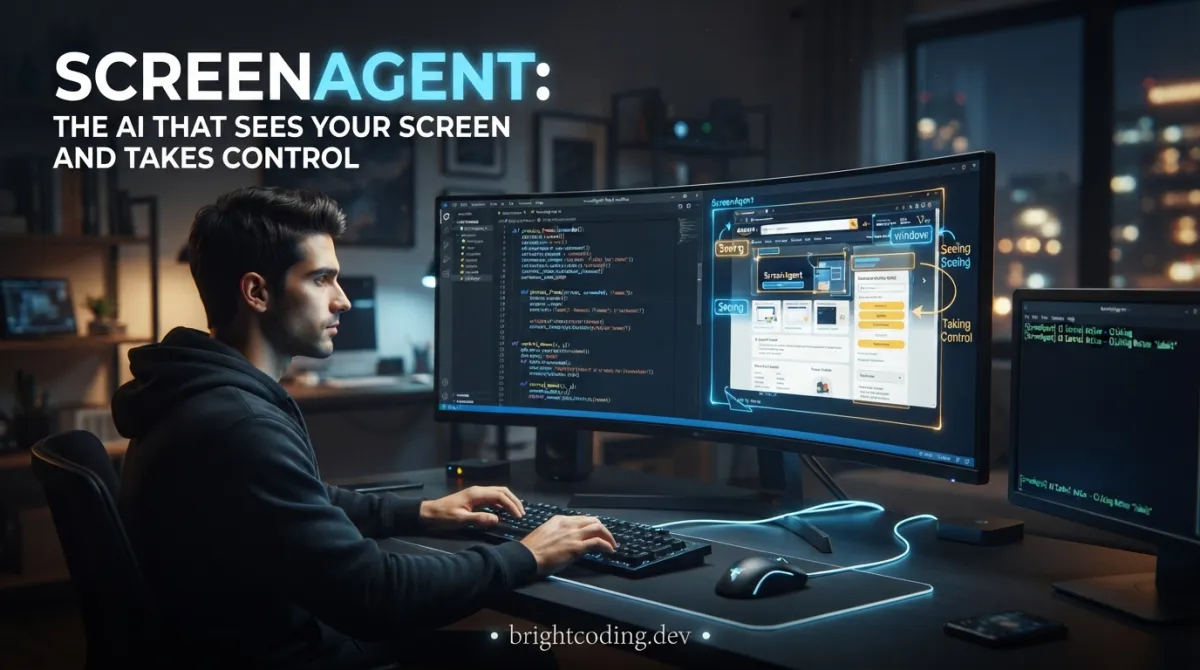
What if your computer could watch its own screen and do your work for you? Not with fragile scripts or brittle APIs, but by actually seeing what's happening and making human-like decisions. Sounds like science fiction? A team of researchers just made it reality—and they open-sourced everything.
Every developer knows the pain: automating GUI tasks means wrestling with Selenium locators that break on every redesign, pyautogui coordinates that fail across resolutions, or RPA tools that cost thousands and still require manual configuration. What if automation didn't need element IDs, CSS selectors, or DOM inspection? What if an AI could simply look at your screen the way you do, understand what it sees, and click, type, and navigate exactly where it needs to?
Enter ScreenAgent, the computer control agent driven by visual language models that captured the attention of IJCAI 2024. This isn't another wrapper around ChatGPT with a browser plugin. This is a fundamentally different approach to computer automation—one that mirrors human visual cognition rather than relying on programmatic hooks into applications. The implications are staggering: cross-platform compatibility without API access, operation of legacy software with no automation support, and adaptation to interfaces that change dynamically.
In this deep dive, I'll expose exactly how ScreenAgent works, why its visual-first architecture changes everything, and how you can deploy your own autonomous agent in under an hour. Whether you're building the next generation of AI assistants, researching embodied intelligence, or simply tired of writing yet another brittle UI automation script, this is the breakthrough you've been waiting for.
What is ScreenAgent?
ScreenAgent is an open-source computer control agent that operates entirely through visual perception, powered by visual language large models (VLLMs). Developed by researchers including Runliang Niu, Jindong Li, and Shiqi Wang, and accepted at IJCAI 2024, ScreenAgent represents a paradigm shift from API-based automation to visually-grounded autonomous operation.
Unlike traditional automation tools that probe application internals through accessibility trees, DOM queries, or OS-level hooks, ScreenAgent treats the computer screen as its sole interface to the world. It captures screenshots, processes them through multimodal language models capable of understanding both images and text, and outputs precise mouse and keyboard actions to accomplish complex multi-step tasks.
The project's architecture reflects a deliberate design philosophy: universality through visual abstraction. By operating at the pixel level rather than the API level, ScreenAgent achieves something previously impossible—a single automation framework that works across Windows, Linux, macOS, web applications, desktop software, and even games without any modification to target applications. No SDK integration. No plugin installation. No source code access required.
ScreenAgent builds upon the explosive progress in visual language models, particularly leveraging models like GPT-4V, LLaVA-1.5, CogAgent, and its own fine-tuned ScreenAgent model derived from CogAgent. The project arrives at a critical inflection point where multimodal AI capabilities have matured enough to enable practical computer control, yet most developers remain trapped in API-centric thinking about automation.
The repository at niuzaisheng/ScreenAgent provides not just inference code but a complete ecosystem: controller software with PyQt5 GUI, VNC-based environment setup, multiple model worker implementations, comprehensive training pipelines, and the manually annotated ScreenAgent dataset spanning diverse real-world computer tasks.
Key Features That Separate ScreenAgent From Everything Else
Visual-First Action Space. ScreenAgent's most radical departure from conventional tools is its action space design. Rather than calling application-specific APIs, it outputs fundamental mouse and keyboard operations—click, double-click, right-click, drag, scroll, type—specifying exact screen coordinates. This mirrors human interaction patterns and eliminates dependency on any application's internal structure. The coordinate-based approach means ScreenAgent can operate software it's never seen before, including proprietary tools and legacy systems.
Planning-Execution-Reflection Loop. The agent implements a sophisticated cognitive cycle that goes beyond reactive automation. In the planning phase, ScreenAgent decomposes high-level goals into subtasks. During execution, it observes screenshots and generates specific actions. The reflection phase enables self-correction: the agent evaluates execution results, detects failures or unexpected states, and dynamically adjusts—retrying operations, replanning approaches, or terminating when tasks prove impossible. This closed-loop control provides robustness that linear scripts cannot match.
Multi-Model Flexibility. ScreenAgent doesn't lock you into a single provider. The architecture supports GPT-4V for cutting-edge capability, open-source alternatives like LLaVA-1.5 and CogAgent for cost control and privacy, and the custom ScreenAgent model fine-tuned specifically for GUI understanding. This modular design lets you trade off capability, cost, latency, and data sovereignty based on your specific requirements.
Comprehensive Training Infrastructure. For researchers and advanced practitioners, ScreenAgent provides complete training pipelines including dataset preparation scripts, distributed training configurations, and model merging utilities. The project incorporates three existing datasets (COCO 2014, Rico, Mind2Web) alongside its own annotated ScreenAgent dataset, enabling reproducible research and model improvement.
VNC-Based Universal Environment. The Docker↗ Bright Coding Blog container niuniushan/screenagent-env provides an instant, isolated desktop environment with clipboard service integration. This eliminates environment configuration headaches and enables safe experimentation. For production deployments, any VNC server on any platform becomes controllable—Windows servers, Linux workstations, cloud instances, even physical machines.
Real-World Use Cases Where ScreenAgent Dominates
Legacy System Automation. Financial institutions, healthcare organizations, and government agencies run critical software from vendors who disappeared decades ago. These systems lack APIs, modern automation hooks, or even accessible DOM structures. ScreenAgent doesn't care—it sees the interface humans see and operates it directly. A major bank could automate data entry across a 1990s-era terminal emulator without touching a line of COBOL.
Cross-Platform Testing Workflows. QA teams currently maintain separate automation suites for web (Selenium), mobile (Appium), and desktop (various proprietary tools). ScreenAgent unifies this with a single approach: point it at any screen, describe the task, and watch it work. Test a web app, then immediately validate the same workflow on the native desktop version without rewriting a single line of test code.
Intelligent Process Automation. Traditional RPA tools require "teaching" through recorded macros or visual workflow designers that break with UI changes. ScreenAgent's visual understanding provides inherent adaptability—button moved? Different color scheme? It adjusts dynamically. Combined with its planning capabilities, it handles multi-step processes with decision points: "If invoice total exceeds $10,000, route to senior approver; else process normally."
Accessibility Enhancement. For users with motor impairments, ScreenAgent enables voice or high-level command control of any software. "Send my spreadsheet to the printer using landscape format" becomes executable without requiring application-specific accessibility APIs that many programs lack entirely.
AI Research and Benchmarking. The ScreenAgent environment provides a standardized platform for evaluating visual language models on real computer control tasks. Researchers can compare model capabilities, test new training approaches, and contribute to the growing field of embodied AI with reproducible experiments.
Step-by-Step Installation & Setup Guide
Ready to deploy your own ScreenAgent? The setup involves three components: a controllable desktop environment, the controller software, and a vision-language model backend.
Step 1: Prepare the Desktop Environment
The fastest path uses the pre-built Docker container with VNC server and clipboard service:
# Pull and start the ScreenAgent environment container
docker run -d --name ScreenAgent \
  -e RESOLUTION=1024x768 \
  -p 5900:5900 \
  -p 8001:8001 \
  -e VNC_PASSWORD=<VNC_PASSWORD> \
  -e CLIPBOARD_SERVER_SECRET_TOKEN=<CLIPBOARD_SERVER_SECRET_TOKEN> \
  -v /dev/shm:/dev/shm \
  niuniushan/screenagent-env:latest
Critical: Replace <VNC_PASSWORD> and <CLIPBOARD_SERVER_SECRET_TOKEN> with secure values. The clipboard service on port 8001 enables input of long text and Unicode characters—without it, you're limited to ASCII keystrokes only.
For existing desktop environments (Windows, Linux, macOS), install any VNC server like TightVNC and enable the clipboard service:
# Install clipboard service dependencies
pip install fastapi pydantic uvicorn pyperclip

# Set authentication token
export CLIPBOARD_SERVER_SECRET_TOKEN=<CLIPBOARD_SERVER_SECRET_TOKEN>

# Start the clipboard server
python↗ Bright Coding Blog client/clipboard_server.py
Verify clipboard functionality:
curl --location 'http://localhost:8001/clipboard' \
  --header 'Content-Type: application/json' \
  --data '{
    "text":"Hello world",
    "token":"<CLIPBOARD_SERVER_SECRET_TOKEN>"
  }'
Expected response: {"success": True, "message": "Text copied to clipboard"}.
If you encounter "Pyperclip could not find a copy/paste mechanism," specify your display:
export DISPLAY=:0.0
Record your VNC server's IP, port, and credentials in client/config.yml under the remote_vnc_server section.
Step 2: Install Controller Dependencies
The controller orchestrates screenshot capture, VNC command transmission, state machine management, and LLM API communication:
# Install PyQt5-based controller and dependencies
pip install -r client/requirements.txt
Step 3: Configure Your Vision-Language Model
ScreenAgent supports four model backends. Configure your choice in client/config.yml, keeping only one active under llm_api:
llm_api:

  # Option 1: GPT-4V (highest capability, API costs apply)
  GPT4V:
    model_name: "gpt-4-vision-preview"
    openai_api_key: "<YOUR-OPENAI-API-KEY>"
    target_url: "https://api.openai.com/v1/chat/completions"

  # Option 2: LLaVA-1.5 (open source, self-hosted)
  LLaVA:
    model_name: "LLaVA-1.5"
    target_url: "http://localhost:40000/worker_generate"

  # Option 3: CogAgent (strong GUI understanding)
  CogAgent:
    target_url: "http://localhost:40000/worker_generate"

  # Option 4: ScreenAgent (fine-tuned for computer control)
  ScreenAgent:
    target_url: "http://localhost:40000/worker_generate"

  # Shared generation parameters
  temperature: 1.0
  top_p: 0.9
  max_tokens: 500
For LLaVA-1.5 self-hosting:
# Clone and setup LLaVA
git clone https://github.com/haotian-liu/LLaVA.git
cd LLaVA
conda create -n llava python=3.10 -y
conda activate llava
pip install --upgrade pip
pip install -e .

# Start model worker (copy worker from ScreenAgent repo first)
python -m llava.serve.llava_model_worker \
  --host 0.0.0.0 \
  --port 40000 \
  --worker http://localhost:40000 \
  --model-path liuhaotian/llava-v1.5-13b \
  --no-register
For ScreenAgent model (recommended for GUI tasks):
# Download weights from HuggingFace, extract to train/saved_models/ScreenAgent-2312
cd train
RANK=0 WORLD_SIZE=1 LOCAL_RANK=0 \
  python ./cogagent_model_worker.py \
  --host 0.0.0.0 \
  --port 40000 \
  --from_pretrained "./saved_models/ScreenAgent-2312" \
  --bf16 \
  --max_length 2048
Launch the Controller
cd client
python run_controller.py -c config.yml
The PyQt5 interface appears: double-click a task from the left panel, then click "Start Automation". The agent begins its plan-action-reflection cycle, displaying screenshots and generated actions in real-time.
REAL Code Examples: Inside ScreenAgent's Core Mechanics
Let's examine actual implementation patterns from the ScreenAgent repository, dissecting how this system bridges visual perception with physical control.
Example 1: Docker Environment Instantiation
The container deployment reveals architectural decisions about isolation and universality:
docker run -d --name ScreenAgent \
  -e RESOLUTION=1024x768 \
  -p 5900:5900 \
  -p 8001:8001 \
  -e VNC_PASSWORD=<VNC_PASSWORD> \
  -e CLIPBOARD_SERVER_SECRET_TOKEN=<CLIPBOARD_SERVER_SECRET_TOKEN> \
  -v /dev/shm:/dev/shm \
  niuniushan/screenagent-env:latest
Technical breakdown: The 1024x768 resolution standardizes the visual input dimension for VLM processing—models are sensitive to aspect ratio and scale. Port 5900 exposes the VNC protocol (RFB) for framebuffer access and input injection. Port 8001 runs a FastAPI clipboard bridge because direct Unicode keystroke simulation through VNC is unreliable; instead, the controller pushes text to this HTTP endpoint, which uses pyperclip to populate the system clipboard, followed by Ctrl+V injection. The /dev/shm mount provides shared memory for efficient framebuffer operations. This design elegantly solves cross-platform text input without modifying the VNC protocol itself.
Example 2: Clipboard Service Verification
Testing infrastructure reveals operational constraints:
curl --location 'http://localhost:8001/clipboard' \
  --header 'Content-Type: application/json' \
  --data '{
    "text":"Hello world",
    "token":"<CLIPBOARD_SERVER_SECRET_TOKEN>"
  }'
Why this matters: The token-based authentication prevents unauthorized clipboard access—critical since clipboard contents may include passwords or sensitive data. The JSON API design enables programmatic text injection from the controller's Python environment without shelling out to platform-specific utilities. The expected response structure {"success": True, "message": "..."} provides deterministic success/failure detection for the controller's error handling logic.
Example 3: LLaVA Model Worker Deployment
Self-hosted model serving demonstrates the inference architecture:
python -m llava.serve.llava_model_worker \
  --host 0.0.0.0 \
  --port 40000 \
  --worker http://localhost:40000 \
  --model-path liuhaotian/llava-v1.5-13b \
  --no-register
Architecture insight: The --no-register flag indicates this worker operates standalone without a controller worker discovery system—ScreenAgent's controller directly addresses localhost:40000. The 13B parameter model balances capability against inference latency; larger models improve visual grounding accuracy but increase action cycle time. The worker exposes a non-streaming generation API (worker_generate endpoint) because ScreenAgent requires complete action sequences before execution—streaming tokens would complicate parsing and introduce partial action risks.
Example 4: ScreenAgent Fine-Tuned Model Launch
The specialized model startup shows distributed training remnants:
RANK=0 WORLD_SIZE=1 LOCAL_RANK=0 \
  python ./cogagent_model_worker.py \
  --host 0.0.0.0 \
  --port 40000 \
  --from_pretrained "./saved_models/ScreenAgent-2312" \
  --bf16 \
  --max_length 2048
Deep technical note: The environment variables RANK, WORLD_SIZE, and LOCAL_RANK expose the model's heritage from distributed training with DeepSpeed or similar frameworks—single-node inference reuses the same launch protocol. The --bf16 flag enables bfloat16 mixed precision, reducing memory footprint and accelerating inference on NVIDIA Ampere+ GPUs while maintaining numerical stability better than fp16 for model weights. The 2048 token context accommodates complex screenshots encoded as visual tokens alongside textual prompts; each screenshot consumes hundreds of visual tokens, making context length critical for multi-step task history.
Example 5: Controller Launch and Task Execution
The entry point ties everything together:
cd client
python run_controller.py -c config.yml
Operational flow: The controller loads config.yml to establish VNC connection parameters, select the active LLM API endpoint, and configure prompt templates. Internally, it maintains a state machine implementing the plan-action-reflection loop. For each cycle: (1) capture screenshot via VNC framebuffer; (2) construct multimodal prompt with task goal, history, and current image; (3) transmit to VLM worker; (4) parse response for action commands with coordinate parameters; (5) execute via VNC input injection; (6) capture result screenshot; (7) prompt reflection evaluation; (8) branch to continue, retry, or replan based on reflection output.
Advanced Usage & Best Practices
Optimize Screenshot Encoding. VLM inference dominates latency. Reduce screenshot resolution strategically—while ScreenAgent's Docker defaults to 1024x768, many tasks succeed at 800x600 with 2-3x faster inference. Experiment with your target applications; text-heavy interfaces need higher resolution than icon-driven ones.
Craft Precise Task Descriptions. The planning phase's subtask decomposition quality depends on prompt clarity. Instead of "do my taxes," specify "Open TurboTax, navigate to federal filing, enter W-2 from employer ID 12-3456789, then review deductions." Explicit constraints reduce reflection cycles and error recovery.
Implement Checkpoint Recovery. For long-running tasks, extend the controller to save state snapshots every N actions. If VNC disconnects or the model hallucinates, resume from last known good state rather than restarting. The PyQt5 controller's "Re-connect" button handles network interruptions but not logical recovery.
Monitor Token Economics. GPT-4V pricing scales with image dimensions. Each screenshot costs approximately 85-170 tokens depending on detail setting. A 50-action task with reflection doubles costs. Budget $0.50-2.00 per complex task with GPT-4V; self-hosted models eliminate per-call costs but require GPU infrastructure.
Fine-Tune for Your Domain. The provided training pipeline in train/finetune_ScreenAgent.sh enables specialization. Collect 100-500 examples of your specific workflows, add to the mixture dataset in train/dataset/mixture_dataset.py, and fine-tune from CogAgent weights. Domain-specific models dramatically improve reliability on repetitive business processes.
ScreenAgent vs. The Competition
| Capability | ScreenAgent | Selenium/Playwright | Traditional RPA | OS-Copilot |
|---|---|---|---|---|
| Interface Method | Visual (screenshots) | DOM/API access | Mixed APIs, OCR | Mixed APIs, accessibility |
| Cross-Platform | Universal (any VNC host) | Web only | Windows-centric | Linux-focused |
| Legacy Software | ✅ Native support | ❌ Requires web wrapper | ⚠️ Often unsupported | ⚠️ Limited |
| Setup Complexity | Medium (Docker/VNC) | Low (npm/pip install) | High (enterprise) | Medium |
| Adaptability to UI Changes | High (visual understanding) | Low (breaks on selectors) | Low (breaks on changes) | Medium |
| Open Source | ✅ Full stack↗ Bright Coding Blog | ✅ Core tools | ❌ Proprietary | ✅ Partial |
| Self-Hostable Models | ✅ Multiple options | N/A | ❌ Cloud-dependent | ⚠️ Limited |
| Planning/Reasoning | ✅ Built-in loop | ❌ Linear execution | ⚠️ Workflow designers | ✅ Some support |
| Cost Model | Flexible (API or self-host) | Free (infrastructure only) | Expensive licensing | Free (research) |
The verdict: ScreenAgent occupies a unique position—more adaptable than web scrapers, more universal than OS-specific tools, and more intelligent than linear automation. The trade-off is inference latency and computational cost. For high-volume, stable processes, traditional tools remain efficient. For complex, variable, or legacy environments, ScreenAgent's visual approach is unmatched.
Frequently Asked Questions
Is ScreenAgent production-ready for enterprise deployment? ScreenAgent is a research prototype accepted at IJCAI 2024. While functional, it lacks enterprise features like audit logging, role-based access control, and SLA guarantees. Evaluate for proof-of-concept and internal automation before customer-facing deployment.
What hardware is required for self-hosted models? CogAgent/ScreenAgent require NVIDIA GPUs with 24GB+ VRAM for inference (A10, A100, RTX 3090/4090). The 13B parameter models run comfortably on single GPUs with bf16 quantization. CPU inference is impractical due to latency.
How does ScreenAgent handle application errors or crashes? The reflection phase detects unexpected states—blank screens, error dialogs, unchanged screenshots after actions. However, it cannot recover from application crashes without external orchestration. Wrap critical tasks with process monitors.
Can ScreenAgent operate without internet connectivity? Absolutely with self-hosted models (LLaVA, CogAgent, ScreenAgent). Only the GPT-4V backend requires internet. The controller, VNC, and clipboard service function entirely on local networks or air-gapped environments.
What security considerations apply? VNC transmits unencrypted framebuffer data by default—use SSH tunneling or VPNs for remote deployments. The clipboard service token prevents unauthorized access but transmits text over HTTP; deploy behind TLS-terminating proxies for production.
How accurate is coordinate prediction across screen resolutions? ScreenAgent models are trained on specific resolutions and predict normalized coordinates (0-1000 range) scaled to actual dimensions. Performance degrades significantly on aspect ratios far from training data (16:10 vs 4:3). Match Docker resolution to training distribution when possible.
Can I extend ScreenAgent with custom actions? The action space is intentionally constrained to basic mouse/keyboard operations for universality. Complex operations requiring application-specific APIs should be handled by external tools triggered through generic "type" actions (e.g., typing shell commands in a terminal).
Conclusion: The Future of Computer Automation Is Visual
ScreenAgent represents more than incremental improvement—it's a fundamental recalibration of how we think about computer control. The API-centric paradigm served us for decades, but it fractures across platforms, fails on legacy systems, and demands constant maintenance as interfaces evolve. By elevating visual perception to first-class status, ScreenAgent achieves the holy grail of automation: universal operability without universal integration.
The IJCAI 2024 acceptance validates this approach's research significance, but the open-source implementation at niuzaisheng/ScreenAgent makes it immediately actionable. Whether you're automating a COBOL terminal, testing across platforms, or probing the frontiers of embodied AI, ScreenAgent provides the infrastructure to experiment, extend, and deploy.
The project isn't perfect—inference costs demand optimization, latency requires tolerance, and enterprise hardening remains future work. Yet the trajectory is unmistakable. As visual language models scale and accelerate, the gap between human and automated computer operation narrows. ScreenAgent isn't just a tool; it's a glimpse of the inevitable future where AI sees what we see and acts as we would, but tirelessly, consistently, and at machine speed.
Your move. Clone the repository, spin up the Docker container, and watch an AI take control of your desktop through nothing but screenshots and intelligent reasoning. The age of visually-grounded computer agents has arrived—and ScreenAgent is your open-source gateway.
Star the repo, contribute to the dataset, and join the community building the next generation of autonomous computing.
Outils recommandés
Tags
Explore on the BrightCoding network
Hand-picked resources from our other sites.
Stop Wasting GPU Cycles! Lucebox Megakernel Is Insane
Lucebox megakernel delivers 2× faster LLM inference on consumer GPUs through revolutionary single-kernel CUDA fusion. This deep dive covers installation, real c...
Why Open Source AI Is the Future (And How to Use It Free)
For a while, the AI future looked settled: a handful of companies, a handful of APIs, and everyone else rents intelligence by the token. That future alread...
MemOS: Why Top AI Teams Are Ditching Black-Box Memory
MemOS is an open-source Memory Operating System for AI agents that delivers 43.7% better accuracy than OpenAI Memory with 35% token savings. Features graph-stru...
Continuez votre lecture

Why Alexandrie is the Ultimate Markdown Note-Taking App
Why CrossPaste is the Ultimate Game Changer for Clipboard Management

Why Chandra is the Ultimate OCR Tool for Handwriting and Tables

Stop Coding Alone: OPC-Skills Gives Your AI Agent Superpowers
Commentaires 0
Aucun commentaire pour l'instant. Soyez le premier à réagir !