serversideup/financial-freedom: A Self-Hosted Alternative to Mint and YNAB
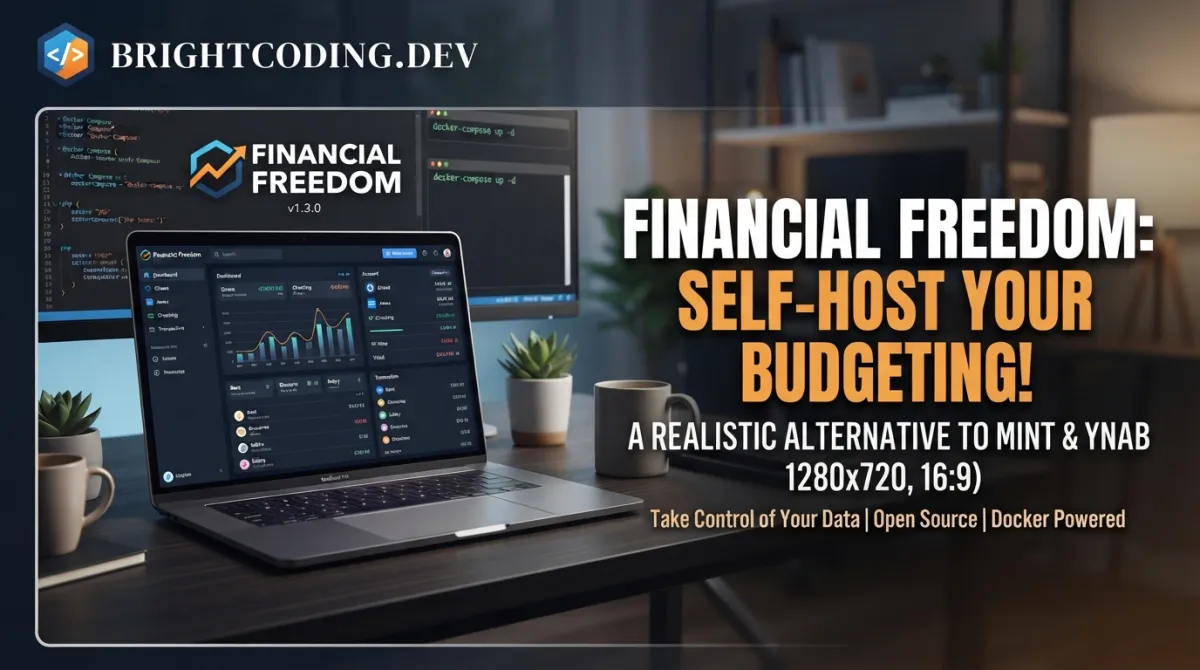
Developers and privacy-conscious users have watched the personal finance app landscape shrink: Mint shut down its free tier, YNAB raised prices, and most alternatives require handing sensitive financial data to venture-backed companies. The tweet pointing to serversideup/financial-freedom captures exactly this frustration—an open-source alternative that promises to keep your budget data under your control. But what does the project actually deliver today, and who is building it?
This article examines serversideup/financial-freedom based strictly on its repository data and README documentation. With 2,888 GitHub stars, 217 forks, and a Vue.js↗ Bright Coding Blog frontend, the project has attracted genuine interest. However, a critical status update from the maintainers changes how developers should evaluate it right now. Read on for the full technical picture before you clone the repo.
What is serversideup/financial-freedom?
serversideup/financial-freedom is an open-source personal finance application positioned as an alternative to Mint, YNAB, and similar proprietary budgeting tools. It is maintained by Server Side Up, a two-person bootstrapped team consisting of Dan Pastori and Jay Rogers. The project is licensed under the GNU General Public License v3.0, ensuring that the source code remains open and modifiable.
Technically, the application is built primarily with Vue as its frontend framework, making it relevant for developers already invested in the Vue ecosystem or those evaluating modern JavaScript↗ Bright Coding Blog-based personal finance tools. The project emphasizes self-hosting via Docker↗ Bright Coding Blog, targeting users who want to deploy on their own infrastructure—whether that is AWS, DigitalOcean, or a Raspberry Pi in their basement.
The project's relevance stems from a specific market dynamic: personal finance apps increasingly monetize through opaque means—selling metadata, pushing investment products, or relying on venture capital to subsidize artificially low prices. The maintainers explicitly reject this model. However, they also acknowledge the economic challenge this creates. As of their latest update, the project is on hold while they pursue self-funding through professional products and SaaS services rather than accepting venture capital or compromising on privacy.
The last commit was dated 2026-05-10, indicating recent activity, but the README contains a prominent caution: the codebase is in the middle of a major refactor and currently produces a blank screen if installed. This is not a production-ready tool at this moment, but rather a project with architectural ambitions and a transparent development process.
Key Features
The README documents several feature areas through visual assets and descriptive text. These are the capabilities the project intends to deliver, though their current implementation status should be understood in context of the on-hold refactor:
Universal Bank Compatibility: The project advertises support for any bank, suggesting integration with financial data sources without vendor lock-in to specific institutions.
Private Synchronization: Rather than relying on third-party aggregation services that may scrape and monetize transaction data, Financial Freedom emphasizes private data synchronization. This aligns with the core value proposition of keeping financial footprints off external servers.
Self-Hosting Flexibility: Docker-based deployment enables running the application on virtually any hardware that supports containers. The documentation specifically mentions cloud providers and edge devices like Raspberry Pi, appealing to both convenience-oriented and tinkerer audiences.
Tagging and Transaction Splitting: Standard personal finance capabilities for organizing spending across categories and handling split transactions—essential for accurate budgeting.
Cash Flow and Budget Management: Core financial tracking features including budget creation and cash flow monitoring, the fundamental functionality users expect from Mint or YNAB replacements.
Global Currency Support: Multi-currency handling for international users, a feature often neglected in US-centric financial tools.
The maintainers also highlight their public GitHub project board for real-time progress tracking, Discord community for discussions, and active solicitation of GitHub stars as confidence indicators. These community-oriented practices suggest a genuinely open development model rather than source-available code with closed governance.
Use Cases
Based on the documented features and architecture, serversideup/financial-freedom serves several concrete scenarios for technically capable users:
Privacy-First Personal Budgeting: Individuals who have migrated away from Mint following its product changes, or who distrust YNAB's data practices, can self-host their entire financial workflow. The Docker deployment model means no third party ever touches transaction data—not even an open-source project's own servers.
Homelab and Raspberry Pi Environments: The explicit mention of Raspberry Pi deployment targets hobbyists running home infrastructure. A low-power, always-on device in a basement can serve a household's budgeting needs without cloud dependency or subscription fees.
Multi-Currency Households: Families or individuals managing finances across countries benefit from global currency support without paying premium tiers at commercial services. Self-hosting eliminates per-account or per-currency upsells.
Developer Customization and Extension: The GPL v3.0 license and Vue.js codebase enable developers to fork, modify, and extend the application. A developer could integrate institution-specific APIs, build custom reporting, or adapt the UI for specialized workflows impossible within closed-source competitors.
Small Business or Freelance Finance Tracking: While not explicitly marketed for business use, the tagging, splitting, and cash flow features support sole proprietors or freelancers who need budget visibility without the complexity or cost of dedicated business accounting software.
Installation & Setup
Critical notice: The maintainers explicitly warn against attempting installation until the on-hold status is resolved. The following information is reproduced from the README for reference when the project resumes active development.
The project is designed for Docker-based deployment. The README does not provide exhaustive installation commands in the excerpted content, but establishes the deployment paradigm clearly:
# The application runs on any device or host supporting Docker
# Examples given: AWS, DigitalOcean, Raspberry Pi
# Specific docker-compose or run commands are not detailed in current README
The Gitpod integration offers an immediate cloud development environment:
# Access via Gitpod button in README
# URL pattern: https://gitpod.io/#https://github.com/serversideup/financial-freedom/
For developers reviewing the codebase during the hold period, standard repository operations apply:
# Clone the repository for code review
git clone https://github.com/serversideup/financial-freedom.git
cd financial-freedom

# Review current state (expect incomplete UI due to refactor)
git log --oneline -10
The maintainers state they were "working on the release process first before putting the project on hold," suggesting that deployment infrastructure is partially implemented but the application layer is not functional. Developers should monitor the GitHub project board for resumption signals before investing setup effort.
Real Code Examples
The provided README content does not contain extensive code snippets for application configuration or API usage. This reflects the project's current documentation state rather than a gap in our analysis. What is available relates to project engagement and development environment access:
Gitpod Development Environment:
<!-- From README: Gitpod launch button -->
<a href="https://gitpod.io/#https://github.com/serversideup/financial-freedom/">
  <img src="https://gitpod.io/button/open-in-gitpod.svg" alt="Open in Gitpod">
</a>
This embeddable button enables one-click cloud development without local Docker setup. For contributors examining the Vue codebase, this removes environment friction.
Badge and Status Integration:
<!-- License badge from README -->
<a href="https://github.com/serversideup/financial-freedom/blob/main/LICENSE" target="_blank">
  <img src="https://badgen.net/github/license/serversideup/financial-freedom" alt="License">
</a>
While not application code, this demonstrates the project's commitment to transparent licensing communication—relevant for developers auditing dependencies for GPL compatibility.
The absence of configuration examples, API documentation, or Docker Compose files in the README excerpt is notable. Developers should expect to derive deployment specifics from source examination or wait for documentation completion when development resumes. This limitation is explicitly acknowledged by the maintainers and should inform evaluation timelines.
Advanced Usage & Best Practices
Given the project's architecture and stated values, several practices align with effective self-hosting of financial applications—framed as guidance based on the documented design:
Container Security Hardening: When deployment resumes, running Financial Freedom with non-root Docker containers, read-only filesystems where possible, and secrets management for bank connection credentials follows security best practices for financial data. The Docker flexibility mentioned in the README enables these configurations.
Backup Strategy for Transaction Data: Self-hosting shifts data responsibility to the user. Implementing automated volume backups for the database container—whether PostgreSQL↗ Bright Coding Blog, MySQL↗ Bright Coding Blog, or another backend—prevents data loss without relying on SaaS provider recovery.
Network Isolation: Deploying the application within a private network or VPN, rather than exposing Docker ports directly to the internet, reduces attack surface. The Raspberry Pi use case particularly benefits from local-network-only access.
Monitoring the Project's Funding Progress: The maintainers are transparent about their self-funding timeline through their professional products. Developers invested in the project's success might evaluate these offerings as indirect sponsorship, or alternatively engage through GitHub Sponsors.
Contribution Preparation: The contribution guidelines and code of conduct are documented. Developers interested in participating can review these standards and monitor the Discord or GitHub Discussions for coordination when active development resumes.
Comparison with Alternatives
| Feature | serversideup/financial-freedom | Mint (Intuit) | YNAB | Maybe Finance |
|---|---|---|---|---|
| License | GPL v3.0 | Proprietary | Proprietary | Open source (previously) |
| Self-hosting | Docker, any hardware | Cloud-only | Cloud-only | Cloud or self-hosted (paused) |
| Pricing model | Free, community-funded | Free (ad-supported) / Paid tiers | $14.99/month subscription | Previously free/paid tiers |
| Data privacy | User-controlled | Data monetization | Subscription model, no ads | User-controlled |
| Development status | On hold (refactoring) | Active | Active | Paused (funding challenges) |
| Primary tech stack | Vue.js | Closed | Closed | Ruby on Rails |
The comparison reveals a pattern: Maybe Finance, another open-source personal finance tool, paused development for funding reasons similar to those cited by Server Side Up. This validates the maintainers' concern about sustainable open-source financial tools. Unlike venture-funded competitors that can operate at losses, bootstrapped open-source projects face direct revenue pressure.
Mint offers no self-hosting and monetizes through data products. YNAB provides a cleaner subscription model but locks users into their cloud infrastructure and pricing. serversideup/financial-freedom represents a values-aligned alternative that does not yet exist in stable form. The trade-off is clear: potential long-term autonomy versus current functionality and support availability.
FAQ
Is serversideup/financial-freedom ready for production use? No. The maintainers explicitly state the project is on hold mid-refactor and will display a blank screen if installed.
What technology stack does it use? Vue.js for the frontend, with Docker for deployment. The primary language is Vue, per repository metadata.
Can I contribute code during the hold period? You can review and fork the code, but active contribution coordination is likely limited until development resumes.
How does the GPL v3.0 license affect my usage? You can freely use, modify, and distribute the software. If you distribute modified versions, you must release source code under the same license.
Will the project accept venture capital? The maintainers have explicitly committed to self-funding and rejected VC investment to preserve user data privacy.
What alternatives exist if I need a working tool now? YNAB and Monarch Money are operational alternatives, with trade-offs in pricing, privacy, and self-hosting capability.
How can I support the project's return? GitHub Sponsors, purchasing Server Side Up professional products, or community engagement through Discord and GitHub stars.
Conclusion
serversideup/financial-freedom occupies a specific niche in the open-source landscape: a genuinely privacy-focused, self-hostable personal finance application built by principled maintainers who have chosen sustainability over growth-at-all-costs. For developers and privacy advocates, the project's values and technical direction—Vue.js frontend, Docker deployment, GPL licensing—are compelling.
However, the current reality is unambiguous: this is not a tool you can deploy today. The on-hold status, blank-screen warning, and mid-refactor state mean serversideup/financial-freedom is a project to watch, not a solution to adopt immediately. The maintainers' transparency about their funding challenges, including direct reference to Maybe Finance's similar pause, builds credibility even as it delays utility.
The best audience for this project right now includes: developers interested in contributing to or learning from a Vue-based financial application; privacy-focused users planning future infrastructure; and supporters of sustainable open-source funding models who can engage through sponsorship or community participation.
Monitor the GitHub project board for development resumption, join the Discord for updates, and star the repository to signal demand. When self-funded development resumes, serversideup/financial-freedom may deliver on its promise of financial autonomy without compromise.
Explore the project: https://github.com/serversideup/financial-freedom
Outils recommandés
Explore on the BrightCoding network
Hand-picked resources from our other sites.
PostgREST/postgrest: REST API from PostgreSQL Without Boilerplate
PostgREST serves a fully RESTful API from any existing PostgreSQL database. Written in Haskell with 27,442 GitHub stars, it delegates JSON serialization, valida...
IAmTomShaw/f1-race-replay: Interactive F1 Telemetry Visualization in Python
IAmTomShaw/f1-race-replay is a Python application for interactive Formula 1 race visualization and telemetry analysis, built with FastF1 and Arcade. Features in...
coder/coder: Self-Hosted Cloud Dev Environments with Terraform
coder/coder is a self-hosted platform for cloud development environments and AI agents using Terraform. Define workspaces as code, connect via Wireguard®, and r...
Continuez votre lecture
Why Alexandrie is the Ultimate Markdown Note-Taking App

Why CrossPaste is the Ultimate Game Changer for Clipboard Management
Why Chandra is the Ultimate OCR Tool for Handwriting and Tables

Stop Coding Alone: OPC-Skills Gives Your AI Agent Superpowers
Commentaires 0
Aucun commentaire pour l'instant. Soyez le premier à réagir !