Stop Building Loan Software from Scratch! Use Frappe Lending Instead
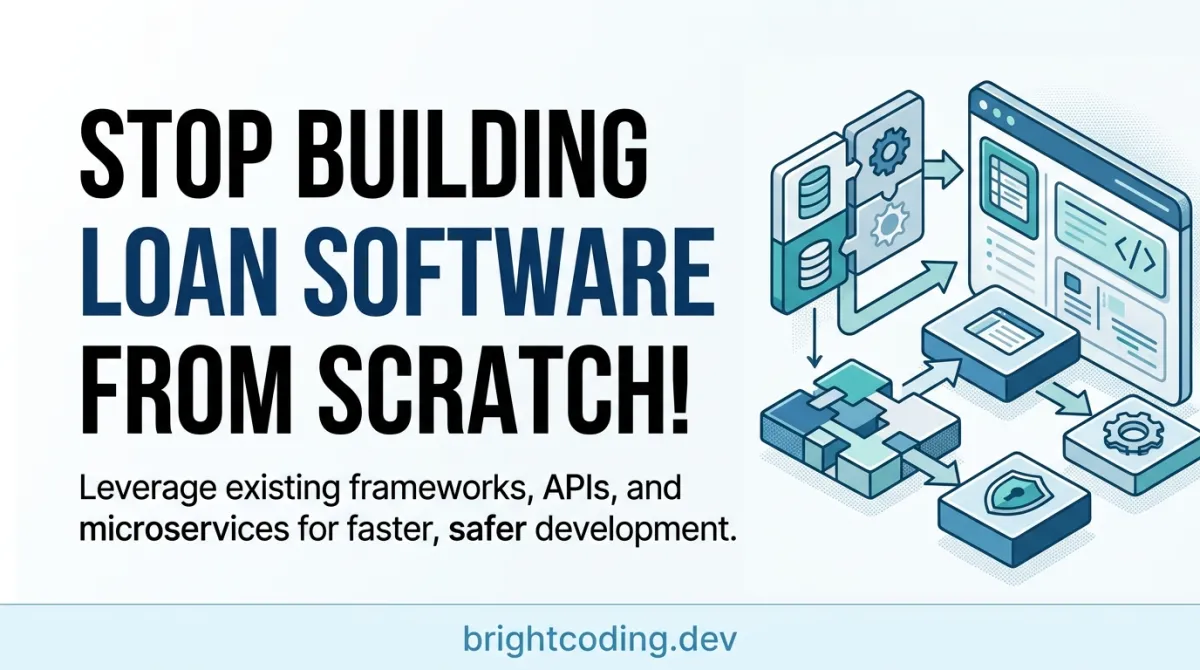
Stop Building Loan Software from Scratch! Use Frappe Lending Instead
What if I told you that financial institutions worldwide are hemorrhaging millions on proprietary loan management systems—while a battle-tested open-source alternative sits quietly on GitHub, waiting to disrupt everything?
Picture this: You're a fintech startup founder. You've just secured seed funding. Your product roadmap screams "loan origination platform." You hire three senior engineers. Six months later, they're still wrestling with amortization schedules, regulatory compliance modules, and the nightmare of double-entry bookkeeping for disbursements. Your runway evaporates. Your competitors launch first. Sound familiar?
Or maybe you're an IT director at an NBFC drowning in spreadsheets, legacy COBOL systems, and vendor lock-in that costs more than your actual loan portfolio. Every "simple" feature request becomes a six-figure consulting engagement. Your CFO is asking why the tech stack eats 40% of operational budget.
Here's the brutal truth: Loan management is deceptively complex. Interest calculations alone span simple, compound, declining balance, and annuity methods. Add collateral tracking, co-lending partnerships, GST/VAT compliance, and real-time accounting integration—and you've built a specialized ERP masquerading as a "simple" app.
But what if you could skip the blood, sweat, and venture capital bonfire? Enter Frappe Lending—the open-source loan management system that's making proprietary vendors nervous and smart developers ecstatic. Built atop the rock-solid Frappe Framework and ERPNext ecosystem, this isn't some fragile side project. It's production-grade infrastructure that powers real financial institutions right now.
In this deep dive, I'll expose why Frappe Lending deserves your attention, how it slashes development time from years to weeks, and the exact steps to get a fully functional loan system running on your infrastructure. Whether you're building the next digital lender or modernizing a sleepy credit union, this might be the most consequential GitHub repository you discover this year.
What is Frappe Lending?
Frappe Lending is a comprehensive, open-source Loan Management System (LMS) designed to automate the complete loan lifecycle—from initial application through final closure. Born from the same engineering DNA that powers ERPNext (used by 10,000+ companies globally), it represents a paradigm shift in how financial technology gets built and deployed.
The project lives at github.com/frappe/lending and is actively maintained by Frappe Technologies, the Mumbai-based open-source powerhouse behind the Frappe Framework. Don't let "open source" fool you into thinking "amateur hour." Frappe's commercial arm supports enterprise deployments for Unilever, Toyota, and Siemens. This is bank-grade infrastructure with a community-driven heart.
Why it's trending now: The global digital lending platform market is projected to hit $20.5 billion by 2026, yet most institutions still run on software from the 1990s. Meanwhile, fintech startups face a cruel choice: burn millions on custom development or accept rigid SaaS platforms that own your data. Frappe Lending threads this needle with radical transparency—you host it, you customize it, you own your destiny.
The system rides on two proven pillars:
- ERPNext: A mature, battle-tested ERP handling everything from inventory to accounting, trusted by organizations across 150+ countries
- Frappe Framework: A full-stack Python↗ Bright Coding Blog/JavaScript↗ Bright Coding Blog framework with built-in ORM, authentication, REST API, and a low-code app builder that accelerates development exponentially
This isn't a standalone toy that breaks when you need real accounting. It's a first-class module within a comprehensive business operating system—meaning your loan book connects seamlessly to general ledger, customer management, reporting, and tax compliance from day one.
Key Features That Separate Frappe Lending from the Pack
Let's dissect what makes this system genuinely powerful for serious lending operations.
Loan Products & Management
Create infinitely configurable loan products without writing code. Define tenor ranges, interest rate bands, grace periods, penalty structures, and repayment frequencies through the Frappe UI. Need a microloan product with weekly collections at 24% declining balance? A 30-year mortgage with annual rests? Configure it in minutes, not sprints.
Streamlined Loan Operations
The entire lifecycle gets automated: application → appraisal → approval → sanction → disbursement → repayment → closure. Each stage triggers configurable workflows, document collections, and approval hierarchies. No more loans stuck in email limbo or approved without proper collateral verification.
Collateral and Security Management
Track multiple collateral types—immovable property, vehicles, financial securities, guarantees—linked to specific loans or loan portfolios. Set coverage ratios, trigger margin calls when values dip, and generate release documentation upon full repayment. For NBFCs dealing with secured lending, this is non-negotiable functionality.
Automated Financial Accounting
Here's where Frappe Lending destroys standalone competitors. Every loan transaction—disbursement, interest accrual, principal repayment, write-off—auto-generates double-entry accounting entries in ERPNext's general ledger. Your CFO gets real-time P&L by product. Your auditors get clean trial balances. Your compliance team stops crying.
Billing and Taxation Engine
Automate interest calculations, EMI generation, and tax computation (GST, TDS, stamp duty) with configurable rules. Handle prepayments, part-payments, and rescheduling without manual spreadsheet gymnastics. The system maintains full audit trails for every penny computed.
Risk and Compliance Framework
Generate credit bureau reports, NPA classifications, and provisioning calculations automatically. Set early warning indicators for portfolio deterioration. Build regulatory reports (RBI, SEC, Basel) using Frappe's report builder. Compliance stops being a quarterly panic attack.
Co-Lending and Loan Transfers
The secret weapon for modern lending: native support for co-lending models (bank-fintech partnerships popularized by India's OCEN protocol) and seamless loan portfolio transfers between lenders. Originate, service, sell, or participate—without system fragmentation.
Real-World Use Cases Where Frappe Lending Dominates
1. Digital NBFC Launch
A fintech founder needs to launch a digital lending platform in 90 days. Custom build? 18 months minimum. Proprietary LMS? $500K+ license plus per-loan fees. Frappe Lending on cloud infrastructure: Deploy in days, customize workflows for their specific underwriting model, integrate with eKYC and payment gateways via Frappe's REST API. Total cost: infrastructure + one senior Python developer.
2. Credit Union Modernization
A 50-year-old credit union runs on a FoxPro database from 1998. Members demand mobile access. Regulators demand modern reporting. Migration to Frappe Lending preserves their community-focused loan products while adding online applications, automatic credit scoring integration, and real-time member dashboards. The open-source nature means no vendor can hold their data hostage.
3. Supply Chain Finance Platform
An enterprise wants to offer invoice financing to suppliers. They need: buyer credit limits, dynamic discounting, automated disbursement upon invoice verification, and integration with their existing ERP. Frappe Lending's modular architecture + ERPNext's procurement modules = unified platform without the integration hell of bolting standalone systems together.
4. Microfinance Institution Scaling
An MFI with 50,000 borrowers outgrows their Excel-based system. They need group lending support, center meeting schedules, mobile field officer apps, and portfolio-at-risk reporting. Frappe Lending's low-code capabilities let them build custom mobile interfaces while the core handles complex joint liability calculations and automated collection scheduling.
5. Bank-Fintech Co-Lending
Post-pandemic regulatory frameworks encourage bank-fintech partnerships. The bank brings balance sheet; the fintech brings technology and customer acquisition. Frappe Lending's co-lending module manages risk participation, blended interest rates, and dual servicing arrangements—functionality that typically requires six-figure enterprise software licenses.
Step-by-Step Installation & Setup Guide
Ready to deploy? Here's your complete path from zero to functioning loan system.
Prerequisites
- Ubuntu 22.04 LTS or Debian 11 server (4GB RAM minimum, 8GB recommended)
- Python 3.10+
- Node.js 18+
- MariaDB 10.6+ or PostgreSQL↗ Bright Coding Blog 13+
- Redis 6+ (for caching and background jobs)
- wkhtmltopdf (for PDF generation)
Method 1: Frappe Bench Installation (Recommended)
Frappe Bench is the official CLI tool managing multi-tenant Frappe deployments. Install the complete stack:
# Install system dependencies
sudo apt update && sudo apt upgrade -y
sudo apt install -y git python3-dev python3-setuptools python3-pip python3-venv \
    redis-server mariadb-server libmysqlclient-dev xvfb libfontconfig wkhtmltopdf \
    npm nodejs nginx software-properties-common

# Secure MariaDB installation
sudo mysql_secure_installation

# Configure MariaDB for Frappe
cat <<EOF | sudo tee /etc/mysql/mariadb.conf.d/99-frappe.cnf
[mysqld]
innodb-file-format=barracuda
innodb-file-per-table=1
innodb-large-prefix=1
character-set-client-handshake=FALSE
character-set-server=utf8mb4
collation-server=utf8mb4_unicode_ci
EOF

sudo systemctl restart mariadb

# Install Frappe Bench globally
sudo pip3 install frappe-bench

# Initialize bench with Frappe framework
bench init --frappe-branch version-15 frappe-bench
cd frappe-bench

# Create new site
bench new-site lending.local

# Install ERPNext (required dependency)
bench get-app erpnext --branch version-15
bench --site lending.local install-app erpnext

# Install Frappe Lending
bench get-app lending https://github.com/frappe/lending.git
bench --site lending.local install-app lending

# Start development server
bench start
Method 2: Docker↗ Bright Coding Blog Deployment (Production-Ready)
For production environments, use the official Docker compose setup:
# Clone the official Docker repository
git clone https://github.com/frappe/frappe_docker
cd frappe_docker

# Copy and customize environment
cp example.env .env
# Edit .env with your domain, database passwords, and secrets

# Deploy the full stack↗ Bright Coding Blog
docker compose -f compose.yaml -f overrides/compose.mariadb.yaml \
    -f overrides/compose.redis.yaml -f overrides/compose.https.yaml up -d

# Create site and install apps
docker compose exec backend bench new-site lending.yourdomain.com \
    --mariadb-root-password your_db_root_password \
    --admin-password your_admin_password

docker compose exec backend bench --site lending.yourdomain.com install-app erpnext
docker compose exec backend bench --site lending.yourdomain.com install-app lending
Post-Installation Configuration
- Navigate to your site (e.g.,
https://lending.local:8000) - Complete setup wizard: Company details, fiscal year, chart of accounts
- Configure loan products: Lending > Loan Products > New
- Set up chart of accounts for lending: Create dedicated loan asset accounts, interest income accounts, and provision accounts
- Define employee roles: Loan Officer, Credit Manager, Collections Agent with appropriate permissions
- Configure notification templates: For EMI reminders, overdue alerts, and approval workflows
REAL Code Examples from the Repository
Let's examine actual implementation patterns from Frappe Lending's codebase and documentation.
Example 1: Creating a Loan Product Programmatically
Loan products are the foundation—every loan issued conforms to a product's rules. Here's how to define one via Frappe's server-side API:
import frappe
from frappe.model.document import Document

# Create a new loan product with specific terms
loan_product = frappe.get_doc({
    "doctype": "Loan Product",
    "product_code": "PL-001",           # Unique identifier for this product
    "product_name": "Personal Loan - Salaried",
    "loan_type": "Term Loan",            # Options: Term Loan, Demand Loan, Overdraft
    "rate_of_interest": 14.5,            # Annual interest rate percentage
    "penalty_interest_rate": 2.0,        # Additional penalty on overdue amounts
    "maximum_loan_amount": 500000,       # Upper sanction limit in company currency
    "minimum_loan_amount": 50000,
    "maximum_tenure": 60,                # Maximum months for repayment
    "minimum_tenure": 12,
    "repayment_method": "Repay Fixed Amount per Period",  # EMI-style fixed payments
    "repayment_schedule_type": "Monthly",  # EMI frequency
    "grace_period_in_days": 7,           # Days after due date before penalty applies
    "write_off_amount": 100,             # Threshold for automatic write-off
    "days_past_due_threshold_for_npa": 90,  # Non-performing asset classification
    "collection_offset_sequence": "Penalty > Interest > Principal",  # Payment application order
    "interest_income_account": "Interest Income - Loans - PL",
    "penalty_income_account": "Penalty Income - Loans - PL",
    "loan_account": "Loans and Advances - PL",
    "disbursement_account": "Bank Account - Primary"
})

loan_product.insert()  # Persist to database
loan_product.submit()  # Activate product for use
frappe.db.commit()     # Ensure transaction completion
What's happening here? This script defines a complete personal loan product with risk parameters, accounting mappings, and collection logic. The collection_offset_sequence is critical—it determines how incoming payments apply against outstanding balances. Frappe Lending supports complex waterfall configurations essential for regulatory compliance.
Example 2: Processing a Loan Application Through Disbursement
The loan lifecycle involves multiple document states. Here's the progression:
# Step 1: Create loan application from customer data
application = frappe.get_doc({
    "doctype": "Loan Application",
    "applicant_type": "Customer",        # Could also be Employee, Member, etc.
    "applicant": "CUST-2024-001",
    "loan_product": "PL-001",
    "loan_amount": 300000,
    "repayment_method": "Repay Fixed Amount per Period",
    "repayment_periods": 36,             # 3-year term
    "rate_of_interest": 14.5,
    "is_secured_loan": 0,                # Unsecured personal loan
    "status": "Draft"
})
application.insert()

# Step 2: Submit for credit appraisal (triggers workflow)
application.submit()
# Workflow transitions: Draft → Sanctioned → Disbursed

# Step 3: Upon approval, create Loan document (the binding contract)
loan = frappe.get_doc({
    "doctype": "Loan",
    "applicant_type": "Customer",
    "applicant": "CUST-2024-001",
    "loan_product": "PL-001",
    "loan_amount": 300000,
    "rate_of_interest": 14.5,
    "disbursement_date": frappe.utils.today(),
    "repayment_start_date": frappe.utils.add_months(frappe.utils.today(), 1),
    "status": "Sanctioned"
})
loan.insert()
loan.submit()

# Step 4: Execute disbursement (creates accounting entries automatically)
disbursement = frappe.get_doc({
    "doctype": "Loan Disbursement",
    "against_loan": loan.name,
    "disbursement_date": frappe.utils.today(),
    "disbursed_amount": 300000,
    "bank_account": "Bank Account - Primary"
})
disbursement.insert()
disbursement.submit()
# This automatically: debits Loan Account, credits Bank Account, generates repayment schedule
Critical insight: Notice how disbursement.submit() triggers automated accounting entries and schedule generation—no manual journal entries, no spreadsheet imports. The Frappe Framework's document hook system (on_submit events) ensures business logic executes transactionally.
Example 3: Custom Interest Calculation Hook
For advanced scenarios, you can override default interest computation:
# In your custom app, extend Frappe Lending's interest calculation
import frappe
from lending.lo_management.doctype.loan_interest_accrual.loan_interest_accrual import LoanInterestAccrual

class CustomLoanInterestAccrual(LoanInterestAccrual):
    def calculate_accrual_amount(self):
        """Override for tiered interest based on outstanding principal"""
        outstanding = self.get_outstanding_principal()

        # Tiered rate structure: lower rates for lower balances
        if outstanding > 1000000:
            effective_rate = self.rate_of_interest + 2.0  # Risk premium
        elif outstanding > 500000:
            effective_rate = self.rate_of_interest + 1.0
        else:
            effective_rate = self.rate_of_interest

        # Daily interest accrual using actual/365 convention
        days_in_year = 365  # or 366 for leap years
        daily_rate = effective_rate / (100 * days_in_year)

        # Calculate for accrual period
        accrual_days = (self.posting_date - self.last_accrual_date).days
        interest_amount = outstanding * daily_rate * accrual_days

        return round(interest_amount, 2)

# Monkey-patch or configure via hooks.py
Why this matters: Many jurisdictions mandate specific interest calculation methods. Frappe Lending's class-based architecture lets you surgically override components without forking the entire codebase—maintainability that proprietary systems can't match.
Advanced Usage & Best Practices
Performance Optimization at Scale
When your portfolio exceeds 100,000 loans, naive queries crater performance. Implement these patterns:
- Partition loan tables by disbursement year using MariaDB partitioning
- Schedule interest accrual as background jobs via Frappe's RQ integration, not synchronous requests
- Materialize portfolio summary views for dashboard queries instead of real-time aggregation
- Archive closed loans to separate historical tables after statutory retention periods
Multi-Entity Lending Structures
Use Frappe's native multi-company support to manage separate NBFCs, SPVs, or geographic entities under one bench instance. Each company maintains independent chart of accounts, loan products, and regulatory reporting while sharing underlying infrastructure.
Custom Workflow Orchestration
Frappe's Workflow engine lets non-developers configure approval matrices:
Loan Application → [Branch Manager if < 5L] → [Regional Head if 5-25L] → [Credit Committee if > 25L] → Sanctioned
Each transition triggers notifications, field validations, and document state changes without code deployment.
API-First Integrations
Expose loan operations via REST for mobile apps, partner portals, or core banking integration:
# Authenticate and fetch customer's active loans
curl -X GET https://lending.yourdomain.com/api/resource/Loan \
  -H "Authorization: token your_api_key:your_api_secret" \
  -G --data-urlencode 'filters=[["applicant","=","CUST-2024-001"],["status","in",["Disbursed","Partially Disbursed"]]]'
Comparison with Alternatives
| Criteria | Frappe Lending | Proprietary LMS (e.g., Finacle, LoanPro) | Custom Build | Generic ERP (SAP, Oracle) |
|---|---|---|---|---|
| Initial Cost | Free (self-hosted) | $200K-$2M license | $500K-$5M development | $1M+ implementation |
| Customization | Unlimited source access | Vendor roadmap dependent | Complete control | Expensive consultants |
| Time to Market | Weeks | Months (procurement + config) | 12-24 months | 6-18 months |
| Accounting Integration | Native (ERPNext) | Separate module/integration | Build from scratch | Complex configuration |
| Compliance Updates | Community + commercial support | Vendor-dependent | Your responsibility | Vendor-dependent |
| Data Sovereignty | Full control | Cloud-hosted or on-prem premium | Full control | Often cloud-locked |
| Co-Lending Support | Native module | Rare/expensive add-on | Build custom | Not designed for |
| Developer Ecosystem | Growing (Python/JS) | Proprietary languages | Your team only | SAP ABAP/Java |
The verdict? Frappe Lending dominates for organizations prioritizing speed, cost-efficiency, and control. Proprietary systems win only when you need vendor blame-shifting for regulatory comfort—and even then, Frappe's commercial support subscriptions provide equivalent accountability.
FAQ: Your Burning Questions Answered
Q: Is Frappe Lending production-ready for regulated financial institutions?
Absolutely. The underlying Frappe Framework and ERPNext power regulated entities across banking, healthcare, and government. Implement proper audit trails, access controls, and backup procedures as you would with any enterprise system.
Q: Can I customize interest calculation methods for my jurisdiction?
Yes. The Python-based architecture allows complete override of accrual engines. Common implementations include 30/360, actual/actual, and Islamic profit-rate structures.
Q: How does mobile collection agent functionality work?
Build custom Frappe apps using the Frappe Mobile SDK, or integrate with third-party field force platforms via REST APIs. The Frappe community has published open-source collection apps.
Q: What's the migration path from our existing loan system?
Use Frappe's Data Import Tool for master data, then build ETL scripts for historical transactions. The Document API supports bulk operations with validation.
Q: Is commercial support available?
Frappe Technologies and certified partners offer SLA-backed support, custom development, and managed hosting. You're never dependent purely on community goodwill.
Q: How does co-lending data segregation work between partner banks?
Frappe's permission engine supports field-level and record-level access control. Configure role permissions so each partner sees only their participation data while you maintain consolidated portfolio views.
Q: Can it handle Islamic (Shariah-compliant) financing structures?
With customization, yes. The modular design accommodates Murabaha, Ijara, and Mudaraba structures by overriding interest calculations with profit-sharing logic and reconfiguring accounting entries.
Conclusion: The Lending Infrastructure You Actually Own
Here's what we've uncovered: Frappe Lending isn't just another open-source project collecting GitHub stars. It's a strategic weapon for any organization that believes financial infrastructure should be transparent, customizable, and economically rational.
The proprietary lending software industrial complex thrives on artificial complexity and vendor lock-in. They've convinced institutions that loan management requires million-dollar sacrifices to oracle-like vendors. Frappe Lending exposes this mythology with working code you can inspect, modify, and deploy on your terms.
Whether you're launching a digital lender, modernizing legacy operations, or building innovative co-lending marketplaces, this platform delivers enterprise functionality without enterprise extortion. The Python/JavaScript skillset means you're not hunting extinct COBOL programmers or paying SAP consultant rates. The ERPNext foundation means your loan book lives in harmony with general ledger, CRM, and HR systems—not siloed in yet another data prison.
My recommendation? Don't take my word for it. Spin up a test instance this week. Build one loan product. Process one application. Feel the velocity of a system designed by developers who understand that financial software should accelerate business, not strangle it.
The future of lending infrastructure is open-source, composable, and developer-friendly. That future is already on GitHub, waiting for you to claim it.
👉 Star the repository, read the documentation, and join the community at github.com/frappe/lending
Your loan operations team—and your CFO—will thank you.
Outils recommandés
Tags
Explore on the BrightCoding network
Hand-picked resources from our other sites.
Stop Learning AI Wrong: 93 Projects That Actually Build Skills
Discover the AI Engineering Hub: 93+ production-ready open-source projects covering LLMs, RAG systems, and AI agents. From beginner OCR apps to advanced fine-tu...
simoncirstoiu/alice: Self-Hosted YOLO Dataset Toolkit for Frigate NVR
simoncirstoiu/alice is a self-hosted, AI-powered toolkit for YOLO dataset management, annotation, and training with native Frigate NVR integration. Supports YOL...
Stop Struggling with LLMs! Use Hands-On-Large-Language-Models Instead
Master LLMs from scratch with Hands-On Large Language Models — the official O'Reilly book repository with 300+ visuals, 12 executable chapters, and production-r...
Continuez votre lecture

The Multi-Agent Revolution: How AI Agent Platforms Are Transforming Financial Applications (2025 Guide)
StockBench Exposed: How AI Language Models Are Quietly Revolutionizing Stock Trading (And Which Ones Actually Make Money)

How Multi-Agent AI Workflows Are Generating 400% Faster Returns for Smart Investors

Stop Coding Alone: OPC-Skills Gives Your AI Agent Superpowers
Commentaires 0
Aucun commentaire pour l'instant. Soyez le premier à réagir !