Stop Duct-Taping RAG Pipelines! Morphik Core Is the Fix
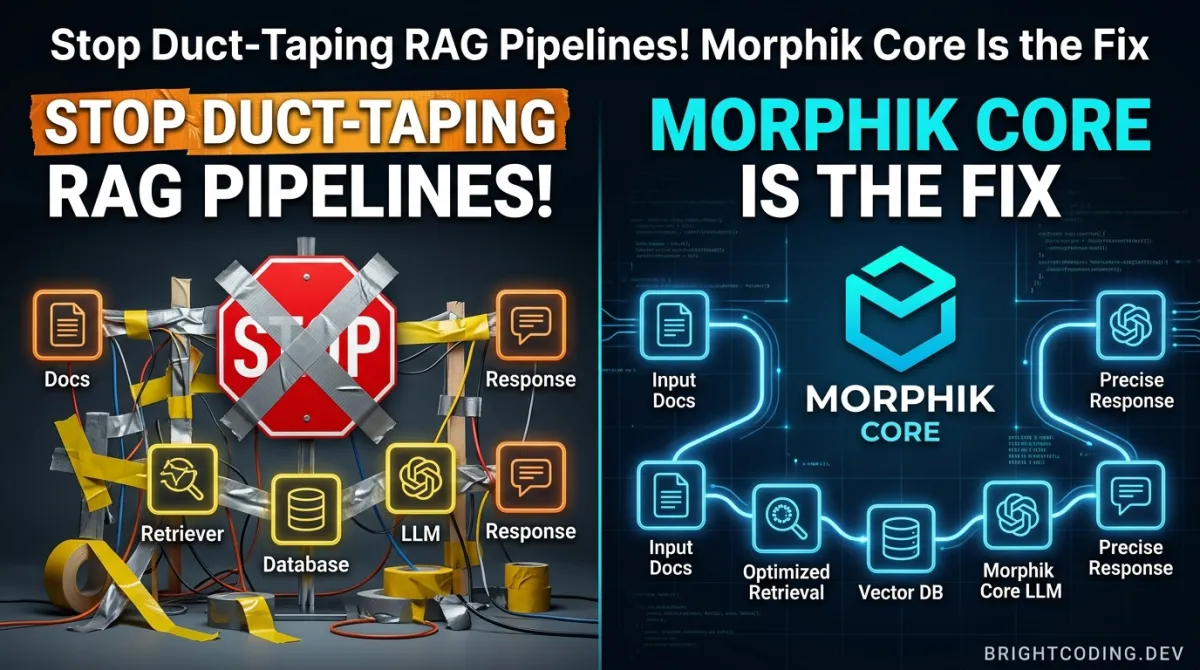
Stop Duct-Taping RAG Pipelines! Morphik Core Is the Fix
You've been there. Your "simple" RAG demo worked beautifully on three clean PDFs. Then production hit. Suddenly, that 500-page technical manual with embedded diagrams, charts, and tables becomes a minefield of hallucinated answers. Your vector database chokes. Your embedding model turns that critical architecture diagram into meaningless noise. And your LLM? It's confidently wrong—because it never actually saw the visual information that mattered most.
Here's the dirty secret nobody warned you about: traditional RAG is fundamentally broken for real documents. The kind with mixed text, images, charts, and spatial relationships. The kind your enterprise actually uses.
What if you could stop cobbling together a dozen fragile tools and get one system that actually understands documents visually? Enter Morphik Core—the AI-native document search and store that's making developers abandon their duct-taped pipelines forever. Built by the team at Morphik, this isn't just another vector database wrapper. It's a complete rethink of how AI applications should interact with unstructured, visually rich data.
Ready to see what you've been missing? Let's dive deep.
What Is Morphik Core?
Morphik Core is the open-source engine behind Morphik—described by its creators as "the most accurate document search and store for building AI apps." But that tagline barely scratches the surface of what's happening under the hood.
Created by the Morphik team, this project addresses a critical gap in the AI infrastructure landscape: the complete inability of traditional retrieval systems to handle visually rich, multimodal documents. While the industry obsessed over chunking strategies and embedding models, they ignored the elephant in the room—documents aren't just text. They're complex visual artifacts where meaning lives in layout, spatial relationships, diagrams, and the interplay between text and imagery.
Morphik Core is trending now because the pain has become impossible to ignore. Enterprises are flooding LLMs with PDFs full of technical schematics, financial reports with intricate charts, and product manuals where a single diagram contains more information than three pages of text. Traditional RAG fails catastrophically here. Morphik Core succeeds by treating documents as multimodal first, not as an afterthought.
The project is source-available under the Business Source License 1.1—free for personal, indie, and small commercial use (under $2,000/month gross revenue), with automatic Apache 2.0 relicensing four years after each version's release. This licensing model balances sustainable development with genuine open-source commitment.
With active development (check those GitHub commit activity badges), a growing Discord community, and a generous free tier, Morphik Core is rapidly becoming the go-to choice for developers who've been burned by fragile RAG pipelines one too many times.
Key Features That Destroy Traditional RAG
Morphik Core isn't incrementally better—it's a paradigm shift. Here's what makes it devastatingly effective:
Multimodal Search with ColPali
This is where Morphik Core fundamentally diverges from every vector database you've used. Instead of extracting text and throwing away visual context, Morphik employs ColPali and similar techniques to build search that understands visual content natively. Search across images, PDFs, videos, and more through a single endpoint. That architecture diagram? It's searchable as a visual entity, not degraded into garbled OCR text.
Fast, Scalable Metadata Extraction
Morphik Core doesn't just store documents—it comprehends them. Extract metadata including bounding boxes, automatic labeling, and classification at scale. This isn't manual tagging; it's intelligent document understanding that preserves spatial and structural information critical for accurate retrieval.
End-to-End Integration Ecosystem
Stop writing glue code. Morphik integrates natively with Google Suite, Slack, Confluence, and expanding toolchains. Your documents flow in, get processed with full multimodal understanding, and become queryable without fragile pipeline orchestration.
Production-Grade Performance
The June 2025 authentication optimization delivered 70-80% faster query performance for existing deployments. This isn't hobbyist software—it's engineered for real load with real latency requirements.
Multiple Access Patterns
Whether you're a Python↗ Bright Coding Blog developer, REST API consumer, web UI user, or MCP (Model Context Protocol) integrator, Morphik Core meets you where you are. No forced abstractions that don't fit your architecture.
Real-World Use Cases Where Morphik Core Dominates
1. Technical Documentation & Engineering Specs
Manufacturing and hardware companies live or die by technical specifications. A single chair assembly manual might contain 200 pages of mixed text, exploded diagrams, dimension tables, and material callouts. Traditional RAG turns that diagram of "screw 14-A" into unsearchable noise. Morphik Core's ColPali-powered search lets engineers query: "What's the height of screw 14-A in the chair assembly instructions?" and get accurate answers because the system preserves visual-spatial relationships.
2. Financial Report Analysis
Quarterly earnings reports are visual documents. Critical trends hide in chart shapes, table structures, and the relationship between textual commentary and visual data representations. Analysts using traditional RAG miss pattern changes in revenue graphs because their system sees only extracted text. Morphik Core searches the actual visual content—trend lines, bar comparisons, pie segment proportions—alongside text.
3. Medical Imaging & Clinical Documentation
Clinical pathways often combine radiology reports (text), imaging annotations (visual), and patient history tables. The spatial relationship between a tumor annotation and its measurement table matters clinically. Traditional systems destroy this relationship through text-only extraction. Morphik Core maintains multimodal context for clinically relevant retrieval.
4. Legal Document Review
Contracts and case files contain complex tables, signature blocks, and referenced exhibits where layout carries legal meaning. "The clause in the third column of Schedule B" is a valid legal query that requires visual understanding. Morphik Core enables spatially-aware legal search that traditional text extraction cannot support.
5. Multimodal Content Platforms
Media companies, educational platforms, and research archives need to search across video transcripts, embedded slides, diagrams, and textual narration simultaneously. Morphik Core's unified multimodal endpoint eliminates the need for separate video, image, and text search systems.
Step-by-Step Installation & Setup Guide
Morphik offers two paths: managed cloud (recommended for fastest start) or self-hosted open source. Here's how to get running with both.
Option A: Managed Cloud (Fastest—Recommended)
The zero-infrastructure path to production-grade multimodal search:
# Step 1: Sign up for free at morphik.ai
# Visit: https://www.morphik.ai/signup
# Generous free tier; pay only for compute usage at scale

# Step 2: Get your Morphik URI from the dashboard
# Format: https://api.morphik.ai/<your-workspace-id>

# Step 3: Install the Python SDK
pip install morphik
That's it. No vector database setup. No embedding model hosting. No OCR pipeline configuration. The managed service handles all infrastructure, scaling, and optimization.
Option B: Self-Hosted (Full Control)
For organizations requiring data sovereignty or custom deployments:
# Clone the repository
git clone https://github.com/morphik-org/morphik-core.git
cd morphik-core

# Follow detailed self-hosting instructions at:
# https://morphik.ai/docs/getting-started

# Docker↗ Bright Coding Blog installation available for containerized deployment
# Direct installation also supported
Critical Migration Note for Existing Installations:
If you deployed Morphik before June 22nd, 2025, run this authentication migration to unlock 70-80% query performance improvements:
# Run the migration script with your PostgreSQL↗ Bright Coding Blog URI
python scripts/migrate_auth_columns_complete.py \
  --postgres-uri "postgresql+asyncpg://user:pass@host:port/db"
Self-Hosting Reality Check: The Morphik team is transparent about support limitations. They provide installation guides and an active Discord community, but cannot guarantee full support for self-hosted deployments due to resource constraints.
Environment Configuration
For cloud usage, you'll need:
- Python 3.9+
morphikSDK (pip install morphik)- Your Morphik URI from the dashboard
For self-hosted:
- Docker (recommended) or Python 3.9+
- PostgreSQL with asyncpg support
- Sufficient compute for multimodal model inference
Real Code Examples from Morphik Core
Let's examine actual code patterns from the Morphik Core repository and explain how they solve real problems.
Example 1: Basic Document Ingestion
The foundation of any document search system is getting data in. Morphik Core makes this trivially simple:
from morphik import Morphik

# Initialize with your Morphik URI (cloud or self-hosted)
# This single object becomes your gateway to all multimodal operations
morphik = Morphik("<your-morphik-uri>")

# Ingest any file—PDF, image, video, or mixed document
# Morphik automatically detects format, extracts multimodal content,
# and builds searchable representations using ColPali techniques
morphik.ingest_file("path/to/your/super/complex/file.pdf")
What's happening here? Traditional systems would require you to: (1) read the PDF, (2) extract text with something like PyPDF2, (3) run OCR with Tesseract for any images, (4) chunk the text, (5) generate embeddings with an external API, (6) store in a vector database. Six steps, six failure points. Morphik Core collapses this into one method call with built-in multimodal understanding.
Example 2: Natural Language Querying
Once documents are ingested, querying is equally streamlined:
# Query using natural language—Morphik handles the complexity
# This searches across text, visual elements, and their relationships
result = morphik.query("What's the height of screw 14-A in the chair assembly instructions?")

# The result contains relevant information from the document,
# preserving visual context that traditional RAG would destroy
print(result)
Why this matters: That query about "screw 14-A" requires understanding: (a) that "screw 14-A" is a labeled entity in a diagram, (b) the spatial relationship between the label and dimension callout, (c) that "height" refers to a specific measurement annotation. Traditional RAG loses all this visual-spatial information. Morphik Core's ColPali-based retrieval preserves and searches these relationships natively.
Example 3: Production Pattern with Error Handling
For production deployments, wrap operations with proper error handling:
from morphik import Morphik
import os

# Best practice: load URI from environment variables
# Never hardcode credentials in production code
MORPHIK_URI = os.getenv("MORPHIK_URI")
if not MORPHIK_URI:
    raise ValueError("MORPHIK_URI environment variable required")

morphik = Morphik(MORPHIK_URI)

# Batch ingestion pattern for document collections
document_paths = [
    "specs/chair_assembly.pdf",
    "specs/table_dimensions.pdf",
    "images/hardware_diagram.png",
    "videos/assembly_guide.mp4"  # Yes, video too!
]

for path in document_paths:
    try:
        # ingest_file returns document metadata you can store
        # for tracking, updating, or deletion later
        doc_info = morphik.ingest_file(path)
        print(f"Ingested: {path} → ID: {doc_info.id}")
    except Exception as e:
        # Log and continue—production resilience
        print(f"Failed to ingest {path}: {e}")

# Complex query with domain-specific terminology
query = "Compare load-bearing specifications between model X7 and X9 in the structural analysis section"
response = morphik.query(query)
Production insight: Notice how Morphik handles heterogeneous document types in a single collection. PDFs, images, and videos coexist with unified search. No separate pipelines, no format-specific preprocessing, no "sorry, we only support text" limitations.
Example 4: Integration with Existing Workflows
Morphik Core's REST API enables non-Python integrations:
# Direct API access for any language or tool
curl -X POST "https://api.morphik.ai/v1/ingest" \
  -H "Authorization: Bearer <your-token>" \
  -F "file=@/path/to/document.pdf" \
  -F "metadata={\"source\":\"engineering\",\"priority\":\"high\"}"

# Query via REST
curl -X POST "https://api.morphik.ai/v1/query" \
  -H "Authorization: Bearer <your-token>" \
  -H "Content-Type: application/json" \
  -d '{"query":"Find all torque specifications for M12 bolts"}'
Advanced Usage & Best Practices
Optimize Ingestion Patterns
For large document collections, ingest during off-peak hours. Morphik's multimodal processing is compute-intensive—batch strategically to balance latency and throughput.
Leverage Metadata Extraction
Use Morphik's rules processing to automatically extract bounding boxes and classifications. This creates structured metadata overlays on unstructured documents, enabling hybrid search (metadata filters + semantic similarity).
Monitor Query Patterns
The Morphik Console provides visibility into query performance. Identify slow queries and consider: (a) document pre-segmentation, (b) metadata-based filtering before semantic search, or (c) query reformulation strategies.
MCP Integration for Agent Systems
For AI agent architectures, integrate via Model Context Protocol. This exposes Morphik's retrieval capabilities directly to agent reasoning loops, enabling tool-use patterns where agents dynamically retrieve document context.
Version Your Document Collections
Track document versions through external metadata. When specifications update, ingest new versions with version tags and use metadata filters to query specific document generations.
Morphik Core vs. Alternatives: Why Make the Switch?
| Capability | Traditional RAG (Pinecone/Weaviate + LangChain) | Morphik Core |
|---|---|---|
| Native Multimodal Search | ❌ Requires separate image/video pipelines | ✅ ColPali-powered unified search |
| Visual-Spatial Understanding | ❌ Destroys layout/diagram relationships | ✅ Preserves spatial context |
| Setup Complexity | 🔴 High (5-10+ components to configure) | 🟢 Low (single SDK or managed service) |
| OCR + Text Extraction | 🔴 Separate tools (Tesseract, AWS↗ Bright Coding Blog Textract) | ✅ Built-in, optimized |
| Video Support | ❌ Not natively supported | ✅ Native ingestion and search |
| Production Maintenance | 🔴 Fragile pipeline orchestration | 🟢 Managed or containerized |
| Cost at Scale | 🔴 Multiple vendor bills, hidden costs | 🟢 Transparent compute-based pricing |
| Open Source | Partial (components vary) | ✅ Source-available, future Apache 2.0 |
The verdict? If your documents are primarily clean text, traditional RAG might suffice. But if you work with technical documentation, financial reports, medical records, legal contracts, or any visually rich content, Morphik Core isn't just better—it's the only option that actually works.
FAQ: What Developers Ask About Morphik Core
Is Morphik Core really free?
Yes! The source-available license permits free personal, indie, and small commercial use (under $2,000/month gross revenue). Larger commercial deployments require a key from morphik.ai/pricing. Plus, every version automatically becomes Apache 2.0 after four years.
How does ColPali search differ from CLIP embeddings?
CLIP generates single vector representations for entire images. ColPali produces token-level visual representations that preserve spatial relationships and fine-grained visual details. This enables precise retrieval of specific visual elements (like a labeled screw in a diagram) rather than vague image-level similarity.
Can I self-host without Docker?
Yes, direct installation is documented at morphik.ai/docs/getting-started. However, Docker is recommended for dependency isolation and reproducible deployments.
What document formats are supported?
PDFs, images (PNG, JPG, etc.), videos, and more. The unified ingestion endpoint handles format detection and appropriate processing automatically.
How do I migrate from an existing vector database?
Re-ingest documents through Morphik's SDK. The improved retrieval quality typically justifies the one-time migration cost. For large collections, use batch ingestion with progress tracking.
Is there a JavaScript↗ Bright Coding Blog/TypeScript SDK?
Currently Python SDK and REST API are primary interfaces. The REST API enables any language integration. Check the documentation for latest SDK updates.
How does performance compare after the June 2025 update?
The authentication optimization delivered 70-80% faster queries for existing deployments. Run the migration script if you installed before June 22nd, 2025.
Conclusion: The Future of Document Search Is Multimodal
Here's the hard truth: your AI application is only as good as the context you feed it. And if your retrieval system is blindly extracting text while destroying visual information, you're feeding your LLM garbage. Beautifully vectorized garbage, perhaps—but garbage nonetheless.
Morphik Core represents a fundamental course correction. By building multimodal understanding into the foundation rather than bolting it on as an afterthought, it enables the kind of accurate, reliable document search that production AI applications actually require.
The team at Morphik has done something rare: they've identified a genuine blind spot in the AI infrastructure landscape and built a solution that doesn't just patch it, but reimagines what's possible. From ColPali-powered visual search to unified ingestion across document types, from generous free tiers to genuine open-source commitment, this is a project worth watching—and using.
Stop duct-taping your RAG pipeline. Stop pretending diagrams don't matter. Stop accepting hallucinated answers because your system never understood the document in the first place.
Get started today: sign up for the free tier, grab the Python SDK, or dive into the source code on GitHub. Your future self—and your users—will thank you.
Found this breakdown valuable? Star the Morphik Core repository, join their Discord community, and start building document search that actually sees what your documents contain.
Outils recommandés
Explore on the BrightCoding network
Hand-picked resources from our other sites.
ScreenAgent: The AI That Sees Your Screen and Takes Control
ScreenAgent is an IJCAI-24 visual language model agent that autonomously controls computers by perceiving screenshots and outputting mouse/keyboard actions. Lea...
Stop Coding RAG From Scratch! Let Claude Code Build It For You
Discover how to build production-grade agentic RAG systems without writing code using the Claude Code Agentic RAG Masterclass. An 8-module course where you coll...
Stop Learning AI Wrong: 93 Projects That Actually Build Skills
Discover the AI Engineering Hub: 93+ production-ready open-source projects covering LLMs, RAG systems, and AI agents. From beginner OCR apps to advanced fine-tu...
Continuez votre lecture

Why Alexandrie is the Ultimate Markdown Note-Taking App

Why CrossPaste is the Ultimate Game Changer for Clipboard Management

Why Chandra is the Ultimate OCR Tool for Handwriting and Tables

Stop Coding Alone: OPC-Skills Gives Your AI Agent Superpowers
Commentaires 0
Aucun commentaire pour l'instant. Soyez le premier à réagir !