Stop Guessing What's Killing Your Battery: Jolt Exposed
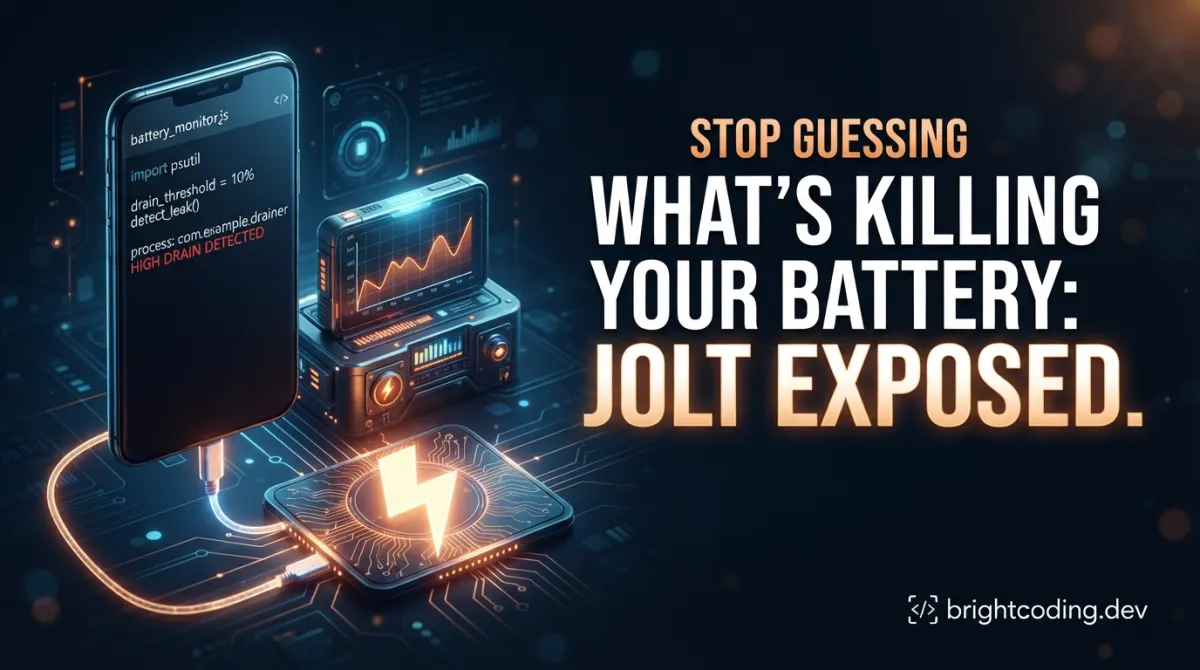
Your laptop dies at 2 PM. Again. You've tried everything—dimming the screen, closing tabs, even sacrificing Chrome to the battery gods. But here's the brutal truth: you're flying blind. macOS Activity Monitor lies to you. Linux powertop looks like it was designed in 1997. And neither tells you which process is secretly guzzling watts while you code.
What if you could see your battery's soul?
Enter jolt—a terminal-based battery and energy monitor that exposes exactly what's draining your power, in real-time, with the kind of beautiful interface that makes you want to leave it running just to watch the graphs. Built by developer Jordon de Hoog, this Rust-powered tool is already becoming the secret weapon of developers who refuse to let mystery processes steal another minute of productivity.
In this deep dive, I'll show you why top developers are abandoning bloated GUI monitors, how jolt reveals hidden power vampires you never knew existed, and exactly how to wield it like a pro. Your battery—and your sanity—will thank you.
What is Jolt?
Jolt is an open-source, terminal-based battery and energy monitoring tool for macOS and Linux, written in Rust for maximum performance and minimal resource overhead. It delivers real-time insights into power consumption, per-process energy impact, battery health metrics, and historical trends—all through a clean, customizable Text User Interface (TUI) that runs directly in your terminal.
Created by Jordon de Hoog and hosted at jordond/jolt, this project addresses a genuine gap in developer tooling. While macOS ships with Activity Monitor and Linux offers fragmented power tools, neither provides a unified, scriptable, visually informative solution for understanding energy consumption at a glance.
Jolt is trending now because it hits a sweet spot: serious utility with delightful UX. The Rust implementation means it starts instantly, uses negligible CPU, and won't become part of the battery problem it's solving. The TUI approach means it integrates seamlessly into developer workflows—no context switching, no floating windows, no Electron bloat.
The project supports 10+ built-in themes with automatic dark/light detection, a background daemon for continuous historical data collection, and even direct process termination for killing energy hogs without leaving the interface. For developers who live in terminals, jolt feels less like a new tool and more like something that should have shipped with the OS.
Key Features That Make Jolt Irresistible
Jolt isn't just another top clone with battery percentages. Here's what separates it from everything else:
🔋 Comprehensive Battery Intelligence
Jolt exposes charge percentage, time remaining, battery health percentage, and cycle count—all critical for developers running older hardware or managing fleet machines. The health metric alone can save you from unexpected shutdowns during deployments.
⚡ Real-Time Power Monitoring
See system-wide power draw with CPU/GPU breakdowns. On Apple Silicon Macs, this is shockingly precise. Suddenly you'll discover that your Docker↗ Bright Coding Blog containers pull more watts than your IDE, or that Slack's "idle" state is a complete fiction.
🎯 Process-Level Energy Tracking
Processes are sorted by energy impact with color-coded severity indicators. No more hunting through PID lists. The worst offenders glow red. One keystroke expands process groups to reveal child processes hiding their parent's sins.
📊 Historical Graphs
Battery and power trends over time, powered by jolt's background daemon. Spot patterns: Does your battery crater at 11 AM daily? Is that new Chrome extension the culprit? Data beats guessing.
🎨 10+ Themes with Auto-Detection
From sleek minimalism to high-contrast accessibility, jolt adapts to your aesthetic. The auto-detection respects your system theme without configuration—small touch, massive satisfaction.
👻 Background Daemon
The daemon collects data even when the TUI isn't running. Your history is complete, not just from when you remembered to check. Start it once, forget it forever.
💀 Kill Processes Inline
Press K on any process. Confirm. Gone. No ps aux | grep, no kill -9 hunting. The fastest intervention possible when a runaway build or rogue container starts cooking your lap.
Where Jolt Absolutely Dominates
Scenario 1: The Remote Developer Coffee Shop Crisis
You're on battery, no outlets in sight, deadline looming. Jolt's real-time power draw shows your Rust compile just spiked to 45W. You spot a forgotten Docker container burning 12W idle—kill it instantly. Your estimated battery time jumps from 2 hours to 4. Crisis averted, dignity intact.
Scenario 2: Debugging CI/CD Battery Drains on Developer Laptops
Your team reports laptops dying during local Kubernetes testing. Jolt's process tracking reveals kind clusters consuming 18W per node. You document with jolt pipe JSON output, file the issue, and justify remote CI resources. Data-driven decisions, not complaints.
Scenario 3: Maximizing Apple Silicon Efficiency
M-series chips are efficient, but poorly optimized apps still waste watts. Jolt's CPU/GPU breakdown exposes when your Electron app forces discrete GPU usage unnecessarily. Confront the developers with precise power metrics. Watch fixes ship faster.
Scenario 4: Linux Power User Optimization
Running Arch on a ThinkPad? Jolt's RAPL-based power monitoring (with proper permissions) finally gives you macOS-quality energy visibility on Linux. Tune powertop settings, verify improvements with jolt's historical graphs. Close the loop on optimization.
Installation & Setup: From Zero to Jolt in 60 Seconds
Quick Install (Recommended)
The fastest path to battery enlightenment:
# One-liner installation—verifies and installs automatically
curl -fsSL https://getjolt.sh/install.sh | bash
Homebrew (macOS/Linux)
# Add the tap and install
brew install jordond/tap/jolt
Cargo (Rust toolchain required)
# Install from crates.io
cargo install jolt-tui
Nix (Declarative or ephemeral)
# Run without installing
nix run github:jordond/jolt

# Install to current profile
nix profile install github:jordond/jolt
For NixOS systems, add to configuration.nix:
# Add jolt to system packages declaratively
environment.systemPackages = [
  (builtins.getFlake "github:jordond/jolt").packages.${pkgs.system}.default
];
Building from Source
# Clone the repository
git clone https://github.com/jordond/jolt.git
cd jolt

# Development build (faster compile, slower runtime)
cargo build
./target/debug/jolt

# Production build (optimized, recommended)
cargo build --release
./target/release/jolt
Linux Power Metrics Setup
Linux requires RAPL (Running Average Power Limit) permissions for power monitoring. See the Linux setup guide for configuring access without running as root.
Starting the Daemon (Critical for Historical Data)
# Enable background data collection
jolt daemon start

# Verify it's running
jolt daemon status

# Stop when needed (rarely)
jolt daemon stop
Real Code Examples: Jolt in Action
Let's examine actual functionality from jolt's command structure and usage patterns.
Example 1: Basic TUI Launch and Navigation
# Launch the interactive terminal UI—your new battery command center
jolt
Once running, jolt presents a live-updating interface. The keyboard shortcuts become muscle memory quickly:
| Key | Action | When to Use |
|---|---|---|
j / k |
Navigate up/down | Scanning process list |
Enter |
Expand/collapse process group | Investigating process families |
K |
Kill selected process | Emergency intervention on power hogs |
g |
Toggle graph | Switching between battery and power views |
t |
Open theme picker | Matching your terminal aesthetic |
s |
Open settings | Tuning refresh rates and defaults |
h |
View history | Analyzing trends over hours/days |
? |
Show help | Learning advanced shortcuts |
q |
Quit | Returning to your shell |
The K kill functionality is particularly powerful—it's context-aware process termination without leaving the interface. No PID lookup, no kill command construction. Select, confirm, eliminated.
Example 2: JSON Output for Scripting and Automation
# Output machine-readable metrics for integration with other tools
jolt pipe
This command streams structured JSON containing all current metrics. Perfect for:
- CI/CD integration: Fail builds if local power consumption exceeds thresholds during tests
- Monitoring systems: Pipe to Prometheus via node_exporter textfile collector
- Custom dashboards: Feed to your status bar or notification system
- Automated reports: Log energy usage during specific development tasks
The JSON output includes battery state, power draw, per-process energy impact, and system metadata—everything needed for programmatic analysis.
Example 3: Daemon Control for Continuous Monitoring
# Start background data collection service
jolt daemon start

# Check if daemon is healthy and collecting
jolt daemon status

# Stop collection (preserves existing history)
jolt daemon stop
The daemon is essential for historical graphs. Without it, jolt only shows instantaneous data. With it, you get trend analysis that reveals patterns invisible in momentary snapshots.
The daemon uses minimal resources—typically under 1% CPU and negligible memory—by leveraging efficient Rust async patterns and batched data writes.
Example 4: Debug Information for Troubleshooting
# Print comprehensive system and battery diagnostics
jolt debug
Use this when:
- Power metrics seem incorrect on Linux (check RAPL availability)
- Battery health doesn't match system reports
- Investigating platform-specific limitations
- Filing bug reports with complete environment context
Example 5: Theme and Configuration Management
# List and preview available themes
jolt theme

# Edit configuration directly
jolt config
Configuration includes refresh intervals, default views, graph time ranges, and theme preferences. The TUI's t shortcut provides instant visual preview—no restart required.
Advanced Usage & Pro Tips
Tip 1: Bind to Terminal Startup
Add jolt daemon start to your shell's login scripts. Historical data begins immediately, ensuring no gaps in your energy audit trail.
Tip 2: Status Bar Integration
Combine jolt pipe with tools like tmux or i3status-rust for always-visible power draw in your status bar:
# Extract current wattage for status display
jolt pipe | jq '.power.watts'
Tip 3: Automated Power Hog Alerts
Wrap jolt pipe in a cron job or systemd timer to notify when specific processes exceed wattage thresholds—catch runaway builds before they drain your battery.
Tip 4: Theme Synchronization
Jolt's auto-detection respects system theme, but you can force alignment in scripts:
# Set dark theme for night coding sessions
jolt config set theme "catppuccin-mocha"
Tip 5: Historical Export for Analysis
The daemon's data store can be queried for custom time ranges. Export and analyze with Python↗ Bright Coding Blog/pandas to identify weekly patterns or correlate energy usage with git commit activity.
Jolt vs. The Alternatives: Why Switch?
| Feature | Jolt | macOS Activity Monitor | Linux powertop |
battop |
|---|---|---|---|---|
| Terminal-native | ✅ Native TUI | ❌ GUI only | ✅ CLI | ✅ TUI |
| Real-time power draw | ✅ With CPU/GPU split | ⚠️ Basic | ✅ Yes | ❌ No |
| Per-process energy | ✅ Color-coded severity | ⚠️ Basic % | ⚠️ Estimates | ❌ No |
| Historical graphs | ✅ With daemon | ❌ No | ❌ No | ❌ No |
| Kill processes inline | ✅ Single keystroke | ⚠️ Separate dialog | ❌ No | ❌ No |
| Cross-platform | ✅ macOS + Linux | ❌ macOS only | ❌ Linux only | ⚠️ Limited |
| Themes/customization | ✅ 10+ themes | ❌ None | ❌ None | ⚠️ Minimal |
| JSON/scriptable output | ✅ jolt pipe |
❌ No | ⚠️ Limited | ❌ No |
| Background daemon | ✅ Built-in | ❌ No | ❌ No | ❌ No |
| Startup speed | ✅ Instant (Rust) | ⚠️ Slow | ✅ Fast | ✅ Fast |
The verdict: Activity Monitor is fine for casual checks, powertop is powerful but archaic, and battop lacks power metrics entirely. Jolt combines the best of all worlds with modern UX and extensibility.
FAQ: What Developers Ask About Jolt
Is jolt safe to run continuously?
Absolutely. The daemon uses <1% CPU and minimal memory. It's designed to be invisible—monitoring without becoming the monitored.
Why does Intel Mac show "Battery data only" for power metrics?
Apple Silicon exposes detailed power domains through private APIs that Intel chips don't provide. Jolt shows everything the hardware allows; this is a platform limitation, not a jolt limitation.
Can I use jolt without the daemon?
Yes, but you'll only see real-time data. Historical graphs require the daemon. We strongly recommend enabling it.
How accurate are Linux power readings?
Accuracy depends on RAPL (Running Average Power Limit) interface availability and permissions. Modern Intel/AMD laptops with proper kernel support provide excellent accuracy. See the Linux setup guide for configuration.
Can I contribute themes or features?
Please do! Jolt is MIT-licensed and actively maintained. Check CONTRIBUTING.md for guidelines. The theme system is particularly extensible.
Will jolt work on Windows?
Not currently. The project focuses on Unix-like platforms where battery/power tooling is most fragmented. Windows already has reasonable built-in tools; macOS and Linux needed jolt more.
How does jolt pipe differ from jolt ui?
ui launches the interactive TUI for human exploration. pipe outputs structured JSON for machine consumption—scripts, monitoring, automation. Same data, different audiences.
Conclusion: Your Battery Deserves Transparency
We've accepted mystery battery drain for too long. We've tolerated tools that hide the truth behind outdated interfaces or platform limitations. Jolt changes the equation—giving developers precise, beautiful, actionable power intelligence in the environment we already inhabit.
Whether you're optimizing Apple Silicon efficiency, debugging Linux power anomalies, or simply tired of your laptop dying during critical work, jolt provides the visibility you've been missing. The Rust implementation ensures it won't become part of the problem. The daemon architecture means your data is complete. And the kill-on-keystroke workflow might just save your next deadline.
Stop guessing. Start knowing. Install jolt today, start the daemon, and finally see what's actually consuming your watts. Your future self—working productively at 5 PM on battery—will thank you.
⭐ Star the project, file issues for your platform, and join the growing community of developers who refuse to let hidden processes steal another minute of battery life.
Built with Rust. Loved by developers. Your terminal's new superpower.
Explore on the BrightCoding network
Hand-picked resources from our other sites.
lihaoyun6/AirBattery: Track All Your Apple Device Batteries on Mac
lihaoyun6/AirBattery is a Swift-based open-source macOS utility that aggregates battery levels from iPhone, iPad, Apple Watch and Bluetooth peripherals, display...
Hermes Agent: The Self-Improving AI That Learns While You Sleep
Discover Hermes Agent by Nous Research—the only open-source AI agent with a built-in learning loop that creates skills from experience, improves them during use...
im2nguyen/rover: Interactive Terraform Plan Visualization in Your Browser
im2nguyen/rover is an open-source Terraform visualizer that transforms plans and configurations into interactive browser-based graphs. Built in Go with 3,310 Gi...
Continuez votre lecture
Why Alexandrie is the Ultimate Markdown Note-Taking App

Why CrossPaste is the Ultimate Game Changer for Clipboard Management

Why Chandra is the Ultimate OCR Tool for Handwriting and Tables

Stop Coding Alone: OPC-Skills Gives Your AI Agent Superpowers
Commentaires 0
Aucun commentaire pour l'instant. Soyez le premier à réagir !