Stop Leaking Voice Data! FireRedChat Changes Everything
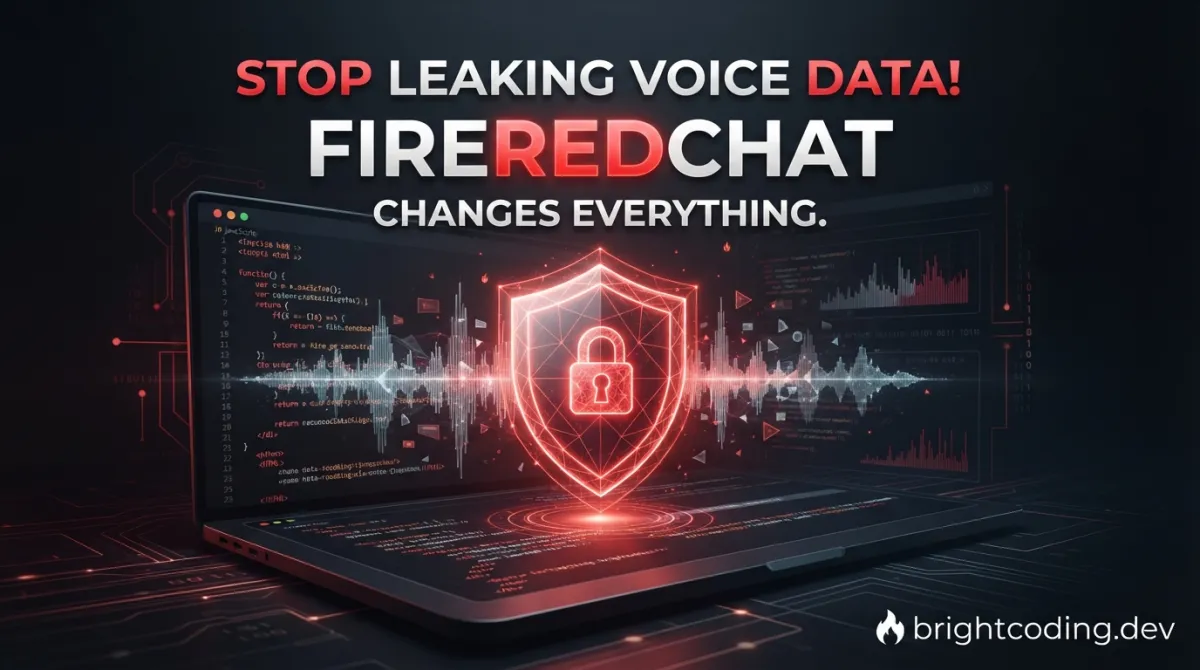
Every time you ship voice data to a cloud API, you're gambling with user privacy. Every. Single. Time. Breaches happen. Compliance violations pile up. And that "simple" voice bot you built? It's now a liability magnet with a microphone attached.
But what if you could build real-time voice AI agents that never leave your infrastructure? No external API calls. No data exfiltration. Complete deployment control from silicon to speech.
Enter FireRedChat — the fully self-hosted solution for full-duplex voice interaction that's making cloud-dependent voice AI look like a relic from 2023. Built by the FireRedTeam and released in September 2025, this isn't another wrapper around OpenAI's Whisper or ElevenLabs. This is a ground-up, privacy-first architecture that integrates personalized voice activity detection, accelerated text-to-speech, automatic speech recognition with punctuation intelligence, and end-of-turn detection — all running on hardware you control.
The secret weapon? A modular system architecture leveraging LiveKit RTC Server for real-time communication, Redis for multi-node scalability, and your choice of LLM backend — from lightweight Ollama setups to production-grade vLLM deployments. Whether you're building HIPAA-compliant healthcare assistants, financial services bots bound by GDPR, or simply refuse to let Big Tech monetize your users' voiceprints, FireRedChat delivers something the cloud giants can't: true data sovereignty.
Ready to discover how this architecture works under the hood? Let's dive into the technical revolution that top developers are already deploying.
What is FireRedChat?
FireRedChat is a fully self-hosted, open-source platform for building real-time voice AI agents with full-duplex interaction capabilities. Developed by the FireRedTeam and released on September 16, 2025, it represents a paradigm shift in voice AI infrastructure — moving from API-dependent, black-box solutions to transparent, controllable, on-premises deployments.
The project's core mission is radical: eliminate external dependencies entirely. While competitors like OpenAI's Realtime API, ElevenLabs' conversational AI, or Amazon Lex require you to stream sensitive audio to their servers, FireRedChat keeps everything local. Your users' voices never traverse the public internet for processing. Your training data stays yours. Your compliance scope shrinks dramatically.
Why it's trending now:
The convergence of three forces has created explosive demand for FireRedChat's approach:
-
Regulatory pressure: GDPR, HIPAA, SOC 2, and emerging AI regulations are making cloud voice processing legally perilous for enterprises handling sensitive data.
-
Hardware democratization: Consumer GPUs now run 7B-70B parameter LLMs at conversational speeds, making local deployment economically viable.
-
Developer fatigue: After years of API rate limits, unpredictable pricing, and vendor lock-in, the open-source community is aggressively reclaiming infrastructure ownership.
FireRedChat's architecture reflects this philosophy through six core components:
| Component | Purpose |
|---|---|
| LiveKit RTC Server | Core real-time audio/video meeting infrastructure |
| AI-Agent Bot Server | Intelligent agent processing and response orchestration |
| Agents-Playground (WebUI) | Browser-based interface for room interaction |
| Redis Server | Multi-node state management and scalability |
| TTS Server | Accelerated speech synthesis with normalization |
| ASR Server | Speech-to-text with punctuation intelligence |
Critically, you supply your own LLM — via Ollama, vLLM, Dify, or any OpenAI-compatible endpoint. This "bring your own brain" approach prevents vendor lock-in while letting you optimize for latency, cost, or capability as needed.
The project is actively maintained with a public demo, academic paper, and HuggingFace models — signaling serious research backing, not weekend hackathon code.
Key Features That Destroy the Competition
FireRedChat isn't merely "self-hosted Whisper + TTS." The FireRedTeam engineered specific optimizations that cloud APIs simply cannot offer due to their generalized, multi-tenant architectures.
🔥 Accelerated FireRedTTS with G2P Intelligence
The TTS service goes beyond basic neural speech synthesis. It incorporates text normalization (converting "$50" to "fifty dollars," handling dates, abbreviations) and Grapheme-to-Phoneme (G2P) conversion. G2P ensures proper pronunciation of out-of-vocabulary words, names, and technical terminology — critical for domain-specific applications like medical dictation or legal documentation where mispronunciation destroys credibility.
🔥 ASR with Punctuation Model Integration
Raw speech-to-text without punctuation is nearly unusable for downstream LLM processing. FireRedASR integrates a dedicated punctuation model that restores sentence boundaries, capitalization cues, and formatting. This dramatically improves LLM comprehension and response quality without prompt engineering hacks.
🔥 Personalized Voice Activity Detection (pVAD)
Generic VAD fails in noisy environments or with overlapping speakers. FireRedChat's pVAD (Personalized Voice Activity Detection) adapts to individual speaker characteristics, dramatically improving the barge-in experience — that crucial moment when a user interrupts the AI mid-sentence. In production voice agents, barge-in handling separates amateur implementations from professional ones.
🔥 Compact End-of-Turn Detection
The Turn-Detector model identifies when a user has finished speaking, triggering faster AI responses. Supporting both English and Chinese with a compact architecture, it reduces perceived latency — the killer metric for conversational AI satisfaction. Cloud APIs often add 300-800ms of network latency alone; FireRedChat's local processing eliminates this entirely.
🔥 Multi-Node Scalability via Redis
Redis enables horizontal scaling across multiple agent nodes. Unlike single-instance open-source alternatives, FireRedChat supports production deployments with load balancing, failover, and session persistence.
🔥 Fork of LiveKit Ecosystem
By forking livekit/agents and livekit/agents-playground, FireRedChat inherits battle-tested WebRTC infrastructure while adding voice-AI-specific optimizations. This isn't reinventing wheels — it's building a race car on a proven chassis.
Use Cases: Where FireRedChat Dominates
1. Healthcare & Telemedicine Voice Assistants
HIPAA violations from cloud voice processing carry penalties up to $1.5 million annually. FireRedChat enables AI-powered patient intake, symptom triage, and post-operative follow-up calls with zero PHI exposure to third parties. The pVAD adapts to elderly patients' speech patterns; G2P handles medical terminology flawlessly.
2. Financial Services & Trading Floors
Banks and trading desks require sub-100ms response latency for voice-controlled operations. Cloud APIs add unpredictable network hops. FireRedChat's local deployment guarantees consistent performance, while keeping proprietary trading strategies and client conversations air-gapped from competitors' training data pipelines.
3. Defense & Government Secure Communications
Classified environments cannot risk voice data reaching foreign cloud infrastructure. FireRedChat's self-contained deployment satisfies air-gapped requirements while delivering modern AI assistant capabilities previously exclusive to consumer tech.
4. Enterprise Contact Centers (On-Premises)
For organizations with existing on-prem infrastructure investments, FireRedChat integrates with internal telephony and CRM systems without cloud egress fees. The Redis-backed multi-node architecture scales to thousands of concurrent agents — matching commercial offerings at fraction of operational cost.
5. Developer Privacy Tools & Personal Assistants
Privacy-conscious developers are building personal AI companions that never leak intimate conversations. FireRedChat + local LLM (Ollama with Qwen2.5) runs on a single GPU, giving individuals enterprise-grade voice AI without surveillance capitalism's data extraction.
Step-by-Step Installation & Setup Guide
Ready to deploy? FireRedChat's architecture requires orchestrating multiple services, but the Docker↗ Bright Coding Blog-based quickstart gets core infrastructure running in minutes.
Prerequisites
- Linux server with Docker and Docker Compose installed
- NVIDIA GPU recommended (for LLM, ASR, TTS acceleration)
- Domain name (optional, for HTTPS/WSS production deployments)
- Minimum 16GB RAM, 50GB storage
Step 1: Clone and Deploy Core Infrastructure
First, grab the repository with all submodules:
# Clone with submodules to get all forked components
git clone --recurse-submodules https://github.com/FireRedTeam/FireRedChat.git
For production with a domain, generate LiveKit configuration:
mkdir output
docker pull livekit/generate
# Interactive configuration generator for TLS, TURN server, etc.
docker run --rm -it -v $PWD:/output livekit/generate
Deploy RTC Server, Redis, and WebUI via Docker Compose:
cd docker
# -d flag runs services in background
docker-compose up -d
Verify deployment:
- RTC Server:
ws://0.0.0.0:7880(WebSocket for real-time communication) - WebUI:
http://0.0.0.0:3000(Browser interface) - Each user consumes two UDP ports for media streams
Production HTTPS/WSS Configuration
For secure remote access, configure Nginx as reverse proxy:
# Example Nginx snippet (adapt from Foundry VTT guide)
server {
    listen 443 ssl http2;
    server_name your-domain.com;

    # WebSocket upgrade for LiveKit
    location /livekit {
        proxy_pass http://localhost:7880;
        proxy_http_version 1.1;
        proxy_set_header Upgrade $http_upgrade;
        proxy_set_header Connection "upgrade";
    }

    # WebUI static serving
    location / {
        proxy_pass http://localhost:3000;
    }
}
Critical firewall rules:
- Port 443 (HTTPS/WSS)
- UDP range 50000-60000 (LiveKit media streams)
Update client configuration from ws://0.0.0.0:7880 to wss://your-domain.com/livekit.
Step 2: Deploy Voice Processing Services
FireRedASR (Speech Recognition): Follow ASR Server README for model download and GPU/CPU configuration.
FireRedTTS (Speech Synthesis): Follow TTS Server README for voice model setup and acceleration options.
Step 3: Deploy Your LLM Backend
Option A: Lightweight Ollama Setup
# One-line installer
curl -fsSL https://ollama.com/install.sh | sh

# Pull and run Qwen2.5 (strong multilingual performance)
ollama run qwen2.5

# Verify: Ollama serves on localhost:11434 by default
Option B: Production vLLM Deployment
# Docker deployment with tensor parallelism for large models
# See https://docs.vllm.ai/en/latest/deployment/docker.html
docker run --runtime nvidia --gpus all \
  -v ~/.cache/huggingface:/root/.cache/huggingface \
  -p 8000:8000 \
  vllm/vllm-openai:latest \
  --model meta-llama/Meta-Llama-3-70B-Instruct \
  --tensor-parallel-size 4
Option C: Advanced Workflows with Dify
For complex agent orchestration, RAG integration, or multi-step reasoning, deploy Dify and connect via OpenAI-compatible API.
Step 4: Start AI-Agent Bot Server
The final piece — the intelligent agent orchestrator:
# Follow Agents Service README for environment configuration
# https://github.com/fireredchat-submodules/agents/blob/fireredchat/README.md

# Key configuration: point to your ASR, TTS, and LLM endpoints
# The bot worker auto-spawns when users join rooms
REAL Code Examples from FireRedChat
Let's examine actual implementation patterns from the repository, with detailed explanations of what each component accomplishes.
Example 1: Docker Compose Infrastructure Orchestration
The core docker-compose.yml (implied by the cd docker; docker-compose up -d command) orchestrates multiple services. Here's the conceptual structure with annotations:
# docker/docker-compose.yml (conceptual structure)
version: '3.8'

services:
  # LiveKit RTC Server: WebRTC signaling and media routing
  livekit:
    image: livekit/livekit-server:latest
    ports:
      - "7880:7880"      # WebSocket signaling port
      - "7881:7881"      # RTC UDP ports (configurable range)
    environment:
      - LIVEKIT_CONFIG=/etc/livekit/config.yaml
    volumes:
      - ./livekit.yaml:/etc/livekit/config.yaml
    # UDP port range for media: 50000-60000 per deployment docs

  # Redis: Multi-node state coordination
  redis:
    image: redis:7-alpine
    ports:
      - "6379:6379"
    # Enables horizontal scaling of agent workers across machines
    # Persists room state, user sessions, bot worker assignments

  # Agents Playground: React↗ Bright Coding Blog-based WebUI
  webui:
    image: fireredchat/agents-playground:latest
    ports:
      - "3000:3000"
    environment:
      - NEXT_PUBLIC_LIVEKIT_URL=ws://localhost:7880
    depends_on:
      - livekit
    # Users join rooms via browser, auto-triggers bot worker dispatch
What's happening here? This isn't a monolith — it's a microservices architecture where each component scales independently. The LiveKit server handles WebRTC's complexity (NAT traversal, codec negotiation, packet loss concealment) so you don't become a video engineer. Redis transforms single-node prototypes into production clusters. The WebUI fork adds voice-AI-specific controls to LiveKit's proven meeting interface.
Example 2: Ollama LLM Integration Pattern
The README provides this exact pattern for lightweight LLM deployment:
# ollama example, refer to https://ollama.com for official guide
curl -fsSL https://ollama.com/install.sh | sh
ollama run qwen2.5
Let's expand this into a production-relevant configuration:
#!/bin/bash
# setup-ollama.sh - Production-hardened Ollama deployment

# Install Ollama with official installer
curl -fsSL https://ollama.com/install.sh | sh

# Pull Qwen2.5 (strong multilingual, good for voice agent contexts)
# 7B parameters balances quality and inference speed on consumer GPUs
ollama pull qwen2.5

# Create Modelfile with voice-optimized system prompt
cat > /etc/ollama/voice-agent.modelfile << 'EOF'
FROM qwen2.5
SYSTEM """You are a helpful voice assistant. Keep responses concise (1-3 sentences) for natural conversation flow. Avoid markdown↗ Smart Converter formatting — speak naturally."""
PARAMETER temperature 0.7
PARAMETER top_p 0.9
EOF

# Build custom model
ollama create voice-agent -f /etc/ollama/voice-agent.modelfile

# Run with exposed API (default: localhost:11434)
# Configure Agents Service to point here
ollama run voice-agent
Critical insight: Voice agents require different prompting strategies than text chatbots. The system prompt enforces concision (long responses feel unnatural in spoken dialogue) and strips markdown (you can't "speak" bold text). The temperature and top_p parameters balance creativity against consistency — too high and the agent rambles; too low and responses feel robotic.
Example 3: Service Dependency Architecture
The README's architecture diagram translates to this operational flow:
# Conceptual agent orchestration (inferred from architecture description)
# Actual implementation in agents submodule

class FireRedChatAgent:
    """
    Core agent worker spawned per room join event.
    Manages full-duplex voice interaction pipeline.
    """

    def __init__(self, room_id: str, user_id: str):
        # LiveKit room connection for real-time media
        self.room = livekit.Room(room_id)

        # Service endpoints (configured via environment)
        self.asr_client = ASRClient(url=os.getenv("FIRERED_ASR_URL"))
        self.tts_client = TTSClient(url=os.getenv("FIRERED_TTS_URL"))
        self.llm_client = LLMClient(url=os.getenv("LLM_URL"))

        # pVAD for personalized barge-in detection
        self.vad = PersonalizedVAD(
            speaker_embedding_path=f"embeddings/{user_id}.pt"
        )

        # Turn detector for EoT (End-of-Turn) recognition
        self.turn_detector = TurnDetector(
            model_path="turn-detector-v1.onnx",  # ONNX for fast inference
            languages=["en", "zh"]  # Bilingual support
        )

    async def handle_audio_stream(self, audio_chunk: bytes):
        """
        Real-time audio processing pipeline.
        Called on each incoming audio frame from LiveKit.
        """
        # Step 1: pVAD filters non-speech (noise, background)
        if not self.vad.is_speech(audio_chunk):
            return  # Discard without ASR processing (saves compute)

        # Step 2: Accumulate until turn ends
        self.audio_buffer.append(audio_chunk)

        # Step 3: Turn-Detector decides if user finished speaking
        if self.turn_detector.is_end_of_turn(self.audio_buffer):
            # Flush buffer to ASR for transcription
            transcript = await self.asr_client.transcribe(
                audio=self.audio_buffer,
                punctuate=True  # Enable punctuation model
            )

            # Step 4: LLM generates response
            response = await self.llm_client.complete(
                messages=[{"role": "user", "content": transcript}],
                max_tokens=150  # Keep responses brief for voice
            )

            # Step 5: TTS synthesizes with context-aware normalization
            audio_response = await self.tts_client.synthesize(
                text=response,
                normalize=True,  # "Dr." → "Doctor", "$50" → "fifty dollars"
                g2p=True         # Ensure proper pronunciation
            )

            # Step 6: Stream back via LiveKit
            await self.room.publish_audio(audio_response)

            # Reset for next turn
            self.audio_buffer.clear()
Architecture deep-dive: This pipeline reveals FireRedChat's sophistication. The pVAD pre-filtering prevents wasted ASR compute on non-speech. The turn-detector replaces naive silence-detection (which fails with thoughtful pauses or network jitter). G2P normalization handles edge cases that break lesser TTS systems. And critically, everything happens locally — the audio_chunk never leaves your network.
Advanced Usage & Best Practices
Latency Optimization
Target <500ms total response latency for natural conversation:
- GPU batching: Run ASR and TTS on same GPU with CUDA streams for parallel processing
- Model quantization: Use INT8/INT4 LLM quantization via vLLM's
--quantization awqflag - Streaming ASR: Enable incremental transcription rather than waiting for turn-end
- TTS pre-generation: Cache common greetings/confirmations ("Hello," "Let me check that")
Multi-Speaker Rooms
The pVAD's personalization requires speaker enrollment:
# Extract speaker embedding for enrollment
python↗ Bright Coding Blog -m fireredchat.enroll_speaker \
  --audio sample_speaker.wav \
  --output embeddings/user_123.pt
Store embeddings in Redis for distributed access across agent nodes.
Monitoring & Observability
# Prometheus metrics endpoint (add to docker-compose)
prometheus:
  image: prom/prometheus
  volumes:
    - ./prometheus.yml:/etc/prometheus/prometheus.yml
Track critical metrics: ASR latency, TTS real-time factor (RTF), LLM time-to-first-token, pVAD false-accept rate.
Comparison with Alternatives
| Feature | FireRedChat | OpenAI Realtime API | ElevenLabs Conv. AI | Amazon Lex |
|---|---|---|---|---|
| Self-hosted | ✅ Full control | ❌ Cloud only | ❌ Cloud only | ❌ Cloud only |
| Data privacy | ✅ Zero leakage | ❌ Processed externally | ❌ Processed externally | ❌ Processed externally |
| Custom TTS voices | ✅ FireRedTTS + G2P | ❌ Limited voices | ✅ Excellent | ❌ Limited |
| Custom LLM | ✅ Any OpenAI-compatible | ❌ GPT-4o only | ❌ Limited | ❌ Lex only |
| Barge-in (pVAD) | ✅ Personalized | ✅ Generic | ✅ Generic | ❌ Poor |
| End-of-turn detection | ✅ Compact model | ✅ Built-in | ✅ Built-in | ❌ Rule-based |
| Cost at scale | 💰 Hardware only | 💰💰💰 Per-minute | 💰💰💰 Per-character | 💰💰 Per-request |
| Setup complexity | 🔧 Moderate | 🟢 Minimal | 🟢 Minimal | 🟡 Moderate |
| Latency control | ✅ Sub-100ms possible | ❌ Network variable | ❌ Network variable | ❌ Network variable |
Verdict: Choose FireRedChat when privacy, latency predictability, or cost at scale matter. Cloud APIs win for rapid prototyping without infrastructure investment.
FAQ
Q: What hardware do I need for FireRedChat? A: Minimum: CPU-only with 16GB RAM for testing. Recommended: NVIDIA GPU (RTX 4090/A100) with 24GB+ VRAM for concurrent ASR + TTS + LLM inference. Multi-GPU setups scale via vLLM tensor parallelism.
Q: Can I use FireRedChat with my existing LLM (GPT-4, Claude, etc.)? A: The architecture supports any OpenAI-compatible API endpoint. However, using external LLMs partially defeats the privacy benefits. For full data sovereignty, deploy local models via Ollama or vLLM.
Q: How does pVAD differ from standard VAD? A: Standard VAD detects any speech. pVAD (Personalized VAD) learns individual speaker characteristics, reducing false triggers from background conversations — critical for barge-in in multi-person environments.
Q: Is the Turn-Detector model open-source? A: Yes, released September 16, 2025 alongside pVAD, FireRedTTS, and FireRedASR services. Models available on HuggingFace.
Q: Can I deploy on Kubernetes? A: The Docker Compose setup translates directly to Kubernetes deployments. Redis clustering and LiveKit's horizontal pod autoscaling are documented in the LiveKit self-hosting guides.
Q: What languages are supported? A: Currently optimized for English and Chinese. The modular ASR/TTS architecture allows extending to additional languages by swapping model checkpoints.
Q: Is FireRedChat production-ready? A: The academic disclaimer suggests ongoing validation. The LiveKit foundation is production-proven; evaluate FireRed-specific components (pVAD, turn-detector) against your accuracy requirements before full deployment.
Conclusion: Own Your Voice AI Future
FireRedChat isn't just another open-source voice project — it's a declaration of independence from cloud API dependency. In an era where voice data is harvested for model training, where a single API change breaks production systems, where compliance violations cost millions, the FireRedTeam has built something genuinely disruptive: complete infrastructure sovereignty.
The technical architecture is thoughtful — pVAD for real-world noise, G2P for professional pronunciation, turn-detection for natural flow, Redis for enterprise scale. The "bring your own LLM" philosophy prevents the vendor lock-in that traps teams in expensive, limited ecosystems.
Is it more work than pip install openai? Absolutely. But for teams where privacy isn't negotiable, where latency must be predictable, where costs must scale linearly not exponentially, FireRedChat delivers capabilities that no cloud API can match.
The future of voice AI isn't streaming everything to someone else's server. It's running intelligent agents on infrastructure you control, with data that never leaves your perimeter.
Start building that future today. Clone the repository, spin up the Docker services, and experience what truly self-hosted voice AI feels like. Your users' voices — and your compliance team — will thank you.
Found this breakdown valuable? Star the repository, share with your infrastructure team, and follow the FireRedTeam for upcoming Audio LLM Service and Context-Aware TTS releases that will push local voice AI even further.
Explore on the BrightCoding network
Hand-picked resources from our other sites.
Stop Wrestling with Backend Analytics! SQLRooms Brings DuckDB to React
SQLRooms is a React framework powered by DuckDB-WASM that enables blazing-fast browser-native analytics without any backend. Build privacy-first, AI-assisted da...
Stop Writing SEO Content Manually! Use SEO Machine Instead
Discover SEO Machine, a specialized Claude Code workspace for creating long-form, SEO-optimized blog content. Built with custom commands, intelligent agents, an...
Stop Coding Alone: Build an AI Dev Team with awesome-claude-agents
Discover how awesome-claude-agents transforms Claude Code into a 24-agent AI development team. Learn installation, real code examples, and advanced orchestratio...
Continuez votre lecture
Why Alexandrie is the Ultimate Markdown Note-Taking App

Why CrossPaste is the Ultimate Game Changer for Clipboard Management
Why Chandra is the Ultimate OCR Tool for Handwriting and Tables

Stop Coding Alone: OPC-Skills Gives Your AI Agent Superpowers
Commentaires 0
Aucun commentaire pour l'instant. Soyez le premier à réagir !