Stop Letting LLMs Guess Your Genome: ClawBio Exposed
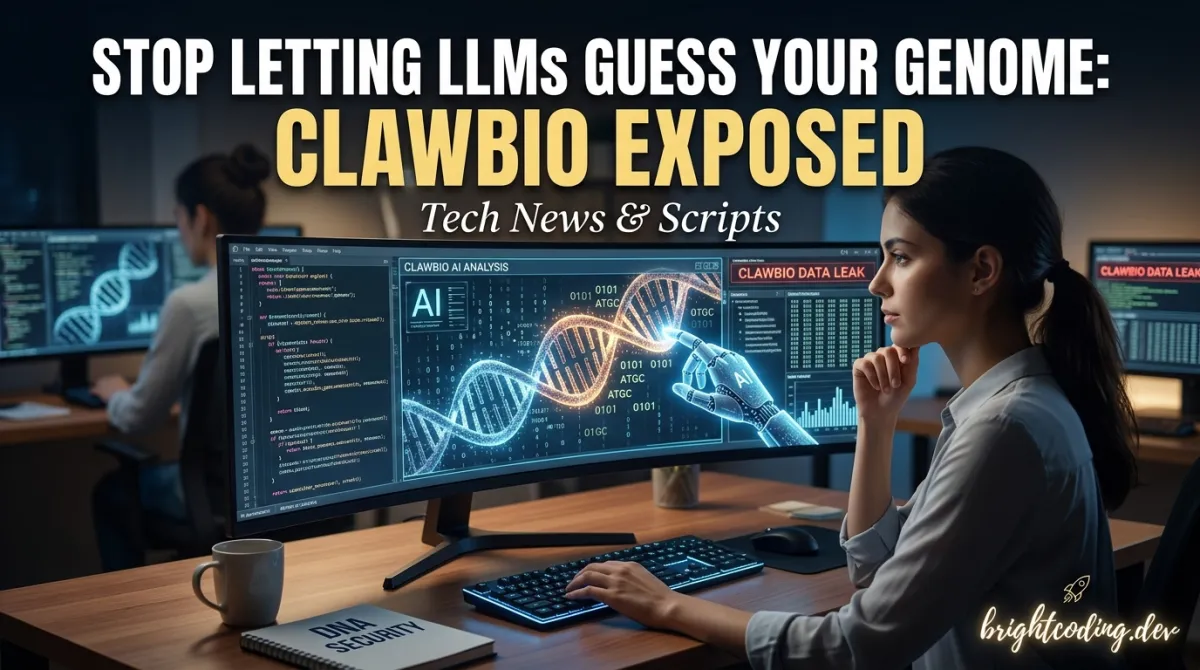
Stop Letting LLMs Guess Your Genome: ClawBio Exposed
What if your AI assistant's "educated guess" about your DNA could kill you?
Picture this: You upload your 23andMe results to a chatbot and ask, "Should I take codeine for this migraine?" The LLM generates confident Python↗ Bright Coding Blog code, analyzes your CYP2D6 gene, and spits out a dosage recommendation. Except it misclassified *4 as "reduced function" instead of "no function." You're a Poor Metabolizer. That codeine gives you zero pain relief — and nobody caught the error because the code "looked right."
This isn't hypothetical. Roughly 7% of Europeans are CYP2D6 Poor Metabolizers. Roughly 0.5% carry DPYD variants where standard fluorouracil dosing can be lethal. When LLMs improvise pharmacogenomics from training data, stochastic errors become life-threatening stochastic harms.
The bioinformatics community has a dirty secret: reproducibility is broken. You read a paper, clone the repo, fight dependency hell for two days, discover the Zenodo link is dead, email the first author, wait three weeks, and ultimately give up. Meanwhile, AI agents are being unleashed on genomic data with no specification layer constraining their behavior — just vibes and prompt engineering.
Enter ClawBio — the first bioinformatics-native AI agent skill library. Built on the massively popular OpenClaw framework (180k+ GitHub stars), ClawBio doesn't let LLMs improvise your biology. It encodes expert analytical decisions into versioned, peer-reviewable, machine-readable skills that execute identically whether called by Claude, ChatGPT, or your local Ollama instance. Local-first. Privacy-focused. Reproducible.
Ready to see why top bioinformaticians are abandoning ad-hoc LLM code generation? Let's dive in.
What Is ClawBio?
ClawBio is an open-source, MIT-licensed skill library that transforms how AI agents perform bioinformatics analyses. Created by Manuel Corpas and contributors, it launched publicly in early 2026 and has already accumulated 66 production skills, 8,000 Galaxy tool integrations, 1,756 tests, and a rigorous benchmark validation framework.
The project sits at the intersection of three exploding trends: AI agent orchestration, computational biology, and the reproducibility crisis in science. But ClawBio isn't just another wrapper around bioinformatics tools. It addresses a critical gap that existing agentic systems ignore.
Current approaches split into two camps. Reasoning-layer systems constrain LLM outputs with knowledge graphs or fine-tuning. Connectivity-layer systems wrap tools as MCP servers. Neither solves the specification layer: the encoding of domain expert decisions into a machine-readable contract that constrains agent behavior. Without this, your agent reconstructs expert knowledge from its training distribution — a stochastic, unversioned, unverifiable process.
A ClawBio skill is a self-contained directory with:
- A declarative
SKILL.mdspecification (the contract) - Validated Python implementation
- Demo data for immediate testing
- Reproducibility support (commands, environment snapshots, checksums)
This specification-first architecture means domain expertise lives in versioned files, not model weights. Update CPIC guidelines? Change one file, not your entire model. Peer review? Read the specification, not reverse-engineer prompt engineering.
The project is agent-agnostic (works with any LLM), local-first (your genome never leaves your machine), and reproducible (many skills export replay metadata). It's built on OpenClaw, the agent platform with 180k+ GitHub stars, giving it instant compatibility with a massive ecosystem.
Current version: v0.5.0 (released April 4, 2026), featuring validation infrastructure, Alzheimer's disease ground truth benchmarks, mock API servers for offline CI, and swappable fine-mapping pipelines.
Key Features That Separate ClawBio From the Pack
Specification-First Architecture
Every skill encodes expert decisions in SKILL.md — not prompts, not model weights. This makes analytical logic versioned, diffable, and peer-reviewable. When CPIC updates warfarin dosing guidelines, you update one specification file rather than retraining or reprompting.
Agent-Agnostic Execution
Skills run identically whether invoked by Claude Code, ChatGPT, a local Ollama instance, or direct Python import. The orchestration layer is decoupled from the biological computation. Your reproducibility doesn't depend on Anthropic's API uptime.
Local-First Privacy
Your genomic data never touches cloud servers. Run analyses on your laptop, in air-gapped environments, or in regulated clinical settings. The Telegram bot demo runs against Manuel Corpas's own CC0-licensed genome — not yours — but install locally and analyze your own data privately.
Reproducibility Bundles
Many skills write a reproducibility/ directory containing commands.sh, environment.yml, checksums.sha256, and optional runtime-lock.json. The exact contents vary by skill, but the principle is consistent: given the bundle and inputs, anyone can replay your analysis.
Massive Integration Surface
- 66 native skills covering pharmacogenomics, GWAS, single-cell, proteomics, metagenomics, methylation, clinical reporting, and more
- 8,000+ Galaxy tools searchable and executable via the Galaxy Bridge skill
- Integration with 9 genomic databases (gnomAD, ClinVar, GTEx, GWAS Catalog, Open Targets, Ensembl, LDlink, UK Biobank PheWAS, LOVD)
Rigorous Validation Framework
v0.5.0 introduces systematic benchmarking:
- AD Ground Truth: 34 Alzheimer's genes across 3 evidence tiers with 20 negative controls
- Mock API Server: Deterministic offline endpoints for CI without rate limits
- 74 benchmark tests, all green at baseline
- Live leaderboard: 168/182 tests passing (92.3%) across 10 audited skills
Real-World Use Cases Where ClawBio Dominates
1. Clinical Pharmacogenomics at Point of Care
A physician snaps a photo of warfarin packaging in Telegram. ClawBio's Drug Photo skill identifies the drug, queries the patient's pharmacogenomic profile from their 23andMe data, and returns: **"CYP2C9 1/2 Intermediate · VKORC1 High Sensitivity — AVOID standard dose." This happens on-device in seconds, not in a cloud black box. The skill correctly handles VKORC1's minus-strand reporting (a common error source) and references current CPIC guidelines.
2. Reproducing Published GWAS Analyses
You read a paper with Figure 3 showing ancestry PCA results. Instead of dependency hell, you run:
python skills/claw-ancestry-pca/ancestry_pca.py --demo --output fig3
Demo output regenerates with bundled checksums for verification. The skill normalizes contig naming, removes related individuals, filters to common biallelic SNPs, and produces publication-quality 4-panel figures against the SGDP reference panel (345 samples, 164 populations).
3. Multi-Database Variant Investigation
A genetic counselor receives a VCF with variant rs3798220. Instead of manually querying nine databases, one command federates across GWAS Catalog, gnomAD, ClinVar, Open Targets, Ensembl, GTEx, LDlink, UK Biobank PheWAS, and LOVD — returning allele frequencies, tissue-specific eQTL effects, disease associations, and linkage disequilibrium patterns.
4. Research Equity Auditing
A funding agency wants to measure structural bias in biomedical research. The Semantic Similarity Index skill computes Semantic Isolation Index (SII) across 13.1M PubMed abstracts using PubMedBERT embeddings. Key finding: neglected tropical diseases are +38% more semantically isolated (P < 0.0001, Cohen's d = 0.84). Fourteen of the 25 most isolated diseases are Global South priorities — knowledge silos that kill innovation.
5. Single-Cell Pipeline Automation
A biologist has FASTQ files and needs clean h5ad with clusters and markers. The nf-core scRNA Wrapper skill handles upstream preprocessing (simpleaf, STARsolo, kallisto, CellRanger) with strict preflight checks and reproducibility bundles. The scRNA Orchestrator then automates Scanpy: QC, optional Scrublet doublet detection, clustering, marker detection, and cell type annotation.
Step-by-Step Installation & Setup Guide
Prerequisites
- Python 3.10+ (check with
python --version) - Git for cloning
- Approximately 2GB disk space for demo data and dependencies
Option 1: Clone and Run (Recommended)
# Clone the repository
git clone https://github.com/ClawBio/ClawBio.git
cd ClawBio

# Install core dependencies
pip install -r requirements.txt

# Verify installation with the fastest demo
python clawbio.py run pharmgx --demo
The PharmGx demo completes in under 2 seconds and requires no external data downloads.
Option 2: Use as Python Library
from clawbio import run_skill, list_skills

# Discover available skills
skills = list_skills()
print(f"Available skills: {len(skills)}")

# Run pharmacogenomics with built-in demo data
result = run_skill("pharmgx", demo=True)

# Run with your own genomic data
result = run_skill("gwas-lookup", rsid="rs3798220", output="/tmp/report")
Option 3: Claude Code Plugin
Inside Claude Code:
/plugin marketplace add ClawBio/ClawBio
/plugin install clawbio
All skills become agent-routable commands. Alternatively, clone the repo and open it as your working directory — the CLAUDE.md file teaches Claude automatic skill routing.
Environment Configuration
Core dependencies in requirements.txt include: biopython, pandas, numpy, scikit-learn, matplotlib, openai, pydeseq2.
Some skills need additional setup:
| Skill | Extra Dependency | Install Command |
|---|---|---|
| Metagenomics | Kraken2, RGI, HUMAnN3 | Conda environment (see skill README) |
| Methylation Clock | PyAging | pip install pyaging |
| scRNA Embedding | scvi-tools | pip install scvi-tools |
| Galaxy Bridge | BioBlend | pip install bioblend |
No Docker↗ Bright Coding Blog or Singularity required for core functionality.
Quick Verification
Run the full demo suite to confirm everything works:
python clawbio.py list                           # 66 skills available
python clawbio.py run pharmgx --demo             # < 2 seconds
python clawbio.py run gwas-lookup --demo         # ~5 seconds, 9 databases
python clawbio.py run ukb-navigator --demo       # ~5 seconds, semantic search
python clawbio.py run equity --demo              # ~55 seconds, HEIM metrics
Running Tests
pip install pytest
python -m pytest
The v0.5.0 baseline includes 74 benchmark tests, all passing green.
REAL Code Examples From the Repository
Let's examine actual code patterns from ClawBio's README and documentation, with detailed explanations of what each does and why it matters.
Example 1: Basic Skill Execution (Python API)
from clawbio import run_skill, list_skills

# List available skills programmatically
skills = list_skills()

# Run pharmacogenomics with demo data
result = run_skill("pharmgx", demo=True)

# Run with your own input
result = run_skill("gwas-lookup", rsid="rs3798220", output="/tmp/report")
What's happening here? The clawbio module exposes a clean functional API. list_skills() returns the machine-readable catalog from skills/catalog.json — the same file that powers Claude Code routing and RoboTerri's auto-detection. run_skill() is the universal entry point: it loads the skill's SKILL.md specification, validates inputs against the declared schema, executes the validated Python implementation, and returns structured results.
The demo=True flag is crucial for reproducibility testing. Every production skill must include demo data that exercises all code paths without requiring external inputs. This enables CI validation and lets new users verify functionality instantly.
Example 2: Command-Line Skill Execution
# Clone and setup
git clone https://github.com/ClawBio/ClawBio.git
cd ClawBio
pip install -r requirements.txt    # Python 3.10+

# Run pharmacogenomics demo
python clawbio.py run pharmgx --demo
The CLI design philosophy: clawbio.py is a thin router. It parses arguments, discovers the skill directory, validates that SKILL.md declares support for the provided flags, and delegates to the skill's Python implementation. The --demo flag triggers a special execution mode that uses bundled test data and may skip expensive external API calls.
Notice there's no pip install clawbio package yet — the project is intentionally source-first during rapid development. You clone the repo, you see all the code, you can modify any skill. This transparency matters for scientific reproducibility: you can inspect exactly what analytical decisions are encoded.
Example 3: Pharmacogenomic Report Generation
python pharmgx_reporter.py --input demo_patient.txt --output report
Behind this simple command: The PharmGx Reporter skill parses raw genetic data (auto-detecting 23andMe, AncestryDNA, or VCF formats, including gzip compression), extracts 31 pharmacogenomic SNPs across 12 genes, calls star alleles using specified CPIC guidelines, determines metabolizer phenotypes, and looks up drug recommendations for 51 medications.
The demo result for a CYP2D6 *4/*4 Poor Metabolizer: 10 drugs to AVOID (codeine, tramadol, 7 TCAs, tamoxifen), 20 with caution, 21 standard dosing. This isn't LLM improvisation — it's specification-constrained execution where the SKILL.md explicitly defines star allele calling rules, phenotype mappings, and drug-gene interaction tables from CPIC.
Example 4: Drug Photo with Genotype Integration
python pharmgx_reporter.py --drug warfarin --dose "5mg" --input my_23andme.txt --output report
The Drug Photo skill pipeline: When triggered via Telegram (no command needed — photo upload auto-detects), Claude vision extracts the drug name and visible dose from packaging. The skill then cross-references the user's 23andMe genotype against 31 PGx SNPs, with correct VKORC1 minus-strand handling (23andMe reports rs9923231 on the minus strand; many tools get this wrong, leading to inverted genotype interpretations).
Output is a four-tier classification: STANDARD DOSING / USE WITH CAUTION / AVOID / INSUFFICIENT DATA. For warfarin with CYP2C9 *1/*2 and VKORC1 high sensitivity: AVOID — DO NOT USE at standard dose due to over-anticoagulation risk.
Example 5: GWAS Lookup Across Nine Databases
python gwas_lookup.py --rsid rs3798220 --output report
python gwas_lookup.py --demo --output /tmp/gwas_lookup_demo
Federated query architecture: This skill demonstrates ClawBio's database integration depth. A single rsID triggers parallel or sequential queries to: GWAS Catalog (genome-wide associations), gnomAD (125,748 exome allele frequencies), ClinVar (clinical significance), Open Targets (disease-gene evidence), Ensembl (functional annotation), GTEx (tissue-specific eQTLs), LDlink (linkage disequilibrium across 26 populations), UK Biobank PheWAS (4,000+ traits), and LOVD (pathogenicity).
The --demo mode uses cached responses or the mock API server for offline execution. This is critical for CI and air-gapped environments — the benchmark infrastructure validates that demo outputs match expected structures even without live database connectivity.
Example 6: Benchmark and Validation Infrastructure
# Run the fine-mapping benchmark
python tests/benchmark/finemapping_benchmark.py --output /tmp/fm_bench

# Score a gene list against AD ground truth
python tests/benchmark/benchmark_scorer.py --genes "APP,BIN1,CLU,TREM2,GAPDH"

# Start mock API server for offline testing
python tests/benchmark/mock_api_server.py &
Why this matters: v0.5.0's validation infrastructure is unprecedented in agentic bioinformatics. The finemapping_benchmark.py compares SuSiE vs ABF (Approximate Bayes Factor) credible sets on identical data using a method registry pattern — add FINEMAP or PolyFun by implementing the same interface. The benchmark_scorer.py computes gene recovery rate, FDR, precision, recall, F1, and a tier-weighted composite score against curated Alzheimer's disease ground truth (34 genes, 3 evidence tiers, 20 negative controls).
The mock API server eliminates CI flakiness from external service rate limits. Deterministic endpoints for Ensembl, GWAS Catalog, and ClinPGx mean 74 tests pass reliably, every time, without network dependencies.
Advanced Usage & Best Practices
Skill Chaining for Complex Workflows
Combine skills for analyses no single tool provides. Galaxy VEP annotates variants → ClawBio PharmGx generates dosage reports. Galaxy Kraken2 classifies metagenomic reads → ClawBio profiler generates functional summaries. The Bio Orchestrator skill routes inputs automatically based on file type and content keywords.
Reproducibility Bundle Management
Always preserve reproducibility/ directories. The bundle contains:
commands.sh: Exact replay commandenvironment.yml: Conda environment snapshotchecksums.sha256: Cryptographic verification of outputsruntime-lock.json: Optional extra lock metadata
Caveat: Some replays require original external inputs. The bundle documents what's needed; verify completeness before archiving.
Custom Skill Development
Use the official template:
cp templates/SKILL-TEMPLATE.md skills/<your-skill-name>/SKILL.md
# Edit SKILL.md, add Python implementation, demo data, and tests
Key requirements: declarative specification, validated code, demo data, test coverage. Submit PRs via the Telegram contributors community.
Privacy-Hardened Deployment
For maximum privacy, use the self-hosted OpenClaw gateway instead of Telegram/Discord. The LLM operates at the orchestration layer only — biological data processing stays entirely local, with no external messenger platform involved.
Comparison With Alternatives
| Feature | ClawBio | Ad-hoc LLM | Galaxy Alone | Nextflow Tower |
|---|---|---|---|---|
| Specification layer | ✅ SKILL.md contracts |
❌ Prompt engineering | ❌ Tool wrappers | ❌ Workflow definitions |
| Agent-agnostic | ✅ Any LLM | ❌ Vendor-locked | ❌ Manual execution | ❌ Manual execution |
| Local-first | ✅ No cloud required | ⚠️ Often cloud-based | ✅ Self-hostable | ⚠️ SaaS default |
| Reproducibility bundles | ✅ Built-in | ❌ None | ⚠️ History logs | ✅ Provenance tracking |
| Bioinformatics depth | ✅ 66 skills + 8K Galaxy tools | ❌ Surface-level | ✅ 8K+ tools | ✅ Extensive |
| Validation framework | ✅ Ground truth benchmarks | ❌ None | ⚠️ Limited | ⚠️ Limited |
| Privacy for genomic data | ✅ On-device processing | ❌ Often sent to APIs | ✅ Self-hostable | ⚠️ Cloud option |
| Setup complexity | ⚠️ Clone + pip install | ✅ Chat interface | ⚠️ Server deployment | ⚠️ Infrastructure |
ClawBio's unique advantage: It's the only system that combines specification-constrained execution with agent-agnostic orchestration and deep bioinformatics integration. Ad-hoc LLM coding fails on verification. Galaxy and Nextflow excel at workflow execution but lack AI agent integration. ClawBio bridges both worlds.
FAQ
Q: Is ClawBio production-ready for clinical use? A: v0.5.0 is rapidly maturing with 1,756 tests and benchmark validation, but remains pre-1.0. The MIT license explicitly disclaims clinical liability. Use for research and education; clinical deployment requires institutional validation.
Q: How does ClawBio protect my genomic data? A: Local-first by design. Analyses run on your machine. No cloud uploads, no data exfiltration. The Telegram bot demo uses Manuel Corpas's CC0 genome, not yours.
Q: Can I use ClawBio without any AI agent? A: Absolutely. The CLI and Python API work standalone. The LLM layer is purely for natural language orchestration — all biological computation is local and inspectable.
Q: What's the difference between a skill and a Galaxy tool? A: Galaxy tools are individual bioinformatics programs. ClawBio skills are analytical contracts that may orchestrate multiple tools, encode expert decisions, and produce reproducibility bundles. The Galaxy Bridge skill lets you search and run 8,000+ Galaxy tools from ClawBio.
Q: How do I contribute a new skill?
A: Copy templates/SKILL-TEMPLATE.md, implement your analysis, include demo data and tests, and submit a PR. Community skills already in production include NutriGx Advisor, WGS-PRS, and DnaSP.
Q: Why no pip install clawbio yet?
A: Intentionally source-first during rapid development. Cloning ensures transparency — you see every specification, every analytical decision. A PyPI package is planned for future release.
Q: What reference genome does ClawBio use? A: The Corpasome — a real, fully open human genome (Manuel Corpas, CC0). Available as 23andMe SNP chip (~600K variants) or 30x Illumina WGS subsets (~4M SNPs, ~600K indels, structural variants). Published on Zenodo with full citation details.
Conclusion
ClawBio represents a fundamental shift in how we apply AI to bioinformatics. Instead of letting LLMs improvise life-critical analyses from stochastic training data, it encodes expert knowledge into versioned, verifiable, reproducible skills that execute identically across any agent platform.
The numbers tell the story: 66 skills, 8,000 Galaxy tools, 1,756 tests, 92.3% benchmark pass rate — and that's just v0.5.0. The specification-first architecture solves reproducibility at its root: analytical decisions live in human-readable, peer-reviewable contracts, not in opaque model weights.
For pharmacogenomics, GWAS, single-cell analysis, health equity research, or simply stopping your AI from guessing your genome, ClawBio is the tool that serious bioinformaticians are adopting now.
Clone it. Run a demo in 30 seconds. See the difference specification makes.
git clone https://github.com/ClawBio/ClawBio.git
cd ClawBio
pip install -r requirements.txt
python clawbio.py run pharmgx --demo
Your future self — and possibly your patients — will thank you for choosing reproducibility over improvisation.
Star the repository, join the contributors on Telegram, or try RoboTerri for instant demos without installation.
Outils recommandés
Explore on the BrightCoding network
Hand-picked resources from our other sites.
Stop Building Chatbots That Forget Everything! Use Memoh Instead
Memoh is a self-hosted, always-on AI agent orchestrator that gives every bot its own containerized workspace with persistent memory. Connect to Telegram, Discor...
Stop Losing Context! cmux Is the Terminal AI Agents Actually Need
cmux is a free, open-source Ghostty-based macOS terminal with vertical tabs, smart notifications for AI coding agents, and an integrated scriptable browser. Sto...
Stop Wasting Hours on Busywork: 42 OpenClaw Use Cases That Actually Work
Discover 42 battle-tested OpenClaw use cases that automate real work—from overnight app builds to self-healing servers. This community-curated repository shows...
Continuez votre lecture
How Building LLM Apps From Scratch Changes the Future of AI Development

awesome-ai-awesomeness: The Essential AI Resource Goldmine
RunAnywhere SDKs: The Essential Toolkit for On-Device AI

Stop Coding Alone: OPC-Skills Gives Your AI Agent Superpowers
Commentaires 0
Aucun commentaire pour l'instant. Soyez le premier à réagir !