Stop Naming Files Perfectly! Mango Finder Finds Anything
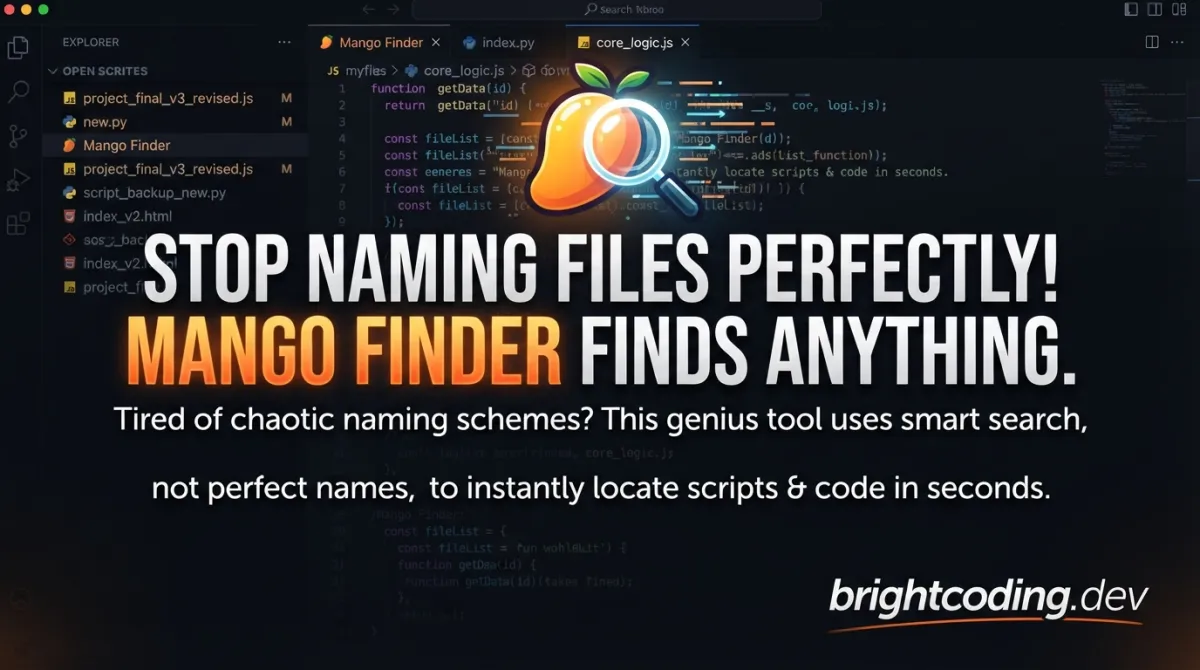
You know that soul-crushing moment. It's 11:47 PM. Your boss needs that report from March. You remember writing it. You remember the content—something about Q3 projections and that weird client who demanded purple charts. But the filename? Could be final_final_v3_ACTUAL.docx, buried in Downloads/Sort Later/2024/Maybe This One. Your Spotlight search? Laughing at you. Your folder structure? A digital graveyard of good intentions.
Here's the dirty secret we've all been too embarrassed to admit: file names are a terrible way to find information. We don't remember filenames. We remember meaning. We remember context, snippets of conversation, visual impressions, the feeling of creating something. Yet for decades, we've been forced to play this ridiculous guessing game with our own computers—our own data, trapped behind our own forgetfulness.
What if you could just... describe what you remember? What if your computer actually understood you?
Enter Mango Finder (formerly MangoDesk)—the open-source desktop application that's making traditional file search feel like using a card catalog in the age of Google. Built by developer moyangzhan and available on GitHub, Mango Finder doesn't just search your files. It understands them. Across devices. Across languages. Without sending your data to anyone.
Ready to stop the filename madness? Let's dive into how this tool works—and why developers everywhere are quietly switching.
What is Mango Finder?
Mango Finder is a local-first, cross-device desktop application for searching documents using natural language. Born from the frustration of modern file management, it represents a fundamental shift in how we interact with our digital archives.
The project, led by creator moyangzhan, emerged from a simple observation: our file systems have scaled exponentially, but our search tools remain stuck in the literal-text era. While cloud services like Google Drive offer some semantic capabilities, they demand your data. Local tools like Spotlight or Everything index fast but think dumb. Mango Finder bridges this gap with on-device AI that preserves privacy while delivering genuinely intelligent search.
The "Mango" name evokes something sweet, accessible, and universally loved—fitting for a tool designed to make file retrieval actually enjoyable. The "Finder" suffix nods to macOS's native tool while promising something far more capable.
Why it's trending now:
- Privacy backlash: Post-ChatGPT, developers are increasingly wary of cloud-only AI solutions
- Cross-device chaos: Remote work means files scatter across laptops, NAS drives, and home servers
- Local AI maturity: Projects like Ollama and whisper.cpp make on-device inference genuinely viable
- Agent ecosystem: Tools like Claude Code and Cursor need structured document access—Mango Finder auto-parses files to Markdown↗ Smart Converter for exactly this
The repository's bilingual documentation (English and Chinese) and immediate availability via GitHub Releases signal serious intent for global adoption. This isn't a toy project—it's production-ready infrastructure for personal knowledge management.
Key Features That Change Everything
Mango Finder packs capabilities that sound almost unfair compared to traditional search tools. Here's what makes it technically special:
💭 Semantic Search by Meaning
At its core, Mango Finder uses embedding models (specifically ONNX-based neural networks) to convert both your documents and your queries into high-dimensional vectors. When you search "that presentation about server costs from last year," the system doesn't look for those exact words. It finds documents whose semantic vectors cluster near your query's vector. This is the same technology powering modern RAG (Retrieval-Augmented Generation) systems, but applied locally to your filesystem.
📍 Exact Keyword Match (When You Need Precision)
Sometimes you do know the exact string—an error code, a function name, a legal citation. Mango Finder preserves traditional inverted-index search alongside semantic capabilities, giving you the best of both worlds without context-switching between tools.
🔍 Multi-Modal Similarity Detection
This is where it gets wild. Mango Finder implements:
- Perceptual hashing for images (find visually similar photos even with different filenames)
- Semantic document similarity (find related papers, contracts, or reports)
- Audio fingerprinting via whisper.cpp (locate podcasts, recordings, or meetings by spoken content)
The vision.onnx and whisper-small-q8_0.bin models handle these modalities locally—no cloud transcription services required.
🔗 Cross-Device Search via mDNS
Using multicast DNS for device discovery, Mango Finder creates a decentralized search mesh across your local network. Your laptop can query your NAS. Your work desktop can find files on your home machine. All without VPNs, cloud sync, or port forwarding nightmares.
🌐 100+ Language Cross-Lingual Search
The embedding model supports cross-lingual retrieval—search in Chinese, find English documents, zero configuration. For global teams and multilingual researchers, this eliminates the "which language did I file this under?" problem entirely.
🔒 Privacy-First Architecture
Three processing tiers ensure your data stays yours:
- Local: Fully offline, all models run on-device
- Self-Hosted: Ollama or vLLM integration for team/enterprise environments
- Cloud: Optional remote services (disabled by default), only for image/audio when explicitly enabled
⚡ Real-Time Indexing with File Watching
The backend uses OS-level file system notifications to maintain an up-to-date index without periodic rescans. Add a file, and it's searchable in seconds.
🤖 AI Agent Ready
Documents are automatically parsed to structured Markdown—immediately consumable by Claude Code, Cursor, OpenClaw, and future CLI tools. Your file system becomes a queryable knowledge base for autonomous coding agents.
Real-World Use Cases Where Mango Finder Dominates
1. The Researcher's Nightmare
You've accumulated 3,000 PDFs across five years. Papers, preprints, conference proceedings, book chapters. You remember a study about transformer architectures in low-resource languages, published around 2022, maybe by someone from Google Research. With Mango Finder: "transformer low resource languages Google 2022" surfaces the exact paper in under a second. No Zotero tagging discipline required.
2. The Creative Professional's Asset Library
Photographers and designers face a unique hell: 50,000 images with names like IMG_4829.jpg. You need "that photo with the red door in Lisbon, golden hour." Mango Finder's perceptual hashing and vision model make visual similarity search local and instant. Find by description, not by date-taken metadata drilling.
3. The Distributed Team's Knowledge Silos
Your startup has docs on Notion, Confluence, Google Drive, and seventeen different Slack threads you "saved for later." But critical IP lives in local Markdown files, design assets on shared NAS, meeting recordings on individual laptops. Mango Finder's cross-device search unifies this fragmentation without forcing migration to yet another platform.
4. The Compliance and Legal Archive
Law firms and regulated industries can't ship documents to cloud AI services. Mango Finder's self-hosted Ollama/vLLM integration keeps everything in-house. Search across deposition transcripts, contract versions, and regulatory filings with natural language—while auditors smile at your data residency posture.
5. The Multilingual Family or Organization
Search your grandmother's scanned letters in Chinese with English queries. Find German technical documentation with French keywords. The cross-lingual embedding model eliminates language as a search barrier entirely.
Step-by-Step Installation & Setup Guide
Getting Mango Finder running requires attention to dependencies, but the process is well-documented. Here's the complete path from zero to semantic search:
Prerequisites Overview
| Component | Version Required | Purpose |
|---|---|---|
| Node.js | 20+ | Frontend runtime |
| PNPM | 9+ | Package manager |
| Rust | 1.94.0+ | Backend compilation |
| Tauri | Latest | Desktop app framework |
| CMake | 4.3 (Windows) | whisper.cpp build |
| LLVM/Clang | 18 (Windows) | whisper.cpp compilation |
Step 1: Frontend Environment
Install Node.js version 20 or higher. The project recommends nvm for version management:
# Install nvm if needed, then:
nvm install 20
nvm use 20
Install PNPM globally:
npm install pnpm -g
Install project dependencies:
pnpm i
Step 2: Rust Backend Setup
Install Rust 1.94.0 or newer via rustup:
curl --proto '=https' --tlsv1.2 -sSf https://sh.rust-lang.org | sh
Verify installation:
rustc --version # Should show 1.94.0+
Step 3: Tauri Prerequisites
Follow platform-specific setup at tauri.app/start/prerequisites/. This includes WebView2 on Windows, Xcode tools on macOS, and various libraries on Linux.
Step 4: Download AI Model Files
This is critical—Mango Finder needs local models to function. Download from either:
Option A: GitHub Release (Recommended)
- Grab
model.zipfrom v0.1.0 release - Extract to
src-tauri/assets/model/
Option B: Hugging Face (Manual)
- Visit moyangzhan/mango-finder
- Download individually:
embedding.onnx+embedding_tokenizer.json(text search)vision.onnx+vision_tokenizer.json(image search)whisper-small-q8_0.bin(audio transcription)
Step 5: Platform-Specific whisper.cpp Build
The audio feature uses whisper.cpp and requires careful compilation:
Windows (Most Complex):
# Verify tools first
cmake --version
clang --version  # Must show 18.1.8

# Set permanent environment variables for UTF-8 support
# Via System Properties → Environment Variables:
# CXXFLAGS = /utf-8
# CFLAGS = /utf-8

# Build from VS 2022 x64 Native Tools Command Prompt:
cd your-project-path\src-tauri
cargo build

# If previous build failed, clean cache first:
cargo clean -p whisper-rs-sys
⚠️ Critical: LLVM 19/20/22 are incompatible. Use exactly LLVM 18. The
/utf-8flags prevent encoding failures. After initial whisper compilation, regularpnpm tauri devworks in any terminal.Advertisement
macOS (Apple Silicon Special Handling):
# Install dependencies
xcode-select --install
brew install cmake

# Required ARM64 workarounds
export CFLAGS="-U__ARM_FEATURE_MATMUL_INT8"
export MACOSX_DEPLOYMENT_TARGET="10.15"

# Make permanent
echo 'export CFLAGS="-U__ARM_FEATURE_MATMUL_INT8"' >> ~/.zshrc
echo 'export MACOSX_DEPLOYMENT_TARGET="10.15"' >> ~/.zshrc
source ~/.zshrc

# Add Rust target
rustup target add aarch64-apple-darwin

# Build
pnpm tauri build --target aarch64-apple-darwin
Linux (Ubuntu/Debian):
sudo apt update
sudo apt install build-essential cmake
# Then proceed with standard build
Step 6: Development Run
With all dependencies resolved:
pnpm tauri dev
This starts both the Rust backend core process and the WebView frontend simultaneously.
Production Build
pnpm tauri build
Output locations:
- Windows:
src-tauri/target/release/bundle/msi/Mango Finder_0.1.0_x64_en-US.msi - macOS/Linux:
src-tauri/target/release/
REAL Code Examples from the Repository
Let's examine actual implementation patterns from Mango Finder's codebase and documentation.
Example 1: Cross-Device Network Diagnostics
When multi-device search fails, the README provides concrete diagnostic commands. Here's the actual troubleshooting workflow:
# Test basic network connectivity between devices
# On device A, ping device B's IP address
ping 192.168.1.xxx

# If ping succeeds, test Mango Finder's HTTP endpoint
curl http://192.168.1.xxx:7890/ping

# Expected: HTTP 200 with pong response
# If this fails, check firewall rules or port conflicts
Explanation: Mango Finder uses mDNS for auto-discovery but falls back to direct IP connections. The :7890 port is the default HTTP service port (distinct from the 15678 mDNS discovery port). This dual-port architecture separates discovery from data transport—smart for debugging, as you can isolate whether the problem is network reachability or application-level failure.
The curl test verifies the Tauri backend's HTTP server is actually responding. If ping works but curl fails, you've narrowed the problem to firewall rules or Mango Finder not running on the target device.
Example 2: Environment Configuration for Windows Builds
The Windows whisper.cpp compilation requires specific environment setup. Here's the exact variable configuration:
# These MUST be set as permanent environment variables
# Not just for current session, but system-wide

# Variable name: CXXFLAGS
# Value: /utf-8

# Variable name: CFLAGS
# Value: /utf-8

# Set via: Win + R → sysdm.cpl → Advanced → Environment Variables
# Then restart terminal completely
Explanation: The /utf-8 compiler flag forces MSVC to treat source files as UTF-8. whisper.cpp contains international comments and string literals that corrupt without this setting. The README explicitly warns that LLVM 19/20/22 break compatibility—this reflects real FFI (Foreign Function Interface) binding issues between whisper-rs-sys (the Rust wrapper) and upstream whisper.cpp's evolving C++ API.
The requirement to use "x64 Native Tools Command Prompt for VS 2022" rather than PowerShell ensures the correct MSVC toolchain is in PATH. This is a classic Windows C++ development gotcha that trips up Rust developers accustomed to cross-platform simplicity.
Example 3: macOS ARM64 Build Configuration
For Apple Silicon Macs, the build requires architecture-specific workarounds:
# Temporary (current shell only)
export CFLAGS="-U__ARM_FEATURE_MATMUL_INT8"
export MACOSX_DEPLOYMENT_TARGET="10.15"

# Permanent (zsh default)
echo 'export CFLAGS="-U__ARM_FEATURE_MATMUL_INT8"' >> ~/.zshrc
echo 'export MACOSX_DEPLOYMENT_TARGET="10.15"' >> ~/.zshrc
source ~/.zshrc

# Add cross-compilation target for universal builds
rustup target add aarch64-apple-darwin
Explanation: The -U__ARM_FEATURE_MATMUL_INT8 undefines a compiler macro that whisper.cpp's optimized ARM kernels incorrectly detect on Apple Silicon. Without this, you get illegal instruction crashes or build failures. The MACOSX_DEPLOYMENT_TARGET=10.15 ensures compatibility back to Catalina—important for distributing binaries.
Adding the aarch64-apple-darwin Rust target explicitly enables native ARM compilation rather than Rosetta x86_64 emulation. This matters enormously for ML workloads: emulated whisper.cpp would be perhaps 10x slower than native, making real-time audio indexing impossible.
Example 4: Standard Development and Build Commands
The core Tauri workflow commands are straightforward once dependencies resolve:
# Development: starts both backend (Rust) and frontend (WebView) processes
pnpm tauri dev

# Production build: creates optimized release binaries
pnpm tauri build

# Explicit target specification for CI/CD or cross-compilation
pnpm tauri build --target aarch64-apple-darwin
Explanation: Tauri's dual-process architecture separates the Rust "core process" (filesystem access, native APIs, ML inference) from the WebView "frontend process" (UI rendering, user interaction). This matches modern desktop app security models—Chromium's renderer sandbox can't directly touch your files, but the Rust backend can.
The pnpm tauri dev command orchestrates both processes with hot-reload for the frontend and automatic recompilation for backend changes. For production, pnpm tauri build creates signed, optimized binaries with embedded WebView resources.
Advanced Usage & Best Practices
Optimize Your Index Strategy: Mango Finder's real-time watching is convenient but can spike CPU during bulk imports. For initial setup of large archives, consider temporarily disabling watchers and doing a manual reindex trigger.
Self-Hosted Model Tuning: When using Ollama integration, experiment with quantization levels. The README mentions q8_0 (8-bit quantization) for whisper—this balances quality vs. speed. For faster but less accurate audio search, q4_0 or q5_0 variants of whisper models exist in the Ollama ecosystem.
Network Topology for Multi-Device: Place your most powerful machine (best GPU for embeddings) as the "hub" in star topology. Other devices can query it rather than each running full local inference. The mDNS discovery handles this dynamically, but manual IP configuration (via "Add Device") lets you optimize routing.
Markdown Pipeline for Agents: The automatic Markdown parsing isn't just convenience—it's strategic. Pipe Mango Finder's output directly to Claude Code with --context flags, or use Cursor's @ file references. Your entire document corpus becomes prompt-context for AI-assisted coding and writing.
Coming CLI Integration: The README teases CLI support. When released, this enables scripting: mango search "Q3 projections purple charts" --format json | jq '.[0].path' for automation workflows.
Comparison with Alternatives
| Feature | Mango Finder | macOS Spotlight | Everything (Windows) | Recoll | Algolia DocSearch |
|---|---|---|---|---|---|
| Natural Language Search | ✅ Native semantic | ❌ Literal only | ❌ Literal only | ⚠️ Basic stemming | ✅ But cloud-only |
| Cross-Device Search | ✅ Local network mesh | ❌ Single device | ❌ Single device | ❌ Single device | ❌ Single site |
| Multi-Modal (Image/Audio) | ✅ Local ML models | ⚠️ Basic image tags | ❌ | ❌ | ❌ |
| Privacy | ✅ Local-first, optional self-host | ✅ Local | ✅ Local | ✅ Local | ❌ Cloud required |
| Cross-Lingual | ✅ 100+ languages | ⚠️ OS-dependent | ❌ | ⚠️ Configurable | ✅ |
| AI Agent Integration | ✅ Auto Markdown | ❌ | ❌ | ❌ | ⚠️ API only |
| Setup Complexity | ⚠️ Moderate (model download) | ✅ Built-in | ✅ Simple | ⚠️ Moderate | ✅ Simple |
| Open Source | ✅ MIT License | ❌ Proprietary | ❌ Proprietary | ✅ GPL | ❌ Proprietary |
The Verdict: Mango Finder occupies a unique position. It's the only open-source tool combining semantic search, multi-modal understanding, cross-device operation, and genuine privacy—at the cost of more involved setup. For developers comfortable with Rust/Node toolchains, this tradeoff is compelling. For non-technical users, prebuilt releases eliminate most complexity.
FAQ: Developer Concerns Answered
Q: Does Mango Finder send my document contents to cloud AI services?
A: No—by default, all processing is local. Cloud models for image/audio are entirely opt-in and disabled out of the box. The architecture diagram in the README explicitly shows data flowing through local → self-hosted → cloud tiers, with you in control.
Q: Why does the codebase include references to GPT-5-mini and other remote models?
A: These are optional fallbacks for image/audio processing where local models may lack quality. The README states plans to replace them with local alternatives when capable models become available. They're disabled by default and require explicit user activation.
Q: How large are the model files, and what hardware do I need?
A: The required models total approximately 2-3GB: embedding model (~400MB), vision model (~600MB), and whisper-small (~900MB). Any modern CPU handles text search; GPU acceleration helps vision/audio tasks. 16GB RAM recommended for comfortable operation with large indexes.
Q: Can I use Mango Finder in my company's air-gapped environment?
A: Absolutely. The self-hosted mode with Ollama or vLLM is designed exactly for this. All data stays within your internal network. The mDNS cross-device discovery works on isolated LANs without internet access.
Q: What file types does Mango Finder index?
A: Documents (PDF, Word, Markdown, plain text), images (with perceptual hash and vision model analysis), and audio files (via whisper.cpp transcription). The README emphasizes it "works with your existing local files" without reorganization.
Q: How does cross-device search handle security?
A: Devices must be explicitly connected via the multi-device UI. mDNS discovery is local-network only. For additional control, manual IP/port entry bypasses broadcast discovery entirely. No encryption details are specified—sensitive environments should use VPN or tunnel overlays.
Q: Is there an API or CLI for automation?
A: CLI is marked "coming soon" in the README. The current architecture (Tauri with Rust backend) suggests IPC or HTTP API access is technically feasible for motivated developers. The Markdown output format already enables agent integration patterns.
Conclusion: Your Files, Finally Findable
Mango Finder represents something rare: a tool that solves a universal problem with technical sophistication while respecting user autonomy. In an era where most AI products demand your data as payment, moyangzhan's creation keeps intelligence local, private, and genuinely useful.
The setup requires effort—downloading models, resolving whisper.cpp compilation quirks, understanding Tauri's dual-process architecture. But the payoff is transformative: a searchable extension of your own memory, spanning every device you own, understanding meaning rather than memorizing filenames.
For developers building the next generation of AI-native applications, Mango Finder's automatic Markdown parsing and agent-ready output format make it infrastructure, not just utility. For researchers, creatives, and knowledge workers drowning in digital accumulation, it's liberation from folder-structure tyranny.
The call to action is simple: Star the repository, download a release, and experience search that finally thinks like you do. Your future self—frantically searching for that file at 11:47 PM—will thank you.
👉 Get Mango Finder on GitHub — star it, build it, and never lose a file again.
Outils recommandés
Explore on the BrightCoding network
Hand-picked resources from our other sites.
joinly-ai/joinly: Open-Source AI Agent Middleware for Video Meetings
joinly-ai/joinly is MIT-licensed Python middleware that uses MCP to let AI agents join video calls. Supports Zoom, Meet, Teams with modular STT/TTS and bring-yo...
Stop Wrestling With One AI Model—Orchestrate Them All with PAL MCP
PAL MCP Server transforms Claude Code, Codex CLI & Gemini CLI into a unified AI dev team. Orchestrate Gemini, GPT-5, O3, Grok & local models with seamless conte...
Stop Wasting Hours on AI Tutorials That Don't Build Real Skills
Discover AI Engineering Hub: 93+ production-ready projects for LLMs, RAG, and AI agents. Structured learning from beginner to advanced with real code, MCP cover...
Continuez votre lecture
Why Alexandrie is the Ultimate Markdown Note-Taking App

Why CrossPaste is the Ultimate Game Changer for Clipboard Management
Why Chandra is the Ultimate OCR Tool for Handwriting and Tables

Stop Coding Alone: OPC-Skills Gives Your AI Agent Superpowers
Commentaires 0
Aucun commentaire pour l'instant. Soyez le premier à réagir !