Stop Reading Docker Docs! Learn Containers by Doing with Dockerlings
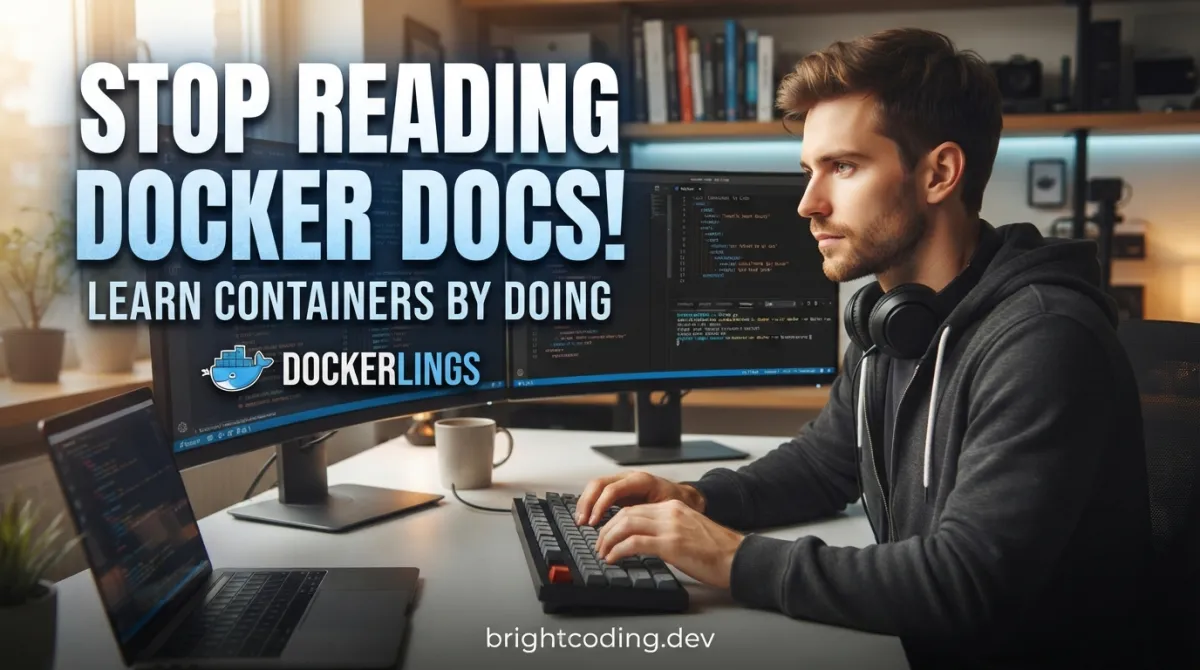
What if I told you that you've been learning Docker↗ Bright Coding Blog the wrong way this entire time?
You've been there. Staring at walls of documentation. Copy-pasting commands from tutorials that break the moment you try something slightly different. Watching video courses where the instructor breezes through docker-compose while you're still wondering why your container exited immediately. The Docker learning curve isn't steep—it's a cliff, and most resources throw you off it without a parachute.
Here's the brutal truth: passive learning doesn't work for infrastructure tools. You don't learn Docker by reading about containers. You learn by breaking them, fixing them, and watching them fail in real-time. But setting up your own exercises? Painful. Creating broken scenarios just to fix them? Time-consuming. Finding instant feedback on whether you actually understood a concept? Nearly impossible.
Until now.
Enter Dockerlings—the interactive terminal application that transforms Docker education from a slog into an addictive, game-like experience. No more guessing. No more "did I do it right?" No more context-switching between five browser tabs. Just you, your terminal, and progressively challenging exercises that build real muscle memory. This is how Docker was meant to be learned.
What is Dockerlings?
Dockerlings is an open-source, terminal-based learning platform created by developer Furkan that teaches Docker through hands-on exercises. Built with Go and the elegant Bubble Tea TUI framework, it delivers a polished, keyboard-driven interface that runs entirely in your terminal—no browser required, no distractions tolerated.
The project emerged from a frustration we all share: Docker documentation is comprehensive but overwhelming, while most tutorials optimize for quick wins rather than deep understanding. Dockerlings bridges this gap by forcing you to do rather than consume. Each exercise presents a specific containerization challenge, verifies your solution instantly, and provides progressive hints when you're stuck.
What makes Dockerlings genuinely trend-worthy is its pedagogical architecture. The 15+ exercises aren't random tasks—they're a carefully sequenced curriculum that mirrors how professional developers actually use Docker in production. You'll start with basic container operations, graduate to Dockerfile authoring, tackle persistent storage and networking, and ultimately build multi-stage production images. This isn't toy learning; it's transferable expertise.
The project has gained significant traction in the developer community precisely because it solves a universal pain point. In an era where "learn by doing" has become cliché, Dockerlings actually delivers on the promise with technical rigor and delightful UX. The terminal-native approach also means it integrates seamlessly into your existing workflow—no context switching, no SaaS subscriptions, no data collection.
Key Features That Make Dockerlings Irresistible
100% Interactive TUI Powered by Bubble Tea
Most CLI tools feel like relics from the 90s. Dockerlings doesn't. The Bubble Tea framework enables a responsive, event-driven interface with smooth navigation, real-time state updates, and visual polish that makes terminal work genuinely enjoyable. You navigate with arrow keys, trigger checks with a single keystroke, and receive immediate visual feedback. This isn't a script—it's an application.
Instant Verification with check
The killer feature? Running check evaluates your solution against the exercise's requirements in seconds. No manual comparison against expected outputs. No wondering if your approach was "correct enough." The verification system validates container states, file contents, network configurations, and build artifacts automatically. This tight feedback loop is what makes learning stick—neuroscience confirms that immediate correction accelerates skill acquisition exponentially.
Progressive 15+ Exercise Curriculum
The exercises build deliberately. Core 01-04 establish container fundamentals. Core 05-07 introduce Dockerfile authoring with real directives like COPY, EXPOSE, ENV, and LABEL. Core 08-09 tackle the notoriously confusing volume and bind mount semantics. Core 10-11 demystify container networking. Core 12-14 scale to multi-service orchestration with Docker Compose. Core 15 culminates in multi-stage builds—a production-critical technique most beginners never encounter.
Real-World Skill Transfer
Every exercise maps to actual job requirements. You'll configure named volumes for database persistence, design custom bridge networks for service isolation, and optimize image sizes using builder pattern techniques. These aren't academic puzzles; they're compressed professional experience.
Zero-Friction Onboarding
Three commands and you're learning. No account creation. No dependency hell. No "cloud platform" lock-in. The entire application compiles from source in seconds and runs locally with zero external services required.
Where Dockerlings Absolutely Shines
Scenario 1: The Bootcamp Graduate with Resume Gaps
You completed a coding bootcamp. You listed "Docker" on your resume. But when the interviewer asks about multi-stage builds, you freeze. Dockerlings compresses months of containerization experience into focused evenings. Complete the curriculum, and you'll discuss volume strategies and network segmentation with genuine confidence.
Scenario 2: The Senior Dev Avoiding Containerization
You've been "getting to Docker eventually" for three years. Your team's Kubernetes migration is six months away, and your imposter syndrome grows weekly. Dockerlings respects your intelligence while filling your knowledge gaps. The progressive difficulty prevents boredom, while the hands-on format respects that experienced developers learn fastest by doing, not watching.
Scenario 3: The Platform Engineer Training Teams
You need to onboard five new developers to your containerized infrastructure. Instead of crafting custom workshops that become instantly outdated, point them to Dockerlings. The standardized curriculum ensures consistent baseline knowledge, while the self-paced structure respects individual learning speeds. You verify completion; they gain competence.
Scenario 4: The Homelab Enthusiast Building Production-Grade Skills
Your home server runs twenty containers, but you're copy-pasting docker run commands without understanding them. Dockerlings transforms your hobby into expertise. When you finish, you'll architect services with intentional networking, persistent storage strategies, and security-conscious build practices.
Step-by-Step Installation & Setup Guide
Dockerlings requires two prerequisites: Go (1.21+) and Docker (20.10+). Verify your installations:
# Verify Go installation
go version
# Expected: go version go1.21.x or higher

# Verify Docker installation
docker --version
docker compose version
Clone and Build:
# Clone the repository
git clone https://github.com/furkan/dockerlings.git

# Enter the project directory
cd dockerlings

# Build the application binary
go build -o bin/dockerlings$(go env GOEXE) ./cmd/dockerlings
The $(go env GOEXE) suffix elegantly handles cross-platform executable extensions—empty on Unix, .exe on Windows. No platform-specific build scripts needed.
Launch the Learning Environment:
# Start the interactive TUI
./bin/dockerlings$(go env GOEXE) watch
Navigation Controls:
| Key | Action |
|---|---|
↑ / ↓ |
Navigate between exercises |
c |
Check your current solution |
h |
Reveal progressive hints |
q |
Quit the application |
Optional: Manual Verification
For detailed debugging or CI integration, verify solutions directly:
cd exercises/core-01
bash check.sh   # Executes exercise-specific validation with verbose output
Pro Setup Tip: Create a shell alias for instant access:
# Add to ~/.bashrc or ~/.zshrc
alias dockerlings='~/projects/dockerlings/bin/dockerlings watch'
Real Code Examples from Dockerlings
Let's examine how Dockerlings structures its exercises and verification system. These examples reveal the pedagogical depth behind the polished interface.
Example 1: Building the Application
The installation command itself demonstrates Go cross-platform compilation:
go build -o bin/dockerlings$(go env GOEXE) ./cmd/dockerlings
This single line compiles the main package located at ./cmd/dockerlings and outputs the binary to bin/dockerlings (with platform-appropriate extension). The $(go env GOEXE) subcommand dynamically resolves to .exe on Windows or empty string on Unix systems—elegant cross-platform support without build tags or conditional scripts. The ./cmd/dockerlings path follows Go's standard project layout convention, separating application entry points from library code.
Example 2: Launching the Interactive Interface
./bin/dockerlings$(go env GOEXE) watch
The watch subcommand initializes the Bubble Tea TUI event loop. This isn't a simple script—it spawns a persistent process that monitors exercise state, listens for keyboard input, and re-renders the interface on state changes. The watch terminology suggests file-system watching capabilities, potentially enabling hot-reloading if exercise files are modified externally during learning sessions.
Example 3: Manual Solution Verification
cd exercises/core-01
bash check.sh   # see detailed feedback
Each exercise directory contains a check.sh script implementing exercise-specific validation logic. This decoupled architecture separates the TUI application from verification logic, enabling:
- Independent testing: Run checks without the full application
- CI/CD integration: Automate progress validation in educational pipelines
- Custom verification: Instructors can modify checks without rebuilding the binary
- Transparency: Students inspect exactly how solutions are evaluated
The comment # see detailed feedback indicates verbose output mode—critical for debugging failed attempts. This isn't boolean pass/fail; it's diagnostic information that accelerates learning.
Example 4: Exercise Curriculum Structure
The README's curriculum table reveals intentional pedagogical design:
| Exercise     | You'll learn                                                                 |
|--------------|-------------------------------------------------------------------------------|
| core-01–04   | Running containers, logs, exec, file operations                              |
| core-05–07   | Writing Dockerfiles, COPY, EXPOSE, ENV, LABEL                                |
| core-08–09   | Persistent volumes & live-reloading bind mounts                              |
| core-10–11   | Container networking and port publishing                                     |
| core-12–14   | Docker Compose, multi-service apps, named volumes, custom networks          |
| core-15      | Multi-stage builds for tiny, secure production images                        |
Notice the progression: imperative container operations → declarative image definitions → storage abstractions → network abstractions → orchestration → optimization. This mirrors how organizations actually adopt Docker—first experimenting with containers, then standardizing images, then solving persistence, then connecting services, then scaling complexity, finally optimizing for production.
The grouping (4 exercises, 3 exercises, 2 exercises, 2 exercises, 3 exercises, 1 exercise) reflects cognitive load management. Early concepts need more repetition; advanced concepts like multi-stage builds consolidate multiple techniques into capstone challenges.
Advanced Usage & Best Practices
Batch Progress Tracking
For instructors or self-monitoring learners, parse the TUI state or check script exit codes to build progress dashboards. The check.sh scripts likely return standard exit codes (0 for success, non-zero for failure with specific codes for different failure modes).
Custom Exercise Creation
The modular exercises/ directory structure suggests you can author custom challenges. Follow the established pattern: create a directory with README.md instructions, check.sh verification, and any supporting files. This extends Dockerlings for team-specific technologies or compliance requirements.
Container Debugging Integration
When exercises fail, use standard Docker debugging tools in parallel:
# Inspect exercise containers while Dockerlings runs
docker ps -a
docker logs <container>
docker inspect <container>
Spaced Repetition Strategy
Don't binge the curriculum. Complete 2-3 exercises, then revisit earlier ones after 24 hours. The check command makes verification instant—exploit this for active recall practice. The terminal interface's low friction removes the activation energy that prevents review.
Team Competition Mode
Run Dockerlings in shared terminal sessions or stream your progress. The immediate check feedback creates natural speed-running opportunities. Gamification emerges organically from the tight feedback loops.
Dockerlings vs. The Alternatives
| Feature | Dockerlings | Docker Docs Tutorials | Katacoda/Playgrounds | Video Courses |
|---|---|---|---|---|
| Offline capable | ✅ Yes | ⚠️ Partial | ❌ No | ✅ Yes |
| Instant feedback | ✅ Sub-second | ❌ Manual comparison | ✅ Yes | ❌ Delayed |
| Progressive difficulty | ✅ 15+ sequenced levels | ⚠️ Some structure | ⚠️ Variable | ⚠️ Instructor-dependent |
| Real Docker CLI | ✅ Native execution | ✅ Yes | ⚠️ Sandboxed | ❌ Demonstration only |
| Zero cost | ✅ Open source | ✅ Yes | ❌ Often paid | ❌ Usually paid |
| Customizable | ✅ Modify exercises | ❌ Static | ❌ Closed platform | ❌ Fixed content |
| TUI experience | ✅ Polished Bubble Tea | ❌ Browser-based | ⚠️ Browser terminal | N/A |
| Hint system | ✅ Progressive reveals | ❌ None | ⚠️ Variable | ⚠️ Rewind required |
Why Dockerlings wins: It combines the immediacy of browser playgrounds with the authenticity of local Docker execution, wrapped in a distraction-free terminal interface that respects developer workflows. No SaaS lock-in. No artificial constraints. Just learning that sticks.
Frequently Asked Questions
Q: Is Dockerlings suitable for complete Docker beginners?
Absolutely. Core 01 assumes zero prior knowledge. You'll start with docker run fundamentals and build systematically. The hint system (h key) provides guidance without spoilers.
Q: Can I use Dockerlings with Docker Desktop alternatives like Podman?
Dockerlings targets the Docker CLI specifically. Podman compatibility depends on alias configuration (alias docker=podman), but verification scripts may fail on Docker-specific behaviors. Native Podman support would require community contribution.
Q: How long does the full curriculum take?
Expect 4-8 hours for thorough completion, depending on prior experience. The bite-sized design enables 15-minute sessions—perfect for consistent daily practice. Rushing through in one sitting defeats the purpose.
Q: Is there a certificate or completion tracking?
Currently no formal certification. Progress is locally stored. For credential purposes, document your journey with screenshots or screen recordings of completed exercises.
Q: Can I contribute new exercises or translations?
The open-source license welcomes contributions. The modular exercises/ structure makes extending straightforward. Check the repository's issue tracker for contribution guidelines.
Q: Does Dockerlings work on Windows?
Yes, via WSL2 with Docker Desktop integration, or natively with Go and Docker installed. The $(go env GOEXE) build command handles Windows executable generation automatically.
Q: What if I get completely stuck on an exercise?
The h key reveals progressive hints. For additional help, the Discord community provides peer support. The check.sh scripts are also readable—examine them to understand exact verification criteria.
Conclusion: Your Docker Breakthrough Starts Now
Dockerlings isn't another tutorial to bookmark and forget. It's a paradigm shift in how technical skills are acquired—trading passive consumption for active problem-solving, replacing tutorial hell with verified competence.
The containerization landscape will only expand. Kubernetes, serverless containers, edge deployments—all demand genuine Docker fluency, not superficial familiarity. Dockerlings transforms that requirement from an intimidating obligation into an engaging challenge.
I've evaluated dozens of Docker learning resources. Most optimize for quick impressions; Dockerlings optimizes for lasting capability. The terminal-native design, instant verification, and progressive curriculum create conditions where learning actually transfers to professional contexts.
Your next step is embarrassingly simple:
git clone https://github.com/furkan/dockerlings.git
cd dockerlings
go build -o bin/dockerlings$(go env GOEXE) ./cmd/dockerlings
./bin/dockerlings$(go env GOEXE) watch
That's thirty seconds to your first exercise. Thirty seconds to stop reading about Docker and start understanding it. The containers are waiting. Your terminal is ready. The only question is whether you'll take the keyboard shortcut to competence.
Star Dockerlings on GitHub if it accelerates your learning—and join the Discord to share your progress. The future of Docker education is interactive, terminal-native, and completely free. Don't get left behind reading documentation while your peers are building skills.
Outils recommandés
Explore on the BrightCoding network
Hand-picked resources from our other sites.
Stop Wasting Hours Fixing AI Pixel Art! Use Pixel Snapper Instead
Fix messy AI-generated pixel art instantly with Sprite Fusion Pixel Snapper. This open-source Rust tool snaps pixels to perfect grids, quantizes colors to stric...
Stop Wasting Tokens! auto-prompt Cuts AI Costs by 40%
Discover auto-prompt, the LGPL-licensed AI Prompt Optimization Platform that analyzes inference, visualizes reasoning, and cuts API costs by 40%. Built on .NET...
Stop Losing Track of Your Homelab! Use Home Lab Hub Instead
Stop losing track of your homelab infrastructure. Home Lab Hub is the open-source, self-hosted web application that maps hardware, VMs, apps, storage, and netwo...
Continuez votre lecture
Why Alexandrie is the Ultimate Markdown Note-Taking App
Why CrossPaste is the Ultimate Game Changer for Clipboard Management
Why Chandra is the Ultimate OCR Tool for Handwriting and Tables

Stop Coding Alone: OPC-Skills Gives Your AI Agent Superpowers
Commentaires 0
Aucun commentaire pour l'instant. Soyez le premier à réagir !