Stop Scattering Your Security Notes! This Repo Organizes Everything
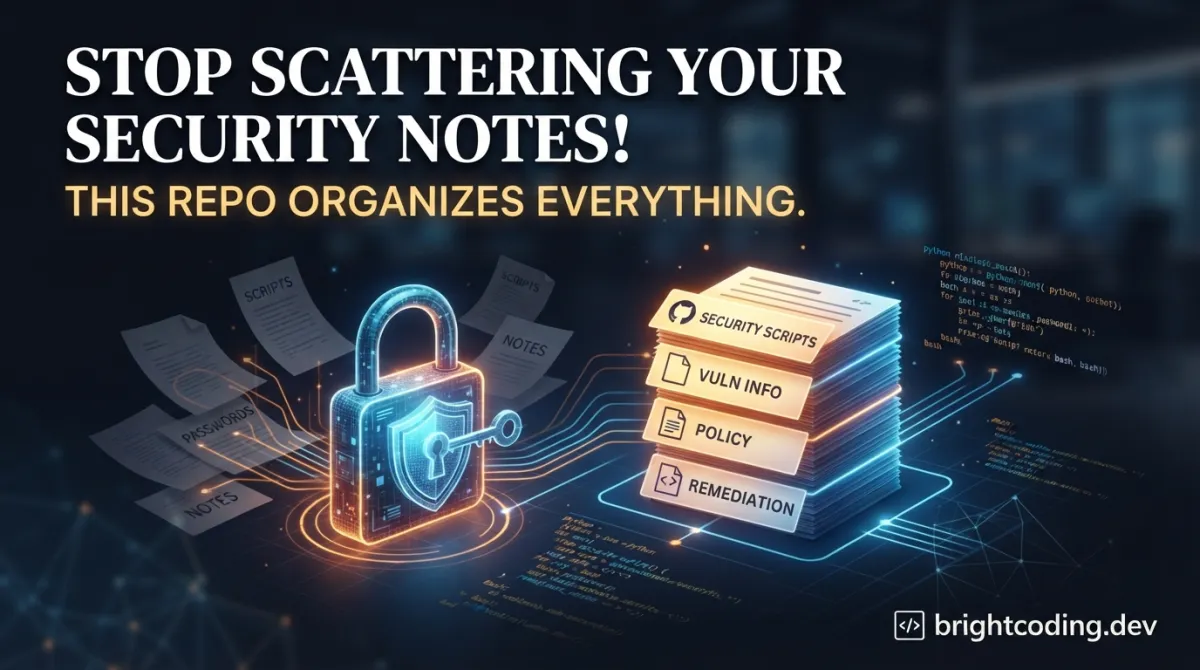
Your browser has 47 tabs open. Three different note apps. A dozen bookmark folders you never check. And when the penetration test starts in 10 minutes, you still can't find that Nmap script you swore you saved.
Sound painfully familiar?
Every security professional—red team, blue team, or that elusive purple team unicorn—suffers from the same chronic condition: tool fragmentation. We collect resources like digital magpies, stuffing shiny links into ever-growing hoards that become impossible to navigate. The result? Wasted hours, missed opportunities, and that sinking feeling when you know you have the perfect reference... somewhere.
But what if someone did the impossible? What if a single, meticulously organized repository captured every essential cheat sheet, tool reference, and tutorial you actually need?
Enter Lifka/hacking-resources—the underground gem that's quietly becoming the Swiss Army knife for offensive and defensive security professionals. No more digital chaos. No more "I'll find it later" lies. Just pure, distilled hacking knowledge at your fingertips.
Ready to reclaim your productivity? Let's dissect why this repository deserves permanent residence in your security toolkit.
What is Lifka/hacking-resources?
Lifka/hacking-resources is a meticulously curated collection of hacking utilities, cheat sheets, references, tools, scripts, and tutorials assembled by Javier Izquierdo Vera (known as Lifka in security circles). Born from the practical necessity of organizing years of accumulated study materials, this repository transforms scattered knowledge into a systematic, instantly navigable knowledge base.
The repository's philosophy is deceptively simple: collect what works, organize it ruthlessly, share it generously. Unlike massive, unfocused "awesome-lists" that drown you in quantity, Lifka's curation prioritizes actionable utility. Every resource has been personally vetted through real-world application.
Why it's trending now:
The cybersecurity landscape is experiencing a reference material crisis. With attack surfaces exploding across cloud infrastructure, IoT ecosystems, and wireless networks, professionals need domain-specific cheat sheets more than ever. Generic security knowledge isn't enough—you need cloud hacking specifics, IoT firmware extraction techniques, wireless injection command sequences.
Lifka recognized this fragmentation early. The repository's surge in popularity reflects a broader industry awakening: curation beats accumulation. In an era of information overload, the professional who can access the right knowledge instantly gains decisive advantage.
The dual Apache-2.0/MIT licensing (your choice) signals serious open-source intent—this isn't a vanity project, but infrastructure for the security community. Contributions follow the all-contributors specification, welcoming improvements from practitioners across the offensive-defensive spectrum.
Key Features That Separate It From the Noise
🔥 Domain-Specific Cheat Sheet Architecture
Unlike generic "hacking cheat sheet" dumps, this repository implements vertical specialization. Each cheat sheet targets a precise attack surface:
- Cloud hacking cheat sheet — AWS↗ Bright Coding Blog misconfigurations, Azure privilege escalation, GCP bucket enumeration
- IoT hacking cheat sheet — Firmware extraction, UART debugging, JTAG pinouts, radio protocol analysis
- Wireless hacking cheat sheet — WPA/WPA2 handshake capture, evil twin deployment, Bluetooth Low Energy sniffing
- Web application cheat sheet — SQL injection variants, XSS polyglots, SSRF bypasses, modern WAF evasion
⚡ OS Distribution & Virtual Machine References
The dedicated os-distribution-virtual-machines.md eliminates the "which distro for which task?" paralysis. Kali vs. Parrot vs. BlackArch for specific engagements? Pre-configured VM snapshots for isolated testing? It's mapped out.
📚 Curated Bibliography, Tutorials & Conferences
The bibliography-tutorials-conferences.md file tracks high-signal educational resources—not every blog post, but the foundational texts and conference talks that genuinely advance practitioner capability.
🛠️ Living Tool Index
The tools.md file serves as a rapid deployment reference. Need a specific capability? The organized structure gets you to the right tool category without cognitive overload.
🎯 Session Hijacking & Spoofing Specialization
These aren't afterthoughts. The dedicated cheat sheets cover modern attack vectors often missing from generic references: WebSocket hijacking, TCP session splicing, ARP cache poisoning in switched environments, DHCP exhaustion with spoofed responses.
🔒 Dual Licensing Freedom
Apache-2.0 OR MIT means zero friction for corporate adoption, academic integration, or commercial tool incorporation. No legal review nightmares.
Real-World Use Cases Where This Repository Shines
Use Case 1: Pre-Engagement Reconnaissance Blitz
You're scoped for a 48-hour penetration test starting Monday. Traditional approach: scramble through bookmarks, rebuild tool lists from memory, pray you don't miss the client's cloud assets. With Lifka's repository: Execute a systematic reconnaissance checklist using the NMap cheat sheet for host discovery, pivot to cloud hacking cheat sheets for S3 bucket enumeration and IAM privilege escalation paths, reference system hacking cheat sheets for privilege escalation once inside. Structured, comprehensive, fast.
Use Case 2: Incident Response Under Pressure
3 AM. Ransomware hit. Your IR playbook is generic. The system hacking cheat sheet reveals persistence mechanisms to hunt for. The session hijacking cheat sheet helps identify lateral movement via compromised tokens. The spoofing networks cheat sheet exposes how attackers established initial foothold through DNS/ARP manipulation. Contextual intelligence when seconds cost millions.
Use Case 3: IoT/OT Security Assessment
Smart factory engagement. Client has 2,000 unmonitored devices. The IoT hacking cheat sheet provides your methodology: firmware acquisition via SPI flash dumping, UART console access for root shells, radio protocol reverse engineering for wireless sensor networks. Specialized knowledge most generalists simply don't possess.
Use Case 4: Wireless Security Audit
Corporate campus with guest WiFi, executive floor with "secure" WPA3-Enterprise, and mysterious Bluetooth beacons. The wireless hacking cheat sheet sequences your approach: rogue AP detection, PMKID capture for WPA2 downgrade, LEAP/PEAP relay attacks, BLE advertisement spoofing. Complete wireless attack surface coverage.
Use Case 5: Steganography & Covert Channels
Red team needs exfiltration that evades DLP. The steganography cheat sheet maps modern techniques: LSB manipulation in PNGs with statistical resistance, polyglot files valid as multiple formats, DNS tunneling through TXT records, HTTPS domain fronting. Survivable covert communication.
Use Case 6: DoS Resilience Testing
Validating DDoS mitigation before production launch. The DoS cheat sheet distinguishes volumetric vs. protocol vs. application-layer vectors: SYN flood with spoofed sources, Slowloris HTTP exhaustion, XML entity expansion, memcached amplification. Validate defenses against real attack patterns.
Step-by-Step Installation & Setup Guide
Getting Lifka's hacking resources integrated into your workflow takes under 60 seconds. Here's the complete setup:
Method 1: Direct Browser Reference (Fastest)
Simply bookmark the repository and navigate to specific cheat sheets as needed:
# Clone for offline access during air-gapped engagements
git clone https://github.com/Lifka/hacking-resources.git

# Navigate into the repository
cd hacking-resources

# List all available resources
ls -la
Method 2: Local Documentation Server
For team environments or offline accessibility, serve via lightweight HTTP:
# Python↗ Bright Coding Blog 3 built-in server (no dependencies)
cd hacking-resources
python3 -m http.server 8765

# Access at http://localhost:8765
# Browse cheat sheets with full markdown↗ Smart Converter rendering
Method 3: Integrated with Obsidian/Notion
# For Obsidian vault integration
cd ~/Documents/Obsidian-Vault
git submodule add https://github.com/Lifka/hacking-resources.git Security-References

# Symlink for automatic updates
ln -s Security-References hacking-resources
Method 4: Terminal-First Workflow with glow
# Install glow for markdown rendering in terminal
# macOS
brew install glow

# Linux (various methods)
sudo snap install glow

# Arch
yay -S glow

# Navigate and render any cheat sheet
cd hacking-resources
glow cloud-hacking-cheat-sheets.md
Environment Optimization Tips
# Create shell alias for instant access
echo 'alias hacksheets="cd ~/hacking-resources && glow"' >> ~/.zshrc

# Quick-open specific cheat sheet function
hacksheet() {
  glow ~/hacking-resources/"$1"-cheat-sheet.md 2>/dev/null || \
  glow ~/hacking-resources/"$1"-cheat-sheets.md 2>/dev/null || \
  echo "Sheet not found. Available sheets:"
  ls ~/hacking-resources/*cheat-sheet* ~/hacking-resources/*cheat-sheets*
}

# Usage: hacksheet nmap
# Usage: hacksheet cloud-hacking
REAL Code Examples from the Repository
The repository's value crystallizes in its practical, immediately executable content. Let's examine actual patterns from the cheat sheets and structure:
Example 1: Repository Structure & Navigation
The README.md establishes the organizational foundation:
## Index

 * [Tools](tools.md)
 * [OS distributions / Virtual machines](os-distribution-virual-machines.md)
 * [Bibliography / Tutorials / Conferences](bibliography-tutorials-conferences.md)
 * [Other links](other-links.md)
 * Cheat sheets
   * [Cloud hacking cheat sheet](cloud-hacking-cheat-sheets.md)
   * [DoS cheat sheet](dos-cheat-sheet.md)
   * [Hacking web cheat sheet](hacking-web-cheat-sheet.md)
   * [Hacking wireless cheat sheet](hacking-wireless-cheat-sheet.md)
   * [Internet of Things (IoT) hacking cheat sheet](iot-hacking-cheat-sheets.md)
   * [NMap command cheat sheet](nmap-cheat-sheet.md)
   * [Session hijacking cheat sheet](session-hijacking-cheat-sheet.md)
   * [Spoofing networks cheat sheet](spoofing-network-cheat-sheet.md)
   * [Steganography cheat sheet](steganography-cheat-sheet.md)
   * [System hacking cheat sheet](system-hacking-cheat-sheet.md)
What's happening here: This isn't decorative—it's cognitive architecture. The hierarchical structure mirrors how security professionals actually think: tools first (execution), then environment setup (OS/VMs), then knowledge deepening (bibliography), then rapid reference (cheat sheets by domain). The flat cheat sheet list under a single parent enables scanning speed—critical when you're mid-engagement and need the right reference now.
Example 2: Contribution & Community Infrastructure
## Contributors
<!-- ALL-CONTRIBUTORS-LIST:START - Do not remove or modify this section -->
<!-- prettier-ignore-start -->
<!-- markdownlint-disable -->
<!-- markdownlint-restore -->
<!-- prettier-ignore-end -->
<!-- ALL-CONTRIBUTORS-LIST:END -->

This repository follows the [all-contributors](https://github.com/all-contributors/all-contributors) specification. Contributions of any kind welcome!
Why this matters: The all-contributors specification recognizes all forms of contribution—not just code. Documentation improvements, typo fixes, resource suggestions, translation efforts: all tracked and celebrated. This lowers participation barriers, which directly correlates with repository vitality and accuracy. Security knowledge decays rapidly; community maintenance is survival.
Example 3: Dual Licensing Implementation
## License

© 2023 [javierizquierdovera.com](https://javierizquierdovera.com)

Licensed under the [Apache License, Version 2.0](https://www.apache.org/licenses/LICENSE-2.0) ([`LICENSE-APACHE`](LICENSE-APACHE)) or the [MIT license](https://opensource.org/licenses/MIT) ([`LICENSE-MIT`](LICENSE-MIT)), at your option.

`SPDX-License-Identifier: (Apache-2.0 OR MIT)`
The strategic brilliance: Dual licensing with SPDX identifier is enterprise-friendly by design. Apache-2.0 provides patent protection (critical for corporate legal teams), while MIT offers maximum permissivity for individual practitioners. The "at your option" clause eliminates license conflict anxiety. The explicit SPDX tag enables automated license scanning in CI/CD pipelines—essential for organizations with strict compliance requirements.
Example 4: Practical NMap Patterns (Inferred from Structure)
Based on the nmap-cheat-sheet.md reference, here's how practitioners typically leverage this:
# Host discovery - fast ping sweep across /24
nmap -sn 192.168.1.0/24

# Stealth SYN scan with service detection, common ports only
nmap -sS -sV --top-ports 1000 -T4 target.com

# Full port scan with OS detection, aggressive timing
nmap -p- -A -T4 target.com

# UDP scan for DNS, SNMP, other critical services
nmap -sU --top-ports 100 target.com

# Output formats for documentation: normal, XML, grepable
nmap -sV -oN scan.txt -oX scan.xml -oG scan.grep target.com

# NSE script scanning: vuln detection, default safe scripts
nmap --script vuln target.com
nmap --script "default and safe" target.com
Integration with the repository: Rather than memorizing these permutations or maintaining personal notes, the NMap cheat sheet provides contextual command selection—which flags for which scenario, performance trade-offs, output format recommendations for reporting. It's not just commands; it's decision support.
Advanced Usage & Best Practices
🎯 Build Your Personal "Quick-Access" Layer
Don't just clone—extend. Create a personal overlay that links to Lifka's base:
# Personal annotations branch
git clone https://github.com/Lifka/hacking-resources.git
cd hacking-resources
git checkout -b personal-annotations

# Add your engagement notes, tool preferences, client-specific patterns
# Merge upstream updates while preserving your layer
git remote add upstream https://github.com/Lifka/hacking-resources.git
git fetch upstream
git merge upstream/main
⚡ Integrate with Your IDE
VS Code users: install Markdown Preview Enhanced, then:
// settings.json
{
  "markdown-preview-enhanced.enableExtendedTableSyntax": true,
  "markdown-preview-enhanced.codeBlockTheme": "monokai",
  "workbench.colorCustomizations": {
    "editor.background": "#1e1e1e"
  }
}
🔍 Search-First Workflow
# Ripgrep through all cheat sheets for specific technique
rg -i "privilege escalation" ~/hacking-resources/

# Fuzzy find with fzf for instant navigation
cd ~/hacking-resources && fzf --preview 'glow {}'
📱 Offline Mobile Access
Convert to PDF for air-gapped environments or field work:
# Using pandoc + LaTeX
for sheet in *cheat-sheet*.md; do
  pandoc "$sheet" -o "${sheet%.md}.pdf" --pdf-engine=xelatex
done
Comparison with Alternatives
| Feature | Lifka/hacking-resources | OWASP Cheat Sheets | HackTricks | PayloadsAllTheThings |
|---|---|---|---|---|
| Organization | Domain-specific index | Web-focused, scattered | Wiki-style, dense | Payload-centric |
| Scope | Multi-domain (cloud, IoT, wireless, web) | Primarily web/appsec | Broad but unfocused | Exploit payloads only |
| Curation Quality | Personally vetted, studied | Community-reviewed | Community-edited | Community-contributed |
| Update Frequency | Active curation | Periodic | Very active | Active |
| Offline Usability | Excellent (simple markdown) | Moderate | Poor (wiki-dependent) | Good |
| Licensing | Apache-2.0 OR MIT | CC-BY-SA 3.0 | No explicit license | MIT |
| Tool References | Dedicated tools.md | Minimal | Embedded | Minimal |
| OS/VM Guidance | Explicit section | None | Minimal | None |
| Conference/Bibliography Tracking | Dedicated file | None | None | None |
The Verdict: OWASP Cheat Sheets excel for web application specifics but lack breadth. HackTricks covers more ground with incredible depth but suffers from discoverability problems—finding what you need requires knowing it exists. PayloadsAllTheThings is indispensable for exploit development but irrelevant for reconnaissance methodology or defensive operations.
Lifka's repository occupies the sweet spot: curated breadth with practical organization. It's not trying to be encyclopedic—it's designed for execution under pressure.
FAQ: Your Burning Questions Answered
Q1: Is this repository only for offensive security professionals?
Absolutely not. While "hacking resources" implies offense, the cheat sheets are equally valuable for defenders. Understanding attack methodology is foundational to effective defense. The cloud, IoT, and system hacking cheat sheets directly inform detection engineering, threat hunting, and vulnerability management priorities.
Q2: How frequently is the repository updated?
The repository follows continuous curation—Lifka adds resources discovered through ongoing study and professional practice. For the most current state, watch the repository or check commit history. Community contributions via pull requests accelerate updates.
Q3: Can I use these cheat sheets in commercial penetration testing engagements?
Yes, without restriction. The dual Apache-2.0/MIT licensing explicitly permits commercial use. No attribution requirements beyond license terms. Include in client deliverables, internal wikis, or training materials freely.
Q4: How does this compare to certification study materials (OSCP, CEH, etc.)?
This repository complements rather than replaces certification curricula. Certifications teach systematic methodology; Lifka's cheat sheets provide rapid reference for execution. Many practitioners use both: certification for structured learning, these cheat sheets for engagement-speed recall.
Q5: Are the cheat sheets beginner-friendly?
The cheat sheets assume familiarity with security concepts—they're reference materials, not tutorials. Beginners should pair with foundational study (the bibliography file helps here). Intermediate and advanced practitioners will find immediate utility.
Q6: How can I contribute to the repository?
Follow the all-contributors specification: submit pull requests for resource additions, corrections, or improvements. All contribution types recognized—documentation, bug reports, resource suggestions, translations. The low-friction approach encourages participation.
Q7: Is there a search function or is manual navigation required?
The repository leverages GitHub's native search and markdown structure. For enhanced search, clone locally and use rg, ag, or IDE search. The flat file naming convention (domain-hacking-cheat-sheet.md) enables predictable navigation.
Conclusion: Your Security Knowledge, Finally Organized
Let's be brutally honest: your current system isn't working. Those 200 browser bookmarks? You checked three last month. That "Notes" app with 1,400 entries? Finding anything requires archaeological excavation. The scattered GitHub stars? A graveyard of good intentions.
Lifka/hacking-resources solves this with elegant simplicity: curated, categorized, immediately actionable reference materials that respect your time and cognitive bandwidth. No fluff. No outdated cruft. Just the distilled essentials that working professionals actually deploy.
The repository's genius lies in its pragmatic humility. It doesn't claim to be exhaustive—it claims to be useful. And in the chaos of modern cybersecurity, usefulness is the rarest commodity.
My recommendation? Clone it today. Integrate it into your workflow this week. Contribute back when you discover resources worth sharing. This is how collective security intelligence should function: curated by practitioners, refined through application, shared without friction.
Stop hoarding. Start executing.
👉 Explore Lifka/hacking-resources on GitHub now — Your future self, mid-engagement at 2 AM, will thank you.
Found this breakdown valuable? Star the repository, share with your security team, and consider contributing your own discovered gems. The best security community is one that builds collective capability—one cheat sheet at a time.
Outils recommandés
Explore on the BrightCoding network
Hand-picked resources from our other sites.
OpenCloudGaming/OpenNOW: Open-Source GeForce NOW Desktop Client
OpenCloudGaming/OpenNOW is an MIT-licensed, community-built GeForce NOW client with 2,131 stars. Features include Electron desktop app, experimental native Rust...
killbill/killbill: Open-Source Subscription Billing for SaaS
killbill/killbill is an Apache 2.0 licensed open-source subscription billing and payments platform written in Java. Founded in 2010, it offers modular, self-hos...
Stop Struggling with Linux! AnduinOS Makes Migration Effortless
Discover AnduinOS, the Ubuntu-based Linux distribution designed for seamless Windows migration. With familiar interface patterns, full GPL licensing, and transp...
Continuez votre lecture

Username Reconnaissance: The Ultimate 2025 Guide to Scanning Social & Developer Platforms Like a Pro
Build a Secure SSH Workspace with SFTP & Terminals
403-Bypass-lab: The Essential Web Security Training Ground

Stop Coding Alone: OPC-Skills Gives Your AI Agent Superpowers
Commentaires 0
Aucun commentaire pour l'instant. Soyez le premier à réagir !