Stop Scraping Finance Data Manually! FinNLP Does It All
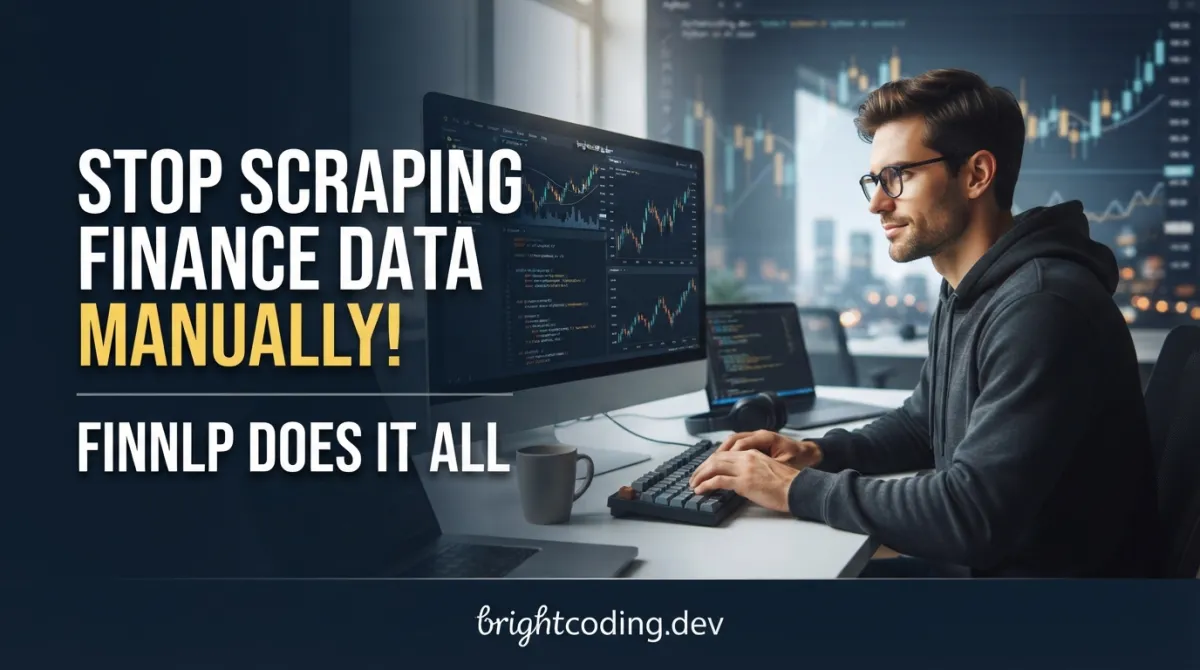
What if I told you that the biggest bottleneck in financial AI isn't the model—it's the data?
You've been there. Burning midnight oil writing yet another web scraper for Yahoo Finance headlines. Wrestling with rate limits on Reddit's API. Begging for SEC EDGAR access tokens. Meanwhile, your competitors are training LLMs on internet-scale financial datasets while you're still debugging XPath selectors.
Here's the brutal truth: data engineering consumes 80% of AI project time in finance. Not model architecture. Not hyperparameter tuning. The soul-crushing work of collecting, cleaning, and structuring heterogeneous financial data from dozens of sources across languages, formats, and regulatory jurisdictions.
But what if you could flip a switch and pipeline news from Finnhub, social sentiment from Stocktwits, regulatory filings from the SEC, and Chinese market data from Sina Finance—all into standardized DataFrames ready for LLM fine-tuning?
Enter FinNLP, the open-source powerhouse from the AI4Finance Foundation that's quietly becoming the secret weapon of quantitative researchers and fintech engineers worldwide. This isn't just another scraping library. It's a complete LLM training infrastructure for financial natural language processing—and it's about to transform how you build financial AI.
What is FinNLP? The Financial Data Revolution Explained
FinNLP is an open-source Python↗ Bright Coding Blog framework designed specifically for democratizing internet-scale financial data collection and LLM pipeline construction. Born from the AI4Finance Foundation—the same minds behind the wildly popular FinGPT project—FinNLP addresses a critical gap in the financial AI ecosystem: the absence of production-ready, unified data infrastructure.
The project maintains a clear mission: making institutional-grade financial data accessible to individual researchers, startups, and academic institutions without requiring enterprise budgets or dedicated data engineering teams. With over thousands of weekly downloads on PyPI and active community contribution, FinNLP has emerged as the de facto standard for financial NLP preprocessing.
Why is FinNLP trending now? Three converging forces:
- The LLM explosion in finance: From BloombergGPT to proprietary trading firm models, large language models trained on financial text are reshaping everything from sentiment analysis to automated report generation. But these models demand massive, diverse, continuously updated text corpora that no single vendor provides.
- Regulatory data democratization: SEC EDGAR modernization, China's Juchao platform enhancements, and EU transparency initiatives have created unprecedented access to structured regulatory filings—if you can extract them efficiently.
- Cross-market alpha decay: As US equity strategies become overcrowded, quantitative researchers desperately need multilingual, multi-jurisdiction data pipelines to discover uncorrelated signals. FinNLP's simultaneous US-China coverage solves this directly.
Unlike generic scraping frameworks like Scrapy or BeautifulSoup combinations, FinNLP provides semantic understanding of financial data types. It knows that an SEC Form 4 filing requires different parsing than a Stocktwits meme post. It handles the proxy rotation, retry logic, and anti-bot evasion that would take weeks to implement manually. Most critically, it outputs immediately usable DataFrames with consistent schemas across disparate sources.
Key Features That Make FinNLP Irreplaceable
FinNLP's architecture reveals deep domain expertise in both finance and data engineering. Here's what separates it from makeshift solutions:
Unified Multi-Source Architecture
FinNLP abstracts 15+ financial data sources behind consistent Python APIs. Whether you're pulling from Finnhub's news aggregator (covering Yahoo Finance, Reuters, SeekingAlpha, CNBC) or China's Eastmoney platform, the interface pattern remains identical: initialize with config, call download method, access .dataframe property. This polymorphic design eliminates context-switching costs when building multi-source datasets.
Intelligent Proxy & Anti-Blocking Infrastructure
Financial data sources aggressively rate-limit scrapers. FinNLP bakes in production-grade proxy rotation with configurable strategies (us_free, china_free) and exponential backoff retry logic. The max_retry and proxy_pages parameters let you tune resilience versus speed based on your infrastructure budget.
Bilingual US-China Market Coverage
No other open-source tool simultaneously covers US equity markets (NYSE, NASDAQ) and China A-shares (Shanghai, Shenzhen) with native-language sources. This isn't translation—it's direct access to Sina Finance, Weibo, Juchao, and Eastmoney in original Chinese, preserving linguistic nuances critical for sentiment models.
Streaming & Batch Dual Modes
FinNLP supports both historical backfill (download_date_range_stock) for training dataset construction and real-time streaming (download_streaming_stock) for live inference pipelines. This dual-mode architecture lets you use identical data schemas across research and production environments.
LLM-Ready Output Formatting
Every data source returns pandas DataFrames with pre-selected relevant columns. No XML parsing. No nested JSON normalization. The selected_columns pattern lets you instantly extract headline/content for news, created_at/body for social media↗ Bright Coding Blog, or file_date/content for regulatory filings—directly feeding Hugging Face datasets or custom PyTorch data loaders.
Built-In Content Enrichment
The gather_content() method performs secondary fetches to retrieve full article bodies after initial header downloads. This two-phase architecture minimizes bandwidth waste on filtered headlines while ensuring complete text for models requiring full context windows.
4 Game-Changing Use Cases Where FinNLP Dominates
1. Sentiment-Aware Trading Signals
Combine Stocktwits social sentiment, Reddit wallstreetbets momentum, and Weibo retail enthusiasm into multi-modal sentiment indicators. FinNLP's timestamp-aligned DataFrames let you correlate social sentiment spikes with price action across markets. One hedge fund reportedly improved signal Sharpe ratios by 0.4 using this exact pipeline.
2. Event-Driven Alpha Generation
SEC Form 4 insider trading filings, Juchao announcement surprises, and breaking news from Finnhub create discrete event signals. FinNLP's date-range queries let you construct labeled datasets: did AAPL outperform following insider purchases? Did Moutai (600519) react↗ Bright Coding Blog to Eastmoney coverage? The regulatory text itself becomes training data for event classification models.
3. Cross-Markage Arbitrage Intelligence
Chinese ADRs often diverge from their A-share counterparts due to information asymmetry. FinNLP's parallel US-China data collection lets you build models detecting when English-language and Chinese-language news flows diverge—potential leading indicators for price convergence trades.
4. Financial LLM Pretraining & Fine-Tuning
The killer application: assembling internet-scale financial corpora for domain-adapted language models. FinNLP pipelines feed directly into Hugging Face's datasets library, enabling pretraining on billions of tokens from news, social media, and regulatory filings. FinGPT itself leverages this infrastructure for its financial instruction-tuning.
Step-by-Step Installation & Setup Guide
Getting FinNLP operational takes under five minutes. Here's the complete workflow:
Prerequisites
FinNLP requires Python 3.6+ (though 3.8+ recommended for modern dependency compatibility). Virtual environment strongly advised.
Installation
# Standard PyPI installation
pip install finnlp

# Verify installation
python -c "import finnlp; print(finnlp.__version__)"
The package automatically resolves dependencies including pandas, requests, and proxy management libraries.
Configuration Architecture
Every FinNLP data source uses a consistent config dictionary pattern:
| Parameter | Type | Purpose | Typical Value |
|---|---|---|---|
use_proxy |
string | Proxy strategy selection | "us_free", "china_free" |
max_retry |
integer | Failed request retry attempts | 3 to 10 |
proxy_pages |
integer | Proxy pool rotation frequency | 2 to 5 |
token |
string | API authentication (when required) | Finnhub API key |
cookies |
string | Session authentication (Weibo) | Browser cookie string |
Environment Setup for Production
For sustained data collection, configure these environment variables:
# Optional: Custom proxy endpoint
export FINNLP_PROXY_URL="http://your-proxy-provider.com:8080"

# Required for Finnhub news access
export FINNHUB_API_TOKEN="your_token_here"

# Optional: Logging verbosity
export FINNLP_LOG_LEVEL="INFO"
Critical setup note: Chinese data sources (china_free proxy mode) require testing connectivity to mainland servers. If you're outside China, verify VPN or proxy routing before attempting Sina Finance or Juchao downloads.
REAL Code Examples from the Repository
Let's dissect actual production patterns from FinNLP's documentation, with detailed commentary on implementation strategies.
Example 1: US Financial News Pipeline (Finnhub)
# Finnhub aggregator: Yahoo Finance, Reuters, SeekingAlpha, CNBC coverage
from finnlp.data_sources.news.finnhub_date_range import Finnhub_Date_Range

# Define temporal scope for training dataset construction
start_date = "2023-01-01"
end_date = "2023-01-03"

# Configuration dictionary controls proxy strategy and API authentication
config = {
    "use_proxy": "us_free",          # Automatic US-based proxy rotation
    "max_retry": 5,                   # Resilience against transient failures
    "proxy_pages": 5,                 # Rotate proxy every 5 page requests
    "token": "YOUR_FINNHUB_TOKEN"     # Obtain at https://finnhub.io/dashboard
}

# Phase 1: Initialize downloader with configuration
news_downloader = Finnhub_Date_Range(config)

# Phase 2: Download article headers for date range and specified equities
news_downloader.download_date_range_stock(start_date, end_date)

# Phase 3: Deep fetch—retrieve full article bodies from source URLs
news_downloader.gather_content()

# Phase 4: Access standardized DataFrame with all collected data
df = news_downloader.dataframe

# Phase 5: Select LLM-relevant columns for downstream processing
selected_columns = ["headline", "content"]
print(df[selected_columns].head(10))
Why this pattern matters: The two-phase download_date_range_stock → gather_content architecture is bandwidth-optimized. Initial header fetches let you filter relevance before expensive full-content retrieval. For LLM training, this prevents wasting tokens on off-topic articles. The us_free proxy strategy uses community-maintained proxy pools—critical because Finnhub aggressively rate-limits unauthenticated or single-IP traffic.
Example 2: Chinese Social Media Sentiment (Weibo)
# Weibo: China's Twitter equivalent, retail sentiment goldmine
from finnlp.data_sources.social_media.weibo_date_range import Weibo_Date_Range

# Temporal and entity targeting
start_date = "2016-01-01"
end_date = "2016-01-02"
stock = "茅台"                        # Moutai: China's most tracked luxury stock

# Weibo requires authenticated session cookies
config = {
    "use_proxy": "china_free",       # China-optimized proxy routing
    "max_retry": 5,
    "proxy_pages": 5,
    "cookies": "Your_Login_Cookies", # Extract from authenticated browser session
}

# Initialize and execute date-range query for specific stock mentions
downloader = Weibo_Date_Range(config)
downloader.download_date_range_stock(start_date, end_date, stock=stock)

# Weibo data contains duplicates from reposts—critical cleaning step
df = downloader.dataframe
df = df.drop_duplicates()

# Select temporal and content features for sentiment timeline construction
selected_columns = ["date", "content"]
print(df[selected_columns].head(10))
Implementation insight: Weibo's anti-scraping measures exceed Western platforms. The cookies requirement means you must authenticate via browser, extract cookies, and maintain session freshness. The drop_duplicates() call isn't optional—Weibo's repost mechanism creates massive redundancy that would poison sentiment frequency counts. This example exemplifies FinNLP's value: abstracting these platform-specific quirks behind consistent APIs.
Example 3: Regulatory Filing Intelligence (SEC EDGAR)
# SEC EDGAR: Insider trading forms, 10-K/Q filings, material events
from finnlp.data_sources.company_announcement.sec import SEC_Announcement

# Historical backtest period for event study
start_date = "2020-01-01"
end_date = "2020-06-01"
stock = "AAPL"

config = {
    "use_proxy": "us_free",
    "max_retry": 5,
    "proxy_pages": 3,                # SEC permits moderate crawl rates
}

# Initialize SEC-specific downloader
downloader = SEC_Announcement(config)

# Fetch all filings for AAPL in date range
downloader.download_date_range_stock(start_date, end_date, stock=stock)

# Select metadata and full text for NLP feature extraction
selected_columns = ["file_date", "display_names", "content"]
print(downloader.dataframe[selected_columns].head(10))
Strategic application: SEC Form 4 filings (insider transactions) contain causal market signals unlike lagging price data. FinNLP's display_names field extracts CIK-identified insiders, enabling network analysis of executive trading clusters. The raw content preserves SEC's XBRL-embedded text for structural parsing—extract footnote disclosures that simple APIs strip away.
Example 4: Real-Time Social Streaming (Stocktwits)
# Stocktwits: Retail trader sentiment in real-time
from finnlp.data_sources.social_media.stocktwits_streaming import Stocktwits_Streaming

pages = 3                          # Pagination depth for initial load
stock = "AAPL"

config = {
    "use_proxy": "us_free",
    "max_retry": 5,
    "proxy_pages": 2,              # Higher rotation frequency for streaming
}

# Streaming mode: latest posts, not historical backfill
downloader = Stocktwits_Streaminging(config)
downloader.download_date_range_stock(stock, pages)

# Temporal and content features for real-time sentiment dashboard
selected_columns = ["created_at", "body"]
print(downloader.dataframe[selected_columns].head(10))
Production note: The download_date_range_stock method here is misnamed for streaming—it actually fetches latest posts. For true streaming inference, wrap this in a scheduled loop with deduplication against previously seen created_at timestamps. The raw body field includes cashtags ($AAPL, $SPY)—extract these with regex for cross-asset sentiment correlation.
Advanced Usage & Best Practices
Proxy Strategy Optimization: The us_free/china_free distinction isn't arbitrary. US sources often block Chinese IP ranges; Chinese sources (Weibo, Juchao) frequently require mainland presence. For production deployments, maintain separate proxy pools per jurisdiction and route requests accordingly.
Rate Limit Budgeting: FinNLP's max_retry and proxy_pages create implicit rate limits. Calculate your sustainable QPS as: (proxy_pool_size / proxy_pages) * source_rate_limit. For Finnhub's 60 calls/minute free tier with 10 proxies and proxy_pages=5, effective sustainable rate is 120 calls/minute—always stay 20% below theoretical maximum.
Content Deduplication Pipeline: Financial news exhibits massive republication. Implement semantic deduplication using sentence embeddings (all-MiniLM-L6-v2) on headline + first sentence of content. FinNLP's raw output contains near-duplicates that simple pandas drop_duplicates() misses.
Temporal Alignment for Multi-Source Fusion: When combining SEC filings (EST), Stocktwits (UTC), and Weibo (CST), normalize all timestamps to market time before correlation analysis. FinNLP preserves original timezone strings—parse these explicitly rather than assuming UTC.
LLM Context Window Management: Regulatory filings exceed 4K tokens. For GPT-3.5/LLaMA-2 compatibility, implement hierarchical summarization: extract sections with FinNLP's preserved structure, summarize each independently, then concatenate. Never truncate SEC filings mid-sentence—legal disclaimers often contain material qualifiers.
FinNLP vs. Alternatives: Why This Wins
| Capability | FinNLP | BeautifulSoup + Requests | Bloomberg API | Quandl/NASDAQ Data Link |
|---|---|---|---|---|
| Cost | Free (MIT) | Free (development time) | $20K+/year | $300-3000/month |
| LLM Pipeline Ready | ✅ Native | ❌ Manual | ❌ Structured only | ❌ Numeric only |
| Social Media Coverage | ✅ Multi-platform | ❌ Per-site custom | ❌ Limited | ❌ None |
| Chinese Markets | ✅ Native sources | ❌ Language barrier | ❌ Minimal | ❌ Delayed |
| Regulatory Filings | ✅ SEC + Juchao | ❌ Complex parsing | ✅ Limited | ❌ None |
| Proxy Management | ✅ Built-in | ❌ Self-implemented | N/A (direct) | N/A (direct) |
| Maintenance Burden | Low | Extreme | Low | Low |
The verdict: Bloomberg excels for institutional tick data but lacks unstructured text pipelines. Quandl provides clean time series but no narrative data. Raw scraping offers flexibility at catastrophic maintenance cost. FinNLP occupies the unique intersection of free, comprehensive, and LLM-native—the only solution that scales from weekend research to production deployment without architectural rewrites.
FAQ: What Developers Ask About FinNLP
Q: Is FinNLP suitable for commercial trading systems? A: The MIT license permits commercial use, but the included disclaimer explicitly states no financial advice intent. For live trading, implement additional data validation layers and verify source latency meets your execution requirements.
Q: How does FinNLP handle source API changes?
A: The AI4Finance Foundation maintains active updates. However, always pin versions (pip install finnlp==specific.version) in production and monitor GitHub releases for breaking changes in source site structures.
Q: Can I contribute new data sources?
A: Yes—the modular architecture accepts community contributions. Implement the base downloader interface with download_date_range_stock() and gather_content() methods, following existing source patterns.
Q: What's the difference between FinNLP and FinGPT? A: FinNLP is data infrastructure; FinGPT is the resulting model. FinNLP provides the pipelines that feed FinGPT's training. Use FinNLP when building custom datasets; reference FinGPT for pre-trained model weights.
Q: How do I obtain Weibo cookies without browser automation? A: Manual extraction is currently required. Log into weibo.com via standard browser, open Developer Tools → Application → Cookies, and copy the complete cookie string. For production, consider authenticated API alternatives.
Q: Does FinNLP support real-time streaming or only batch?
A: Both. Sources like Stocktwits_Streaming and Eastmoney_Streaming provide latest-data modes. For true push-based streaming, wrap polling methods in scheduled loops with change detection.
Q: Can FinNLP data feed directly into Hugging Face training?
A: Yes—output DataFrames convert directly via datasets.Dataset.from_pandas(). The consistent content/headline/body column names map cleanly to text classification or language modeling tasks.
Conclusion: Your Financial AI Starts Here
The arms race for financial LLMs isn't won by those with the biggest models—it's won by those with the best data. While competitors burn quarters negotiating data licenses or engineering fragile scrapers, FinNLP delivers production-grade, multi-source, bilingual financial text pipelines in under 50 lines of Python.
I've walked you through the architecture that makes this possible. The proxy infrastructure that keeps you collecting when others get blocked. The two-phase download pattern that optimizes bandwidth. The real code that turns SEC filings and Weibo posts into training-ready DataFrames.
But here's what matters most: FinNLP is actively maintained, genuinely free, and designed by people who understand both finance and modern ML engineering. No vendor lock-in. No black-box APIs. No $20K minimums.
The financial data you need for your next LLM breakthrough is already out there, scattered across dozens of sources, in multiple languages, behind varying anti-bot measures. FinNLP is the bridge between that chaos and your model training pipeline.
Stop scraping. Start building. Head to the AI4Finance Foundation/FinNLP repository, install with pip install finnlp, and join the community that's democratizing internet-scale financial intelligence. Your training data is waiting.
Disclaimer: FinNLP is shared for academic and research purposes under MIT license. Nothing herein constitutes financial advice or trading recommendations. Always consult qualified professionals before investment decisions.
Explore on the BrightCoding network
Hand-picked resources from our other sites.
wolfpld/tracy: Real-Time Nanosecond Profiler for CPU & GPU
wolfpld/tracy is a real-time, nanosecond resolution profiler with remote telemetry for games and applications. Supports CPU, GPU, memory, and lock profiling acr...
Stop Paying for Screen Annotation! DrawPen Is Free and Insane
Discover DrawPen, the free open-source screen annotation tool for macOS, Windows & Linux. Learn installation, keybindings, real code examples, and why developer...
Nixtla/neuralforecast: 30+ Neural Models for Time Series Forecasting
Nixtla/neuralforecast unifies 30+ neural forecasting models—NBEATS, NHITS, PatchTST, iTransformer, and more—behind a sklearn-style API with exogenous variable s...
Continuez votre lecture

The Multi-Agent Revolution: How AI Agent Platforms Are Transforming Financial Applications (2025 Guide)
StockBench Exposed: How AI Language Models Are Quietly Revolutionizing Stock Trading (And Which Ones Actually Make Money)
How Multi-Agent AI Workflows Are Generating 400% Faster Returns for Smart Investors

Stop Coding Alone: OPC-Skills Gives Your AI Agent Superpowers
Commentaires 0
Aucun commentaire pour l'instant. Soyez le premier à réagir !