Stop Wasting GPU Hours! LingBot-VLA Cuts Training Time by 2.8×
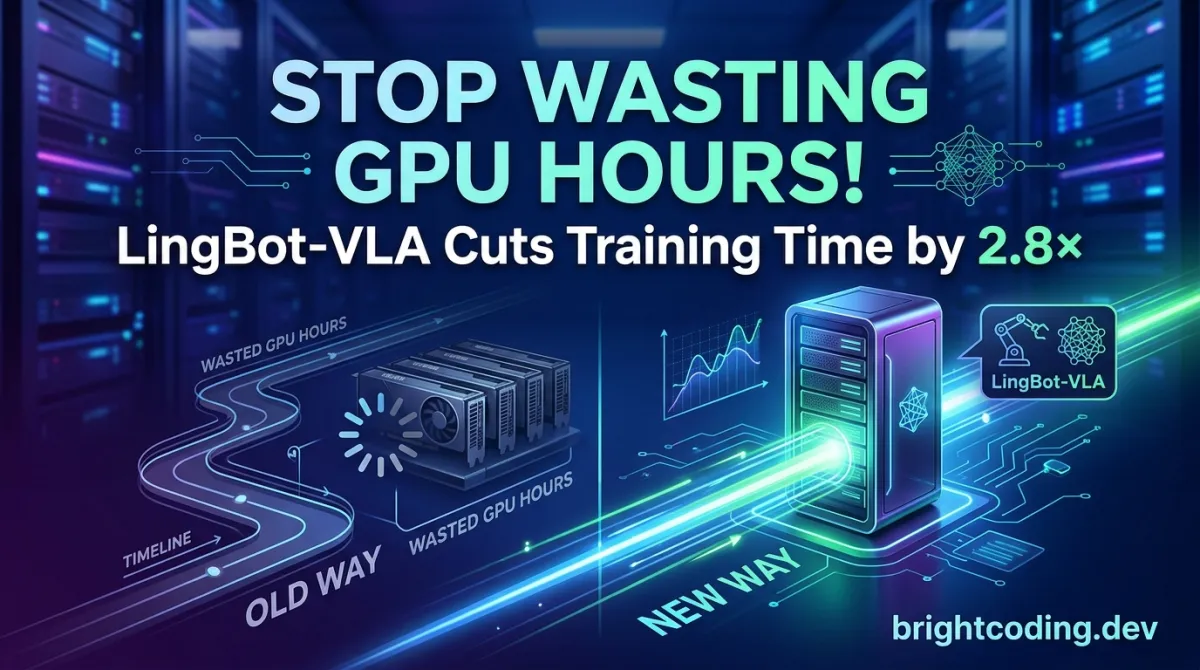
Stop Wasting GPU Hours! LingBot-VLA Cuts Training Time by 2.8×
What if I told you that your robot training pipeline is bleeding money? That every hour your GPUs churn on Vision-Language-Action models, you're burning 1.5 to 2.8 times more compute than necessary? Here's the painful truth most robotics labs won't admit: VLA training is fundamentally broken. We're talking about models that demand weeks of cluster time, datasets scraped together from whatever demos you can record, and codebases so fragmented that reproducing a paper feels like archaeology.
But what if someone finally said "enough" and built something pragmatic?
Enter LingBot-VLA — a pragmatic VLA foundation model that doesn't just promise state-of-the-art performance but delivers it with a engineering philosophy that will make your infrastructure team weep with joy. With 20,000 hours of real-world pre-training data from 9 popular dual-arm robot configurations, this isn't another research toy. This is a production-ready weapon for anyone serious about robot control.
The secret? The team behind LingBot-VLA stopped chasing flashy benchmarks and started solving the actual problems: training efficiency, data scale, and deployment friction. And the results are nothing short of staggering. Ready to see how they're rewriting the rules?
What is LingBot-VLA?
LingBot-VLA is a pragmatic Vision-Language-Action foundation model developed by Robbyant (Robbyant Technologies), designed specifically for robot control tasks. Born from the frustration of watching the robotics community struggle with inefficient training pipelines and data scarcity, this model represents a deliberate pivot toward practical VLA development.
The "pragmatic" label isn't marketing fluff — it's a core design philosophy. While competitors chase theoretical improvements with marginal gains, LingBot-VLA focuses on three pillars that actually matter to practitioners: massive pre-training data, strong empirical performance, and training efficiency that doesn't destroy your cloud budget.
The model builds upon the Qwen2.5-VL-3B-Instruct vision-language architecture, extending it with action prediction capabilities for robotic control. But here's where it gets interesting: the team didn't just slap a policy head on a VLM and call it a day. They engineered the entire training stack for speed, incorporating optimizations that deliver 1.5× to 2.8× faster training depending on your base model choice — a difference that transforms weeks of training into days.
Released in January 2026 with continuous updates through April 2026, LingBot-VLA has rapidly gained traction in the robotics community. The project maintains active distribution through both HuggingFace and ModelScope, with pre-trained weights available in two configurations: a standard depth-free version and a depth-distilled variant that leverages geometric cues for enhanced spatial reasoning.
What makes this model genuinely exciting isn't just the numbers — it's the attitude. The creators explicitly acknowledge their dependencies (VeOmni, LeRobot, Baidu Cloud optimizations) rather than pretending to reinvent every wheel. That humility translates to code that actually works when you clone it.
Key Features That Separate LingBot-VLA from the Pack
Let's dissect what makes this model genuinely different from the VLA noise:
🚀 Massive-Scale Pre-training Corpus
Twenty. Thousand. Hours. Of. Real. World. Data. Let that sink in. We're not talking about synthetic sim-to-real transfer or carefully curated lab demos. LingBot-VLA was pre-trained on 20,000 hours of actual robot execution spanning 9 popular dual-arm robot configurations. This isn't quantity over quality either — the diversity of hardware platforms (Agibot G1, AgileX, Galaxea R1Pro) means the model learns genuinely transferable manipulation priors rather than overfitting to a single embodiment.
⚡ Insane Training Efficiency
The benchmarking data is brutal to competitors. Against established baselines for both Qwen2.5-VL-3B-π and PaliGemma-3B-pt-224-π variants, LingBot-VLA's codebase achieves the fastest training speeds across all GPU configurations tested — 8, 16, 32, 128, and 256 GPUs. The throughput scaling nearly hits theoretical linear limits, which is the kind of distributed systems engineering that separates toy projects from production tools.
🎯 Dual-Mode Depth Support
Not every robot has a depth sensor. Not every task needs geometric reasoning. LingBot-VLA respects this reality by offering two model variants: a streamlined depth-free version for standard RGB setups, and a depth-distilled variant that injects metric spatial information when available. The depth model consistently outperforms on spatially complex tasks, but the gap isn't catastrophic — you can deploy without depth and still beat most competitors.
🔧 LeRobot v3.0 Native Integration
The April 2026 upgrade to LeRobot v3.0 isn't a footnote — it's a statement. The team actively maintains compatibility with the HuggingFace robotics ecosystem rather than building a walled garden. This means your existing LeRobot datasets, your familiar data loaders, your community tools — they all work. The project even provides automated migration scripts for v2.1 datasets.
🛠️ Production-Ready Deployment Stack
Torch Compile support for inference. Open-loop evaluation scripts. Real-robot deployment configurations with configurable denoising steps. These aren't afterthoughts; they're first-class features. The lingbot_vla_policy deployment module is designed for the messy reality of physical robots, not pristine simulation scores.
📉 Memory-Optimized Training
Thanks to Baidu Cloud's optimization solutions, GPU memory consumption dropped by 29.2% during training. In an era where model parallelism complexity can dominate your engineering effort, this kind of memory efficiency directly translates to faster iteration and lower costs.
Use Cases: Where LingBot-VLA Absolutely Dominates
1. General-Purpose Dual-Arm Manipulation
The GM-100 benchmark across three distinct robot platforms tells the story. Whether you're working with Agibot G1's humanoid form factor, AgileX's industrial arms, or Galaxea R1Pro's research platform, LingBot-VLA delivers 17.30% average success rate with depth — crushing π₀.₅'s 13.02% and leaving WALL-OSS (4.05%) and GR00T N1.6 (7.59%) in the dust. If you're building a manipulation system that needs to generalize across hardware, this is your foundation.
2. Simulation-to-Reality Transfer with RoboTwin 2.0
Robotics simulation is only useful if it transfers. On RoboTwin 2.0's clean and randomized evaluations, LingBot-VLA achieves 88.56% clean / 86.68% randomized with depth — a massive gap over π₀.₅'s 82.74% / 76.76%. The randomized environment performance is particularly telling: the model isn't memorizing simulation artifacts, it's learning robust policies that survive visual distribution shift.
3. Rapid Prototyping for Research Labs
That 2.8× training speedup isn't just about money — it's about iteration velocity. A PhD student who can run five experimental iterations in the time their competitor runs two will simply discover more. The streamlined post-training pipeline (prepare LeRobot data → define robot config → compute normalization stats → train) means you go from "idea" to "evaluating on real robot" in days, not weeks.
4. Real-World Deployment with Limited Compute
The real-robot post-training configs (real_load20000h.yaml and real_load20000h_depth.yaml) are explicitly tuned for physical deployment scenarios. With support for gradient accumulation strategies, checkpointing, and the ability to trade denoising steps for speed (--num_denoising_step 5), you can deploy on edge GPUs without sacrificing policy quality.
Step-by-Step Installation & Setup Guide
Let's get LingBot-VLA running. The maintainers have kept this refreshingly straightforward.
System Requirements
- Python↗ Bright Coding Blog: 3.12.3 (strictly required)
- PyTorch: 2.8.0
- CUDA: 12.8
Environment Setup
# Create isolated conda environment
conda create -n lingbotvla python=3.12 -y
conda activate lingbotvla

# Clone repository
git clone https://github.com/Robbyant/lingbot-vla.git
cd lingbot-vla

# Run automated installation
bash install.sh
The install.sh script handles dependency resolution, including the critical LeRobot v3.0 integration. No manual pip gymnastics required.
Download Pre-trained Weights
# Download the 4B parameter depth-free checkpoint
python3 scripts/download_hf_model.py \
    --repo_id robbyant/lingbot-vla-4b \
    --local_dir lingbot-vla-4b
For depth-enhanced performance, substitute lingbot-vla-4b-depth.
Additional Required Weights
To train or fine-tune, you'll also need:
- Qwen2.5-VL-3B-Instruct: Base vision-language model
- MoGe-2-vitb-normal: Monocular geometry estimation for depth variant
- LingBot-Depth: Depth pre-training weights (ViT-L/14)
These are automatically referenced by the training configs when paths are set correctly.
⚠️ Critical Migration Note
If you downloaded checkpoints before May 1, 2026, you may encounter:
draccus.utils.DecodingError: The fields `resize_imgs_with_padding`, ... are not valid for PI0Config
Fix: Re-download latest checkpoints, or manually remove deprecated fields from config.json. The LeRobot v2.1 → v3.0 migration changed configuration schemas.
REAL Code Examples from the Repository
Let's examine actual code from the LingBot-VLA repository, with detailed explanations of what's happening under the hood.
Example 1: Post-Training Launch Script
The training entry point demonstrates the clean configuration-driven design:
# Without depth — standard RGB-only training
bash train.sh tasks/vla/train_lingbotvla.py ./configs/vla/robotwin_load20000h.yaml \
    --data.train_path /path/to/mixed_robotwin_5tasks \
    --data.data_name robotwin \
    --data.norm_stats_file assets/norm_stats/robotwin_50.json \
    --train.output_dir output/

# With depth — geometrically enhanced variant
bash train.sh tasks/vla/train_lingbotvla.py ./configs/vla/robotwin_load20000h_depth.yaml \
    --data.train_path /path/to/mixed_robotwin_5tasks \
    --data.data_name robotwin \
    --data.norm_stats_file assets/norm_stats/robotwin_50.json \
    --train.output_dir output/
What's happening here? The train.sh wrapper handles distributed launch mechanics (likely torchrun or accelerate under the hood). The YAML configs encode the full experimental specification — model architecture, training hyperparameters, data pipeline configuration. The command-line overrides allow quick iteration without editing files. Note the separation of concerns: data path, dataset identity (robotwin), and normalization statistics are independently configurable. The robotwin_load20000h.yaml specifically loads the 20,000-hour pre-trained checkpoint for fine-tuning, leveraging massive prior knowledge rather than training from scratch.
Example 2: Open-Loop Evaluation
Before deploying to expensive real robots, validate in simulation:
# Set required environment variable for model backbone
export QWEN25_PATH=Qwen/Qwen2.5-VL-3B-Instruct

# Run open-loop evaluation on validation data
python scripts/open_loop_eval.py \
    --model_path path_to_posttraining_ckpt \
    --data_path path_to_validation_data \
    --use_length 50

# Omit --data_path to default to training data for sanity checking
Critical details: The QWEN25_PATH environment variable ensures the evaluation script locates the base VLM weights for tokenizer and vision encoder initialization. The --use_length 50 parameter controls the action chunking horizon — predicting 50 future timesteps from a single observation. This open-loop evaluation is essential for catching training failures before physical deployment. The checkpoint path must contain .safetensors weights, config.json, and lingbotvla_cli.yaml — the complete model package.
Example 3: Real-Robot Deployment
The moment of truth — controlling physical hardware:
export QWEN25_PATH=path_to_Qwen2.5-VL-3B-Instruct

python -m deploy.lingbot_vla_policy \
    --model_path path_to_posttraining_ckpt \
    --use_compile \
    --use_length 25

# Speed-optimized variant for latency-critical applications
python -m deploy.lingbot_vla_policy \
    --model_path path_to_posttraining_ckpt \
    --use_compile \
    --use_length 25 \
    --num_denoising_step 5
Deployment deep-dive: The -m deploy.lingbot_vla_policy invocation runs the policy server as a module. --use_compile enables PyTorch 2.x compilation for ~20-30% inference speedup through graph optimization. The reduced --use_length 25 (vs. 50 in eval) trades prediction horizon for lower latency — critical for real-time control loops. The --num_denoising_step 5 flag is the secret weapon: by reducing diffusion denoising iterations from the default (likely 10-20), you cut inference time dramatically with acceptable policy quality degradation. This is the kind of production tuning that separates demo videos from reliable systems.
Example 4: RoboTwin Simulation Server
For standardized benchmark evaluation:
export QWEN25_PATH=path_to_Qwen2.5-VL-3B-Instruct

python -m deploy.lingbot_vla_policy \
    --model_path path_to_posttraining_ckpt \
    --use_compile \
    --use_length 50 \
    --port port
Benchmarking note: The explicit --port parameter exposes the policy as a network service, allowing the RoboTwin evaluation harness to connect via RPC. This decoupled architecture means you can run the policy server on your GPU machine while the physics simulation executes elsewhere — essential for scaling benchmark runs across cluster nodes.
Advanced Usage & Best Practices
Master the Data Pipeline: The three-step preparation (LeRobot format → robot config → normalization stats) seems tedious but prevents the subtle bugs that plague VLA training. The configs/robot_configs/ YAML files are your control surface for mapping arbitrary robot data formats into LingBot-VLA's unified feature space. Spend time here — incorrect feature mapping produces policies that look trained but fail mysteriously.
Depth: When and How: The depth variant shines on spatially complex tasks (cabinet opening, precise placement) but adds inference overhead. My recommendation: start with depth-free, validate your pipeline, then ablate with depth. The depth-distilled architecture means you're not training two separate models — the same checkpoint architecture accommodates both modes.
Memory Optimization Strategies: The 29.2% memory reduction from Baidu Cloud's optimizations is already baked in, but you can push further. Gradient checkpointing in the YAML configs trades compute for memory. For 24GB consumer GPUs, this is often necessary for batch sizes > 1.
Torch Compile for Production: --use_compile is transformative for deployment latency but can complicate debugging. Disable during development, enable for final evaluation and production. The compilation overhead pays off after ~50 inference calls.
Checkpoint Compatibility Vigilance: The LeRobot v3.0 migration was breaking. Always verify your checkpoint download date against the May 2026 compatibility cutoff. The error messages are cryptic (draccus.utils.DecodingError) but the fix is simple: fresh download or manual config surgery.
Comparison with Alternatives
| Dimension | LingBot-VLA | π₀.₅ (Physical Intelligence) | GR00T N1.6 (NVIDIA) | WALL-OSS |
|---|---|---|---|---|
| Pre-training Data | 20,000 hrs real-world | Undisclosed | Undisclosed | Limited |
| Training Speed | Fastest (1.5-2.8×) | Baseline | Slower | Slower |
| GM-100 Avg SR (w/ depth) | 17.30% | 13.02% | 7.59% | 4.05% |
| RoboTwin Clean SR | 88.56% | 82.74% | — | — |
| Open Source Weights | ✅ Full release | ❌ Limited | ❌ Limited | ✅ |
| Dual-Arm Focus | ✅ Native | ✅ | ✅ | ❌ |
| Depth Flexibility | ✅ Optional | ❌ Required | ❌ | ❌ |
| LeRobot Integration | ✅ v3.0 native | ❌ Custom | ❌ Custom | ❌ |
The pattern is clear: LingBot-VLA wins on practicality. Not every metric is a blowout, but the combination of open weights, training efficiency, and deployment flexibility creates a compelling package that closed alternatives can't match.
FAQ: Your LingBot-VLA Questions Answered
Q: Can I use LingBot-VLA with my custom robot hardware?
Absolutely. The robot config YAML system (configs/robot_configs/) is designed for this. Map your robot's state observations, action spaces, and camera topics to the unified feature space. The Custom Data Guide walks through the process.
Q: Do I need depth sensors for good performance?
No. The depth-free variant outperforms most competitors on GM-100 (15.74% vs. π₀.₅'s 13.02%). Depth provides a modest boost for spatial tasks but isn't mandatory. Start without, upgrade if needed.
Q: What GPU memory do I need for training?
With Baidu Cloud optimizations and gradient checkpointing, 24GB consumer GPUs (RTX 4090, A5000) can handle modest batch sizes. For serious multi-GPU training, A100/H100 clusters are recommended. The efficiency gains mean you need fewer GPU-hours overall.
Q: How does this compare to fine-tuning π₀ or OpenVLA?
LingBot-VLA's post-training is architecturally similar but operationally superior due to the massive pre-training corpus and optimized codebase. The 20,000-hour prior means your fine-tuning converges faster and generalizes better than starting from smaller pre-trained bases.
Q: Is commercial use permitted?
Yes. Apache 2.0 license allows commercial applications. The weights, code, and documentation are fully open.
Q: What's the catch with the 2.8× speedup?
The maximum speedup (2.8×) applies to specific VLM base models and GPU configurations. Your mileage varies based on hardware topology and model choice. But even the conservative 1.5× is transformative for iteration cycles.
Q: How stable is the real-robot deployment?
The deployment stack includes production features: Torch Compile, configurable denoising, and explicit memory optimization. The team actively maintains real-robot configs separate from simulation benchmarks, indicating serious deployment intent.
Conclusion: The Pragmatic Revolution in Robot Learning
LingBot-VLA isn't trying to be the flashiest model in the VLA zoo. It's trying to be the one you actually use — the one that trains without drama, deploys without hacks, and improves without endless hyperparameter sweeps. The 20,000-hour pre-training investment, the relentless optimization of training throughput, the respectful integration with existing ecosystems like LeRobot — these choices reveal a team that has suffered through the alternatives and decided to build something better.
The GM-100 and RoboTwin numbers don't lie. But more importantly, the engineering decisions behind those numbers — optional depth, configurable inference speed, memory-optimized training, open weights — create a foundation that adapts to your constraints rather than demanding you adapt to its.
If you're building robot manipulation systems in 2026, you have a choice: chase theoretical perfection with tools that fight you at every step, or ship working systems with a pragmatic foundation that respects your time and budget.
Clone it. Train it. Deploy it. Prove it.
👉 Get LingBot-VLA on GitHub — and stop accepting 2× slower training as inevitable.
Explore on the BrightCoding network
Hand-picked resources from our other sites.
UltraShape-1.0: Why 3D Artists Are Ditching Traditional Mesh Workflows
UltraShape-1.0 from PKU-YuanGroup revolutionizes 3D generation with a two-stage diffusion pipeline: coarse structure synthesis followed by voxel-based geometric...
Clone Any Voice in 5 Seconds: Real-Time-Voice-Cloning Exposed
Complete guide to Real-Time-Voice-Cloning: clone any voice in 5 seconds using this open-source SV2TTS implementation. Includes setup, code examples, and best pr...
reBot-DevArm: The Open Source Robot Arm Top AI Labs Are Secretly Using
Discover reBot-DevArm, the 100% open source robotic arm with full hardware blueprints (CERN-OHL-W-2.0) and software stack (Apache-2.0). Features ROS2, LeRobot,...
Continuez votre lecture
Why Chandra is the Ultimate OCR Tool for Handwriting and Tables
Why Building LLM Applications From Scratch is a Game Changer
How Building LLM Apps From Scratch Changes the Future of AI Development
Stop Coding Alone: OPC-Skills Gives Your AI Agent Superpowers
Commentaires 0
Aucun commentaire pour l'instant. Soyez le premier à réagir !