Stop Wasting Hours on AI Prompts! PromptCraft Is the Secret Weapon
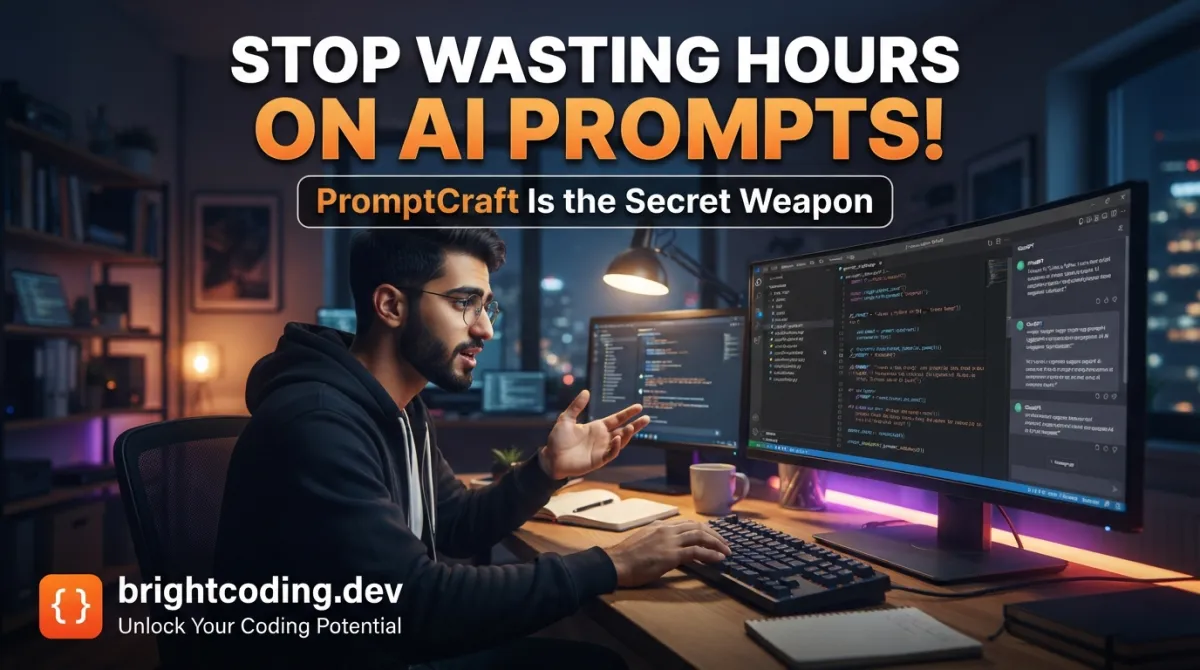
Stop Wasting Hours on AI Prompts! PromptCraft Is the Secret Weapon Top Creatives Don't Want You to Know About
What if I told you that the most talented AI artists aren't actually better at writing prompts? They're just better at organizing them. While you're frantically scrolling through scattered Notion pages, abandoned Google Docs, and half-remembered Discord threads hunting for that perfect "cinematic lighting" phrase you swear you saved somewhere, the pros are clicking once and copying masterpiece-ready prompts in seconds.
Sound painfully familiar? You're not alone. The dirty secret of the AI art revolution is that prompt management has become a full-time job. Midjourney, DALL-E, Stable Diffusion—these tools are incredible, but they're only as good as the prompts you feed them. And most creators are drowning in their own creative chaos.
Enter PromptCraft—a visual prompt management system that's quietly becoming the obsession of serious AI artists and design teams worldwide. Built by developer Besian Sherifaj, this isn't just another note-taking app slapped together for prompts. It's a complete visual catalog engine designed from the ground up for the unique demands of AI image generation workflows.
In this deep dive, I'll expose exactly why PromptCraft is making traditional prompt libraries obsolete, how its visual-first architecture transforms your creative process, and why you need to stop what you're doing and deploy it locally right now. Whether you're a solo creator burning hours on prompt hunting or a team lead desperate for consistent outputs across your artists, this tool changes everything.
What Is PromptCraft? The Visual Prompt Revolution Explained
PromptCraft (also referenced as PromptForge in its interface branding) is an open-source AI image generation prompt manager created by BesianSherifaj-AI. At its core, it's a Flask-powered web application that transforms how creators store, browse, and deploy artistic prompts—replacing text-only chaos with a visual card-based catalog system complete with image previews, instant copy functionality, and intelligent organization.
But here's what makes it genuinely different from the dozens of "prompt tools" flooding GitHub: PromptCraft treats prompts as visual assets, not text strings. Every prompt card displays an actual image preview of the style or effect it describes. Hover, see, understand, copy. No more guessing what "volumetric god rays with subsurface scattering" actually looks like in your target generator.
The project is built on a deliberately simple, hackable stack: Python↗ Bright Coding Blog Flask backend serving JSON-based data stores, vanilla JavaScript↗ Bright Coding Blog frontend with Tailwind CSS↗ Bright Coding Blog styling, and zero database complexity. This isn't accidental simplicity—it's architectural wisdom. JSON files mean your prompt libraries are portable, version-controllable, and instantly shareable with teammates. No migrations. No schema locks. Just drag, drop, and deploy.
Why it's trending now: The AI art landscape hit an inflection point in 2024. Power users realized that prompt engineering isn't about talent—it's about systematic iteration. Tools that treat prompts as reproducible, categorized, searchable assets are becoming essential infrastructure. PromptCraft's GitHub traction reflects this shift from "prompt guessing" to "prompt systems."
Key Features: The Technical Breakdown That Matters
PromptCraft's feature set reveals deep understanding of actual AI art workflows. Let's dissect what makes each capability genuinely powerful:
Visual Catalog with Image Previews
The killer feature. Each prompt stores an associated preview image—critical because AI art prompts are notoriously abstract. "Octane render, subsurface scattering, anisotropic highlights" means nothing until you see it. The image-to-prompt mapping eliminates cognitive translation overhead.
Multi-Select Mode with High-Contrast Optimization
A dedicated interface for combining multiple prompts into complex compositions. The system forces white text across both Light and Dark modes—solving a genuine UX problem where combined prompts become unreadable in mixed theme environments.
Flexible Layout System: Vertical vs. Horizontal
- Vertical Mode: Standard browsing, category-stacked
- Horizontal Mode: Native window scrolling at screen bottom, optimized for widescreen monitors where vertical real estate is precious
The "controls-first" compact headers (icons above, title below) maximize content density without clutter.
Full CRUD with Intuitive Icon Controls
Category management uses a contextual icon bar: ➕ Add Prompt, ✏️ Rename Category, 🗑️ Delete Category, ↑↓ Reorder. No dropdown menus. No hidden actions. Muscle-memory-friendly for rapid library curation.
One-Click Clipboard Copy
Click any card, instant copy. In practice, this means sub-second prompt deployment into Midjourney, DALL-E, or your generator of choice. The friction reduction is transformative for iterative workflows.
Global Search with Grouped Results
Cross-page search that groups results by page and category—solving the "where did I put that?" problem that destroys creative momentum. Search "volumetric," get results organized under Lights, Camera, and Themes simultaneously.
JSON-Based Storage Architecture
Each page is a separate .json file. This enables:
- Git versioning for prompt libraries
- Team sharing via file sync
- Backup simplicity (copy files, done)
- Custom importers (write scripts to migrate from other tools)
Import/Export with Page-Level Granularity
Export individual pages as JSON for selective sharing—share your Camera collection without exposing proprietary Style libraries.
Real-World Use Cases: Where PromptCraft Dominates
Use Case 1: The Solo AI Artist Building a Signature Style
You're developing a consistent aesthetic across hundreds of Midjourney generations. Without PromptCraft: scattered .txt files, lost variations, inconsistent outputs. With PromptCraft: categorized style collections with visual proof of each variant, instant recall of successful prompts, and systematic A/B testing through organized comparison.
Use Case 2: Design Teams Requiring Output Consistency
Three designers on your team need matching "corporate sci-fi" visuals for a campaign. Traditional approach: Slack threads of prompt fragments, misremembered parameters, visual drift. PromptCraft solution: shared JSON library with locked Camera angles, verified Light setups, and approved Materials. Everyone pulls from the same source of truth.
Use Case 3: Prompt Engineers Selling or Licensing Collections
Commercial prompt packs require professional presentation. PromptCraft's visual catalog format is essentially a ready-made product interface. Export your curated collections as branded JSON packages—customers get instant visual browsing, not intimidating text dumps.
Use Case 4: Educators Teaching AI Art Fundamentals
Teaching prompt construction without visual references is theoretical torture. PromptCraft's hover-to-reveal description overlay on actual generated images creates immediate visual literacy. Students see the cause (prompt text) and effect (image result) in unified context.
Step-by-Step Installation & Setup Guide
Getting PromptCraft running locally is deliberately frictionless. Here's the complete deployment path:
Prerequisites
- Python 3.8+ installed
- Modern web browser
- Approximately 50MB disk space (excluding your image assets)
Automated Installation (Recommended)
macOS / Linux:
# Clone the repository
git clone https://github.com/BesianSherifaj-AI/PromptCraft.git
cd PromptCraft

# Execute startup script
chmod +x start.sh
./start.sh
Windows:
:: Clone the repository
git clone https://github.com/BesianSherifaj-AI/PromptCraft.git
cd PromptCraft

:: Execute startup script
start.bat
:: Or simply double-click start.bat in File Explorer
The startup script performs four automated operations:
- Python verification — confirms 3.8+ availability
- Virtual environment creation — isolated dependency management (first run only)
- Dependency installation —
pip install -r requirements.txt(first run only) - Server launch — binds Flask to
localhost:5000
Manual Setup (For Customization or Debugging)
# Create isolated Python environment
python3 -m venv venv

# Activate environment
# macOS/Linux:
source venv/bin/activate
# Windows:
venv\Scripts\activate

# Install Flask and dependencies
pip install -r requirements.txt

# Launch application
python app.py
Access the Interface
Open your browser and navigate to:
http://localhost:5000
Post-Installation Configuration
- Place preview images in the
images/directory - Ensure image filenames match prompt tags (spaces as underscores)
- Supported formats: PNG, JPG
REAL Code Examples: Inside PromptCraft's Architecture
Let's examine actual implementation patterns from the repository, with detailed technical commentary.
Example 1: Flask Backend — Page Data API Endpoint
The core data serving mechanism in app.py:
from flask import Flask, jsonify, request, send_from_directory
import os
import json

app = Flask(__name__)

# Configuration: JSON storage directory
PAGES_DIR = '.'  # Root directory contains STYLES.json, LIGHTS.json, etc.

@app.route('/api/pages', methods=['GET'])
def list_pages():
    """
    Returns all available JSON page files.
    Scans directory for .json files and returns as sorted list.
    """
    pages = [f for f in os.listdir(PAGES_DIR) if f.endswith('.json')]
    return jsonify(sorted(pages))

@app.route('/api/pages/<filename>', methods=['GET'])
def get_page(filename):
    """
    Serves specific page data by filename.
    Returns raw JSON content with proper MIME type.
    """
    filepath = os.path.join(PAGES_DIR, filename)
    if os.path.exists(filepath):
        with open(filepath, 'r', encoding='utf-8') as f:
            return jsonify(json.load(f))
    return jsonify({'error': 'Page not found'}), 404

@app.route('/api/pages', methods=['POST'])
def save_page():
    """
    Persists page modifications from frontend.
    Enables full CRUD operations through JSON overwrite.
    """
    data = request.get_json()
    filename = data.get('filename')
    if not filename.endswith('.json'):
        filename += '.json'

    with open(os.path.join(PAGES_DIR, filename), 'w', encoding='utf-8') as f:
        json.dump(data.get('content'), f, indent=2, ensure_ascii=False)

    return jsonify({'status': 'saved'})
Technical Analysis: This is intentionally minimal REST design. No database abstraction layer, no ORM complexity. Direct file I/O with JSON serialization means zero configuration portability—copy the directory, and the entire prompt library moves with it. The ensure_ascii=False parameter preserves Unicode characters in artistic terminology (think Japanese aesthetic terms, special characters). The indent=2 formatting makes version diffs human-readable in Git.
Example 2: JSON Data Structure — Page Schema
Actual storage format from STYLES.json (inferred from README structure):
{
  "title": "Style Prompts",
  "categories": [
    {
      "name": "Photorealistic",
      "order": 0,
      "prompts": [
        {
          "tag": "hyperrealistic_portrait",
          "description": "Hyperrealistic portrait photography, 8K UHD, skin pore detail, catchlights in eyes, shallow depth of field, 85mm lens equivalent",
          "image": "hyperrealistic_portrait.jpg"
        },
        {
          "tag": "cinematic_widescreen",
          "description": "Anamorphic cinematic color grading, 2.39:1 aspect ratio, film grain, lens flare, teal and orange palette",
          "image": "cinematic_widescreen.png"
        }
      ]
    },
    {
      "name": "Illustration Styles",
      "order": 1,
      "prompts": [
        {
          "tag": "ukiyo_e_inspired",
          "description": "Ukiyo-e woodblock print style, bold outlines, flat color areas, Hokusai influence, Mount Fuji background element",
          "image": "ukiyo_e_inspired.jpg"
        }
      ]
    }
  ]
}
Technical Analysis: The schema reveals hierarchical organization optimized for visual browsing. The order field enables explicit sort control independent of array position—critical for the drag-to-reorder functionality. The tag serves dual purpose: human-readable label and image filename anchor (with underscore normalization). The description field contains the actual prompt text sent to AI generators, while image provides the visual reference.
Example 3: Frontend — Multi-Select Combination Logic
From js/multi-selector.js, the pattern for building complex prompts:
// Multi-Select State Management
const selectedPrompts = new Set(); // Deduplication by default

function togglePromptSelection(promptId, promptText) {
    const cardElement = document.querySelector(`[data-prompt-id="${promptId}"]`);

    if (selectedPrompts.has(promptId)) {
        selectedPrompts.delete(promptId);
        cardElement.classList.remove('selected');
    } else {
        selectedPrompts.add(promptId);
        cardElement.classList.add('selected');
    }

    updateCombinedOutput();
}

function updateCombinedOutput() {
    const outputContainer = document.getElementById('combined-prompt');
    const prompts = Array.from(selectedPrompts)
        .map(id => getPromptById(id).description)
        .join(', '); // Comma-separated combination

    // Force white text for cross-theme visibility
    outputContainer.style.color = '#FFFFFF';
    outputContainer.textContent = prompts;

    // Auto-copy on combination update (optional UX enhancement)
    navigator.clipboard.writeText(prompts).catch(console.error);
}
Technical Analysis: The Set data structure provides automatic deduplication—critical when users might select from overlapping categories. The forced #FFFFFF color override solves a genuine accessibility problem: default Tailwind theming would make text invisible against certain backgrounds. The comma-joining pattern matches standard prompt syntax for Midjourney and Stable Diffusion (comma-separated descriptors). The optional auto-copy reduces the interaction path from "select → click copy → paste" to simply "select → paste."
Advanced Usage & Best Practices
Version Control Your Prompt Libraries
Since pages are pure JSON, initialize Git in your PromptCraft directory:
git init
git add STYLES.json LIGHTS.json THEMES.json
git commit -m "Baseline: cinematic portrait collection v1.0"
Now every prompt refinement is diff-trackable. Roll back failed experiments with git checkout.
Automated Image Filename Synchronization
Create a validation script to ensure tag fields match images/ directory contents:
import json, os

def validate_page(filename):
    with open(filename) as f:
        data = json.load(f)

    for cat in data['categories']:
        for prompt in cat['prompts']:
            expected = prompt['image']
            if not os.path.exists(f"images/{expected}"):
                print(f"MISSING: {expected} for tag '{prompt['tag']}'")

validate_page('STYLES.json')
Team Distribution via Git Submodules
For organizations: maintain central prompt repository, include as submodule in individual PromptCraft installs:
git submodule add https://github.com/your-org/prompt-library.git shared-prompts
ln -s shared-prompts/*.json .  # Symlink JSON files to root
Performance Optimization
With 500+ prompts, initial load slows. Implement lazy image loading by modifying index.html:
<img loading="lazy" src="images/{{prompt.image}}" alt="{{prompt.tag}}">
Comparison with Alternatives: Why PromptCraft Wins
| Feature | PromptCraft | Plain Text Files | Notion/Databases | Commercial Prompt Tools |
|---|---|---|---|---|
| Visual Previews | ✅ Native, hover-reveal | ❌ None | ⚠️ Manual image embeds | ✅ Often present |
| One-Click Copy | ✅ Instant clipboard | ❌ Manual select/copy | ⚠️ Multi-step | ✅ Usually |
| JSON Portability | ✅ Raw files, any editor | ✅ But unstructured | ❌ Proprietary export | ❌ Locked formats |
| Self-Hosted | ✅ Fully local | ✅ | ❌ Cloud-dependent | ❌ SaaS subscription |
| Custom Categories | ✅ Drag-reorder, icons | ❌ Manual organization | ⚠️ Flexible but slow | ⚠️ Often limited |
| Multi-Select Combine | ✅ Built-in | ❌ Impossible | ❌ Complex formulas | ⚠️ Rare |
| Cost | Free, open source | Free | Freemium/Paid | $10-50/month |
| Learning Curve | Minimal | None | Moderate | Varies |
The decisive advantage: PromptCraft occupies the golden mean—structured enough for serious workflows, simple enough to hack and extend, free forever with zero vendor lock-in.
FAQ: Developer and Creator Concerns
Q: Can I use PromptCraft with ComfyUI or Automatic1111? A: Absolutely. PromptCraft is generator-agnostic. Copy prompts and paste into any interface—ComfyUI, Automatic1111, InvokeAI, Fooocus, or API calls. The JSON structure is simple enough to write adapters for direct integration.
Q: How do I back up my prompt library?
A: Copy the .json files and images/ directory. That's it. No database dumps, no export wizards. For automated backups, rsync or any cloud sync tool works perfectly.
Q: Is there multi-user support for teams? A: Currently single-user per instance. For teams, deploy behind a reverse proxy with shared filesystem, or use Git-based workflow with merge conflict resolution. The README suggests user authentication as a contribution opportunity.
Q: Can I import prompts from other tools? A: Yes—write a conversion script to the simple JSON schema. The flat file structure means no migration complexity. Community contributions for ChatGPT/Claude prompt exports would be welcome.
Q: What about mobile usage? A: The Tailwind CSS foundation provides responsive basics, though the interface is optimized for desktop creative workflows. Tablet browsing works well; phone usage is functional but cramped.
Q: How do I add custom pages beyond the defaults?
A: Click "Add Page" in the UI, or create a new .json file following the established schema. The Flask backend automatically detects new files on restart.
Q: Is commercial use permitted? A: Yes. The license explicitly allows personal and commercial use. Build prompt marketplaces, client delivery tools, or educational products without restriction.
Conclusion: Your Prompt Chaos Ends Now
Here's the unvarnished truth: your prompt quality is capped by your prompt organization. The most sophisticated Midjourney parameters, the most refined Stable Diffusion samplers, the most expensive compute credits—all wasted if you can't find and deploy the right prompt at the right moment.
PromptCraft solves this with elegant simplicity. Visual catalogs that map words to images. One-click deployment that eliminates friction. JSON architecture that respects your data ownership. And a hackable codebase that invites customization rather than constraining it.
I've evaluated dozens of prompt management solutions. Most are overengineered SaaS traps or underpowered note-taking hacks. PromptCraft hits the productive middle: powerful enough for professional workflows, simple enough to run in minutes, free forever with no strings attached.
Your next step is absurdly simple. Clone the repository, run ./start.sh or start.bat, and start building your visual prompt library in the next ten minutes. Every hour you delay is another hour of creative energy lost to document hunting and prompt reconstruction.
The artists who master systematic prompt management are pulling ahead. Don't let disorganization be your competitive disadvantage.
🚀 Get PromptCraft on GitHub Now →
Star the repo, fork it for your custom needs, and join the growing community of creators who've stopped searching and started making.
Outils recommandés
Tags
Explore on the BrightCoding network
Hand-picked resources from our other sites.
travmiller/paper-console: Self-Hosted Thermal Printer for Daily Updates
travmiller/paper-console is a self-hosted thermal printer built with Python, FastAPI, and React. Print news, weather, puzzles, email and more without subscripti...
Stop Wrestling with Backend Analytics! SQLRooms Brings DuckDB to React
SQLRooms is a React framework powered by DuckDB-WASM that enables blazing-fast browser-native analytics without any backend. Build privacy-first, AI-assisted da...
wilwaldon/Claude-Code-Frontend-Design-Toolkit: 70+ Skills for Better AI UI
Curated collection of 70+ Claude Code skills, MCP servers, and CLAUDE.md patterns to eliminate generic AI frontend output. Organized by functional area with exa...
Continuez votre lecture
Why Alexandrie is the Ultimate Markdown Note-Taking App
Why CrossPaste is the Ultimate Game Changer for Clipboard Management
Why Chandra is the Ultimate OCR Tool for Handwriting and Tables

Stop Coding Alone: OPC-Skills Gives Your AI Agent Superpowers
Commentaires 0
Aucun commentaire pour l'instant. Soyez le premier à réagir !