Stop Wasting Money on Vision LLMs! PyMuPDF4LLM Slashes PDF Costs 250x
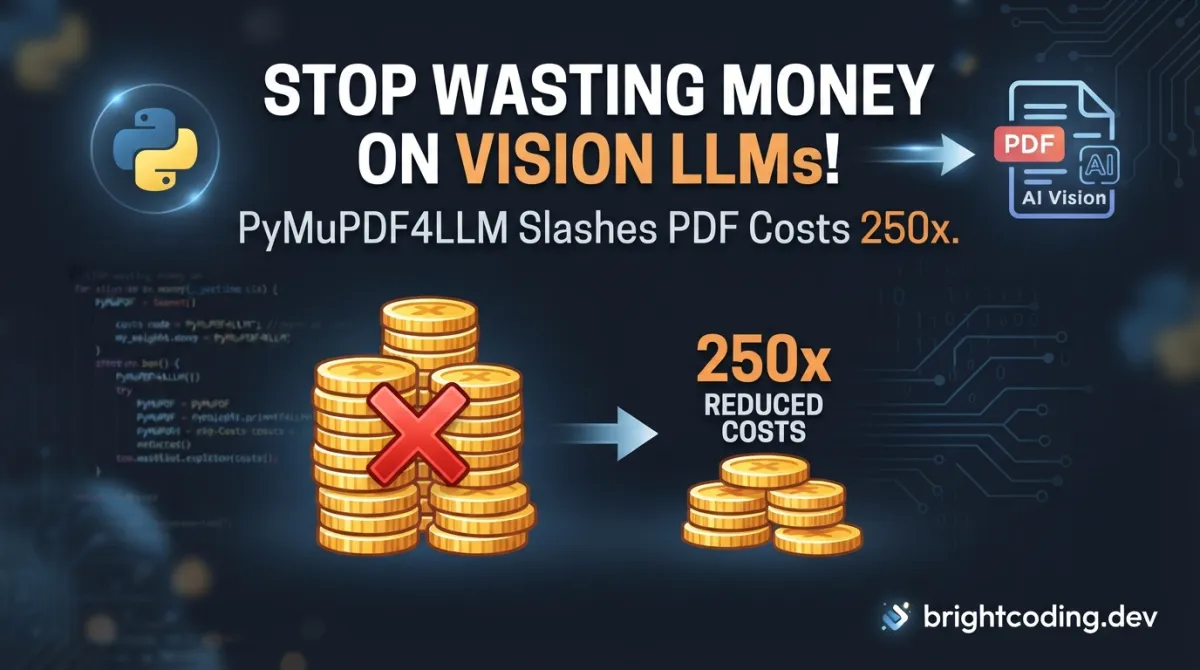
What if I told you that your RAG pipeline is bleeding money—and you don't even know it?
Every day, thousands of developers feed PDFs into expensive vision-based LLMs like GPT-4V or Claude 3, burning through API tokens just to extract readable text from documents. They're paying premium prices for something that should cost pennies. Worse, they're introducing latency bottlenecks that strangle application performance while surrendering sensitive documents to third-party APIs they can't control.
The dirty secret of modern LLM development? Most PDF extraction doesn't need a neural network at all.
Enter PyMuPDF4LLM—a weapon-grade PDF converter that transforms documents into clean, structured Markdown↗ Smart Converter in a single line of Python↗ Bright Coding Blog. No GPU required. No cloud bill. No token counter spinning into oblivion. Built on the battle-tested MuPDF C engine, this library handles multi-column academic papers, complex tables, scanned documents with OCR, and even vector graphics—then outputs pristine Markdown ready for immediate ingestion into LangChain, LlamaIndex, or your custom RAG pipeline.
If you're still using vision LLMs for document extraction, you're solving the wrong problem with the wrong tool. Here's why the smartest engineering teams are quietly switching to PyMuPDF4LLM—and why you should too.
What is PyMuPDF4LLM?
PyMuPDF4LLM is a lightweight, purpose-built extension for the established PyMuPDF library, engineered specifically for the LLM era. Developed and maintained by Artifex Software, Inc.—the same team behind the legendary MuPDF rendering engine—this tool bridges the gap between raw document formats and the structured data that modern AI systems demand.
The library's explosive growth tells its own story. With trending badges across GitHub, thousands of monthly PyPI downloads, and active Discord and Hugging Face communities, PyMuPDF4LLM has become the go-to solution for developers who refuse to compromise on cost or performance. Its repository sits at the intersection of two massive trends: the RAG (Retrieval-Augmented Generation) revolution and the urgent need to process legacy document formats without proprietary cloud dependencies.
What distinguishes PyMuPDF4LLM from generic PDF tools is its LLM-native design philosophy. Traditional PDF extractors output unstructured text blobs that destroy semantic meaning. PyMuPDF4LLM preserves document structure—headings, tables, lists, code blocks, and image references—outputting GitHub-flavored Markdown that LLMs parse with far higher accuracy. The result? Better retrieval, better embeddings, better answers.
And it's fast. Built on MuPDF's optimized C engine, it processes documents locally at speeds that embarrass cloud-based alternatives. The team claims 10× faster performance on standard cloud instances and up to 250× lower infrastructure costs compared to vision-LLM extraction approaches. These aren't marketing numbers—they're the inevitable result of avoiding GPU inference and API round-trips entirely.
Key Features That Separate Amateurs from Pros
PyMuPDF4LLM isn't a basic text extractor with Markdown slapped on top. It's a sophisticated document understanding system with capabilities that reveal themselves the deeper you dig.
Triple Output Formats, Zero Configuration. The library ships with three native output modes: to_markdown() for LLM prompts and RAG pipelines, to_json() for custom pipelines needing bounding boxes and layout metadata, and to_text() for simple search indexing. Switch between them with a single function call—no reconfiguration, no reprocessing.
Layout-Aware Intelligence. Multi-column academic papers? PyMuPDF4LLM reconstructs natural reading order across complex layouts. Tables? Converted to GitHub-compatible pipe tables automatically. Headers and footers? Configurably excluded to prevent pollution of your vector embeddings. The library analyzes page geometry to distinguish body text from marginalia, preserving semantic flow that naive extractors destroy.
Hybrid OCR That Thinks Before It Acts. Here's where engineering elegance shines. Instead of blindly OCRing every page (1,000× slower than native extraction) or skipping OCR on mixed documents (leaving scanned regions unreadable), PyMuPDF4LLM analyzes each page first. It checks for illegible characters, vector graphics simulating text, existing OCR layers, and images containing text—then targets only the regions that actually need optical recognition. Result: ~50% reduction in OCR processing time with zero quality loss.
Framework-Native Integrations. Drop-in support for LlamaIndex via LlamaMarkdownReader() and LangChain via PyMuPDFLoader or MarkdownTextSplitter. These aren't afterthought wrappers—they're first-class integrations that understand the frameworks' document abstractions and chunking strategies.
Page-Level Chunking with Metadata. Enable page_chunks=True and receive dictionaries containing full metadata (page number, document title, format info), table of contents items, layout boxes, and the page's Markdown text. Feed directly into Chroma, Pinecone, Weaviate, or any vector store without transformation overhead.
Use Cases Where PyMuPDF4LLM Dominates
1. Enterprise RAG at Scale
Financial institutions, law firms, and healthcare organizations process millions of pages monthly. Vision-LLM extraction at $0.01-$0.03 per page becomes a six-figure annual line item. PyMuPDF4LLM runs on existing infrastructure, processes documents 10–250× cheaper, and keeps sensitive data behind your firewall. The page_chunks=True output maps perfectly to vector store ingestion pipelines.
2. Academic Research Workflows
Researchers drowning in multi-column PDFs with complex tables, mathematical notation, and mixed scanned/digital content need extraction that preserves structure. PyMuPDF4LLM's reading-order reconstruction and table detection transform impenetrable PDFs into clean Markdown suitable for literature review LLMs and citation analysis tools.
3. Legacy Document Digitization
Organizations with archives of scanned reports, faxed contracts, and image-based PDFs face a nightmare: full OCR is prohibitively slow, but skipping it leaves data trapped. The hybrid OCR strategy intelligently processes only degraded regions, unlocking archives at unprecedented speed without the quality degradation of blanket OCR approaches.
4. Multi-Format Data Pipelines
With PyMuPDF Pro extension, the same pipeline handles PDFs, Word documents, Excel spreadsheets, PowerPoint presentations, and Korean HWP files. One tool, one API, one consistent Markdown output—eliminating the fragile converter chains that break production pipelines.
Step-by-Step Installation & Setup Guide
Getting PyMuPDF4LLM running takes under 60 seconds. Here's the complete setup.
Basic Installation
# Core installation — includes PyMuPDF and PyMuPDF Layout automatically
pip install pymupdf4llm
This single command installs the complete dependency chain. No separate MuPDF compilation, no system package management, no CUDA drivers.
Optional: Office Document Support
# Extend to DOCX, XLSX, PPTX, HWP/HWPX
pip install pymupdfpro
PyMuPDF Pro is a commercial extension that unlocks Microsoft Office and Hangul formats. Evaluate your format requirements before committing—many pipelines need only PDF support.
OCR Prerequisites
For hybrid OCR functionality, install Tesseract OCR:
# Ubuntu/Debian
sudo apt-get install tesseract-ocr

# macOS
brew install tesseract

# Windows — download installer from https://github.com/UB-Mannheim/tesseract/wiki
Optional: rapidocr_onnxruntime for alternative OCR backend:
pip install rapidocr_onnxruntime
PyMuPDF4LLM auto-detects available engines at runtime—no configuration file editing required.
Verify Installation
import pymupdf4llm

# Quick functionality test
md = pymupdf4llm.to_markdown("test.pdf")
print(f"Extracted {len(md)} characters successfully")
REAL Code Examples from the Repository
The PyMuPDF4LLM README contains production-ready patterns that demonstrate the library's depth. Here are the most powerful examples, annotated for immediate use.
Example 1: The One-Liner That Replaces Entire Pipelines
import pymupdf4llm

md = pymupdf4llm.to_markdown("research-paper.pdf")
# Feed directly into your LLM, vector store, or chunker
Before: This simplicity is deceptive. Behind this single call, the library performs layout analysis, reading-order reconstruction, font-size-based header detection, inline formatting preservation (bold, italic, monospace), table conversion to GFM pipe syntax, and image reference extraction. The output is immediately usable in any Markdown-aware system.
After: The returned md string contains structured Markdown with # through ###### headings, **bold** and *italic* spans, fenced code blocks, and  image references. Pass this to MarkdownTextSplitter, store in Chroma, or prompt GPT-4 directly—zero transformation needed.
Example 2: Page Chunking for Production RAG
import pymupdf4llm

chunks = pymupdf4llm.to_markdown("document.pdf", page_chunks=True)

for chunk in chunks:
    print(chunk["metadata"]["page_number"])  # page number
    print(chunk["metadata"]["title"])        # document title
    print(chunk["text"])                     # markdown text for this page
    print(chunk["metadata"]["page_boxes"])   # page layout boxes for this page
Before: Most developers manually split documents, losing metadata associations and creating misaligned chunks that poison retrieval accuracy.
After: Each chunk is a self-contained dictionary with complete provenance. The metadata field includes format, title, author, page, page_count, and file_path. The toc_items array preserves document structure for hierarchical retrieval. The page_boxes enable spatial-aware reranking. Insert into any vector store with confidence:
# Chroma integration example from the repository
import chromadb
from chromadb.utils.embedding_functions import SentenceTransformerEmbeddingFunction

chunks = pymupdf4llm.to_markdown("document.pdf", page_chunks=True)

client = chromadb.Client()
collection = client.create_collection(
    "docs",
    embedding_function=SentenceTransformerEmbeddingFunction(),
)

collection.add(
    documents=[c["text"] for c in chunks],
    metadatas=[c["metadata"] for c in chunks],
    ids=[f"page-{c['metadata']['page']}" for c in chunks],
)
Example 3: LlamaIndex Native Integration
import pymupdf4llm

reader = pymupdf4llm.LlamaMarkdownReader()
docs = reader.load_data("document.pdf")

# docs is a list of LlamaIndex Document objects
for doc in docs:
    print(doc.text)
Before: LlamaIndex users typically write custom PDFReader classes or accept generic loaders that output unstructured text.
After: LlamaMarkdownReader() returns proper Document objects with text, metadata, and doc_id attributes. The Markdown structure is preserved in doc.text, enabling MarkdownNodeParser to create semantically meaningful chunks. No adapter code, no format conversion, no information loss.
Example 4: Precision OCR Control for Mixed Documents
import pymupdf4llm

# OCR is triggered automatically wherever needed
md = pymupdf4llm.to_markdown("mixed-document.pdf")

# Force OCR on every page (e.g. known-corrupt text layer)
md = pymupdf4llm.to_markdown("document.pdf", force_ocr=True)

# Force OCR on specific pages only
md = pymupdf4llm.to_markdown("document.pdf", pages=[2, 3, 4], force_ocr=True)

# Disable OCR entirely (pages with no text will return empty strings)
md = pymupdf4llm.to_markdown("document.pdf", use_ocr=False)

# Set OCR resolution (default 300 dpi; higher values cost quadratically more)
md = pymupdf4llm.to_markdown("document.pdf", ocr_dpi=150)

# Specify OCR language
md = pymupdf4llm.to_markdown("document.pdf", ocr_language="eng+fra")

# Bring your own OCR function
md = pymupdf4llm.to_markdown("document.pdf", ocr_function=my_ocr_fn)
Before: OCR is typically all-or-nothing—either painfully slow full-document processing or incomplete coverage that misses critical content.
After: The hybrid strategy automatically applies OCR only where content analysis indicates need. For edge cases, granular control lets you force OCR on suspect pages, reduce DPI for speed, specify multilingual recognition, or inject custom OCR backends. The ocr_dpi parameter is particularly powerful: since OCR cost scales quadratically with resolution, dropping from 300 to 150 DPI on clean documents yields massive speedups with minimal accuracy impact.
Example 5: Image Extraction with Text
import pymupdf4llm

md = pymupdf4llm.to_markdown(
    "document.pdf",
    write_images=True,        # save extracted images to disk
    image_path="./images",    # directory for saved images
    image_format="png",       # output format
    dpi=150,                  # image resolution
)
Before: Developers run separate tools for text and image extraction, then manually correlate outputs.
After: Images are extracted, saved to configurable paths, and referenced via standard Markdown  syntax in the text output. LLMs with vision capabilities can process these references; image captioning pipelines can transform them to text embeddings. The dpi parameter controls extraction quality versus file size for your specific storage constraints.
Advanced Usage & Best Practices
Batch Processing with Generator Patterns. For large document collections, avoid loading all chunks into memory:
from pathlib import Path
import pymupdf4llm

def document_stream(directory):
    for pdf in Path(directory).glob("*.pdf"):
        yield from pymupdf4llm.to_markdown(str(pdf), page_chunks=True)

# Stream directly to vector store without intermediate lists
for chunk in document_stream("./documents"):
    process_chunk(chunk)
Header Strategy Selection. In legacy mode (pymupdf4llm.use_layout(False)), choose between font-size scanning (IdentifyHeaders), TOC-driven hierarchy (TocHeaders), or custom callables for domain-specific documents with unusual formatting conventions.
OCR Language Packs. Install only needed Tesseract language packs to minimize memory footprint. The ocr_language="eng+fra" pattern supports multilingual documents without loading every available model.
Pre-filtering with PyMuPDF. Open documents with native pymupdf first to validate, rotate, or repair before extraction—then pass the Document object directly to to_markdown().
Comparison with Alternatives
| Capability | PyMuPDF4LLM | Vision LLMs (GPT-4V/Claude) | PyPDF2/pdfplumber | Unstructured.io |
|---|---|---|---|---|
| Cost per 1000 pages | ~$0 (local CPU) | $10–$30 | ~$0 (local) | ~$0–$5 (cloud tiers) |
| GPU Required | No | Yes (API or local) | No | Optional |
| Internet Dependency | None | Full | None | Partial |
| Multi-column Layout | ✅ Native reconstruction | ✅ Good | ❌ Poor | ✅ Good |
| Table Detection | ✅ GFM Markdown tables | ✅ Good | ❌ None | ✅ Good |
| Hybrid OCR | ✅ Intelligent targeting | N/A (always vision) | ❌ None | ⚠️ Basic |
| Output Structure | Markdown/JSON/Text | Unstructured text | Plain text | Multiple formats |
| LLM Framework Integration | Native LlamaIndex/LangChain | Manual | Manual | Good |
| Processing Speed | ⚡ Fastest | Slowest | Fast | Medium |
| Scanned Document Support | ✅ Smart OCR | ✅ Native (expensive) | ❌ None | ✅ OCR backend |
The Verdict: Vision LLMs excel when document understanding requires genuine visual reasoning—interpreting charts, diagrams, or complex infographics. For the 90% of RAG use cases that need structured text extraction from standard documents, PyMuPDF4LLM delivers equivalent or superior output at 1/250th the cost with complete data sovereignty.
FAQ
Does PyMuPDF4LLM require an internet connection? No. All processing runs locally using the MuPDF C engine. Documents never leave your machine, making it ideal for sensitive data and air-gapped environments.
Can I process scanned PDFs without Tesseract installed?
Without Tesseract or rapidocr_onnxruntime, OCR functionality is disabled. Pages with no selectable text will return empty strings. Install Tesseract for full hybrid OCR capabilities.
How does page chunking differ from standard text splitting? Page chunking preserves document-level metadata and spatial layout information per page, enabling metadata-filtered retrieval and reranking. Standard text splitters discard this provenance.
Is PyMuPDF4LLM free for commercial use? The open-source version is licensed under GNU AGPL v3, which requires derivative works to be open-sourced. Commercial licenses are available from Artifex Software for proprietary applications.
Can I extract tables from scanned documents? Yes, if the hybrid OCR successfully recognizes the page content, table detection operates on the OCR output. Quality depends on scan resolution and OCR accuracy.
Does it support password-protected PDFs?
Through underlying PyMuPDF functionality, password-protected documents can be opened with credentials passed to pymupdf.open() before extraction.
What's the performance on 1000-page documents? Typical throughput is thousands of pages per minute on standard CPU instances, varying with layout complexity and OCR triggers. Vision-LLM alternatives require hours and substantial API expenditure for equivalent volumes.
Conclusion
The LLM ecosystem is maturing, and the winners are developers who strip away unnecessary complexity. PyMuPDF4LLM represents a critical inflection point: proof that document extraction doesn't require neural networks, cloud APIs, or budget-destroying infrastructure.
This library delivers production-grade PDF-to-Markdown conversion with layout intelligence, smart OCR, and native framework integrations—at speeds and costs that make vision-based alternatives look irresponsible. The one-line simplicity of pymupdf4llm.to_markdown() conceals sophisticated engineering that handles real-world document chaos: multi-column layouts, embedded tables, mixed scanned content, and complex formatting.
For RAG pipelines, research workflows, and enterprise document processing, PyMuPDF4LLM isn't just an alternative to expensive vision LLMs. It's the correct architectural choice—faster, cheaper, private, and technically superior for text-dominant use cases.
Stop subsidizing OpenAI's GPU clusters for work your CPU can do better. Star PyMuPDF4LLM on GitHub, install it with pip install pymupdf4llm, and reclaim your document pipeline today. Your infrastructure budget—and your latency metrics—will thank you.
Ready to convert? The complete source, examples, and documentation live at github.com/pymupdf/pymupdf4llm. Join the Discord community or explore the live demo to see it in action.
Outils recommandés
Explore on the BrightCoding network
Hand-picked resources from our other sites.
MiniSnip: The Feather-Light OCR Tool You Need
Discover MiniSnip, the revolutionary feather-light Windows OCR tool that captures screens and extracts text completely offline. This comprehensive guide explore...
better-live-text: The OCR Tool for Mac Developer
Discover better-live-text, the revolutionary local OCR tool for macOS that extracts LaTeX equations, tables, and text from any screen content with AI-powered ac...
GibsonAI/memori: Structured Memory Infrastructure for Production AI Agents
GibsonAI/memori is agent-native memory infrastructure that turns AI agent execution into structured, persistent state. LLM-agnostic with 15,590 GitHub stars, it...
Continuez votre lecture
Why Alexandrie is the Ultimate Markdown Note-Taking App
Why CrossPaste is the Ultimate Game Changer for Clipboard Management
Why Chandra is the Ultimate OCR Tool for Handwriting and Tables

Stop Coding Alone: OPC-Skills Gives Your AI Agent Superpowers
Commentaires 0
Aucun commentaire pour l'instant. Soyez le premier à réagir !