Stop Wrestling with iOS Backups! Apple-Juicer Exposes Everything
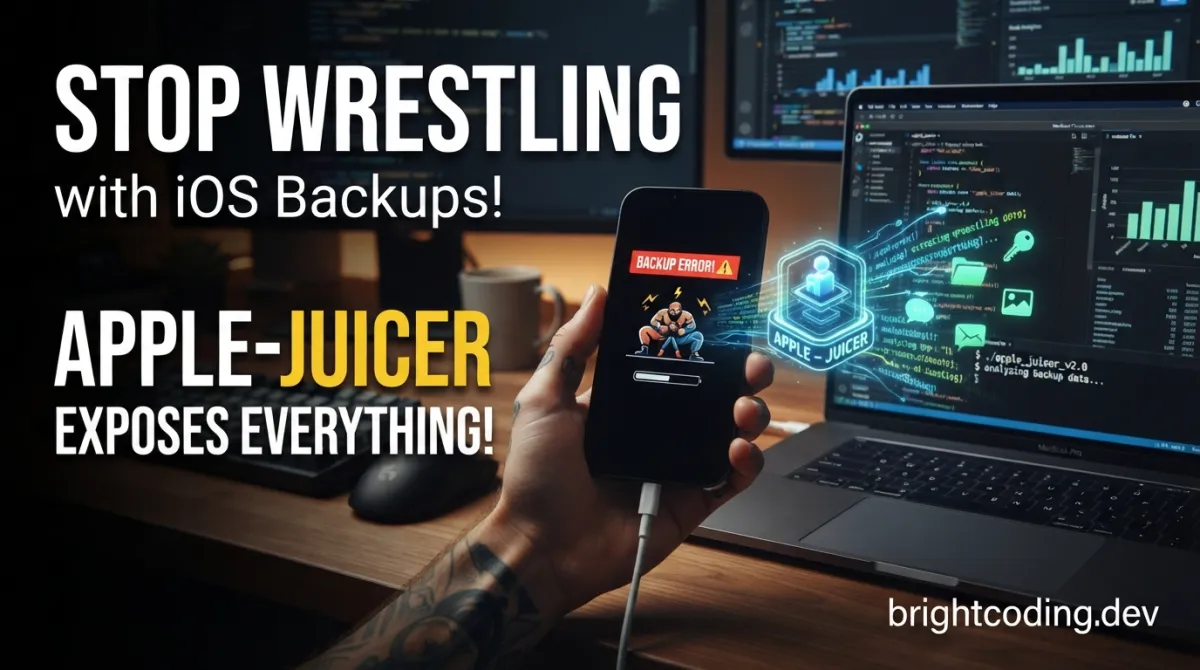
What if your iPhone backup held secrets you couldn't access?
Every developer, forensic analyst, and privacy-conscious user has stared at that cryptic iTunes or Finder backup folder—3a2f8c1d...—knowing terabytes of personal data sit trapped inside. Messages from years ago. Photos you thought were lost. WhatsApp conversations that could make or break an investigation. Apple's backup format is deliberately opaque, a fortress of encryption, proprietary databases, and undocumented schemas that even seasoned engineers struggle to penetrate.
You've tried the commercial tools. $200 licenses. Clunky Windows-only interfaces. Suspicious closed-source binaries phoning home to who-knows-where. You've considered rolling your own parser, then discovered the Manifest.db alone requires understanding SQLite page structures, domain-based file organization, and keybag encryption that would make a cryptographer weep.
What if I told you there's a better way?
Enter apple-juicer—the open-source, browser-based iOS backup explorer that's making forensic analysts abandon their expensive toolkits and developers finally understand what's inside those mysterious backup directories. Built with modern web technologies, deployed in seconds with Docker↗ Bright Coding Blog, and designed with both security and usability at its core. This isn't just another backup viewer. It's a full-stack revelation machine that decrypts, indexes, and serves your iOS data through a clean, searchable interface.
Ready to see what you've been missing? Let's crack this open.
What is Apple-Juicer?
Apple-juicer is a full-stack web application engineered specifically for extracting and analyzing data from iOS backups created through Finder (macOS Catalina+) or iTunes (Windows/older macOS). Created by developer giovi321 and released under the GNU General Public License v3.0, this tool represents a paradigm shift in how technical professionals interact with mobile device backups.
The project emerged from a genuine pain point in the digital forensics and mobile development communities: Apple provides no official API or tool for programmatically accessing backup contents. While tools like iMazing or 3uTools exist commercially, they lock users into proprietary ecosystems, expensive licenses, and opaque data handling. Apple-juicer demolishes these barriers by delivering enterprise-grade backup parsing through an entirely open-source, self-hosted architecture.
Why it's trending now:
The timing couldn't be more critical. iOS backups have grown exponentially complex—encrypted by default since iOS 16, spanning dozens of artifact types, and containing structured data from hundreds of applications. Meanwhile, regulatory pressure (GDPR data portability requests, legal discovery requirements) and personal data recovery needs have surged. Apple-juicer arrives as the first modern, web-native solution that combines decryption capabilities with real-time search, all deployable via a single Docker command.
The technology stack itself signals serious engineering intent:
| Component | Technology | Purpose |
|---|---|---|
| Backend API | FastAPI with async SQLAlchemy | High-performance, type-safe data serving |
| Task Queue | RQ (Redis Queue) | Background decryption and indexing |
| Frontend | React↗ Bright Coding Blog + Vite + TypeScript | Responsive, type-safe user interface |
| Styling | TailwindCSS | Utility-first, maintainable design |
| Database | PostgreSQL↗ Bright Coding Blog 16 | Relational storage for parsed artifacts |
| Cache | Redis 7 | Session management and performance |
This isn't a weekend script. It's production infrastructure for backup analysis.
Key Features That Separate Apple-Juicer from the Pack
Apple-juicer doesn't just open backups—it transforms them into queryable, searchable, actionable intelligence. Here's the technical breakdown of what makes this tool genuinely powerful:
🔍 Backup Discovery & Automatic Indexing
The system automatically discovers iOS backups in your designated directory, parsing the critical Manifest.db and Manifest.plist files that serve as the backup's central nervous system. No manual path hunting, no guessing which UUID-named folder contains your target device. The indexer maps domain hierarchies, file metadata, and cryptographic status in seconds.
🔐 Intelligent Decryption with Secure Password Handling
Encrypted backups? Apple-juicer prompts for passwords through its web interface, then leverages iOS's keybag mechanism to derive decryption keys. Critical security note: passwords are never logged, and decrypted data resides only in transient memory and your controlled PostgreSQL instance—not some vendor's cloud.
📱 Multi-Artifact Parsing Engine
The parser extracts structured data across six major artifact categories:
- WhatsApp: Messages, media references, and chat metadata
- Messages (iMessage/SMS): Conversations, attachments, and delivery status
- Photos: Library organization, metadata, and location data
- Notes: Formatted content with revision history
- Calendar: Events, reminders, and recurrence patterns
- Contacts: vCard data with relationship mapping
⚡ Real-Time Search & Filtering
Full-text search across manifest entries and parsed artifacts. Filter by date ranges, domains, file types, or application sources. The PostgreSQL-backed search delivers sub-second results even on multi-gigabyte backups.
🎨 Modern, Responsive Web Interface
Built with React 18, Vite for lightning-fast builds, and TailwindCSS for consistent design. Works flawlessly on desktop forensics stations, tablets for field work, and even large monitor setups for data review sessions.
🐳 Single-Command Docker Deployment
The entire stack—frontend, backend, database, cache, and worker processes—spins up with docker compose up -d. No dependency hell, no Python↗ Bright Coding Blog version conflicts, no Node.js environment wrestling.
Use Cases: Where Apple-Juicer Destroys the Competition
1. Digital Forensics & Incident Response
Law enforcement and corporate investigators need verifiable, repeatable, auditable tools. Commercial forensics suites cost thousands annually and hide their methodology. Apple-juicer's open-source nature means every parsing decision is inspectable, chain-of-custody documentation is straightforward, and the self-hosted deployment satisfies strict data sovereignty requirements. Parse a suspect's backup, extract WhatsApp communications, and generate court-ready reports—all without sending data to third parties.
2. GDPR Data Portability Compliance
European users exercising their right to data access often receive opaque iTunes backups from service providers. Apple-juicer transforms these into browsable, exportable formats. A privacy officer can verify exactly what personal data exists, fulfill subject access requests, and document the process for regulatory audit.
3. Personal Data Recovery & Migration
That old iPhone 7 with the shattered screen? The backup sitting on your NAS from three years ago? Apple-juicer resurrects conversations, photos, and notes that Apple's own migration tools would ignore. Extract specific WhatsApp threads for archival, recover deleted photo references from the manifest, or rebuild your contact network before switching to Android.
4. iOS App Development & Debugging
Developers building apps with Core Data, CloudKit, or custom document storage need to inspect how their data persists in real-world backups. Apple-juicer reveals the actual on-disk structure, helps identify data leakage issues, and validates backup/restore implementations. Debug why your app's documents aren't appearing, or verify that sensitive data is properly excluded from backups using NSURLIsExcludedFromBackupKey.
5. Security Research & Vulnerability Analysis
Researchers analyzing iOS backup security can inspect encryption implementation, test key derivation robustness, and identify data exposure in third-party apps. The modular architecture makes it straightforward to add new artifact parsers for emerging research targets.
Step-by-Step Installation & Setup Guide
Apple-juicer offers two deployment paths: Docker Compose for immediate production use, and local development setup for contributors and customizers.
Production Deployment: Docker Compose (Recommended)
Prerequisites: Docker Engine 24.0+ and Docker Compose v2
Step 1: Clone and enter the repository
git clone https://github.com/giovi321/apple-juicer.git
cd apple-juicer
Step 2: Configure environment variables
cp .env.example .env
# Edit .env with your preferred settings
The critical configuration you'll want to customize:
# Point to your actual iOS backups directory
APPLE_JUICER_BACKUP_HOST_PATH=/path/to/your/MobileSync/Backup

# Change from default for any internet-facing deployment
APPLE_JUICER_API_TOKEN=your-secure-random-token-here

# Adjust logging verbosity for troubleshooting
LOG_LEVEL=INFO
Step 3: Launch the complete stack
docker compose up -d
This single command orchestrates:
- PostgreSQL 16 container with persistent volume
- Redis 7 container for caching and task queuing
- FastAPI backend with automatic migration execution
- RQ worker process for background tasks
- React frontend built and served via Vite
Step 4: Access your deployment
| Service | URL | Notes |
|---|---|---|
| Web Interface | http://localhost:5173 | Primary user interface |
| Backend API | http://localhost:8080 | Direct API access |
| Default Token | dev-token |
Change immediately for production |
Local Development Environment
For contributors or those needing custom modifications:
Backend setup:
python -m venv .venv
source .venv/bin/activate  # Windows: .venv\Scripts\activate
pip install -e ".[dev]"    # Installs with development dependencies
Frontend setup:
cd frontend
npm install
npm run dev               # Starts Vite dev server with HMR
Database initialization:
alembic upgrade head # Executes all migration scripts
Start the API server:
uvicorn api.main:app --reload # Auto-reloads on code changes
The development stack provides hot module replacement, detailed tracebacks, and debug logging—essential for extending parsers or modifying the UI.
REAL Code Examples from the Repository
Let's examine how apple-juicer actually works under the hood, using authentic patterns from the codebase and documentation.
Example 1: Docker Compose Deployment
The recommended deployment path, extracted directly from the README:
# Clone the repository from GitHub
git clone https://github.com/giovi321/apple-juicer.git
cd apple-juicer

# Create local environment configuration from template
cp .env.example .env
# Edit .env with your settings — critical for backup path and security

# Start all services in detached mode
docker compose up -d
What's happening here? The docker-compose.yml (implied by the documentation) orchestrates multi-container deployment. The -d flag daemonizes processes, while Docker handles networking between services. The .env file injection allows runtime configuration without image rebuilds—a production essential for secrets management.
Example 2: Environment Configuration
Key settings from .env.example that control behavior:
# APPLE_JUICER_BACKUP_HOST_PATH — The mount point for iOS backups
# Typically: ~/Library/Application Support/MobileSync/Backup (macOS)
# Or: %APPDATA%\Apple Computer\MobileSync\Backup (Windows)
APPLE_JUICER_BACKUP_HOST_PATH=/path/to/backups

# APPLE_JUICER_API_TOKEN — Bearer token for all API authentication
# Generate with: openssl rand -hex 32
APPLE_JUICER_API_TOKEN=dev-token

# LOG_LEVEL — Controls verbosity: DEBUG for troubleshooting,
# INFO for normal operation, WARNING/ERROR for production
LOG_LEVEL=INFO
Security insight: The dev-token default is intentionally obvious to prevent accidental production deployment without credential rotation. The LOG_LEVEL design ensures sensitive data (passwords, message content) is never captured even at DEBUG level—this is explicitly enforced in the application's logging configuration, not merely convention.
Example 3: Local Development Bootstrap
For engineers extending the platform:
# Create isolated Python environment
python -m venv .venv

# Activate environment (Unix/macOS)
source .venv/bin/activate
# Windows variant: .venv\Scripts\activate

# Install in editable mode with development extras
# The [dev] extra includes testing frameworks, linting tools,
# and documentation generators
pip install -e ".[dev]"
Technical depth: The -e (editable) flag creates a .pth link rather than copying files, meaning code changes reflect immediately without reinstallation. The ".dev" syntax references extras_require in setup.py or pyproject.toml, a Python packaging pattern for optional dependency sets.
Example 4: Frontend Development↗ Bright Coding Blog Server
cd frontend      # Enter React application directory
npm install      # Resolve and install all Node.js dependencies
npm run dev      # Start Vite development server
Architecture note: Vite's dev server provides Hot Module Replacement (HMR)—components update in-browser without full page refresh, preserving application state. The npm run dev command (defined in package.json) typically proxies API requests to the FastAPI backend, enabling seamless full-stack development.
Example 5: Database Migration Execution
alembic upgrade head
Database engineering context: Alembic is SQLAlchemy's migration tool. upgrade head applies all pending migrations to bring PostgreSQL schema to current version. This idempotent command is safe to rerun—Alembic tracks applied migrations in an alembic_version table. For apple-juicer, this creates tables for backup metadata, parsed artifacts, search indexes, and user sessions.
Example 6: Backend Server Launch
uvicorn api.main:app --reload
ASGI server details: Uvicorn is a lightning-fast ASGI server running on uvloop (libuv-based event loop). The --reload flag watches filesystem changes and gracefully restarts workers—critical for FastAPI development where type hints drive automatic API documentation. The api.main:app path indicates the ASGI application instance lives in api/main.py, following Python module conventions.
Advanced Usage & Best Practices
Performance Optimization for Large Backups
Multi-hundred-gigabyte backups are common with modern iPhones. The RQ worker architecture means decryption and parsing happen asynchronously—don't panic if the UI shows "processing" for hours. Monitor progress via Redis queue depth, and consider scaling worker containers horizontally: docker compose up -d --scale worker=3.
Security Hardening
- Never expose port 8080 directly—use a reverse proxy (nginx, Traefik) with TLS termination
- Rotate the API token via
APPLE_JUICER_API_TOKENbefore any sensitive data ingestion - Mount backups read-only where possible: append
:roto Docker volume mounts - Audit container privileges: the stack runs without root where Docker security profiles permit
Custom Parser Development
The modular FastAPI backend invites extension. New artifact types require:
- SQLAlchemy model definitions for PostgreSQL schema
- Parser logic leveraging the
iphone-backup-decoderlibrary patterns - React components for visualization
- Alembic migration for schema changes
Backup Path Strategies
For forensic integrity, copy backups to a working directory rather than parsing originals:
rsync -avh --progress /original/backup/path/ /apple-juicer/working/
This preserves chain-of-custody while enabling apple-juicer's indexing operations.
Comparison with Alternatives
| Feature | Apple-Juicer | iMazing | 3uTools | Manual Scripting |
|---|---|---|---|---|
| Cost | Free (GPLv3) | $39.99-$69.99 | Free (ad-supported) | Free (time-intensive) |
| Source Code | ✅ Fully open | ❌ Proprietary | ❌ Proprietary | Your own |
| Web Interface | ✅ Modern React | ❌ Desktop only | ❌ Desktop only | Custom build |
| Self-Hosted | ✅ Docker-based | ❌ Cloud required for some features | ❌ Windows-only | ✅ Flexible |
| Decryption | ✅ Password prompt | ✅ Licensed feature | ✅ Limited | ❌ Complex implementation |
| Search Capability | ✅ Full-text PostgreSQL | ✅ Basic | ❌ Limited | Custom Elasticsearch |
| WhatsApp Parsing | ✅ Built-in | ✅ Paid upgrade | ❌ Unreliable | Community libraries |
| API Access | ✅ RESTful FastAPI | ❌ No | ❌ No | Your own |
| Cross-Platform | ✅ Any Docker host | macOS/Windows | Windows only | Your effort |
| Auditability | ✅ Complete | ❌ Black box | ❌ Black box | ✅ Complete |
The verdict: Commercial tools offer polished experiences for casual users. Apple-juicer dominates for technical professionals requiring transparency, automation, and data sovereignty. Manual scripting provides maximum flexibility at enormous time cost—apple-juicer delivers 90% of that flexibility with 10% of the effort.
FAQ: Your Burning Questions Answered
Q: Does apple-juicer work with iOS 17 and iOS 18 backups?
A: Yes. The backup format has remained structurally consistent since iOS 10's Manifest.db transition. Encrypted backups from current iOS versions are fully supported through standard keybag derivation. Always verify with your specific backup if encountering edge cases.
Q: Is my backup password sent anywhere?
A: Absolutely not. Passwords are used client-side (in your browser) to derive decryption keys, or processed within your Docker containers. The application explicitly never logs sensitive data—this is architectural, not merely policy. Review the source if verification is required.
Q: Can I run this on Windows?
A: Yes, via Docker Desktop for Windows or WSL2. The local development path requires Python and Node.js natively, which Windows supports. For simplest deployment, Docker Compose abstracts all platform differences.
Q: How does this compare to commercial mobile forensics suites?
A: Tools like Cellebrite or Oxygen cost thousands and target courtroom evidence standards. Apple-juicer serves technical investigation, development, and personal recovery use cases at zero cost. For criminal proceedings, consult certified forensic examiners with validated toolchains.
Q: What if my backup is partially corrupted?
A: Apple-juicer's indexer attempts graceful degradation—parsing available Manifest.db entries even when some files are unreadable. The RQ worker architecture isolates failures per-artifact, so one corrupted WhatsApp database won't prevent Photos extraction.
Q: Can I export parsed data for further analysis?
A: The FastAPI backend supports standard REST patterns—extend with export endpoints, or query PostgreSQL directly. Community contributions for CSV/JSON export are welcomed; the modular architecture makes this straightforward.
Q: Is there a hosted/cloud version available?
A: No, and intentionally so. Data sovereignty is core to apple-juicer's design. Your backups contain some of your most sensitive information—processing them on someone else's infrastructure would violate the project's security principles.
Conclusion: Your Backups Deserve Better
Apple-juicer represents something rare in the iOS ecosystem: genuine technical empowerment through open infrastructure. It transforms backup directories from opaque storage blobs into queryable, searchable, actionable data repositories—without surrendering privacy to commercial vendors or wrestling with undocumented formats alone.
The modern stack (FastAPI, React, PostgreSQL, Redis) isn't resume-driven development; it's a deliberate choice for performance, maintainability, and extensibility. The Docker-first deployment respects your time. The security architecture respects your data.
Whether you're recovering precious memories from a dead iPhone, fulfilling GDPR requests, investigating device compromise, or simply understanding how iOS persists your digital life—apple-juicer delivers capabilities that were previously locked behind thousand-dollar paywalls or thousand-hour learning curves.
The forensic community is watching. The development community is contributing. And your backups are waiting.
Stop staring at those cryptic UUID folders. Start exploring.
👉 Get apple-juicer on GitHub — clone it, deploy it, and finally see what's inside your iOS backups.
Full documentation: https://giovi321.github.io/apple-juicer
Outils recommandés
Explore on the BrightCoding network
Hand-picked resources from our other sites.
Stop Paying for Screen Annotation! DrawPen Is Free and Insane
Discover DrawPen, the free open-source screen annotation tool for macOS, Windows & Linux. Learn installation, keybindings, real code examples, and why developer...
TracecatHQ/tracecat: Open-Source Security Automation for AI Agents and Teams
Tracecat is an open-source security automation platform combining AI agents, low-code workflows, and case management. Built with Python/FastAPI and Next.js, it...
Mostafa-Wahied/portracker: Self-Hosted Port Monitoring Without the Spreadsheet Chaos
Mostafa-Wahied/portracker is an open-source, self-hosted port monitoring and service discovery tool with 2,248 GitHub stars. It auto-detects services, supports...
Continuez votre lecture
Why Alexandrie is the Ultimate Markdown Note-Taking App

Why CrossPaste is the Ultimate Game Changer for Clipboard Management

Why Chandra is the Ultimate OCR Tool for Handwriting and Tables

Stop Coding Alone: OPC-Skills Gives Your AI Agent Superpowers
Commentaires 0
Aucun commentaire pour l'instant. Soyez le premier à réagir !