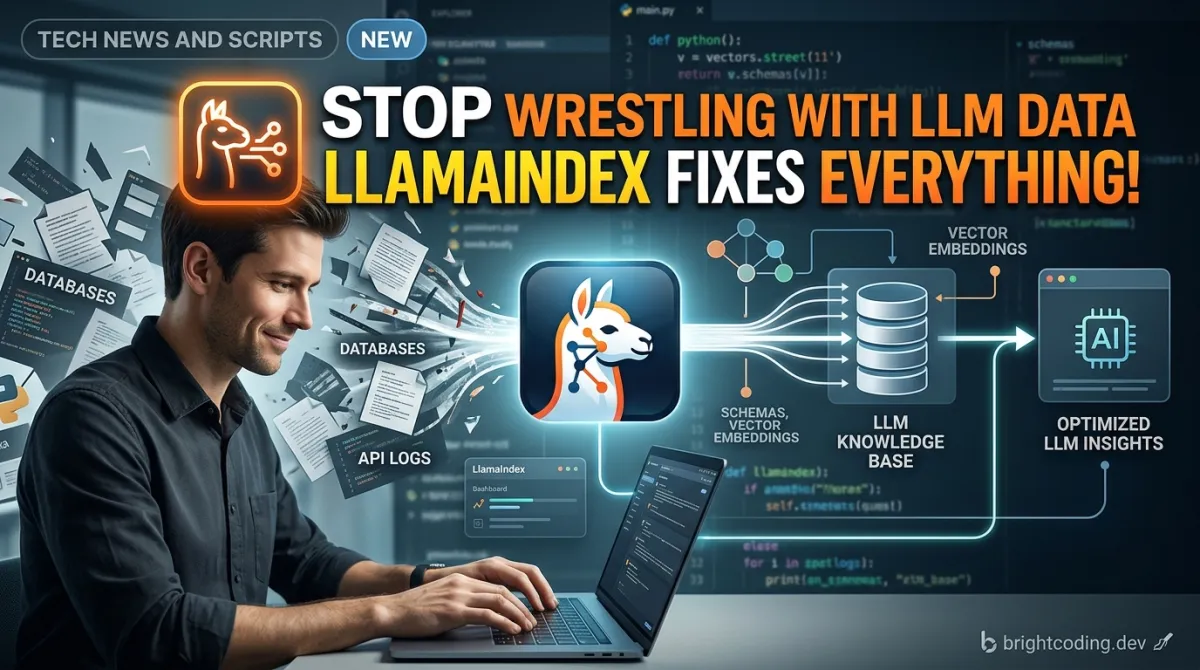
Stop Wrestling with LLM Data—LlamaIndex Fixes Everything
Stop Wrestling with LLM Data—LlamaIndex Fixes Everything
You've built the perfect LLM-powered application. The prompts are polished, the model is cutting-edge, and the demo blows everyone away. Then reality hits: your users want answers from their own documents, not generic training data. Suddenly you're drowning in PDF parsers, vector database configs, chunking strategies, and retrieval pipelines that break every other Tuesday. Sound familiar?
Here's the brutal truth most AI tutorials won't tell you: connecting LLMs to real-world data is where projects die. Not model selection. Not prompt engineering. The messy, unglamorous plumbing of ingestion, indexing, and retrieval. Developers burn weeks wiring together half-baked solutions—only to discover their "simple" document Q&A system can't handle a 200-page contract with tables, footnotes, and scanned signatures.
What if you could skip the suffering entirely?
Enter LlamaIndex—the open-source framework that transforms chaotic data into structured, queryable intelligence for your LLM applications. With over 300 integrations, enterprise-grade parsing capabilities, and a thriving community of 2,000+ contributors, LlamaIndex isn't just another RAG library. It's the infrastructure layer that top engineering teams secretly rely on to ship agentic applications in days, not months.
Ready to stop fighting your data and start building? Let's dive deep.
What Is LlamaIndex?
LlamaIndex (formerly GPT Index) is an open-source "data framework" designed to bridge the gap between large language models and your private, domain-specific data. Created by Jerry Liu in 2022, it emerged from a simple observation: LLMs are phenomenally powerful for reasoning and generation, but they're fundamentally blind to your proprietary information—your internal wikis, customer emails, legal contracts, financial reports, and product documentation.
The project exploded in popularity because it solved this problem with elegant abstractions. Rather than forcing developers to hand-craft brittle pipelines, LlamaIndex provides a unified toolkit for data ingestion, structural organization, and intelligent retrieval. It's now maintained by LlamaIndex, Inc., which also offers LlamaParse—an enterprise platform for agentic OCR, document parsing, and deployed document agents.
What makes LlamaIndex genuinely different from the sea of RAG frameworks? Three critical architectural decisions:
- Modular namespace design: The
llama-index-corepackage provides foundational abstractions, while 300+ integration packages (llama-index-llms-openai,llama-index-embeddings-huggingface, etc.) let you compose exactly the stack you need—no bloat, no lock-in. - Dual API philosophy: Beginners get productive in 5 lines of code with high-level APIs. Advanced users can override every component—connectors, indices, retrievers, rerankers, query engines—for surgical customization.
- Agent-native evolution: LlamaIndex has aggressively evolved beyond simple RAG into full agentic workflows, supporting multi-step reasoning, tool use, and autonomous document agents that can plan, execute, and self-correct.
The framework currently boasts millions of monthly PyPI downloads, active development with rigorous CI/CD, and a Discord community of thousands of practitioners sharing production patterns. When developers talk about "serious" LLM applications in production, LlamaIndex is increasingly the unspoken standard.
Key Features That Separate LlamaIndex from the Pack
Let's dissect what makes this framework genuinely powerful for production workloads—not just toy demos.
300+ Battle-Tested Integrations
LlamaIndex's LlamaHub ecosystem spans LLM providers (OpenAI, Anthropic, Ollama, Cohere), embedding models (OpenAI, HuggingFace, Voyage), vector stores (Pinecone, Weaviate, Chroma, PGVector), and data loaders (Notion, Slack, Google Drive, S3, SQL databases). This isn't vanity metrics—each integration follows consistent patterns, so swapping from OpenAI to local Ollama models requires changing one import and one configuration line.
Sophisticated Indexing Strategies
Beyond naive chunk-and-embed approaches, LlamaIndex implements:
- VectorStoreIndex: Dense retrieval with configurable chunking, overlap, and embedding strategies
- SummaryIndex: Hierarchical summarization for long-document understanding
- TreeIndex: Recursive retrieval that navigates document structure top-down
- KnowledgeGraphIndex: Entity-relationship extraction for complex, interconnected domains
- ComposableGraph: Multi-index orchestration for heterogeneous data sources
Advanced Retrieval & Query Engine
The query engine isn't a simple similarity search. It supports:
- Multi-stage retrieval: Sparse + dense hybrid search with reranking
- Sub-question decomposition: Breaking complex queries into manageable sub-queries
- Recursive retrieval: Following references and links between document sections
- Response synthesis modes: Refine, compact, tree_summarize, and accumulate for different accuracy-latency tradeoffs
Enterprise-Grade Document Parsing (LlamaParse)
The commercial LlamaParse platform handles 130+ formats with agentic OCR—not just text extraction, but structural understanding of tables, forms, headers, and layout. This feeds directly into the open-source framework or operates standalone.
Workflows & Agent Builder
LlamaIndex's newer Workflows system enables event-driven, stateful agent orchestration. Build multi-agent systems with explicit control flow, error handling, and human-in-the-loop checkpoints—critical for production reliability.
Real-World Use Cases Where LlamaIndex Dominates
1. Enterprise Knowledge Management at Scale
A 5,000-person consulting firm has 20 years of proposals, case studies, and methodology documents scattered across SharePoint, Confluence, and file shares. Their consultants waste 3+ hours weekly searching for relevant precedents. LlamaIndex solution: Ingest all sources via connectors, build a ComposableGraph with domain-specific indices, deploy a query engine with access controls. Result: Sub-10-second answers with source attribution, saving 15,000 person-hours annually.
2. Financial Document Analysis & Compliance
Hedge funds and regulatory teams need to extract structured insights from 10-K filings, earnings calls, and credit agreements—documents with complex tables, footnotes, and cross-references. LlamaIndex + LlamaParse: Parse PDFs with table preservation, build KnowledgeGraphIndex for entity relationships, use recursive retrieval for multi-document analysis. The agentic layer can even flag inconsistencies across quarterly reports.
3. Legal Contract Review & Due Diligence
M&A transactions involve thousands of pages of contracts with inconsistent terminology and hidden obligations. LlamaIndex approach: Custom data connector for document management systems, TreeIndex for hierarchical clause navigation, custom reranker trained on legal language. Query engines answer "What termination clauses reference IP rights?" with precise document locations—not hallucinated summaries.
4. Technical Support Automation
SaaS companies drown in support tickets referencing outdated documentation, GitHub issues, and internal runbooks. LlamaIndex implementation: Real-time ingestion from multiple sources, SummaryIndex for quick overviews, VectorStoreIndex for specific error matching, Workflow-based agent that escalates ambiguous cases to humans with full context. Resolution time drops 60%, customer satisfaction climbs.
5. Research & Academic Literature Synthesis
PhD students and research scientists need to synthesize findings across hundreds of papers with conflicting methodologies. LlamaIndex pattern: PDF ingestion with metadata extraction, citation graph construction, sub-question decomposition for systematic reviews. The system can answer "Which studies using X method found Y effect, and what were their sample sizes?" with verifiable sources.
Step-by-Step Installation & Setup Guide
Getting started with LlamaIndex is deliberately simple, but production deployments require thoughtful configuration. Here's the complete path from zero to querying.
Installation Options
LlamaIndex offers two installation strategies depending on your control requirements:
Option 1: Starter Package (Recommended for Beginners)
# Includes core + curated integrations
pip install llama-index
Option 2: Customized Installation (Recommended for Production)
# Core framework only
pip install llama-index-core

# Add only the integrations you need
pip install llama-index-llms-openai      # OpenAI GPT models
pip install llama-index-llms-ollama       # Local Ollama models
pip install llama-index-embeddings-huggingface  # Open embeddings
pip install llama-index-vector-stores-pinecone  # Pinecone vector DB
pip install llama-index-readers-web       # Web scraping
The customized approach minimizes dependency conflicts, reduces container image sizes, and gives explicit control over version pinning.
Environment Configuration
For cloud LLM providers, set API keys securely:
# Linux/macOS
export OPENAI_API_KEY="sk-..."
export ANTHROPIC_API_KEY="sk-ant-..."

# Windows PowerShell
$env:OPENAI_API_KEY="sk-..."
For production, use secret management (AWS↗ Bright Coding Blog Secrets Manager, Azure Key Vault, HashiCorp Vault) rather than environment variables.
Verification
Confirm installation:
import llama_index
print(llama_index.__version__)

# Verify specific integrations
from llama_index.core import VectorStoreIndex
from llama_index.llms.openai import OpenAI
print("Core + OpenAI integration ready")
LlamaParse Setup (Optional, for Enterprise Parsing)
# Install LlamaParse client
pip install llama-parse
Sign up at cloud.llamaindex.ai for API key, then:
from llama_parse import LlamaParse

parser = LlamaParse(
    api_key="YOUR_API_KEY",
    result_type="markdown↗ Smart Converter",  # or "text", "json"
    verbose=True
)
REAL Code Examples from LlamaIndex
Let's examine production-ready patterns using actual code from the repository. These aren't simplified toy examples—they're the patterns that scale.
Example 1: Basic Vector Store Index with OpenAI
The simplest viable RAG pipeline. This is where every LlamaIndex journey starts:
import os

# Secure API key configuration
os.environ["OPENAI_API_KEY"] = "YOUR_OPENAI_API_KEY"

# Core imports: VectorStoreIndex for dense retrieval,
# SimpleDirectoryReader for filesystem ingestion
from llama_index.core import VectorStoreIndex, SimpleDirectoryReader

# Load all files from directory (recursive, auto-detects formats)
documents = SimpleDirectoryReader("YOUR_DATA_DIRECTORY").load_data()

# Build index: chunks documents, generates embeddings via default OpenAI,
# stores in memory by default
index = VectorStoreIndex.from_documents(documents)
What's happening under the hood? SimpleDirectoryReader handles PDF, TXT, MD, DOCX, and more. VectorStoreIndex.from_documents() uses the default embedding model (OpenAI text-embedding-ada-002), chunks with 1024 tokens with 200-token overlap, and builds a in-memory vector store. The entire pipeline is configurable—chunk size, overlap, embedding model, and vector store can all be overridden.
Example 2: Local LLM Deployment with Ollama
For privacy-sensitive or cost-conscious deployments, run entirely local:
from llama_index.core import Settings, VectorStoreIndex, SimpleDirectoryReader
from llama_index.embeddings.huggingface import HuggingFaceEmbedding
from llama_index.llms.ollama import Ollama
from transformers import AutoTokenizer

# Configure local LLM via Ollama
# request_timeout generous for slower local inference
Settings.llm = Ollama(
    model="llama-3.1:latest",
    request_timeout=360.0,
)

# CRITICAL: Tokenizer must match LLM for accurate chunk sizing
# Mismatched tokenizers cause context overflow or underutilization
Settings.tokenizer = AutoTokenizer.from_pretrained(
    "meta-llama/Llama-3.1-8B-Instruct"
)

# Open embedding model—no API costs, runs locally
Settings.embed_model = HuggingFaceEmbedding(
    model_name="BAAI/bge-small-en-v1.5"
)

# Same ingestion pattern, completely different backend
documents = SimpleDirectoryReader("YOUR_DATA_DIRECTORY").load_data()
index = VectorStoreIndex.from_documents(
    documents,
)
Why this matters: The Settings object provides global configuration—any component that needs an LLM or embedder retrieves it from here. This eliminates passing dependencies through every function call. The BAAI/bge-small-en-v1.5 model offers competitive performance at 384 dimensions, dramatically reducing vector storage costs versus OpenAI's 1536 dimensions.
Example 3: Querying with Persistence
Building the index is half the battle. Production requires persistence and reload:
# --- Querying ---
query_engine = index.as_query_engine()

# Returns Response object with .response (text) and .source_nodes (attribution)
response = query_engine.query("What are the key revenue drivers in Q3?")
print(response.response)

# Inspect source documents for verification
for node in response.source_nodes:
    print(f"Source: {node.metadata.get('file_name')}, Score: {node.score:.3f}")

# --- Persistence to disk ---
# Saves index, docstore, and vector store to ./storage/
index.storage_context.persist()

# --- Reload from disk ---
from llama_index.core import StorageContext, load_index_from_storage

# Rebuild storage context from persisted directory
storage_context = StorageContext.from_defaults(persist_dir="./storage")

# Load index—no re-embedding, instant availability
index = load_index_from_storage(storage_context)
Critical production insight: persist() serializes the complete index state. For cloud deployments, replace local disk with storage_context configured for S3, GCS, or Azure Blob. The reload pattern enables serverless cold-start optimization—pre-built indices load in milliseconds versus minutes of re-indexing.
Example 4: Import Namespace Patterns
Understanding LlamaIndex's naming convention prevents confusing errors:
# CORE functionality: always includes 'core' in import path
from llama_index.core.llms import LLM           # Abstract base class
from llama_index.core import VectorStoreIndex   # Core index implementation
from llama_index.core.retrievers import VectorIndexRetriever  # Core retriever

# INTEGRATION packages: NO 'core' in path—provider-specific implementations
from llama_index.llms.openai import OpenAI      # OpenAI LLM wrapper
from llama_index.llms.ollama import Ollama      # Ollama LLM wrapper
from llama_index.embeddings.huggingface import HuggingFaceEmbedding  # HF embedder

# Concrete usage: abstract type hint, concrete instantiation
def create_query_engine(llm: LLM, index: VectorStoreIndex):
    # Works with ANY LLM implementation—OpenAI, Ollama, Anthropic, etc.
    return index.as_query_engine(llm=llm)
This namespace discipline enables seamless provider swapping without rewriting business logic. Your query orchestration remains identical whether using GPT-4 or a fine-tuned Llama model.
Advanced Usage & Best Practices
Chunking Strategy Optimization
Default chunking fails for structured documents. Override for your content:
from llama_index.core.node_parser import SentenceWindowNodeParser

# Sentence-window retrieval: embed single sentences,
# retrieve with surrounding context for coherence
node_parser = SentenceWindowNodeParser.from_defaults(
    window_size=3,  # sentences on each side
    include_metadata=True,
)
Hybrid Search with Reranking
Dense retrieval misses keyword matches. Combine approaches:
from llama_index.core.retrievers import QueryFusionRetriever

# Fuses vector search + BM25, then reciprocal rank fusion
retriever = QueryFusionRetriever(
    [vector_retriever, bm25_retriever],
    similarity_top_k=10,
    num_queries=4,  # generate query variations
)
Production Monitoring
Implement tracing for debugging retrieval failures:
from llama_index.core.callbacks import CallbackManager, LlamaDebugHandler

# Captures timing, token usage, and intermediate steps
debug_handler = LlamaDebugHandler()
Settings.callback_manager = CallbackManager([debug_handler])

# After query: inspect retrieval and LLM call details
debug_handler.get_llm_inputs_outputs()
debug_handler.get_event_pairs()
Cost Control
For high-volume applications, cache embeddings and implement query classification:
from llama_index.core.query_engine import RouterQueryEngine

# Route simple factual queries to cached index,
# complex analytical queries to premium LLM
query_engine = RouterQueryEngine.from_defaults(
    query_engine_tools=[
        simple_tool,      # fast, cheap
        analytical_tool,  # slower, expensive
    ],
    selector=LLMSingleSelector.from_defaults(),
)
LlamaIndex vs. Alternatives: Why Make the Switch?
| Dimension | LlamaIndex | LangChain | Haystack | Direct Implementation |
|---|---|---|---|---|
| Learning Curve | Gentle ramp, 5-line quickstart | Steeper, more abstractions | Moderate | Steepest, build everything |
| Integration Ecosystem | 300+ purpose-built integrations | Broad but often community-maintained | Growing, enterprise-focused | None, DIY everything |
| Index Sophistication | 6+ index types with composability | Basic vector store focus | Strong for NLP pipelines | Whatever you implement |
| Agent Framework | Native Workflows with observability | LangGraph for complex flows | Limited agent support | Full control, full effort |
| Document Parsing | Enterprise LlamaParse (130+ formats) | Community loaders | Good OCR via extensions | Custom parsers needed |
| Production Maturity | Proven at scale, active enterprise support | Widely used, breaking changes common | Strong in search use cases | Your team's expertise |
| Community & Support | 2,000+ contributors, active Discord | Largest community, fragmented support | Smaller, enterprise-oriented | N/A |
When to choose LlamaIndex: You need document-centric RAG with sophisticated retrieval, value integration breadth, and want a clear path from prototype to production without framework rewrites.
When to consider alternatives: LangChain for general-purpose LLM orchestration (chains, tools beyond RAG); Haystack for traditional search-heavy NLP pipelines; direct implementation when you have unusual constraints and dedicated infrastructure teams.
FAQ: What Developers Actually Ask
Is LlamaIndex free for commercial use?
Yes. The core llama-index and llama-index-core packages are MIT-licensed. LlamaParse (enterprise parsing) has a free tier with paid upgrades for high-volume usage.
Can I use LlamaIndex without OpenAI?
Absolutely. The Ollama + HuggingFace example above runs entirely locally. LlamaIndex supports dozens of LLM providers including Anthropic, Cohere, Mistral, Google, and self-hosted models via vLLM or TGI.
How does LlamaIndex handle document updates?
Use index.refresh_ref_docs(documents) for incremental updates, or implement a full re-indexing pipeline with change detection. For high-churn content, consider the LlamaCloud Index service with automatic synchronization.
What's the difference between LlamaIndex and LlamaParse?
LlamaIndex is the open-source framework for building agentic applications. LlamaParse is a commercial document parsing platform (OCR, extraction, indexing) that integrates with LlamaIndex but also works standalone.
How do I scale LlamaIndex to millions of documents?
Use external vector stores (Pinecone, Weaviate, Milvus, PGVector) instead of in-memory storage. Implement distributed ingestion with Celery or Airflow. Consider LlamaCloud's managed indexing for elastic scaling without infrastructure management.
Can LlamaIndex agents execute code or API calls?
Yes. Through the FunctionTool and QueryEngineTool abstractions, agents can call arbitrary Python↗ Bright Coding Blog functions, REST APIs, SQL databases, and other agents—enabling complex multi-step workflows with full observability.
Is there a JavaScript↗ Bright Coding Blog/TypeScript version?
Yes. llamaindex on npm provides TypeScript support with API parity for core features, though the Python ecosystem remains more mature for advanced use cases.
Conclusion: Your Data Deserves Better Than Duct Tape
Building production LLM applications isn't about finding the perfect prompt—it's about systematically connecting intelligence to information. LlamaIndex provides the architectural foundation that separates demo-grade toys from enterprise-grade systems that users actually trust.
The framework's evolution from simple RAG toolkit to full agentic platform reflects where the industry is heading: autonomous systems that don't just retrieve, but reason, plan, and act across complex document landscapes. With 300+ integrations, battle-tested abstractions, and a clear commercial backing, LlamaIndex offers both immediate productivity and long-term viability.
My take? If you're building anything more sophisticated than a chatbot over a single text file, starting with raw LLM APIs is technical debt. LlamaIndex's structured approach pays dividends in maintainability, observability, and team velocity.
Ready to transform how your applications handle data?
⭐ Star the repository, dive into the documentation, and join the Discord community where core maintainers and production engineers share patterns daily. Your future self—debugging at 2 AM—will thank you.
Outils recommandés
Explore on the BrightCoding network
Hand-picked resources from our other sites.
Stop Writing Phone Automation Scripts! Use mobile-use Instead
Discover mobile-use, the open-source AI agent achieving 100% on AndroidWorld benchmark. Control Android and iOS devices with natural language—no scripts, no sel...
e2b-dev/surf: OpenAI Agent Meets Cloud Virtual Desktops
e2b-dev/surf is an open-source Next.js app (824 stars, Apache 2.0) that integrates OpenAI's computer use agent with E2B's cloud desktop sandbox for natural lang...
Stop Wasting Hours on OpenAI API Docs — Use the Cookbook Instead
Stop wasting hours on OpenAI API documentation. Discover how the official OpenAI Cookbook provides production-ready code examples, battle-tested patterns, and e...
Continuez votre lecture

Why Alexandrie is the Ultimate Markdown Note-Taking App

Why CrossPaste is the Ultimate Game Changer for Clipboard Management
Why Chandra is the Ultimate OCR Tool for Handwriting and Tables
Stop Coding Alone: OPC-Skills Gives Your AI Agent Superpowers
Commentaires 0
Aucun commentaire pour l'instant. Soyez le premier à réagir !