the0: Why Top Quants Are Ditching Proprietary Engines
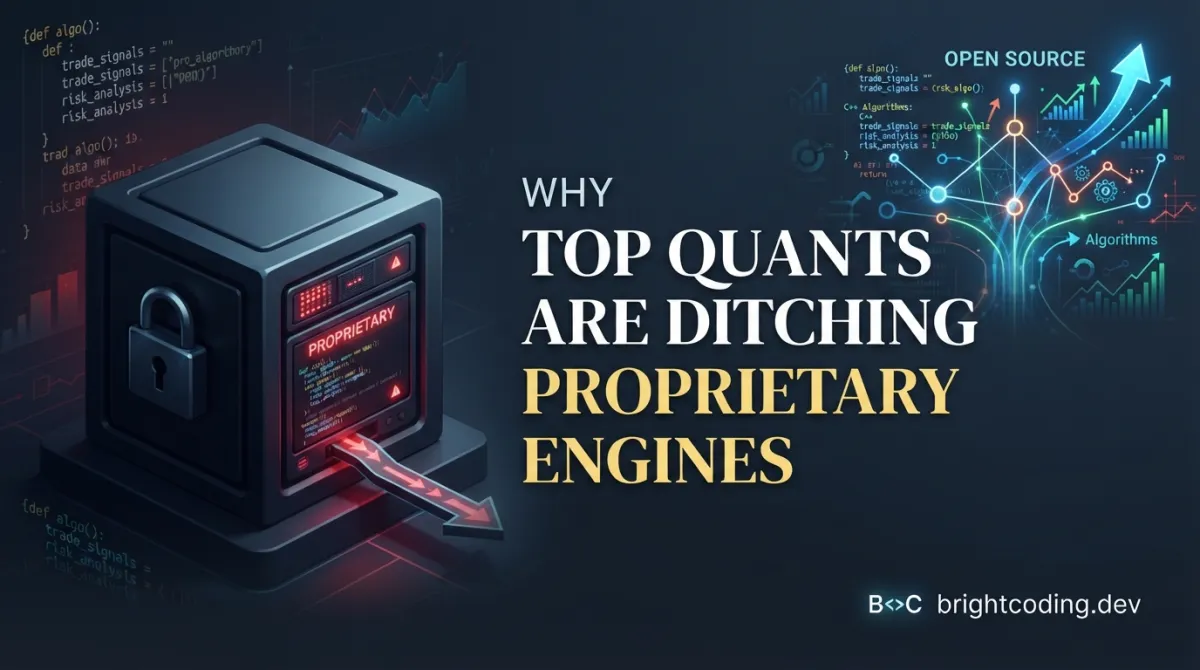
What if your trading bot infrastructure cost you nothing—and worked in any language you already know?
For years, quantitative developers have been trapped in an expensive paradox. Build your strategies in Python↗ Bright Coding Blog, and you're stuck with sluggish execution. Switch to C++ for speed, and your iteration cycles crawl. Pay for a proprietary platform, and you're locked into their ecosystem, their fees, their mercy. Meanwhile, the market doesn't wait. A latency edge today is gone tomorrow. A strategy that worked last quarter gets arbitraged into oblivion while you're still negotiating enterprise licenses.
Here's the painful truth most traders won't admit: your execution engine is eating your alpha. Every millisecond of overhead, every forced language migration, every vendor lock-in decision subtracts from your edge. You've felt it—the frustration of rewriting a perfectly good Rust strategy in some vendor's proprietary DSL. The horror of watching a $10,000/month platform crash during volatility because you couldn't inspect the source code. The paralysis of knowing your infrastructure budget could fund another researcher instead.
What if there was another path? What if you could write strategies in Python, TypeScript, Rust, C++, C#, Scala, or Haskell—your choice, no compromises—and deploy them to a production-grade, self-hosted execution engine with real-time monitoring, custom dashboards, and zero licensing fees?
Meet the0—the open-source algorithmic trading platform that's making proprietary trading infrastructure obsolete. And before you dismiss this as another toy project, consider this: it's built with the same architectural patterns used by top-tier quant funds, wrapped in a developer experience that actually respects your time.
What is the0?
the0 is an open-source algorithmic trading execution engine designed for developers who refuse to compromise between flexibility and performance. Created by Alexander Wanyoike and positioned as a production-grade infrastructure layer, it enables quantitative developers to deploy and manage trading bots across multiple markets without surrendering control to third-party vendors.
The project sits at a fascinating intersection in the fintech landscape. On one side, you have retail-focused platforms like QuantConnect or TradingView—accessible but constraining. On the other, institutional solutions like Quantlib or custom kdb+/q installations—powerful but prohibitively expensive and complex. the0 carves out a third space: institutional-grade architecture with developer-first ergonomics.
Currently in active beta development, the0 explicitly warns that it's "not production-ready"—a refreshing dose of honesty in a space crowded with overpromising. Yet the momentum is undeniable. The repository has attracted attention from quantitative developers precisely because it solves a genuine infrastructure gap: how do you run serious trading strategies without serious vendor lock-in?
The name itself hints at ambition. "the0" (pronounced "the zero") suggests a foundational layer, a ground-up rebuild of how algorithmic trading infrastructure should work in the open-source era. It's not merely a backtesting library or a connector to broker APIs. It's a complete execution environment—from strategy development to deployment orchestration to real-time monitoring.
What makes this particularly timely is the industry shift toward multi-language quantitative stacks. Python dominates research, but Rust and C++ dominate execution. TypeScript enables rapid dashboard development. Scala and Haskell attract functional programming purists building mathematically rigorous strategies. Rather than forcing unnatural language choices, the0 embraces this polyglot reality.
Key Features That Separate the0 from the Pack
Let's dissect what makes this engine genuinely compelling for serious practitioners:
Multi-Language SDK Ecosystem — This isn't superficial language support. the0 provides official SDKs for seven languages: Python (PyPI), TypeScript/Node.js (npm), Rust (crates.io), C++ (header-only via FetchContent), C# (NuGet), Scala (GitHub Packages), and Haskell (cabal). Each SDK is idiomatically designed, not a thin wrapper around a C API. You can write your alpha generation in Python's pandas ecosystem, your execution logic in Rust's zero-cost abstractions, and your monitoring dashboard in React↗ Bright Coding Blog TypeScript—all communicating through the same unified platform.
Custom React Frontends — Most trading platforms force you into their visualization paradigm. the0 flips this: use the React SDK (@alexanderwanyoike/the0-react) to build bespoke dashboards tailored to your specific strategies. Your volatility arbitrage bot gets a volatility surface visualization. Your pairs trading strategy gets a cointegration monitor. The platform provides the data plumbing; you design the cognitive interface.
Real-Time & Scheduled Execution — Two distinct runtime services handle different execution models. The Bot Runner manages continuous real-time execution with live market data feeds. The Bot Scheduler handles cron-based deployments for strategies that don't need microsecond responsiveness—think daily rebalancing, weekly option rolls, or monthly portfolio optimization. Both run in isolated environments with proper resource management, preventing runaway bots from destabilizing your infrastructure.
Self-Hosted Sovereignty — In an era of API rate limits, data residency requirements, and sudden vendor policy changes, owning your infrastructure isn't paranoia—it's risk management. the0 deploys via Docker↗ Bright Coding Blog Compose for development or Kubernetes for production. Your strategies, your data, your uptime guarantees. No sudden "sunsetting" announcements from a SaaS provider can destroy your operation.
CLI-First Developer Experience — The Go-based CLI (the0) provides a Cobra-powered interface for the entire development lifecycle: local testing, deployment automation, log streaming, and configuration management. Quantitative development is already iterative; the tooling should accelerate cycles, not add ceremony.
Exchange Agnostic Architecture — the0 doesn't hardcode broker relationships. The example DCA bot uses Alpaca, but the platform's design accommodates any trading venue with an API. This future-proofs your infrastructure against broker acquisitions, API deprecations, or geographic expansion requirements.
Where the0 Shines: 5 Battle-Tested Scenarios
1. Multi-Strategy Fund Infrastructure
You're running a small quant fund with three distinct strategies: a high-frequency market-making layer in Rust, a medium-frequency statistical arbitrage system in Python, and a monthly tactical allocation model in Scala. Previously, you maintained three separate infrastructures. With the0, all three strategies deploy to the same orchestrated environment, sharing monitoring, logging, and risk controls while retaining language-optimized execution.
2. Proprietary Trading Firm Migration
Your firm has outgrown a commercial platform that's doubling prices and restricting API access. You need to migrate without rewriting years of strategy code. the0's multi-language support means your existing Python and C++ strategies port with minimal changes, while the Kubernetes deployment option provides the reliability your risk committee demands.
3. Academic Research-to-Production Pipeline
You've developed a novel execution algorithm in your PhD research—implemented in Haskell for its mathematical elegance. Traditional platforms force a rewrite in "industry-standard" languages. With the0, you deploy your Haskell implementation directly, maintaining formal verification properties that would be lost in translation, while building a React dashboard to demonstrate results to potential investors.
4. Retail Trader Scaling Beyond Brokers
You've maxed out the automation capabilities of your broker's basic API. You need scheduled execution, proper logging, and strategy isolation to run multiple approaches without interference. the0's Docker Compose deployment gets you running locally in minutes, with a clear upgrade path to cloud Kubernetes when your AUM justifies it.
5. AI-Native Trading Operations
You're experimenting with LLM-powered strategy generation and want your AI assistant to directly manage bot deployment. the0's MCP (Model Context Protocol) server enables Claude Code to list bots, retrieve logs, and deploy configurations through natural language—bridging the gap between AI research and operational execution.
Step-by-Step Installation & Setup Guide
Ready to escape proprietary prison? Here's your complete deployment path.
Prerequisites
Before starting, ensure you have:
- Docker 20.10+ with the Compose plugin installed
- At least 4GB RAM available for container allocation
- For CLI builds from source: Go 1.21+ and Git
Method 1: CLI Local Deployment (Recommended for Development)
The fastest path to a running platform:
# Install the CLI with automatic OS/architecture detection
curl -sSL https://install.the0.app | sh

# The installer downloads the latest release binary, verifies its checksum,
# and places it at ~/.the0/bin/the0. Ensure this directory is in your PATH.

# Launch all platform services
# This starts the API server, frontend dashboard, databases, and runtime services
# in orchestrated Docker containers with proper networking and volume mounts
the0 local start

# Access your local deployment
open http://localhost:3001   # Next.js↗ Bright Coding Blog web dashboard (bot management & monitoring)
open http://localhost:3000   # NestJS API server (REST endpoints & orchestration)
open http://localhost:9001   # MinIO object storage console (admin/the0password)
The the0 local start command handles the complex orchestration: PostgreSQL↗ Bright Coding Blog for relational data, MongoDB for runtime state, NATS JetStream for event streaming, MinIO for blob storage, and the Go-based runtime services. This single command replaces hours of manual configuration.
Method 2: Kubernetes with Helm (Production-Ready)
For teams requiring high availability and scaling:
# Add the official Helm repository
helm repo add the0 https://alexanderwanyoike.github.io/the0
helm repo update

# Install with namespace isolation
# The --create-namespace flag ensures clean separation from other workloads
helm install the0 the0/the0 --namespace the0 --create-namespace
Local Kubernetes testing with Minikube:
cd k8s
make minikube-up      # Provision local Kubernetes cluster
make setup-hosts      # Configure local DNS resolution for the0 services
The k8s/README.md provides comprehensive documentation for production Kubernetes deployments including ingress configuration, persistent volume claims, and horizontal pod autoscaling.
CLI Configuration for Bot Operations
Once deployed, configure your CLI to communicate with the correct API endpoint:
# For Docker Compose local deployments
export THE0_API_URL=http://localhost:3000

# For Kubernetes deployments with ingress configured
export THE0_API_URL=http://api.the0.local:3000
For comprehensive bot management commands—deploying strategies, streaming logs, configuring schedules—consult the0 CLI Documentation.
REAL Code Examples: From Repository to Running Bot
Let's examine actual code from the0's documentation, with detailed commentary on implementation patterns.
Example 1: Production DCA Bot in Python
This is the canonical example from the0's documentation—a dollar-cost averaging implementation demonstrating the platform's Python SDK:
from typing import Dict, Any
from alpaca.trading.client import TradingClient

def main(id: str, config: Dict[str, Any]) -> Dict[str, Any]:
    """Dollar Cost Averaging bot - buys a fixed amount regularly

    This function signature is the0's standard bot interface:
    - id: Unique bot instance identifier (provided by runtime)
    - config: Strategy parameters from deployment configuration
    - Returns: Standardized result dictionary for logging and monitoring
    """

    # Initialize trading client with credentials from secure configuration
    # The 'paper' flag defaults to True—a critical safety feature preventing
    # accidental live trading during development and testing
    client = TradingClient(
        api_key=config["api_key"],
        secret_key=config["secret_key"],
        paper=config.get("paper", True)  # Safe default: paper trading
    )

    # Extract strategy parameters from configuration
    # This decouples strategy logic from deployment specifics,
    # enabling the same code to run different symbols or amounts
    symbol = config["symbol"]
    amount = config["amount"]

    # Execute market buy order with notional (dollar) amount
    # Using notional rather than quantity ensures consistent
    # dollar exposure regardless of share price movements
    order = client.submit_order(
        symbol=symbol,
        notional=amount,           # Buy $X worth, not Y shares
        side=OrderSide.BUY,
        type=OrderType.MARKET,     # Immediate execution for scheduled DCA
        time_in_force=TimeInForce.DAY  # Auto-cancel if not filled by close
    )

    # Return standardized result for the0's monitoring and logging pipeline
    # This enables automatic P&L tracking, execution quality analysis,
    # and alerting without custom instrumentation
    return {
        "status": "success",
        "message": f"Purchased ${amount} of {symbol}",
        "order_id": order.id      # Correlates with broker's audit trail
    }
Key architectural insight: The main(id, config) signature is the0's universal bot contract. Regardless of language, your strategy implements this interface. The runtime injects the bot instance ID and configuration dictionary, then processes your return value for logging, alerting, and dashboard display. This standardization is what enables the multi-language support—each SDK handles the language-specific boilerplate, but the conceptual model remains identical.
Example 2: MCP Server Configuration for AI Integration
The0's MCP server enables Claude Code to manage your trading operation conversationally. Here's the exact configuration from the repository:
{
  "mcpServers": {
    "the0": {
      "type": "http",
      "url": "http://localhost:3000/mcp",
      "headers": {
        "x-api-key": "${THE0_API_KEY}"
      }
    }
  }
}
This configuration uses environment variable expansion (${THE0_API_KEY}) to prevent secret leakage in version-controlled files. The MCP server exposes tools including bot_list, bot_deploy, logs_get, and custom_bot_schema—enabling natural language operations like "Show me the logs for my trading bot" or "Deploy a new scheduled bot with this configuration."
Security note: The x-api-key header authenticates all MCP requests. Generate keys via the web dashboard (Settings → API Keys) or CLI (the0 auth login). Never commit actual key values to repositories.
Example 3: CLI Installation Verification
From the repository's build instructions, verifying your CLI installation:
# Clone the complete repository for source builds
git clone https://github.com/alexanderwanyoike/the0.git
cd the0/cli

# Build and install from source
# This compiles the Go-based CLI with Cobra command framework
make install

# Verify correct installation and display available commands
# Expected output: help text with commands for local, bot, auth, etc.
the0 --help
The make install target builds the CLI for your specific platform and places the binary at ~/bin/the0. Ensure this directory is in your PATH for global access. The Cobra framework provides bash/zsh/fish completions, making command discovery effortless.
Example 4: Kubernetes Local Development Workflow
For teams iterating on infrastructure changes:
cd k8s

# Provision complete local Kubernetes environment
# Includes cluster setup, namespace creation, and resource limits
make minikube-up

# Configure /etc/hosts entries for local service discovery
# Maps api.the0.local, dashboard.the0.local to Minikube IPs
make setup-hosts
This workflow enables infrastructure-as-code testing without cloud costs. The Makefile encapsulates complex kubectl operations, Helm chart dependencies, and ingress configuration into reproducible commands. Teams can validate production deployment patterns locally before committing to cloud resources.
Advanced Usage & Best Practices
Strategy Isolation Patterns: Deploy each strategy as a separate bot instance with dedicated resource limits. The runtime services enforce isolation, but you should also use distinct API keys per strategy for broker-side audit trails. This prevents a bug in one strategy from affecting another's capital allocation.
Configuration Security: Never hardcode credentials in strategy code. Use the0's configuration injection and store secrets in environment variables or your organization's secret manager. The MCP server's ${THE0_API_KEY} pattern demonstrates the correct approach.
Monitoring-Driven Development: Build your React dashboard before deploying live capital. The custom frontend capability isn't merely cosmetic—it's a cognitive tool for understanding strategy behavior. Visualize position deltas, execution slippage, and risk metrics in formats matched to your decision-making process.
Language Selection Heuristics: Match language to strategy characteristics:
- Python: Research-heavy strategies with complex statistical models
- Rust/C++: Latency-sensitive execution, high-frequency approaches
- TypeScript: Strategies tightly coupled to web data sources or requiring rapid iteration
- Scala/Haskell: Mathematically complex strategies benefiting from type system rigor
Graduated Deployment: Use Docker Compose for strategy development, Minikube for integration testing, and cloud Kubernetes for production. the0's consistent deployment model across these environments eliminates "works on my machine" surprises.
the0 vs. Alternatives: Why Make the Switch?
| Capability | the0 | QuantConnect | TradingView | Custom Build |
|---|---|---|---|---|
| Licensing | Apache 2.0 (free) | Freemium/paid | Paid tiers | N/A (your cost) |
| Languages | 7 (Python, TS, Rust, C++, C#, Scala, Haskell) | Python, C# | Pine Script | Your choice |
| Self-Hosted | ✅ Full control | ❌ Cloud-only | ❌ Cloud-only | ✅ Your burden |
| Source Access | ✅ Complete | ❌ Proprietary | ❌ Proprietary | ✅ Complete |
| Custom Dashboards | ✅ React SDK | Limited | Limited | ✅ Build from scratch |
| AI Integration | ✅ MCP server | ❌ None | ❌ None | ❌ Build yourself |
| Kubernetes Ready | ✅ Official Helm charts | ❌ N/A | ❌ N/A | ✅ Your configuration |
| Community | Growing open source | Established | Massive | N/A |
The decisive advantage: the0 combines custom-build flexibility with productized convenience at zero licensing cost. You're not paying for features you'll never use, nor building infrastructure that already exists. For teams with existing code in multiple languages, the migration path is dramatically smoother than alternatives.
FAQ: What Developers Actually Ask
Is the0 really production-ready? The project explicitly states "Beta - Not production-ready" in its current status. However, the architecture—microservices, Kubernetes, event streaming—reflects production patterns. Early adopters should expect API evolution and participate in community feedback. For production capital, consider it a rapid prototyping and staging environment while contributing to stabilization.
How does the0 handle strategy failures and crashes? Each bot runs in an isolated execution context with resource limits. The Bot Runner and Bot Scheduler services capture exceptions, log comprehensive error traces to MinIO, and report status via the API. The platform provides restart policies, though specific behavior (retry, alert, halt) is configurable per deployment.
Can I use my existing broker relationships? Yes. The0 is exchange-agnostic. The Python SDK example uses Alpaca, but you implement the broker-specific connection within your strategy code using your preferred libraries. The platform handles deployment, scheduling, and monitoring; your strategy handles market connectivity.
What's the performance overhead compared to direct broker API calls? The runtime services add orchestration overhead measured in milliseconds, not microseconds. For sub-millisecond latency requirements, evaluate whether the0's current architecture meets your needs or requires custom runtime modifications. For strategies executing on second-to-minute timescales, overhead is negligible.
How do I contribute strategies back to the community? The project welcomes "Bot Templates" as contributions. Package your strategy with documentation, example configurations, and risk disclosures. See CONTRIBUTING.md for guidelines—including their refreshing stance that AI-assisted development is explicitly encouraged.
Is there commercial support available? The project is maintained by AlphaNeuron with community Discord support. For enterprise requirements, evaluate whether the open-source community meets your response time needs or whether custom support arrangements are possible.
Can I run the0 entirely offline for security? The Docker Compose deployment works fully offline after initial image pulls. However, your strategies will need network access to market data and broker APIs. For air-gapped research environments, implement mock data feeds for strategy development.
Conclusion: The Infrastructure You Deserve
The quantitative trading landscape has long forced an impossible choice: vendor lock-in with polished products, or complete freedom with infinite infrastructure burden. the0 refuses this false dichotomy.
By delivering production-grade architecture—microservices, event streaming, Kubernetes orchestration—through a developer experience that respects your language preferences and operational requirements, the0 represents something genuinely new. It's not merely open-source software; it's infrastructure sovereignty for the quantitative community.
The multi-language SDK ecosystem matters because your strategies shouldn't be distorted by tooling constraints. The React frontend SDK matters because your monitoring should match your cognition. The MCP server matters because AI-assisted operations are becoming table stakes, not novelty.
Is it perfect? No—it's beta software, actively evolving, seeking community validation. But the foundation is sound, the architecture is thoughtful, and the trajectory is compelling. For quantitative developers who've felt the pain of proprietary platforms, the0 offers a credible escape route.
The question isn't whether open-source trading infrastructure will mature—it's whether you'll be shaping that future or waiting for vendors to dictate it.
Start building today: Explore the complete source, documentation, and community at github.com/alexanderwanyoike/the0. Your next strategy deserves better infrastructure.
Built by AlphaNeuron | the0.app | docs.the0.app | Discord Community
Outils recommandés
Explore on the BrightCoding network
Hand-picked resources from our other sites.
cocos/cocos-engine: Cross-Platform Game Engine with Modern Graphics
cocos/cocos-engine is the open-source runtime framework for Cocos Creator, built with C++ and TypeScript. It powers 2D/3D games across Web, mobile, desktop, and...
Stop Writing SEO Content Manually! Use SEO Machine Instead
Discover SEO Machine, a specialized Claude Code workspace for creating long-form, SEO-optimized blog content. Built with custom commands, intelligent agents, an...
nv-tlabs/kimodo: Generate 3D Human & Robot Motion from Text Prompts
nv-tlabs/kimodo is NVIDIA's open-source kinematic motion diffusion model for generating controllable 3D human and robot motion from text prompts and constraints...
Continuez votre lecture
The Ultimate Guide to Self-Hosted Workflow Automation Executors: Take Control of Your Automation Empire
AI Research Assistant: How Real-Time Web Scraping is Revolutionizing Knowledge Work in 2025

🎮 The Ultimate Guide to Open Source JavaScript Games: 100+ Free Games & Dev Tools You Can Use Today

Stop Coding Alone: OPC-Skills Gives Your AI Agent Superpowers
Commentaires 0
Aucun commentaire pour l'instant. Soyez le premier à réagir !