This Free AI Tool Automates Your Entire Job (Here's How)
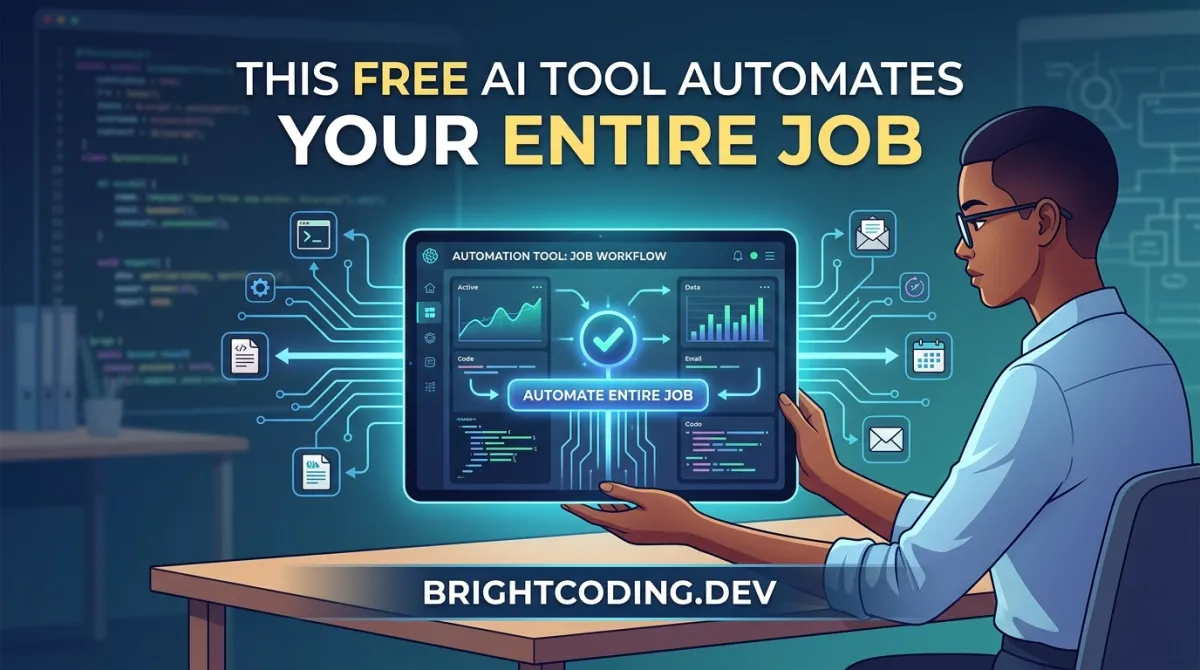
Clickbait headline, I know. Let me be honest upfront: no free tool is going to wipe your job description into a pile of ash. But one tool can quietly eat the most tedious 60% of your day — the copy-pasting, the data wrangling, the "please forward this to Finance" work — and leave you the part that actually matters. That tool is n8n, the self-hosted workflow automation platform, and it costs exactly $0 if you're willing to run it yourself.
Here's the uncomfortable truth: the automation hype you see on LinkedIn is usually someone demoing a demo. This is the real thing — the workflow engine people actually build careers on — and I'll show you exactly how to point it at your job.
TL;DR — Key Takeaways
- n8n is free when self-hosted (no per-workflow fees, unlike Zapier or Make), and its AI features are baked into the core workflow builder.
- You don't automate a job, you automate tasks — the fastest wins are email sorting, report generation, data entry, and meeting notes.
- The 80/20 rule applies: a handful of well-built workflows can reclaim 5–10 hours a week, not 40.
- Start with one painful, repetitive task and ship it in an afternoon — momentum beats perfection.
- The catch: self-hosting means you're the DevOps↗ Bright Coding Blog team. Plan for it.
Why n8n and Not Zapier or Make
The big three no-code automation tools all promise the same thing: "connect your apps, watch the magic happen." But if you've used Zapier, you know the magic has a billing page. On the free tier you get a few hundred tasks a month — which sounds fine until you realize one "task" is a single step in a workflow.
n8n flips the model. It's open source (Fair-code license, so the community edition is free forever), and when you self-host it on a $5 VPS or a spare Raspberry Pi, the cost is basically electricity. That's not a limitation, it's a superpower: no task caps, no "premium app" paywalls, no emailing support when you hit a quota.
| n8n (self-hosted) | Zapier | Make | |
|---|---|---|---|
| Monthly cost (start) | ~$0 (hosting only) | Free tier, then $19.99+ | Free tier, then $9+ |
| Task/operation caps | None | 100s on free tier | 1,000 ops on free tier |
| AI/LLM nodes | Built-in (OpenAI, Anthropic, local models) | Limited / beta | Limited |
| Run code | Full JS/Python↗ Bright Coding Blog via Code node | Limited | Limited |
| Data stays on your server | Yes | No | No |
| Setup difficulty | High (you deploy it) | Low | Low |
Who this is for: builders, freelancers, solopreneurs, and anyone comfortable with a terminal for 20 minutes.
Who this is NOT for: people who want a plug-and-play SaaS with support tickets answered by a human in under 24 hours. If the idea of updating Docker↗ Bright Coding Blog makes you flinch, stick with Make.
How to Actually Point It at Your Job
Here's the part everyone skips: the tool doesn't do anything until you do the unglamorous work of mapping your day. Before you touch n8n, spend one evening listing every task you repeat weekly. Not the interesting ones — the ones you could do in your sleep.
Then ask three questions about each task:
- Is it rule-based? (If X, then Y.) Automatable.
- Does it happen more than once a week? Worth automating.
- Does it need a human judgment call? If yes, half-automate: let the workflow do the prep, you do the call.
Anything that passes all three is a candidate. The mistake beginners make is trying to automate a full process end-to-end on day one. Automate the friction, not the whole job.
The 4 Workflows That Actually Save Time
1. Inbox Triage — the 30-Minute-a-Day Win
Your email is a firehose and most of it is junk. A simple n8n workflow can label, tag, and route incoming mail: newsletters go to a digest folder, invoices get forwarded to your accounting stack, client emails get tagged by priority keywords.
Real example: a freelance designer I know routes all "invoice" and "payment" emails into a sheet her accountant reads weekly. She saves ~25 minutes a day of scanning. That's ~100 hours a year [VERIFY — depends on inbox volume].
2. Report Generation — the Morning Scrape
Sales dashboards, analytics exports, "can you send me last month's numbers?" — all of it is fetching, formatting, and pasting.
Real example: a marketing manager's workflow pulls data from Google Sheets and Google Analytics every Monday at 7 a.m., drops it into a template slide deck, and emails the PDF to her team before the 9 a.m. standup. The report she used to build Monday mornings? She now reads it like everyone else.
3. Meeting Notes to Action Items
Record the call (or use the transcript), feed it to an LLM node, and have it extract decisions, action items, and owners. n8n has native nodes for OpenAI and Anthropic, and you can also plug in a local model via Ollama if you want zero data leaving your machine.
Real example: a project manager runs transcripts through a prompt that outputs a structured "Decisions / Action Items / Blockers" summary into Notion. Action items were getting lost before; now they're tracked within the hour.
4. Data Entry and the "Human API" Work
Someone uploads a spreadsheet; your job is to move the columns into three different systems. It's the most mind-numbing task in any org, and it's 100% automatable.
Real example: an ops coordinator built a workflow that reads a CSV from a shared drive, validates rows against her own rules (missing email? bad date format?), and upserts records into CRM + billing. Rows that fail validation get flagged in a Slack message instead of silently breaking.
The Part Nobody Tells You About
Let me be straight about the downsides, because every automation bro article skips this.
You become the support team. When your n8n instance breaks at 11 p.m., there's no ticket system. You're SSH'd into a box at midnight figuring out why a webhook changed its payload format. This happens. Budget for it.
APIs change without asking. Tools update their endpoints and your workflow quietly dies. The maintenance cost is real — figure on revisiting your workflows every few months.
AI nodes cost money. The tool is free, but the LLM calls aren't. Using GPT-4o-class models on heavy workflows adds up. Solutions: use cheaper models for simple tasks, batch your calls, or run a local model like Llama for the trivial stuff. [VERIFY — model pricing changes frequently]
The 80/20 rule applies to automation too. Most of the time savings come from a handful of workflows. Don't automate everything just because you can — you'll spend more time maintaining automations than you save.
The Edge Cases and Traps
- Over-automation: automating a task that changes weekly means rewriting it weekly. Automate stable processes only.
- Silent failures: workflows that fail quietly are worse than no workflow. Add error notifications to every critical flow.
- Scope creep: one workflow that does 15 things is a liability. Split it into small, single-purpose workflows.
- Security: self-hosted means you own the security. Put it behind a VPN, use secrets management, and never expose the editor to the public internet.
Conclusion
No tool automates your entire job — and anyone who says otherwise is selling you a course. But n8n genuinely can automate the worst 60% of your day: the repetitive, rule-based, soul-draining stuff. One afternoon of setup, one painful workflow solved, and you'll start seeing automation opportunities everywhere.
Here's the pattern-interrupt for you: stop watching automation TikToks. Start one workflow tonight. Pick your most annoying weekly task, install n8n, and ship it. Then share what you built in the comments — the best workflows are always the ones people describe with "wait, that's genius."
If this article helped, subscribe for more automation deep-dives, and tell me in the comments: what's the one task you'd automate first?
Outils recommandés
Explore on the BrightCoding network
Hand-picked resources from our other sites.
Top 15 Free AI Tools for Small Businesses in 2026
You run a small business, which means you wear every hat in the company — marketer, accountant, HR, IT. You've probably googled "free AI tools" before and...
I Tested 87+ Free AI Tools in One Place. Here Is What Happened (No Account Needed)
Discover 87+ free AI tools organized into 22 specialized hubs on one fast, no-account dashboard. From writing and coding to SEO, business plans, and fitness, Pr...
Claude Code Skills: The Secret Weapon Top Devs Use to Automate Delivery
Discover Claude Code Skills: 137 production-ready skills with hash-verified MCP servers, two-agent AI review, and full Agile lifecycle automation. Transform cha...
Continuez votre lecture
Guide to Vibe Workflow Platforms: How Non-Technical Creators Are Automating Their Way to 6-Figure Incomes (2025)
The Ultimate Guide to Self-Hosted Workflow Automation Executors: Take Control of Your Automation Empire
AI Research Assistant: How Real-Time Web Scraping is Revolutionizing Knowledge Work in 2025

Stop Coding Alone: OPC-Skills Gives Your AI Agent Superpowers
Commentaires 0
Aucun commentaire pour l'instant. Soyez le premier à réagir !