Electric Cars Explained: Batteries, Range, Charging and Costs
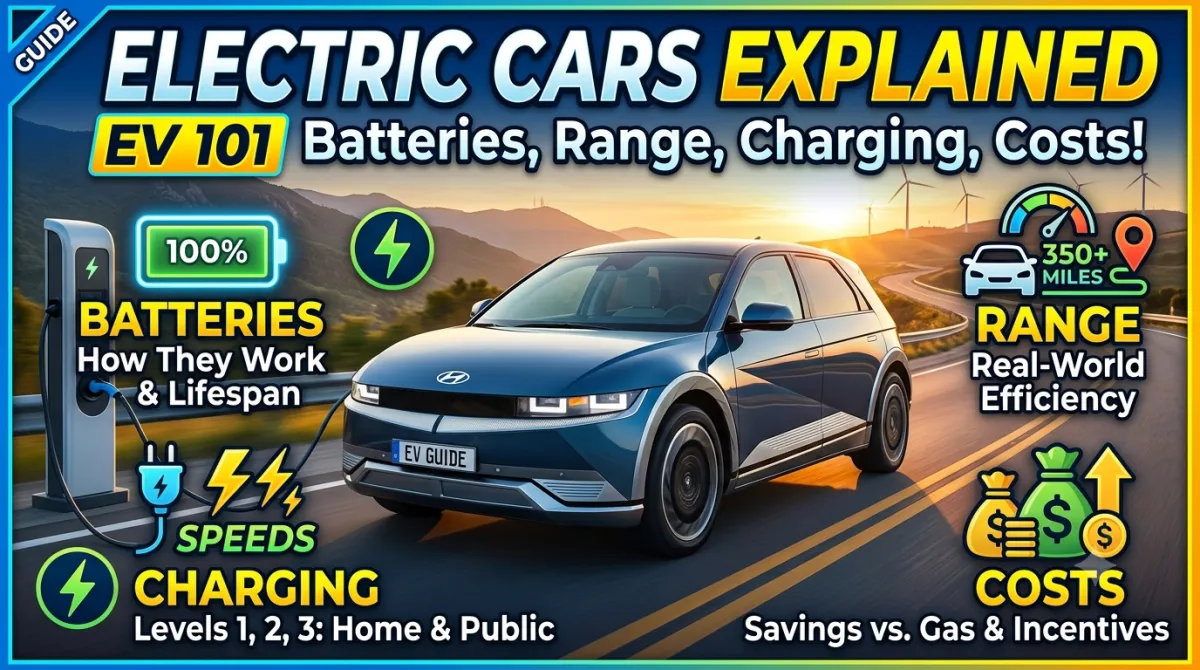
Electric cars now make up more than one in five new car sales worldwide, yet most buyers still have the same questions: How far can it go? How long does charging take? Is it really cheaper than petrol? This guide answers all of them — with calculators to run the numbers for your own driving.
TL;DR
- An EV runs on an electric motor + battery instead of an engine and fuel tank
- Range is typically 300–600 km (WLTP), and real range depends on temperature, speed and driving style
- Charging happens at home overnight (cheapest) or at public fast chargers on road trips
- Running costs are usually 2–4× lower per km than petrol, and maintenance is far simpler
- The higher purchase price is often recovered in 3–6 years through savings
To model your exact situation, our interactive electric vehicle guide includes a range simulator, a charging time & cost calculator and an EV-vs-petrol savings calculator.
How an electric car works
The electric car is gloriously simple. Energy flows from the wall plug into a battery pack, an inverter converts it, and an electric motor drives the wheels. There's no gearbox, no exhaust, no oil. When you brake, the motor becomes a generator and pushes energy back into the battery — this is regenerative braking, and it recovers up to 20% of real-world energy in city driving.
The battery is measured in kilowatt-hours (kWh). A 60 kWh battery with a typical consumption of 15 kWh per 100 km gives a theoretical range of about 400 km. Cold weather, highway speed and cabin heating all reduce that — often by 15–30% in winter.
Range: what really matters
Three things decide your range:
- Battery size — 40–60 kWh suits city commuters; 80–100 kWh suits frequent long trips
- Consumption — speed and weight matter; the efficiency sweet spot is usually 50–90 km/h
- Conditions — cold, rain, hills and towing all cut range
Use the range calculator in our guide to model your exact driving. A good rule: plan a 20–30% buffer in winter.
Charging: levels and costs
There are three levels of charging:
- Level 1 (wall socket) — 1.4–2.3 kW, adds 8–15 km per hour. Fine for emergencies only.
- Level 2 (home wallbox) — 7–22 kW, adds 40–110 km per hour. This is where 80% of real charging happens: plug in at night, full battery by morning.
- Level 3 (DC fast charging) — 50–350 kW, adds hundreds of km in 15–30 minutes. Reserved for road trips.
At $0.15/kWh, a 60 kWh battery costs about $9 for 300 km of range. Public fast charging is typically 3–4× that. Our charging calculator shows the exact time and cost for any setup.
EV vs petrol: the honest numbers
For a typical 15,000 km/year driver:
- Petrol: 7 L/100 km at $1.60/L ≈ $1,680/year
- EV (home charging): 15 kWh/100 km at $0.15/kWh ≈ $340/year
That's roughly $1,300 saved per year on fuel alone, before maintenance, which is about 30% lower for EVs. The catch is the higher purchase price — usually recovered in 3–6 years. The full EV vs petrol comparison breaks it down and lets you enter your own prices.
Battery health: three habits that matter
- Keep 20–80% for daily driving — charging to 100% daily accelerates wear; charge to 100% only for trips
- Avoid exclusive fast charging — it's fine on trips, but prefer AC for daily use
- Pre-condition while plugged in — warm the battery before winter drives to recover range
Modern EV batteries lose only 2–3% capacity per year and are typically warrantied for 8 years / 160,000 km. Our battery guide covers NMC vs LFP chemistries and how to read a battery-health (SOH) report on used cars.
FAQ
Is it really cheaper to run an EV? Yes, usually 2–4× cheaper per km when charging at home. Maintenance is lower too — no oil changes, exhaust or spark plugs.
How long does a full charge take? 8–12 h on a home wallbox, 30–60 min on a 50 kW fast charger, 15–25 min on a 150–350 kW ultra-fast charger. You rarely charge from 0 to 100%.
Do EVs work in winter? Yes, but range drops 15–30%. Heat pumps, pre-conditioning and a little buffer solve most of it.
Are EV batteries bad for the environment? Over a lifetime, EVs emit far less CO₂ than petrol cars, even accounting for battery manufacturing and today's electricity grids.
Should I buy new or used? Used EVs are excellent value since batteries are durable. Always ask for a battery-health (SOH) report. The buying guide has a full checklist.
Conclusion
Electric cars are simpler, cheaper to run and much cleaner than their petrol equivalents — and the technology keeps improving. The main decisions are battery size, charging setup and local prices. Run the calculators on our EV guides, compare the top models, and you'll have everything you need to decide with confidence.
Explore on the BrightCoding network
Hand-picked resources from our other sites.
Electric Car Won't Charge: The Complete Troubleshooting Guide (2026)
Your EV refusing to charge can be frustrating and stressful. This comprehensive 2026 guide walks you through every possible cause from faulty cables and tripped...
Sudden EV Power Loss: 7 Frequent Causes and How to Fix Them A Complete Driver's Guide
Sudden autonomy loss in electric vehicles can be alarming, but most causes are preventable. Discover the 7 most frequent culprits — from battery degradation to...
Electric Car Won't Start: Complete Troubleshooting & Step-by-Step Repair Guide
Your electric car won't start? Don't panic. This comprehensive guide walks you through every possible cause—from a dead 12V battery to software glitches with ac...
Continuez votre lecture




Commentaires 0
Aucun commentaire pour l'instant. Soyez le premier à réagir !