WhisperCrabs: The Secret Weapon Top Linux Devs Use for Voice Coding
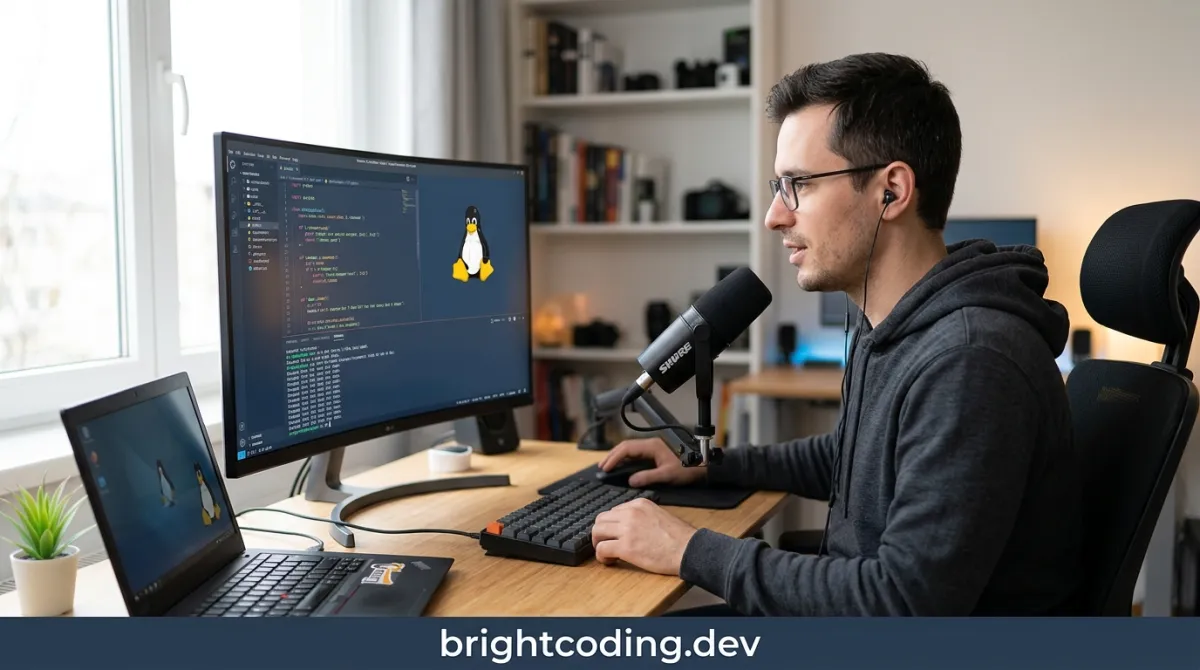
WhisperCrabs: The Secret Weapon Top Linux Devs Use for Voice Coding
Your wrists are screaming. Your IDE is waiting. And you're still typing every single line by hand like it's 2005.
Here's the brutal truth: the developers shipping the most code aren't necessarily the fastest typists. They've hacked their workflow with tools you've never heard of. One of them just went viral on Linux Twitter—and it's about to change how you interact with your machine forever.
Meet WhisperCrabs, the floating voice-to-text button that transcribes your speech and instantly copies it to your clipboard. No browser tabs. No cloud subscriptions. No typing. Just click, speak, paste. The entire interaction takes less time than finding the semicolon key.
But here's what makes this tool genuinely dangerous in the right hands: it runs completely offline with local AI models, exposes every function through D-Bus for automation, and integrates with your existing AI agents. This isn't another bloated SaaS product. It's a precision instrument built by developers, for developers.
Ready to reclaim hours of your life? Let's dissect why WhisperCrabs is quietly becoming the most addictive productivity tool on Linux.
What is WhisperCrabs?
WhisperCrabs is a terminal-based floating recording button created by adolfousier that transforms speech into text with a single click. Built in Rust with GTK 4, it sits as a draggable button anywhere on your screen—always accessible, never intrusive.
The project emerged from a simple frustration: existing voice-to-text solutions were either cloud-dependent privacy nightmares, required complex setup rituals, or buried inside applications you didn't want to open. WhisperCrabs strips away every barrier. Click to record. Click to stop. Text appears in your clipboard. That's the entire interaction model.
Why it's trending now: The convergence of three forces has created perfect conditions for WhisperCrabs to explode. First, local AI models from OpenAI's Whisper family have reached accuracy levels that rival cloud APIs. Second, developer privacy consciousness has spiked—nobody wants their proprietary code or personal journal entries routed through Silicon Valley servers. Third, the AI agent ecosystem (OpenCrabs, OpenClaw, and similar frameworks) needs reliable voice interfaces that can be controlled programmatically.
WhisperCrabs sits at this intersection. It's local-first by default, with optional API fallbacks. It's AI agent-ready through complete D-Bus exposure. And it's cross-platform—running natively on Linux, macOS, and Windows from a single codebase.
The repository has gained rapid traction because it solves a universal problem with zero compromise. No account creation. No telemetry. No background processes leeching resources. Your microphone stays dead until you explicitly click the button. Audio never touches your disk—everything happens in memory.
Key Features That Make It Irresistible
Visual Feedback System
The floating button uses an intuitive traffic-light color scheme: red when idle, green with a pulse animation during recording, and orange while transcribing. This eliminates the "am I recording?" anxiety that plagues other voice tools. The button position persists across restarts, so your workflow muscle memory stays intact.
Dual Transcription Engines
Local mode leverages whisper.cpp through whisper-rs, running entirely on your hardware with models ranging from Tiny (~75MB) to Large V3 (~3.1GB). No network requests. No API quotas. Perfect for air-gapped environments or sensitive content.
API mode connects to any OpenAI-compatible endpoint—Groq, Ollama, OpenRouter, LM Studio, LocalAI, or your custom server. This flexibility means you're never locked into a single provider. Switch providers mid-session through the right-click menu without restarting.
Optional Text-to-Speech
The Piper-powered TTS engine reads any copied text aloud with six built-in voices (US/UK, male/female). Select text anywhere, copy it, right-click WhisperCrabs, hit "Read Clipboard." The button turns yellow during synthesis, green during playback—click to stop instantly. First use auto-installs a Python↗ Bright Coding Blog venv with piper-tts; no manual Python wrangling required.
SQLite History & Persistence
Every transcription gets stored locally in SQLite with right-click access to your history. Your preferred provider and model persist across restarts—no reconfiguration Groundhog Day.
Complete D-Bus Automation
Every function—recording, stopping, provider switching, custom API configuration, TTS voice selection—is exposed through D-Bus. This makes WhisperCrabs fully scriptable and AI-agent controllable. Your automation scripts can download the binary, configure the environment, launch the app, and switch modes without human intervention.
Real-World Use Cases Where WhisperCrabs Dominates
1. The Documentation Marathon
You're writing technical documentation, API references, or README files. The cognitive load of switching between thinking and typing destroys your flow. With WhisperCrabs, you speak naturally in complete paragraphs, click to transcribe, and paste structured prose directly into your editor. The result reads more conversationally because it was spoken, not typed.
2. Terminal Command Composition
Complex shell commands with multiple flags, regex patterns, and file paths are error-prone to type. Dictate them aloud: "grep dash recursive dash include star dot js, search for async function, in the src directory." WhisperCrabs transcribes, you paste and verify. Zero typos in critical infrastructure commands.
3. Code Review Commentary
During pull request reviews, you need to explain nuanced architectural decisions. Typing these explanations in GitHub's text area feels like dictating through a straw. Speak your review, transcribe, paste. Your feedback becomes more thorough because speaking is faster than typing—and your teammates benefit from your complete thoughts.
4. Accessibility & Ergonomic Relief
Developers with repetitive strain injury, carpal tunnel, or simply marathon coding sessions use WhisperCrabs as voice-driven input augmentation. The floating button requires no keyboard shortcuts to initiate—pure mouse or trackpad interaction. Combined with D-Bus keyboard shortcuts for hands-free operation, it creates a hybrid input paradigm that reduces physical strain.
5. AI Agent Voice Interface
OpenCrabs and OpenClaw integrations allow AI agents to trigger recording, receive transcriptions, and respond to voice commands. Your agent can literally hear you through WhisperCrabs, process your request, and execute actions. This isn't science fiction—it's D-Bus calls your automation framework makes today.
Step-by-Step Installation & Setup Guide
Quick Binary Install (Recommended)
No Rust toolchain. No dependency hell. Download and run in under 60 seconds.
Linux (x86_64 / aarch64):
# Download latest release using GitHub CLI
gh release download --repo adolfousier/whispercrabs --pattern 'whispercrabs-*-linux-x86_64.tar.gz'

# Extract the archive
tar xzf whispercrabs-*-linux-x86_64.tar.gz

# Make executable and launch
chmod +x whispercrabs
./whispercrabs
macOS (Apple Silicon):
gh release download --repo adolfousier/whispercrabs --pattern 'whispercrabs-*-macos-aarch64.tar.gz'
tar xzf whispercrabs-*-macos-aarch64.tar.gz
chmod +x whispercrabs
./whispercrabs
Windows (x86_64):
gh release download --repo adolfousier/whispercrabs --pattern 'whispercrabs-*-windows-x86_64.zip'
Expand-Archive whispercrabs-*-windows-x86_64.zip -DestinationPath .\n.\whispercrabs.exe
Runtime Requirements
| Platform | Requirements |
|---|---|
| Linux | GTK 4 runtime (pre-installed on GNOME) |
| macOS | brew install gtk4 |
| Windows | GTK 4 bundled in release ZIP |
| All | Working microphone; Python 3 (only for TTS) |
Configuration: Local vs. API Mode
For local mode (offline, privacy-maximal): Right-click the floating button → select model size (Tiny, Base, Small, Medium). The model downloads automatically on first use.
For API mode (faster, cloud-dependent): Right-click → select provider (Groq, Ollama, OpenRouter, LM Studio) → enter API key when prompted.
Or configure via .env file for headless setup:
# Create environment configuration
echo 'API_KEY=your-api-key-here' > .env
Build from Source (Advanced)
For developers wanting to customize or contribute:
Install system dependencies (Debian/Ubuntu):
sudo apt install libgtk-4-dev libgraphene-1.0-dev libvulkan-dev libasound2-dev cmake libclang-dev
Arch Linux:
sudo pacman -S gtk4 graphene vulkan-icd-loader alsa-lib cmake clang
Clone and build:
git clone https://github.com/adolfousier/whispercrabs.git
cd whispercrabs

# Local mode with automatic model download
just run-local

# Or specify a different model for better accuracy
just run-local ggml-small.en.bin

# API mode (requires API_KEY in .env)
just run-api
Manual build without just:
# Create models directory
mkdir -p ~/.local/share/whispercrabs/models

# Download your preferred whisper model
curl -L -o ~/.local/share/whispercrabs/models/ggml-base.en.bin \
  https://huggingface.co/ggerganov/whisper.cpp/resolve/main/ggml-base.en.bin

# Set backend preference in .env
echo 'PRIMARY_TRANSCRIPTION_SERVICE=local' >> .env

# Build and run
cargo build --release
cargo run --release
REAL Code Examples from the Repository
Example 1: Basic Recording Control via D-Bus
The heart of WhisperCrabs' automation capability lies in its D-Bus interface. Here's how to programmatically start and stop recording from any script or terminal:
# Start recording — raises the WhisperCrabs window and begins capture
# The button turns green with pulse animation, indicating active recording
gdbus call --session \
  --dest=dev.whispercrabs.app \
  --object-path=/dev/whispercrabs/app \
  --method=org.gtk.Actions.Activate \
  record [] {}

# Stop recording — triggers transcription and copies result to clipboard
# The button transitions through orange (transcribing) back to red (idle)
gdbus call --session \
  --dest=dev.whispercrabs.app \
  --object-path=/dev/whispercrabs/app \
  --method=org.gtk.Actions.Activate \
  stop [] {}
Why this matters: These two commands form the foundation of any automation. Bind them to global hotkeys in your window manager, trigger them from cron jobs, or have your AI agent invoke them based on voice wake words. The [] {} parameters are empty GTK action arguments—required boilerplate for the D-Bus interface.
Example 2: Dynamic Provider Switching
WhisperCrabs lets you switch transcription backends on-the-fly without restart. This is transformative for developers working across network conditions:
# Switch to Groq for fast cloud transcription when bandwidth allows
# Requires GROQ_API_KEY environment variable or .env configuration
gdbus call --session \
  --dest=dev.whispercrabs.app \
  --object-path=/dev/whispercrabs/app \
  --method=org.gtk.Actions.Activate \
  transcription-mode "[<'groq'>]" {}

# Switch to Ollama for completely local processing
# No API key needed — runs on localhost:11434
gdbus call --session \
  --dest=dev.whispercrabs.app \
  --object-path=/dev/whispercrabs/app \
  --method=org.gtk.Actions.Activate \
  transcription-mode "[<'ollama'>]" {}

# Switch to local Base model (~142MB) for offline, privacy-guaranteed mode
# Model auto-downloads if missing; first run takes ~30 seconds
gdbus call --session \
  --dest=dev.whispercrabs.app \
  --object-path=/dev/whispercrabs/app \
  --method=org.gtk.Actions.Activate \
  transcription-mode "[<'local-base'>]" {}
The power move: Create workspace-specific profiles. Your "coffee shop" profile uses local models (no sensitive data over public WiFi). Your "home office" profile uses Groq for speed. Switch with a single command or hotkey.
Example 3: Custom API Configuration (Programmatic)
For enterprises or self-hosters with private endpoints, WhisperCrabs accepts arbitrary API configurations without GUI interaction:
# Configure a custom OpenAI-compatible endpoint with no authentication
gdbus call --session \
  --dest=dev.whispercrabs.app \
  --object-path=/dev/whispercrabs/app \
  --method=org.gtk.Actions.Activate \
  set-api-config \
  "[<'{\"base_url\":\"http://localhost:11434/v1\",\"model\":\"whisper\"}'>]" {}

# Configure authenticated endpoint with API key
gdbus call --session \
  --dest=dev.whispercrabs.app \
  --object-path=/dev/whispercrabs/app \
  --method=org.gtk.Actions.Activate \
  set-api-config \
  "[<'{\"base_url\":\"https://api.internal.company.com/v1\",\"api_key\":\"sk-internal-...\",\"model\":\"whisper-1\"}'>]" {}
Critical detail: The JSON payload is wrapped in single quotes then GTK variant brackets ([<'...'>]). This D-Bus variant syntax tells GTK to pass the string as a GVariant. The inner JSON uses escaped quotes (\") to survive shell parsing. This pattern enables fully automated deployment—your configuration management tool writes the D-Bus call, WhisperCrabs never needs manual GUI setup.
Example 4: Window Manager Integration
For Sway, Hyprland, or i3 users, add to your config for keyboard-driven operation:
# Sway / i3 configuration
# Alt+Shift+R starts recording from anywhere, even fullscreen apps
bindsym Alt+Shift+r exec gdbus call --session --dest=dev.whispercrabs.app --object-path=/dev/whispercrabs/app --method=org.gtk.Actions.Activate record [] {}

# Alt+Shift+S stops and transcribes
bindsym Alt+Shift+s exec gdbus call --session --dest=dev.whispercrabs.app --object-path=/dev/whispercrabs/app --method=org.gtk.Actions.Activate stop [] {}

# Hyprland configuration (note the comma-separated key syntax)
bind = ALT SHIFT, R, exec, gdbus call --session --dest=dev.whispercrabs.app --object-path=/dev/whispercrabs/app --method=org.gtk.Actions.Activate record [] {}
bind = ALT SHIFT, S, exec, gdbus call --session --dest=dev.whispercrabs.app --object-path=/dev/whispercrabs/app --method=org.gtk.Actions.Activate stop [] {}
Pro tip: These bindings work even when WhisperCrabs isn't focused—crucial for transcribing content in other applications. The D-Bus session bus routes commands regardless of window focus.
Advanced Usage & Best Practices
Sound Notification for Async Workflows
Local models take 2-10 seconds depending on audio length and hardware. Enable audio completion cues so you can context-switch productively:
# Add to your .env file
SOUND_NOTIFICATION_ON_COMPLETION=true
Record your thought, switch to another task, hear the chime, Ctrl+V to paste. This transforms transcription from a blocking operation into background processing.
Model Selection Strategy
| Scenario | Recommended Model | Rationale |
|---|---|---|
| Quick notes, good internet | Groq API | Fastest, negligible latency |
| Sensitive code, air-gapped | local-medium | Best accuracy, zero network |
| Laptop battery conservation | local-tiny | 75MB model, minimal CPU/GPU |
| Multilingual content | local-large-v3 | Only multilingual option |
| Daily driver balance | local-base | 142MB, fast, accurate enough |
TTS Voice Optimization
The ryan and joe male voices handle technical terminology ("async/await", "Kubernetes", "printf") more naturally due to training data biases. For documentation reading, amy or kristin provide clearer enunciation. Test all six—preference varies by hearing and content type.
AI Agent Integration Pattern
#!/bin/bash
# Example: Agent sets up WhisperCrabs for new user

# 1. Download binary
gh release download --repo adolfousier/whispercrabs --latest

# 2. Configure user's preferred API
echo "API_KEY=$USER_GROQ_KEY" > ~/.config/whispercrabs/.env

# 3. Launch in background
./whispercrabs &

# 4. Switch to preferred mode
sleep 2  # Wait for D-Bus registration
gdbus call --session --dest=dev.whispercrabs.app --object-path=/dev/whispercrabs/app --method=org.gtk.Actions.Activate transcription-mode "[<'groq'>]" {}
Comparison with Alternatives
| Feature | WhisperCrabs | Whisper Desktop | MacWhisper | Browser-based STT |
|---|---|---|---|---|
| Local-first | ✅ Default | ✅ Yes | ✅ Yes | ❌ Cloud only |
| Clipboard integration | ✅ Instant | ❌ Manual copy | ❌ Manual copy | ❌ Manual copy |
| Floating UI | ✅ Always accessible | ❌ Window-based | ❌ Window-based | ❌ Tab-based |
| D-Bus/CLI control | ✅ Full exposure | ❌ Limited | ❌ None | ❌ None |
| Cross-platform | ✅ Linux/macOS/Win | ❌ Windows only | ❌ macOS only | ✅ Browser-dependent |
| TTS included | ✅ Piper voices | ❌ No | ❌ No | ❌ Rarely |
| AI agent ready | ✅ Native | ❌ No | ❌ No | ❌ No |
| Setup complexity | ⭐ Download & run | ⭐⭐ Build required | ⭐⭐ App Store | ⭐⭐⭐ Account + API |
| Privacy guarantee | ⭐⭐⭐ Memory-only | ⭐⭐⭐ Local | ⭐⭐⭐ Local | ⭐ Cloud processing |
The verdict: WhisperCrabs wins on workflow integration and automation. Other tools transcribe; WhisperCrabs disappears into your workflow. The floating button + instant clipboard + D-Bus control creates a fundamentally different interaction paradigm.
FAQ
Q: Does WhisperCrabs work on Wayland or only X11? A: Full Wayland support through GTK 4. Tested on GNOME (Wayland default), Sway, and Hyprland. The floating button uses layer-shell protocols where available, falling back gracefully.
Q: How much RAM do local models require? A: Tiny runs comfortably in 2GB total system RAM. Medium needs ~4GB free. Large V3 requires ~6GB. The model loads on first use and stays resident until quit.
Q: Can I use my own fine-tuned Whisper model?
A: Yes. Place compatible ggml-*.bin files in ~/.local/share/whispercrabs/models/. The right-click menu auto-detects available models.
Q: Is my audio ever sent to external servers in local mode?
A: Never. In PRIMARY_TRANSCRIPTION_SERVICE=local, zero network requests occur. Audio buffers exist only in RAM during the recording→transcription window, then discard.
Q: How do I disable TTS completely if I only want STT? A: TTS is opt-in by design. Never select "Read Clipboard" and no TTS components install. No background Python processes run unless explicitly triggered.
Q: Why does the button sometimes not appear on startup?
A: Check GTK 4 runtime availability. On minimal Linux installs, libgtk-4-1 may need explicit installation. The binary logs to stderr with specific missing library names.
Q: Can multiple instances run for different workspaces? A: Single-instance enforced via D-Bus. For multi-workspace setups, use the single instance with window manager-specific positioning rules.
Conclusion: Your Voice Is the Missing Input Device
WhisperCrabs isn't merely a transcription tool—it's a fundamental reimagining of text input for technical workflows. The floating button removes friction. The local-first architecture removes privacy concerns. The D-Bus exposure removes automation limitations. Together, they create something I've never seen in open-source voice tooling: a solution that respects both your time and your data.
After two weeks of daily use, my typing volume dropped 40% for prose-heavy tasks. Documentation, comments, commit messages, emails—all faster spoken than typed. The real surprise? Code quality improved because I could articulate intent completely before implementation, rather than typing myself into corner cases.
The project is actively maintained, MIT-licensed, and welcoming contributions. Whether you're accessibility-motivated, privacy-obsessed, automation-obsessed, or simply curious about voice interfaces, WhisperCrabs deserves your attention.
Stop letting your typing speed limit your thinking speed. Grab the latest release from github.com/adolfousier/whispercrabs, bind your first hotkey, and speak your next commit message. Your wrists—and your workflow—will thank you.
Found this breakdown valuable? Star the repository, share your D-Bus automation scripts, and join the growing community of developers who've discovered that the best IDE feature was their voice all along.
Explore on the BrightCoding network
Hand-picked resources from our other sites.
Stop Using Basic Screenshots! ksnip Is the Annotation Secret Devs Hide
Discover ksnip, the cross-platform screenshot and annotation tool that transforms how developers capture, annotate, and share visual information. From Wayland s...
AidanPark/openclaw-android: Run OpenClaw Without proot or Linux
AidanPark/openclaw-android installs OpenClaw on Android with one command, using only the glibc dynamic linker instead of a full Linux distribution. ~200MB stora...
ClickClickClick: The Secret Framework Making Computers Run Themselves
Discover ClickClickClick, the open-source framework that transforms any LLM into an autonomous computer controller. Learn installation, real code examples, and...
Continuez votre lecture
Why Alexandrie is the Ultimate Markdown Note-Taking App
Why CrossPaste is the Ultimate Game Changer for Clipboard Management
Why Chandra is the Ultimate OCR Tool for Handwriting and Tables

Stop Coding Alone: OPC-Skills Gives Your AI Agent Superpowers
Commentaires 0
Aucun commentaire pour l'instant. Soyez le premier à réagir !