Why Developers Are Ditching VS Code for This Markdown Editor
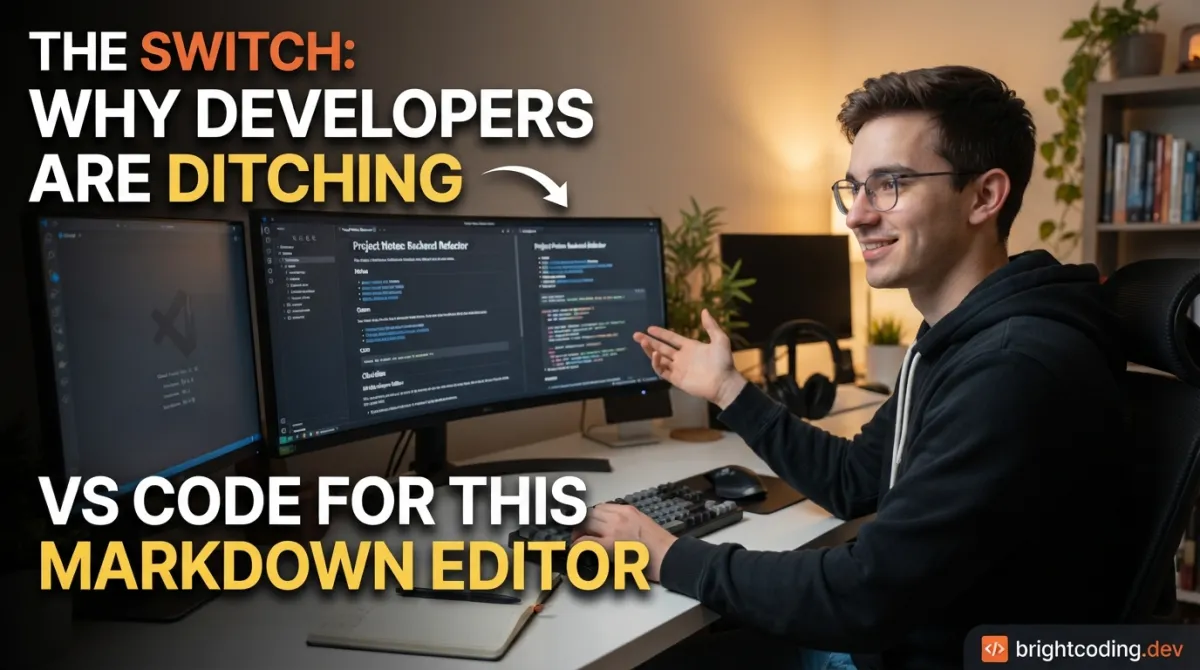
Why Developers Are Ditching VS Code for This Markdown↗ Smart Converter Editor↗ Smart Converter
What if your note-taking app could run your code, draw your diagrams, manage your Git history, and even finish your sentences with AI? Most developers juggle five different tools just to document their work—one for writing, another for diagrams, a third for code execution, plus a separate AI assistant. That fragmented workflow is bleeding hours of productivity every single week. But here's the secret that top open-source contributors have already figured out: there's a single tool that eliminates this chaos entirely. Meet Yank Note, the highly extensible Markdown editor that's redefining what it means to write technical documentation in 2025.
What Is Yank Note?
Yank Note is a powerhouse Markdown editor built by purocean and hosted on GitHub. Unlike typical note apps that treat Markdown as an afterthought, Yank Note is architected from the ground up for developers who demand more from their documentation workflow. It combines the editing precision of Monaco (the same kernel powering VS Code) with an unprecedented suite of embedded capabilities that transform static documents into living, executable workspaces.
The project has gained serious traction in the developer community because it solves a genuine pain point: the disconnect between writing about code and actually running it. Where traditional editors force you to context-switch between your IDE, terminal, browser, and note app, Yank Note collapses everything into a unified environment. Your documentation doesn't just describe your system—it becomes your system.
What makes Yank Note particularly compelling is its extreme extensibility. The entire architecture invites customization through JavaScript↗ Bright Coding Blog plugins, macro replacements, and HTML applets. This isn't a closed ecosystem like Notion or Obsidian; it's an open platform that respects your data as local Markdown files while supercharging them with interactive capabilities. The editor supports version control natively, encrypts sensitive files, and even embeds Reveal.js presentations—all without proprietary lock-in.
Key Features That Make Yank Note Insane
Let's dissect what separates Yank Note from the sea of Markdown editors flooding the market:
-
AI Copilot Integration: This isn't basic autocomplete. Yank Note supports multiple AI providers—OpenAI, Ollama, Gemini, Kimi, Tongyi Qianwen, and even image generation with Flux.1. The OpenCode AI Agent provides intelligent coding assistance directly within your documents. You're not just writing notes; you're pair-programming with AI.
-
Runnable Code Blocks: Execute JavaScript, PHP↗ Bright Coding Blog, Node.js, Python↗ Bright Coding Blog, and Bash directly inside your Markdown. Documentation and execution live in the same file. No more "copy-paste-run-forget" cycles.
-
Monaco Kernel Precision: The editing experience mirrors VS Code—IntelliSense, command palette, keybindings. You sacrifice nothing in editing ergonomics.
-
Embedded Visualizations: PlantUML, Draw.io, ECharts, Mermaid, and even Luckysheet spreadsheets render natively. Your architecture diagrams, data visualizations, and flowcharts update in real-time as you edit.
-
Mind Map Generation: Nested lists transform into interactive mind maps instantly. Brainstorming and documentation converge.
-
Document Encryption: Files ending in
.c.mdreceive per-file password protection with frontend encryption. Your secrets stay secret, with independent passwords for each sensitive document. -
Integrated Terminal: Open terminals directly in-editor with automatic working directory switching. Your shell is always one keystroke away.
-
Macro Replacement: Embed JavaScript expressions that dynamically replace document content. Generate reports, calculate values, or build templates that update themselves.
-
Plugin Architecture: Drop JavaScript files into
home directory/pluginsand extend functionality infinitely. The editor grows with your needs.
Real-World Use Cases Where Yank Note Dominates
1. Technical Documentation That Actually Runs
Stop maintaining separate code repositories and documentation. Write your API guides with executable examples that readers can run instantly. When your SDK updates, your documentation self-validates.
2. Security Research & Incident Response
Encrypt sensitive findings with .c.md files. Each engagement gets its own password. Run Bash and Python scripts to analyze logs without switching contexts. The integrated terminal keeps your investigation contained.
3. Data Science Notebooks Without Jupyter Bloat
Embed ECharts visualizations alongside Python data processing. Share pure Markdown files instead of bulky .ipynb JSON. Collaborators don't need Python environments to read your analysis—just Yank Note to run it.
4. Architecture Decision Records (ADRs) with Living Diagrams
Write ADRs in Markdown with embedded PlantUML or Draw.io diagrams. When decisions evolve, update the source diagram inline. The mind map view helps stakeholders grasp complexity instantly.
5. AI-Assisted Content Creation
Draft technical blog posts with AI completion from Kimi or Gemini. Generate header images with Flux.1. Export to multiple formats via Pandoc backend. One tool, publication-ready output.
Step-by-Step Installation & Setup Guide
Getting Yank Note running takes under two minutes. Here's the complete setup:
Download Prebuilt Binaries
Visit the releases page or grab the latest v3.90.0 directly:
# Windows (x64)
# Download: https://github.com/purocean/yn/releases/download/v3.90.0/Yank-Note-win-x64-3.90.0.exe

# macOS (Apple Silicon)
# Download: https://github.com/purocean/yn/releases/download/v3.90.0/Yank-Note-mac-arm64-3.90.0.dmg

# macOS (Intel)
# Download: https://github.com/purocean/yn/releases/download/v3.90.0/Yank-Note-mac-x64-3.90.0.dmg

# Linux (AppImage - recommended for portability)
wget https://github.com/purocean/yn/releases/download/v3.90.0/Yank-Note-linux-x86_64-3.90.0.AppImage
chmod +x Yank-Note-linux-x86_64-3.90.0.AppImage
./Yank-Note-linux-x86_64-3.90.0.AppImage

# Linux (Debian/Ubuntu)
wget https://github.com/purocean/yn/releases/download/v3.90.0/Yank-Note-linux-amd64-3.90.0.deb
sudo dpkg -i Yank-Note-linux-amd64-3.90.0.deb
Try Without Installing
Not ready to commit? Test drive instantly:
# No installation required—runs in browser
# Visit: https://demo.yank-note.com/
Post-Installation Configuration
- Launch Yank Note and define your workspace directories (called "Repositories")
- Configure AI providers in Settings → AI Assistant (add your OpenAI/Gemini/Ollama endpoints)
- Enable auto-save (on by default; orange title bar indicates unsaved changes)
- Set up encryption password for sensitive
.c.mdfiles via File → Encrypt
Plugin Development Setup
Create your first custom plugin:
# Create the plugins directory in Yank Note's home directory
mkdir -p ~/.yank-note/plugins

# Place your JavaScript plugin files here
# Reference: https://github.com/purocean/yn/blob/master/help/PLUGIN.md
touch ~/.yank-note/plugins/my-custom-plugin.js
REAL Code Examples from Yank Note
Let's examine actual patterns from the Yank Note ecosystem that demonstrate its unique capabilities.
Example 1: Generating a Dynamic Table of Contents
Yank Note extends standard Markdown with macro-powered TOC generation:
<!-- Place this anywhere in your document to auto-generate a TOC -->
[toc]{level: [2]}

## Introduction
Content here...

## Architecture
More content...

## Implementation
Details here...
The [toc]{level: [2]} syntax is not standard Markdown—it's Yank Note's macro system in action. The level: [2] parameter restricts the table of contents to H2 headers only. You can customize with type: "ol" for ordered lists or specify ranges like level: [1,2,3]. This beats manually maintaining anchor links that break when headings change.
Example 2: Running Code Directly in Documents
Here's where Yank Note shatters conventional Markdown limitations:
// In a Markdown code block, click the run button to execute
const data = [1, 2, 3, 4, 5];
const squared = data.map(x => x ** 2);
console.log('Squared values:', squared);
// Output renders directly below the code block
Supported languages include JavaScript, PHP, Node.js, Python, and Bash. The execution environment uses your local interpreters—no sandboxed restrictions that limit real-world utility. This transforms documentation into executable specifications.
Example 3: Embedding Interactive Visualizations
Yank Note renders multiple diagram formats natively:
<!-- PlantUML sequence diagram embedded directly -->
```plantuml
@startuml
Alice -> Bob: Authentication Request
Bob --> Alice: Authentication Response
Alice -> Bob: Data Request
Bob --> Alice: Data Payload
@enduml
{
  "title": { "text": "Monthly Active Users" },
  "xAxis": { "data": ["Jan", "Feb", "Mar", "Apr", "May"] },
  "yAxis": {},
  "series": [{
    "type": "line",
    "data": [820, 932, 901, 934, 1290]
  }]
}
These aren't static images—they're **live-rendered** from source. Update the code, and the visualization refreshes instantly. The ECharts example uses standard JSON configuration that any data scientist recognizes.

### Example 4: Macro Replacement for Dynamic Content

Yank Note's most powerful feature for automation:

```markdown
<!-- JavaScript expressions evaluate at render time -->
Current date: ${new Date().toLocaleDateString()}

<!-- Calculate values from document metadata -->
Document age: ${Math.floor((Date.now() - new Date('2024-01-01')) / 86400000)} days

<!-- Conditional content based on environment -->
${process.env.NODE_ENV === 'production' ? '**PRODUCTION BUILD**' : 'Development mode'}
The ${...} syntax executes arbitrary JavaScript during document rendering. Generate status reports, calculate deadlines, or inject environment-specific warnings—all without leaving Markdown.
Advanced Usage & Best Practices
Security First: Yank Note intentionally sacrifices sandbox security for power. Before opening foreign Markdown files, audit for malicious code blocks. This trade-off enables runnable code but demands vigilance.
Encryption Discipline: Frontend encryption means password recovery is impossible. Use a password manager for .c.md files. The encryption is strong enough to protect credentials, but only if you remember the key.
Plugin Performance: Place heavy computations in background threads. Yank Note's plugin system runs in the main process—blocking operations freeze the UI. Use setTimeout or Web Workers for intensive tasks.
AI Provider Fallbacks: Configure multiple AI endpoints. When OpenAI rate-limits, Yank Note can fail over to local Ollama instances. The settings panel supports per-provider API keys and base URLs.
Version Control Hygiene: Commit your .md files to Git, but exclude auto-generated assets. Yank Note's version control tracks document history internally—use it for rapid iteration before final Git commits.
Mind Map Optimization: Structure brainstorming documents with strict hierarchical lists. The mind map renderer expects consistent indentation—mixing list styles breaks the visualization.
Yank Note vs. The Competition
| Feature | Yank Note | Obsidian | Notion | VS Code + Extensions |
|---|---|---|---|---|
| Local File Storage | ✅ Native Markdown | ✅ Markdown (with metadata) | ❌ Proprietary | ✅ Any file |
| Runnable Code Blocks | ✅ Built-in (5 languages) | ❌ Requires plugins | ❌ Limited embeds | ✅ Via extensions |
| AI Copilot Integration | ✅ Multi-provider native | ❌ Third-party only | ✅ Limited | ✅ Via Copilot |
| Document Encryption | ✅ Per-file passwords | ❌ Vault-wide only | ❌ Enterprise only | ❌ Not native |
| Integrated Terminal | ✅ Built-in | ❌ No | ❌ No | ✅ Built-in |
| Diagram Embedding | ✅ 6+ formats native | ✅ Via plugins | ✅ Limited | ❌ Requires extensions |
| Plugin Extensibility | ✅ JavaScript plugins | ✅ Large ecosystem | ❌ Closed API | ✅ Massive marketplace |
| Data Ownership | ✅ 100% local files | ✅ Local with sync options | ❌ Cloud-dependent | ✅ Local |
| Free & Open Source | ✅ MIT license | ✅ Free, not FOSS | ❌ Freemium | ✅ Free, not FOSS |
The verdict? Yank Note wins where technical execution matters. Obsidian excels at knowledge graphs, Notion at team collaboration, VS Code at pure coding. But only Yank Note unifies documentation, execution, and AI assistance in a single open-source package without cloud dependency.
FAQ: What Developers Ask About Yank Note
Q: Is Yank Note completely free? A: Yes—MIT licensed and fully open source. No feature paywalls, no subscription tiers. Download from GitHub releases.
Q: Can I use my local AI models? A: Absolutely. Ollama integration runs entirely offline. Configure your local endpoint in Settings → AI Assistant for zero-latency, private AI completion.
Q: How does version control compare to Git? A: Yank Note's internal versioning tracks document-level history for rapid iteration. It's complementary to Git—use both: Yank Note for hourly drafts, Git for milestone commits.
Q: Is the encryption truly secure? A: Encryption/decryption occurs client-side with industry-standard algorithms. However, password loss means permanent data loss—no backdoors, no recovery. Plan accordingly.
Q: Can non-developers use Yank Note? A: The Monaco editor has a learning curve. For pure writing without code execution, simpler tools may suit better. But for technical teams, the power is unmatched.
Q: What platforms are supported? A: Windows x64, macOS (Intel & Apple Silicon), Linux (AppImage & .deb). The web demo works anywhere but lacks file system access for security.
Q: How do I migrate from Notion/Obsidian?
A: Export to Markdown—Yank Note reads standard .md files natively. Some proprietary features (Notion databases, Obsidian callouts) require manual conversion.
Conclusion: The Documentation Workflow You've Been Missing
Yank Note isn't just another Markdown editor—it's a fundamental reimagining of how technical professionals should interact with their knowledge. By embedding code execution, AI assistance, visualization, and encryption into a single open-source platform, it eliminates the tool fragmentation that drains developer productivity.
The Monaco kernel ensures you never compromise on editing quality. The plugin architecture guarantees the tool evolves with your needs. And the local-first, Markdown-native approach keeps your data permanently portable.
If you're still maintaining separate environments for writing, coding, diagramming, and AI assistance, you're working harder than necessary. Yank Note collapses that complexity into one elegant workspace.
Ready to transform your documentation workflow? Download Yank Note today from the official GitHub repository, try the live demo, and join the growing community of developers who've already made the switch. Your future self—writing less, executing more, and thinking clearer—will thank you.
Star the repo, contribute plugins, or report issues at github.com/purocean/yn. The project thrives on community engagement.
Outils recommandés
Tags
Explore on the BrightCoding network
Hand-picked resources from our other sites.
buildermethods/design-os: Close the Gap Between Product Vision and Code
buildermethods/design-os is an MIT-licensed TypeScript tool that bridges product planning and implementation through a guided AI conversation workflow, exportin...
Stop Overpaying for Tax Software! Use UsTaxes Instead
Discover UsTaxes, the free open-source tax filing app that keeps your data private. File federal returns via web or desktop without paying a dime. Learn install...
plotly/plotly.js: Interactive JavaScript Charting for Web Apps
plotly/plotly.js is an MIT-licensed JavaScript charting library with 18,260+ GitHub stars, powering interactive statistical, 3D, and scientific visualizations a...
Continuez votre lecture
Why Alexandrie is the Ultimate Markdown Note-Taking App

Why CrossPaste is the Ultimate Game Changer for Clipboard Management
Why Chandra is the Ultimate OCR Tool for Handwriting and Tables

Stop Coding Alone: OPC-Skills Gives Your AI Agent Superpowers
Commentaires 0
Aucun commentaire pour l'instant. Soyez le premier à réagir !