Why Everyone Is Switching to Open Source AI in 2026
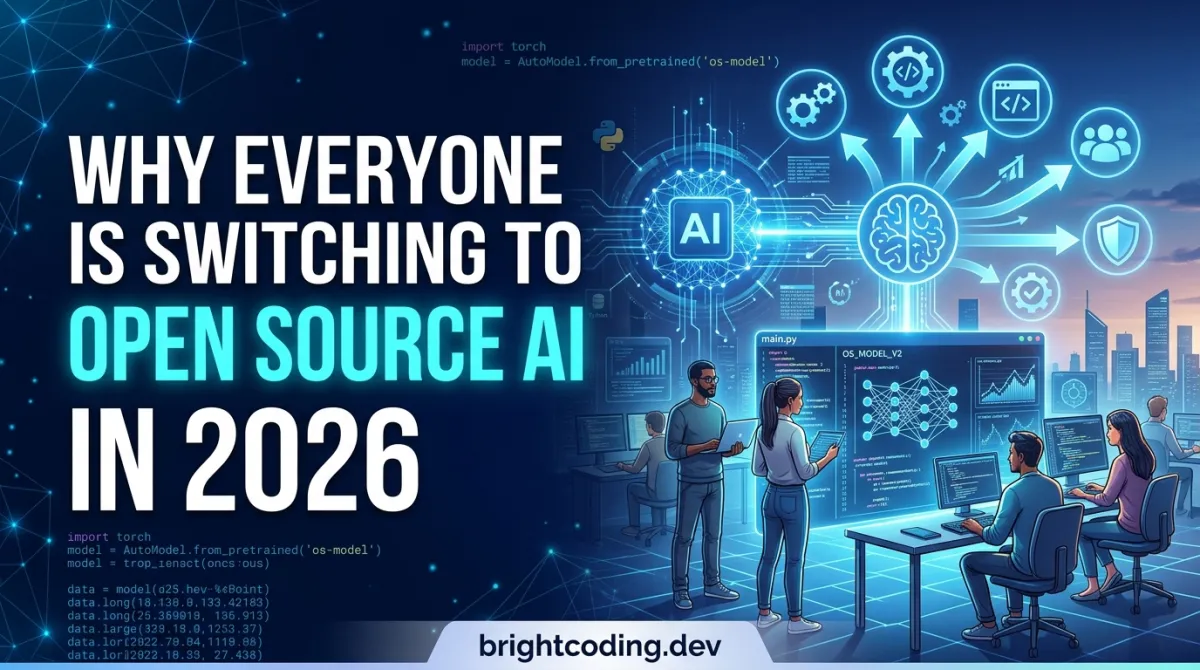
Why Everyone Is Switching to Open Source AI in 2026
The numbers are hard to ignore. Across developer forums, Reddit's self-hosted communities, and enterprise IT budgets, one trend keeps surfacing: teams are quietly replacing their cloud AI subscriptions with self-hosted, open source models. In 2026 this isn't a fringe hobbyist move anymore — it's the default recommendation in rooms where people are paid to think about cost and control.
Why now? Three forces collided: open source models got genuinely good, cloud API prices stayed stubbornly high, and companies got burned — badly — by vendor lock-in, data leaks, and surprise bills. Let me show you what's actually driving the switch, with real numbers where I'm confident and [VERIFY] markers where I'm not.
TL;DR — Key Takeaways
- Open source models in 2026 match or exceed cloud equivalents on many benchmarks — while costing a fraction to run at scale.
- The real driver isn't ideology; it's cost, control, and the fear of lock-in.
- A single consumer GPU (24GB VRAM) can now run a capable model locally; a used server can serve a small team.
- The trade-off is real: you own the infrastructure, the security, and the maintenance.
- The "everyone" in the headline is more accurate than you think — but it's mostly technical teams, not the average office worker. Yet.
What Changed: The 2026 Reality Check
Let's rewind three years. In 2023, "open source AI" meant running a model that was, charitably, a curious toy. You needed a data center to run anything useful, and the results trailed the big proprietary models by a wide margin. The decision was easy: pay the API bill, get the best model.
That equation flipped. The gap between top open source models and the flagship proprietary ones has narrowed to single-digit percentage points on many benchmarks [VERIFY — benchmark numbers shift monthly]. Meanwhile, a model that needed a cloud GPU cluster in 2023 now runs on hardware that costs less than a decent used car. The same $20/month you'd spend on an AI subscription can buy electricity for a local model running around the clock — or you can pocket it.
The math is the message. For a team making thousands of API calls a day, the cloud bill is a line item that keeps growing. A self-hosted model is a fixed cost that you amortize to near-zero.
The Three Forces Driving the Switch
1. The Cost Curve Went Parabolic
Cloud AI pricing doesn't just stay put — it's tied to model generation, context windows, and usage spikes. A runaway weekend of automated tasks can produce an invoice that makes you question your life choices.
Self-hosting inverts this: hardware is a capital cost, usage is basically free. Run it 24/7 or once a month — same price. For high-volume workloads, this isn't a rounding error; it's a 10–50x difference. [VERIFY — depends heavily on model and hardware]
Real example: a small SaaS team I know was spending ~$600/month on API calls for a customer-support summarization feature. They moved to a quantized open source model on a single rented GPU instance. Their bill dropped to ~$120/month with similar output quality. The catch: they had to hire someone who knew how to run a model. [VERIFY]
2. Data Control Stopped Being a "Nice to Have"
Every week there's another story about a company discovering its data was used to train someone else's model, or a tool that quietly shipped user inputs to a server in another jurisdiction. For companies handling medical, legal, or proprietary data, that's a liability, not a feature.
Open source, self-hosted AI means your data never leaves your infrastructure. No uploads, no API logs, no third-party terms of service to read with a lawyer. In regulated industries, this isn't a preference — it's a compliance requirement.
Real example: a healthcare analytics firm [VERIFY — hypothetical, not a named client] runs a local model behind its own firewall specifically so patient data never touches a commercial API. It costs them a data engineer's time, but it closes an entire category of audit risk.
3. Vendor Lock-In Fears Went Mainstream
Ask anyone who built their business on a proprietary API about "dependency risk." They'll tell you about the day the API changed pricing, deprecated a model, or added a terms-of-service clause that broke their product. When your core feature is a rented model, your product is a feature request away from someone else's roadmap.
Open source models can be fine-tuned, forked, and owned. If one model's behavior regresses, you switch. That flexibility is why "AI vendor portability" has become a real talking point in architecture reviews.
The Benchmark Reality Check
People love to argue about leaderboards, so let's be honest: open source models are not uniformly better. They win on cost, speed, and control; they sometimes lose on long-context reasoning and fine-grained instruction following [VERIFY]. The flagship proprietary models still lead on the hardest tasks and have polished tooling.
But here's the kicker: most teams don't need the hardest tasks. They need summarization, classification, extraction, and drafting. For those, a capable open source model at 1/10th the price is a no-brainer — especially when you can also run it on your own hardware with zero data leaving the building.
| Open Source, Self-Hosted | Proprietary Cloud API | |
|---|---|---|
| Upfront cost | Hardware (can be $0–2k for modest use) | None |
| Per-use cost | ~$0 | Priced per token |
| Data privacy | Complete (stays on your hardware) | Depends on vendor terms |
| Model choice | Unlimited (fine-tune, fork, switch) | Locked to vendor's catalog |
| Setup effort | High (you run the infra) | Low (sign up, pay, go) |
| Support | Community, docs, your own skills | Vendor SLA |
| Best for | High volume, sensitive data, cost control | Quick start, no ops team, best-possible quality |
Who Is This Actually For?
Let's puncture the headline a little. "Everyone is switching" is doing heavy lifting. The truth:
Switching now: technical teams, startups with real API bills, privacy-sensitive orgs, and power users who run local models for fun and profit.
Not switching yet: most non-technical businesses, solo users who want zero friction, and companies that need the absolute best model for complex reasoning. The proprietary tools still have a huge market — and a huge moat.
The migration path is also more gradual than the hype suggests. The smartest setup isn't "all local or all cloud" — it's hybrid: cheap, high-volume tasks go to local models; hard, low-volume tasks go to the flagship API. That's the pattern the savvy teams are actually deploying.
What Nobody Tells You About Open Source AI
Time for the honest trade-offs, because every "switch to open source" cheerleader skips them:
- You are now the DevOps↗ Bright Coding Blog team. Model updates, GPU drivers, memory tuning, retries, crashes at 2 a.m. — all yours.
- The community is your support desk. Forums and Discord channels are genuinely helpful, but there's no SLA. When the model won't load, it's on you.
- Quantization has a cost. The clever tricks that shrink models to fit your GPU also degrade quality. On hard tasks, the difference shows.
- "Free" isn't free. Free software, paid-for hardware, paid-for electricity, paid-for expertise. The TCO math works for high volume, not for the occasional chatbot hobby.
- Setup is a real barrier. Even in 2026, installing and serving a model locally is a weekend project for most people, not a coffee-break task.
The Bottom Line
The switch to open source AI in 2026 isn't a fad — it's a rational response to cost, control, and lock-in anxiety, accelerated by models that are finally good enough. The teams moving first are the ones with real workloads and real budgets, and they're not going back.
But the honest version of this story is: it's a trade-off, not a victory lap. Open source gives you control and near-zero marginal cost; it charges you in setup effort and operational responsibility. For the right workloads, that's a bargain. For others, the flagship API is still the right call.
Your move: calculate your actual AI spend for the last three months. If the number makes you wince, spend one weekend testing a local model against your most common task. You might not switch everything — but you'll know exactly what switching is worth.
If this breakdown helped, share it with the person in your org who owns the AI budget — they need to see it. And subscribe for more practical, hype-free AI coverage.
Meta description: Open source AI is winning in 2026 on cost, privacy, and control. Here's why teams are switching, who shouldn't, and the honest trade-offs.
Alternative headlines:
- "The Real Reason Teams Are Ditching Cloud AI for Open Source"
- "Open Source AI in 2026: A Trade-Off Worth Making?"
- "Cloud AI Bills Got You? This Is Why Everyone's Going Local"
Outils recommandés
Explore on the BrightCoding network
Hand-picked resources from our other sites.
Stop Duct-Taping RAG Pipelines! Morphik Core Is the Fix
Morphik Core fixes broken RAG pipelines with native multimodal document search using ColPali. Ingest PDFs, images, videos and query with visual understanding. F...
OpenCoder: The Complete Code LLM Cookbook
OpenCoder is revolutionizing code AI with a completely open-source cookbook for building top-tier code LLMs. Explore models, 2.5T token datasets, processing pip...
Why Open Source AI Is the Future (And How to Use It Free)
For a while, the AI future looked settled: a handful of companies, a handful of APIs, and everyone else rents intelligence by the token. That future alread...
Continuez votre lecture



Commentaires 0
Aucun commentaire pour l'instant. Soyez le premier à réagir !