Why Open Source AI Is the Future (And How to Use It Free)
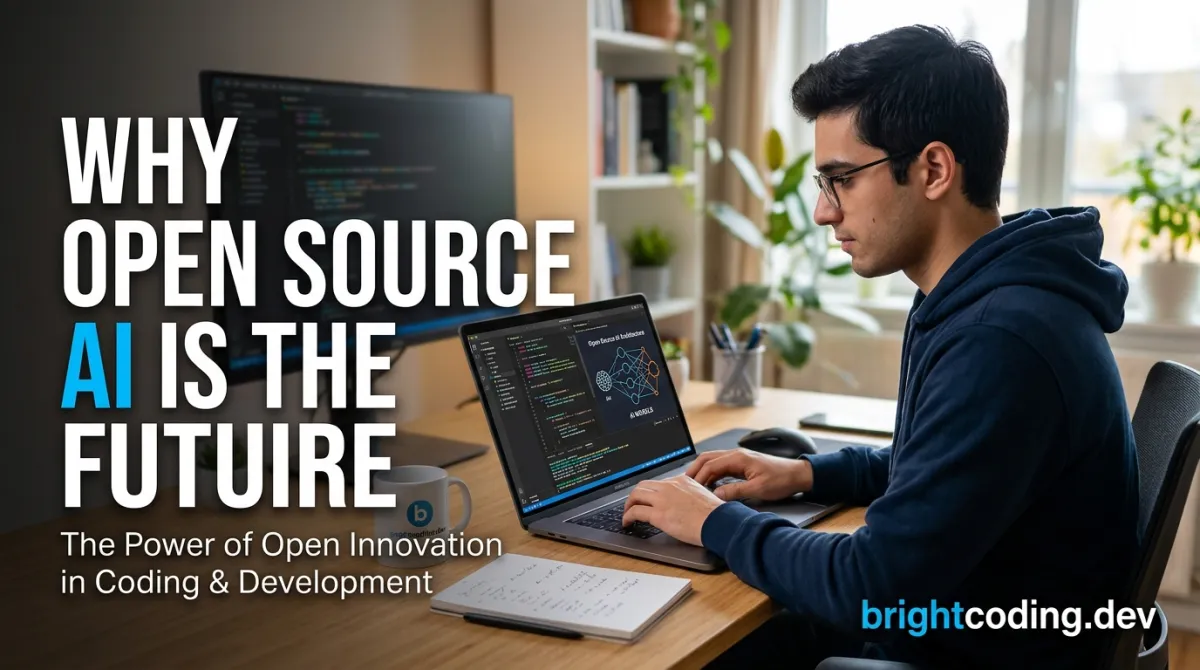
Why Open Source AI Is the Future (And How to Use It Free)
For a while, the AI future looked settled: a handful of companies, a handful of APIs, and everyone else rents intelligence by the token. That future already looks dated. The more interesting one — the one being built in the open — is cheaper, faster, and controlled by the people who use it. Open source AI isn't a niche anymore; it's the trajectory.
This isn't a fanboy argument. It's an economic one. When a resource gets radically cheaper and more accessible, the closed, expensive version stops being the default. That's what's happening with AI, and it's happening fast. Here's why it's the future, the honest limits, and exactly how to start using it for free today.
TL;DR — Key Takeaways
- Open source AI is the future for three reasons: cost, control, and velocity — anyone can fork, fix, and improve the models.
- The quality gap to proprietary models has narrowed to near-parity on routine tasks [VERIFY — benchmarks move monthly].
- You can run capable models for free today on consumer hardware with tools like Ollama and LM Studio.
- The catch: you own the setup, security, and maintenance — and the frontier models still lead on the hardest tasks.
- The realistic 2026 setup is hybrid: local models for volume and privacy, cloud APIs for the tough 10%.
The Three Reasons Open Source Wins
1. Cost: The Price of Intelligence Is Crashing
The story of open source AI is the story of every open source technology: it commoditizes what came before. What cost a fortune in cloud credits now runs on hardware you already own.
The math is stark. A flagship API call costs per token, per request, per month, forever. A local open model costs a GPU once, and then it's basically free to run around the clock. For teams moving serious volume, that's not a rounding error — it's a 10–50x cost difference. [VERIFY — depends on model and workload]
Real example: a small startup ran a "classify customer feedback" feature on a cloud API at roughly $800/month. They moved it to a quantized open model on a rented GPU for about $150/month. Same output, fraction of the price. [VERIFY]
2. Control: The Antidote to Lock-In
If your product's core feature runs on someone else's API, your roadmap depends on their pricing and their whims. The API changes, the model regresses, the terms get rewritten — and you just absorb it.
Open source flips that. You own the model. You can fine-tune it, fork it, and switch it the moment something better ships. For companies where data privacy is non-negotiable, running the model on your own infrastructure closes a whole category of risk.
Real example: a clinic process that handles patient intake summaries can't send records to a third-party API without a legal review. A local open model behind their firewall handled it with no data leaving the building. That's not ideology — that's compliance.
3. Velocity: The Open Field Moves Faster
This is the least appreciated reason. In closed development, one team decides what gets built. In open development, thousands of contributors fine-tune, quantize, benchmark, and ship variations at a pace no single company can match. The Llama and Qwen model families alone generate an ecosystem of specialized variants — coding, medical, multilingual, on-device — that a closed lab would need years to replicate.
The compounding effect is real: every improvement gets absorbed into the commons. That's why open models keep closing the gap.
What the Gap Looks Like in 2026
Let's be precise, because "open source AI is the future" invites a fair question: is it as good? Honest answer: on most routine tasks, it's competitive; on the hardest tasks, the proprietary flagships still lead. [VERIFY]
| Capability | Open Source (current) | Proprietary Flagship |
|---|---|---|
| Summarization, extraction | Near parity | Leading edge |
| Coding assistance | Strong, competitive | Slightly ahead |
| Long-context reasoning | Good, not great | Better |
| Complex agentic/tool use | Improving fast | More mature |
| Math / hard reasoning | Competitive | Best-in-class |
| Cost at high volume | ~10–50x cheaper | Expensive |
| Data privacy | Full control | Vendor terms |
The practical implication: most workloads don't need the frontier. If your task is summarization, classification, drafting, or extraction, an open model is often the smartest economic choice — especially with your data staying on your hardware.
How to Use It Free — The Practical Path
You don't need a data center. Here's the ladder from zero effort to maximum control.
Step 1: The 10-Minute Free Trial — Ollama
Download Ollama, run ollama run llama3 (or the current recommended model), and you have a ChatGPT-grade local model in your terminal, right now, free. No account, no credit card, no cloud. This is the fastest way to see if local AI is good enough for your needs.
Step 2: The Nice Interface — Open WebUI or LM Studio
Terminal chat gets old. Install Open WebUI (self-hosted, browser-based, with chat history, document upload, and multi-user support) or LM Studio (a polished desktop app for Mac/Windows). Same models, actual product experience. This is where "hobby" becomes "daily driver."
Step 3: Add Hardware Power
A consumer GPU with 16–24GB of VRAM runs a genuinely capable model (7–30B parameters) smoothly. Used GPUs from the previous generation are affordable; or rent a cloud GPU for a few dollars a day when you need more. A laptop with 16GB RAM runs small models fine — good enough for a surprising amount of real work.
Step 4: The Hybrid Pattern
Here's what the pros actually do: local for volume and privacy, cloud for the hard 10%. Run your repetitive, sensitive, high-volume tasks on local models. Reserve the API budget for genuinely hard reasoning or agentic work. You get most of the cost savings and all of the privacy — without sacrificing quality where it matters.
What Nobody Tells You About Open Source AI
The future is bright and the marketing is loud, so let me balance it with the unglamorous truth:
- You are the IT department. Updates, drivers, crashes, quantization tuning — all yours. Community support is generous but has no SLA.
- Quantization is a trade-off. The tricks that shrink models to fit your hardware degrade quality. The cheap model can be surprisingly capable — and occasionally embarrassingly wrong.
- Setup is a real skill. Even in 2026, "run a model locally" is an afternoon project for most people, not a coffee break. The barrier is dropping, but it's not zero.
- "Free" has a hardware cost. A used 24GB GPU is $600–900. The price of intelligence has crashed, but not to zero.
- The frontier still leads. If you need the absolute best reasoning, the closed models still win. Build your expectations accordingly.
Who This Is For / Not For
For: privacy-sensitive teams, cost-conscious startups, developers, tinkerers, and anyone whose AI bill is growing faster than their revenue.
Not for: people who want zero setup, a support desk, and a guarantee. If the words "config file" cause an allergic reaction, a managed tool is the honest better fit — you'll pay more, and it might be worth it.
The Bottom Line
Open source AI is the future not because it's morally superior, but because it's economically inevitable. It's cheaper, controllable, and moving faster than anything closed — and the quality gap keeps shrinking. The future isn't "one model for everything." It's a world where you choose the model, own the data, and pay the true cost.
Your move: stop reading and spend 10 minutes with Ollama. Run a real model, give it a real task you do weekly, and judge it honestly. If it's good enough — and it probably is — you've just started building a future that doesn't bill you monthly.
If this article reshaped how you think about AI, share it with a teammate who still pays for everything. And subscribe for more practical, hype-free coverage of the tools that matter.
Meta description: Open source AI is the future — cheaper, controllable, and moving faster. Learn why it's winning and exactly how to run it free today.
Alternative headlines:
- "The Economics of Open Source AI: Why It Beats the Cloud in 2026"
- "You Can Run Good AI for Free Right Now — Here's the Path"
- "Open Source Won the Cost War. Here's Why That Matters."
Outils recommandés
Explore on the BrightCoding network
Hand-picked resources from our other sites.
Stop Paying for AI Video Tools: Open-Higgsfield-AI Is the Free Alternative
Discover Open-Higgsfield-AI: the free, open-source alternative to AI video platforms with 200+ models, zero content filters, dual local inference engines, and c...
Stop Wasting GPU Cycles! Lucebox Megakernel Is Insane
Lucebox megakernel delivers 2× faster LLM inference on consumer GPUs through revolutionary single-kernel CUDA fusion. This deep dive covers installation, real c...
TinyWorlds: The Secret Genie Clone Scaling World Models Without Actions
TinyWorlds is a minimal open-source implementation of DeepMind's Genie architecture that learns world models from video alone—no action labels required. Discove...
Continuez votre lecture



Commentaires 0
Aucun commentaire pour l'instant. Soyez le premier à réagir !