wrchen530/nova3r: Amodal 3D Reconstruction from Unposed Images
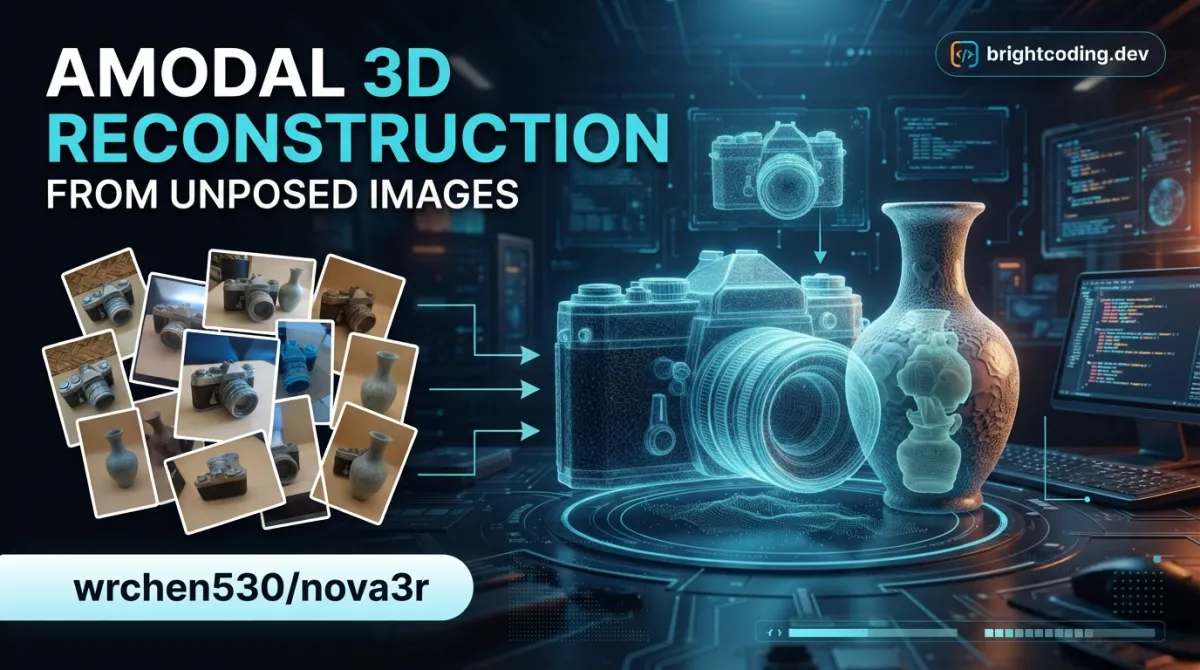
wrchen530/nova3r: Amodal 3D Reconstruction from Unposed Images
Most 3D reconstruction pipelines assume posed cameras, clean visibility, and complete scene coverage. In practice, developers working with real-world image collections—archival photos, drone footage, or casual captures—rarely have calibrated extrinsics or the luxury of occluder-free views. The emerging challenge of amodal 3D reconstruction demands recovering not just visible surfaces but complete, non-overlapping geometry including occluded regions, all without prior pose information. wrchen530/nova3r addresses this directly: a non-pixel-aligned visual transformer that reconstructs physically plausible 3D scenes from unposed multi-view images. Published at ICLR 2026, the implementation is fully open-source under Apache 2.0 with released checkpoints, training code, and evaluation scripts.
What is wrchen530/nova3r?
wrchen530/nova3r is the official PyTorch implementation of NOVA3R (Non-pixel-aligned Visual Transformer for Amodal 3D Reconstruction), developed by Weirong Chen, Chuanxia Zheng, Ganlin Zhang, Andrea Vedaldi, and Daniel Cremers. The repository represents a research artifact from a top-tier machine learning conference, not a commercial product—151 stars and 8 forks as of the latest commit on June 13, 2026, reflecting early but focused community interest.
The project's technical positioning is specific: it operates in the intersection of multi-view 3D reconstruction, amodal completion, and transformer-based scene representation. Unlike pixel-aligned approaches that struggle with viewpoint variation and occlusion, NOVA3R employs a non-pixel-aligned architecture, likely operating in a learned latent space where geometric relationships are encoded independently of image-plane correspondence. The codebase builds on established foundations—DUSt3R for dense matching, CroCo for cross-view completion, VGGT for visual grounding, and TripoSG for shape generation—integrating these components into a two-stage training pipeline.
The repository's relevance stems from its practical accessibility. Where many ICLR papers release inference-only code or require institutional resources, wrchen530/nova3r provides complete training scripts, SLURM templates, and detailed documentation for dataset preparation. The 5.8 GB image-to-point-cloud checkpoints and 262 MB autoencoder weights are hosted on HuggingFace, lowering the barrier for reproduction and extension.
Key Features
Amodal 3D reconstruction from unposed inputs. The defining capability: given one or more images without camera pose information, NOVA3R outputs complete 3D geometry including regions never directly observed. This distinguishes it from standard multi-view stereo or NeRF variants that require posed images and produce only visible-surface reconstructions.
Non-pixel-aligned visual transformer architecture. The technical innovation documented in the paper (arXiv:2603.04179) and implemented in the codebase. By decoupling feature extraction from image-plane alignment, the model handles large viewpoint changes and partial occlusion more robustly than correspondence-dependent methods.
Two-stage training with modular components. Stage 1 trains a point-cloud autoencoder (Pts2Pts) on 3DFront and Scannetpp data; Stage 2 fine-tunes image-conditioned reconstruction (Img2Pts) initialized from Stage 1. This decomposition enables separate optimization of geometric prior and image conditioning.
Multi-view flexibility. Released checkpoints support both single-image (N=1) and two-image (N=2) inference, with the architecture presumably extensible to more views. The demo scripts handle variable input cardinality through unified interfaces.
Production-ready inference pipeline. The repository includes demo scripts producing .ply point clouds and .mp4 360° videos, a Python↗ Bright Coding Blog API for programmatic access, and automated checkpoint downloading. GPU requirements are substantial but explicit: ≥24 GB VRAM, 48 GB recommended, tested on NVIDIA L40s.
Comprehensive evaluation framework. Scripts for SCRREAM benchmark reproduction, with separate configurations for 1-view and 2-view evaluation. The documentation distinguishes between checkpoint-released results and full training reproduction, managing expectations appropriately.
Use Cases
Architectural and interior scene reconstruction from casual photography. A single smartphone image or pair of photos can yield complete room geometry, including furniture arrangements behind visible surfaces. The 3DFront-LaRI training data and Scannetpp coverage suggest strong performance on indoor environments with structured occlusion patterns.
Heritage documentation with uncalibrated image collections. Museums, archives, and field researchers often possess historical photographs without pose metadata. NOVA3R's unposed input requirement enables 3D recovery from these legacy sources, with amodal completion filling gaps from deteriorated or partially captured structures.
Robotics and autonomous systems perception. A robot encountering a novel environment from limited viewpoints needs complete scene understanding for navigation and manipulation planning. The N=1 and N=2 inference modes match realistic sensor constraints, while the point-cloud output integrates with standard planning pipelines.
Content creation and virtual production. Game developers and VFX artists can bootstrap 3D assets from concept art or reference photography. The .ply and .mp4 outputs provide immediate usable formats, though downstream meshing and texturing would require additional processing [INTERNAL_LINK: 3D-asset-workflows].
Research baseline and extension. The full training release, including Stage 1→Stage 2 initialization patterns and SLURM templates, enables academic groups to build on NOVA3R for related problems: amodal instance segmentation, physical scene understanding, or cross-domain generalization.
Installation & Setup
The repository provides automated setup with manual fallback documentation. All commands below reproduce the README exactly.
Clone with submodules (required for dependencies like DUSt3R and CroCo):
git clone --recursive https://github.com/wrchen530/nova3r.git
cd nova3r
The --recursive flag is critical; omitting it will fail to initialize third-party components that the codebase imports directly.
Run automated setup:
bash setup.sh
This script presumably creates a conda environment, installs PyTorch 2.2+ with CUDA 12.1+, and resolves remaining dependencies. For environments where automation fails, docs/INSTALL.md documents manual steps.
Download checkpoints:
bash scripts/download_checkpoints.sh
This fetches three models from HuggingFace: the point-cloud autoencoder (262 MB), and two image-conditioned models for N=1 and N=2 inputs (5.8 GB each). Total download: ~11.9 GB. Storage planning is essential for deployment.
Verify environment:
conda activate nova3r
python -c "import torch; print(torch.cuda.is_available())"  # Should print True
System requirements checklist:
- Python 3.10
- PyTorch 2.2+ compiled against CUDA 12.1+
- NVIDIA GPU with ≥24 GB VRAM (48 GB for comfortable operation)
- ~12 GB disk for checkpoints, additional space for datasets if training
Real Code Examples
The repository includes three documented inference patterns. All snippets below are reproduced verbatim from the README with explanatory context.
Single-image scene reconstruction:
conda activate nova3r

# Single image (scene-level)
python demo_nova3r.py \
  --images demo/examples/scene_1.png \
  --ckpt checkpoints/scene_n1/checkpoint-last.pth \
  --resolution 518 392
This invokes the N=1 checkpoint on a single input image. The --resolution argument specifies processing dimensions; the asymmetry (518×392) suggests non-square cropping or aspect-ratio preservation from training data. Output artifacts write to demo/outputs/scene_1/ by default.
Multi-view reconstruction with two images:
# Two images (multi-view, scene-level)
python demo_nova3r.py \
  --images demo/examples/scrream_scene09_200.png demo/examples/scrream_scene09_275.png \
  --ckpt checkpoints/scene_n2/checkpoint-last.pth \
  --resolution 518 392
The N=2 checkpoint processes paired images, presumably with cross-view attention mechanisms activated. The SCRREAM dataset naming (scrream_scene09) indicates evaluation-aligned examples. Multiple --images arguments are positional and space-separated.
Point-cloud autoencoding (Stage 1 model):
# Point cloud autoencoding from a SCRREAM scene
python demo_nova3r_ae.py \
  --input_ply demo/examples/scrream_scene09.ply \
  --ckpt checkpoints/scene_ae/checkpoint-last.pth \
  --num_queries 50000
This demonstrates the autoencoder's standalone operation: compressing and reconstructing an existing point cloud with 50,000 learned queries. The --num_queries parameter controls reconstruction fidelity versus computational cost.
Python API for programmatic integration:
from demo_nova3r import predict

# Single image → 3D point cloud
pts3d = predict(
    ckpt_path="checkpoints/scene_n1/checkpoint-last.pth",
    image_paths=["path/to/image.png"],
    resolution=(518, 392),
    output_path="output.ply",
)
# pts3d is a numpy array of shape (N, 3)
The API returns a NumPy array for immediate downstream processing while also writing the .ply file. This dual-output design supports both visualization workflows and quantitative evaluation.
Advanced Usage & Best Practices
Resolution selection. The documented 518×392 resolution likely reflects training-time augmentation or backbone constraints. Deviating from this may require adjusting internal feature map expectations; users should verify output quality empirically when modifying.
GPU memory management. The 24 GB minimum VRAM requirement suggests batch-size-1 operation on consumer cards. For A100/H100 deployment, investigate whether the codebase supports gradient checkpointing or model parallelism for multi-sample processing—this is not documented and would require code inspection.
Dataset preparation for training. The 3DFront-LaRI dataset requires manual path configuration in configs/platform/default.yaml. The README explicitly notes that training reproduction differs from released checkpoints; budget time for hyperparameter tuning and potential instability during Stage 2 initialization from Stage 1 weights.
Checkpoint versioning. The checkpoint-last.pth naming suggests automatic overwrite during training. For production inference, copy and rename checkpoints to prevent accidental replacement.
Integration with meshing pipelines. NOVA3R outputs point clouds; surface reconstruction (Poisson, Alpha shapes) and mesh decimation are external steps. The .mp4 generation likely uses point-based rendering—verify whether this meets your visualization requirements or if mesh-based alternatives are needed.
Comparison with Alternatives
| Aspect | wrchen530/nova3r | DUSt3R | VGGT |
|---|---|---|---|
| Input requirement | Unposed images | Unposed images | Unposed images |
| Output modality | Amodal point cloud (complete geometry) | Point map (visible surfaces) | 3D points, poses, depth |
| Amodal completion | Yes (occluded regions) | No | No |
| Training release | Full (Stage 1 + 2) | Inference + partial training | Inference focused |
| Checkpoints | 11.9 GB total | ~2-3 GB | ~1-2 GB |
| GPU requirement | 24-48 GB | 12-24 GB | 16-24 GB |
DUSt3R (upon which NOVA3R builds) excels at dense point map regression from image pairs but does not infer occluded structure. VGGT provides broader 3D understanding including camera poses, yet lacks explicit amodal completion. NOVA3R trades broader geometric tasks for depth in completion quality, with correspondingly higher resource requirements. For applications needing pose estimation alongside reconstruction, a DUSt3R→VGGT→NOVA3R pipeline might be optimal.
FAQ
What does "amodal" reconstruction mean? It means recovering complete object and scene geometry, including parts hidden by occluders, not just visible surfaces.
Can I run this on a 12 GB consumer GPU? No. The README specifies ≥24 GB VRAM; 48 GB is recommended for reliable operation.
Is commercial use permitted? Yes, under Apache License 2.0. Third-party components retain their original licenses.
How does N=1 inference work without pose information? The model learns a geometric prior from training data (3DFront, Scannetpp) enabling single-view depth and completion through statistical regularities.
What's the difference between released checkpoints and training reproduction? The README notes training reproduction "differs from the released checkpoints"; expect minor metric variations due to randomness and hyperparameter sensitivity.
Are SLURM templates provided? Yes, referenced in docs/TRAINING.md for cluster deployment.
Can I extend to N>2 views? The architecture likely supports this, but only N=1 and N=2 checkpoints are released. Custom training would be required.
Conclusion
wrchen530/nova3r occupies a precise niche in the 3D reconstruction landscape: researchers and practitioners needing complete, physically plausible geometry from minimal, unposed visual input. It is not a general-purpose 3D toolkit—pose estimation, mesh generation, and real-time inference are out of scope—but what it targets, it documents thoroughly and releases completely. The resource requirements (24+ GB VRAM, 12 GB checkpoints) position it for institutional GPU access rather than casual experimentation.
For computer vision researchers building on amodal perception, robotics engineers handling partial observability, or technical artists reconstructing scenes from legacy photography, the codebase provides a credible, reproducible foundation. The two-stage training design and modular checkpoint structure invite extension and adaptation.
Explore the implementation, download checkpoints, and review the paper at the official repository. For training details and dataset preparation, consult docs/TRAINING.md and docs/EVALUATION.md after cloning.
Outils recommandés
Explore on the BrightCoding network
Hand-picked resources from our other sites.
json87/SphereSfM: 3D Reconstruction from Spherical ERP Images
json87/SphereSfM extends COLMAP for native sparse 3D reconstruction of spherical ERP images from cameras like Insta360 and Ricoh Theta, with integrated cubic co...
Stop Wasting GPU Hours! LingBot-VLA Cuts Training Time by 2.8×
LingBot-VLA is a pragmatic Vision-Language-Action foundation model with 20,000 hours of pre-training data, 2.8× faster training than alternatives, and state-of-...
allenai/WildDet3D: Promptable 3D Detection for Unstructured Environments
allenai/WildDet3D is a 1.2B parameter promptable 3D detection system from AI2 that runs on single images with text, box, or point prompts. Features built-in mon...
Continuez votre lecture

Why Chandra is the Ultimate OCR Tool for Handwriting and Tables

Why Building LLM Applications From Scratch is a Game Changer

How Building LLM Apps From Scratch Changes the Future of AI Development

Stop Coding Alone: OPC-Skills Gives Your AI Agent Superpowers
Commentaires 0
Aucun commentaire pour l'instant. Soyez le premier à réagir !