Your Agents Forget Everything—Hindsight Fixes It Forever
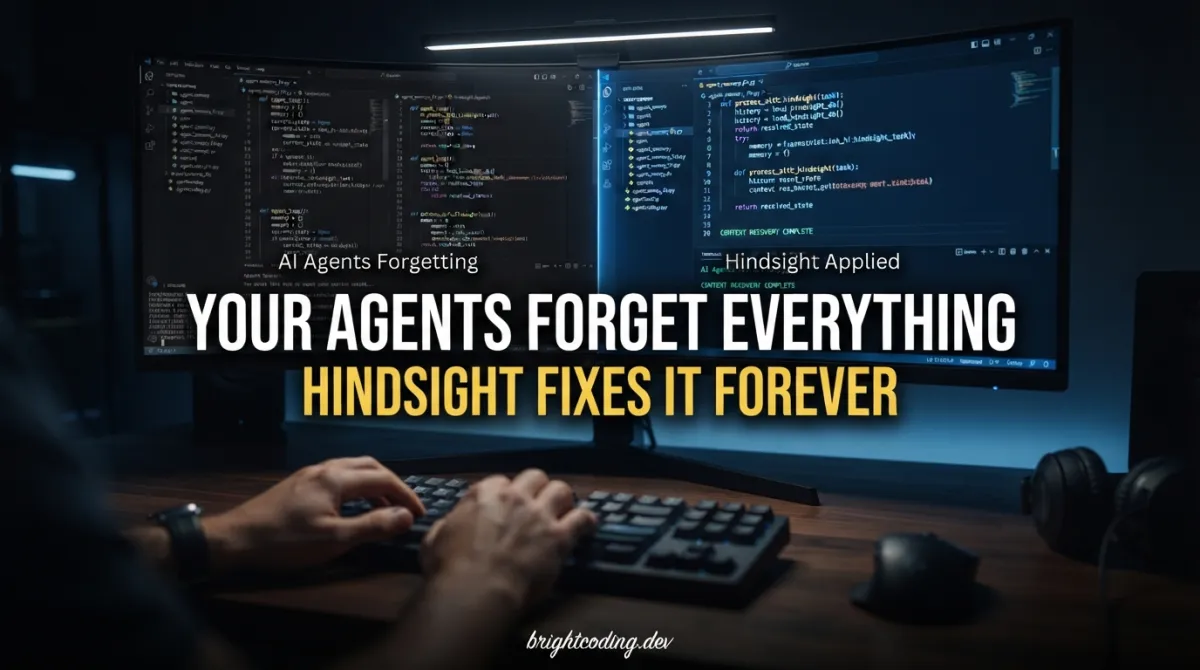
Every conversation starts from zero. Your AI assistant asks your name for the hundredth time. Your coding agent re-explains the same bug pattern it "fixed" last week. Your sales bot pitches products the customer already rejected. Sound familiar? You're not alone—most AI agents have catastrophic amnesia, and it's bleeding productivity across the entire industry.
Here's the dirty secret nobody talks about: retrieval-augmented generation (RAG) and knowledge graphs were never designed for learning. They retrieve. They match. They don't evolve. When your agent needs to understand why a customer got angry, adapt its tone based on past failures, or predict which project risks keep recurring—traditional memory crumbles. The result? Agents that feel like talking to a goldfish with a search engine.
But what if your agent could actually learn from every interaction? What if it built mental models, formed insights, and grew smarter over months—not just recalled chat logs? That's exactly what Hindsight delivers. Born from cutting-edge research and battle-tested at Fortune 500 enterprises, Hindsight isn't another vector database wrapper. It's a biomimetic agent memory system that mirrors how human memory actually works. And the kicker? You can add it to existing agents with just two lines of code.
Ready to stop building forgetful agents? Let's dive into why Hindsight is rewriting the rules of AI memory—and how you can harness it today.
What Is Hindsight? The Memory System That Actually Learns
Hindsight is an open-source agent memory system created by Vectorize.io, designed from the ground up to solve the fundamental flaw in modern AI agents: they don't learn, they only remember. While most "memory" solutions bolt vector search onto conversation history and call it a day, Hindsight implements a sophisticated, biologically-inspired architecture that enables genuine learning over time.
The project emerged from peer-reviewed research published on arXiv and has been independently validated by the Virginia Tech Sanghani Center for Artificial Intelligence and Data Analytics and The Washington Post. This isn't marketing fluff—Hindsight currently holds state-of-the-art performance on the LongMemEval benchmark, the industry standard for assessing memory system performance across diverse conversational AI scenarios.
What makes Hindsight genuinely different? It organizes memories into three distinct, interconnected pathways that mirror human cognition:
- World facts — Objective knowledge about the environment ("The stove gets hot")
- Experiences — The agent's own subjective encounters ("I touched the stove and it really hurt")
- Mental models — Higher-level understanding formed by reflecting on raw memories
This tri-partite structure enables something no RAG system can replicate: emergent insight. When your sales agent reflects on why certain outreach messages succeed while others fail, it's not querying a database—it's thinking. When your project management AI identifies recurring risk patterns across six months of retrospectives, it's not keyword-matching—it's learning.
Hindsight is already deployed in production at Fortune 500 enterprises and adopted by a growing ecosystem of AI startups. With MIT licensing, active CI/CD, and thriving Slack community, it's positioned as the infrastructure layer for the next generation of autonomous agents.
Key Features: Why Hindsight Outperforms Everything Else
Let's dissect what makes Hindsight technically superior to every alternative on the market.
Biomimetic Memory Architecture
Hindsight rejects the simplistic "dump everything into a vector index" approach. Instead, it implements multi-pathway memory processing where ingested information flows through specialized channels:
- Entity extraction and normalization — Raw inputs are parsed into canonical entities, eliminating redundancy and resolving aliases ("Alice," "Alice Smith," "that engineer from Google" become unified)
- Temporal indexing — Time-series representations enable sophisticated chronological reasoning ("What happened before the project delay?")
- Relationship graphs — Causal and associative links between entities enable graph-based traversal during recall
- Sparse/dense hybrid vectors — Combines the precision of keyword matching with the flexibility of semantic search
Four-Strategy Parallel Retrieval
When you query Hindsight, it doesn't just do vector similarity. Recall executes four retrieval strategies simultaneously:
- Semantic retrieval — Dense vector similarity for conceptual matching
- Keyword retrieval — BM25 exact matching for precision requirements
- Graph traversal — Entity, temporal, and causal link following
- Temporal filtering — Time-range constraints for chronological queries
Results are merged via reciprocal rank fusion, then reordered by a cross-encoder reranking model. The final output is token-trimmed to fit your context window. This multi-modal fusion is why Hindsight dominates benchmarks—it's not relying on any single retrieval method's weaknesses.
Disposition-Aware Reflection
The reflect operation is Hindsight's secret weapon. Unlike simple recall, reflection performs deep analysis across memory types to generate novel insights. This enables agents to:
- Identify hidden risk patterns in project management
- Discover why certain customer interactions succeed
- Formulate strategies based on accumulated experience, not just retrieved facts
Zero-Friction Integration
The LLM Wrapper lets you retrofit existing agents without architectural rewrites. Swap your LLM client for Hindsight's wrapper—memories store and retrieve automatically. For custom pipelines, direct SDK and HTTP API access provide full control.
Enterprise-Grade Deployment Flexibility
Run embedded (no server), Docker↗ Bright Coding Blog-contained, or with external PostgreSQL↗ Bright Coding Blog. Oracle AI Database is supported for enterprise deployments with full feature parity. Multi-language SDKs cover Python↗ Bright Coding Blog, Node.js/TypeScript, REST, and CLI.
Use Cases: Where Hindsight Transforms Agent Capabilities
1. AI Employees and Autonomous Workers
The killer use case? Agents that approximate human-level work automation. Imagine an AI project manager that:
- Learns which stakeholders consistently block approvals and proactively routes around them
- Identifies that scope creep always follows certain meeting patterns
- Adapts its communication style based on which team members respond to detail vs. summary
Traditional RAG can't build these mental models—Hindsight can. The system is explicitly designed for agents handling open-ended tasks with feedback loops.
2. Per-User Personalized Chatbots
For conversational AI requiring persistent personalization, Hindsight simplifies implementation dramatically. Store user-specific memories with custom metadata isolation:
# Each user's memories isolated via metadata filtering
client.retain(
    bank_id="support-bot",
    content="User prefers technical explanations over analogies",
    metadata={"user_id": "user-123", "tenant": "enterprise-a"}
)
Retrieve contextually relevant memories while enforcing strict user boundaries. No more cross-contamination between user sessions.
3. Sales and Customer Success Agents
A Hindsight-powered sales agent reflects on outreach performance:
- "Messages sent Tuesday afternoons to CTOs get 3x response rates"
- "This prospect's previous vendor failed on compliance—lead with security credentials"
These aren't retrieved facts; they're emergent strategies formed through reflection on accumulated experiences.
4. Technical Support and Documentation Gap Analysis
Support agents use reflection to identify systematic documentation failures:
- "47 users asked about OAuth refresh tokens in Q3—documentation section 4.2 needs expansion"
This transforms support from reactive to proactively improving the product.
⚠️ When Hindsight might be overkill: Simple workflow automations (n8n, Zapier-style chains) with deterministic logic. The learning overhead isn't justified for purely scripted interactions.
Step-by-Step Installation & Setup Guide
Prerequisites
- Docker (recommended) or Python 3.9+/Node.js 18+
- API key for your preferred LLM provider (OpenAI, Anthropic, Gemini, Groq, Ollama, LMStudio, or MiniMax)
Method 1: Docker (Fastest Path to Production)
# Set your LLM provider API key
export OPENAI_API_KEY=sk-xxx

# Pull and run the latest Hindsight container
docker run --rm -it --pull always -p 8888:8888 -p 9999:9999 \
  -e HINDSIGHT_API_LLM_API_KEY=$OPENAI_API_KEY \
  -v $HOME/.hindsight-docker:/home/hindsight/.pg0 \
  ghcr.io/vectorize-io/hindsight:latest
Access points:
- API:
http://localhost:8888 - Web UI:
http://localhost:9999
Switch LLM providers via environment variable:
export HINDSIGHT_API_LLM_PROVIDER=anthropic # Options: openai, anthropic, gemini, groq, ollama, lmstudio, minimax
Method 2: Docker with External PostgreSQL
For persistent, production-grade storage:
export OPENAI_API_KEY=sk-xxx
export HINDSIGHT_DB_PASSWORD=choose-a-password
cd docker/docker-compose
docker compose up
Same access points. PostgreSQL data survives container restarts. For Oracle AI Database enterprise deployments, consult the storage documentation.
Method 3: Client SDK Installation
Python:
pip install hindsight-client -U
Node.js/TypeScript:
npm install @vectorize-io/hindsight-client
Method 4: Embedded Python (No Server Required)
For lightweight deployments or testing:
pip install hindsight-all -U
This bundles the server runtime directly—no separate container needed.
Verification
After any installation method, confirm functionality:
from hindsight_client import Hindsight

client = Hindsight(base_url="http://localhost:8888")
client.retain(bank_id="test", content="Hindsight is working!")
results = client.recall(bank_id="test", query="Is Hindsight working?")
assert len(results) > 0
REAL Code Examples from the Repository
Let's examine production-ready patterns using actual code from Hindsight's official documentation.
Example 1: Core Operations (Retain, Recall, Reflect)
This Python example demonstrates the three fundamental operations that power all Hindsight integrations:
from hindsight_client import Hindsight

# Initialize client pointing to your Hindsight instance
client = Hindsight(base_url="http://localhost:8888")

# RETAIN: Store information in a named memory bank
# Think of bank_id as a namespace—isolate different agents or users
client.retain(
    bank_id="my-bank",
    content="Alice works at Google as a software engineer"
)
# Behind the scenes: LLM extracts entities, relationships, timestamps
# Normalization creates canonical representations for accurate retrieval

# RECALL: Retrieve relevant memories with natural language queries
client.recall(bank_id="my-bank", query="What does Alice do?")
# Executes 4 parallel retrieval strategies, fuses results, reranks, trims

# REFLECT: Generate disposition-aware, insight-rich responses
client.reflect(bank_id="my-bank", query="Tell me about Alice")
# Performs deep analysis across memory types; may synthesize new observations
What's happening under the hood? The retain call triggers an LLM-powered extraction pipeline that parses your content into structured entities, temporal markers, and relationship graphs. These are normalized—so "Google" and "Google Inc." become the same canonical entity—then indexed across multiple representations. When you recall, Hindsight doesn't just search one index; it fires semantic, keyword, graph, and temporal retrievers in parallel, then uses reciprocal rank fusion and cross-encoder reranking to produce the final ordered result. reflect goes deeper, analyzing patterns across memory types to generate insights that weren't explicitly stored.
Example 2: Temporal Memory with Context
Real agents need to understand when things happened, not just what:
from hindsight_client import Hindsight

client = Hindsight(base_url="http://localhost:8888")

# Basic retention—just the facts
client.retain(
    bank_id="my-bank",
    content="Alice works at Google as a software engineer"
)

# Enhanced retention with temporal and categorical context
client.retain(
    bank_id="my-bank",
    content="Alice got promoted to senior engineer",
    context="career update",           # Categorical tag for filtering
    timestamp="2025-06-15T10:00:00Z"   # Explicit temporal anchor
)

# Temporal recall: "What happened in June?" finds the promotion
client.recall(bank_id="my-bank", query="What happened in June?")
Why this matters: Without temporal indexing, your agent can't distinguish between "Alice was an engineer" and "Alice is an engineer." The timestamp parameter enables chronological reasoning—critical for any agent tracking evolving situations. The context parameter adds categorical structure, letting you filter memories by domain (career, personal, health, etc.) during retrieval.
Example 3: Node.js/TypeScript Integration
Hindsight's multi-language support ensures framework flexibility:
const { HindsightClient } = require('@vectorize-io/hindsight-client');

const main = async () => {
  // Initialize with your Hindsight server URL
  const client = new HindsightClient({ baseUrl: 'http://localhost:8888' });

  // Retain a personal preference for later personalization
  await client.retain('my-bank', 'Alice loves hiking in Yosemite');
  // 'my-bank' is the bank_id; second argument is the content string

  // Recall with natural language query
  const results = await client.recall('my-bank', 'What does Alice like?');
  console.log(results);
  // Returns ranked memories with relevance scores and metadata
}

main();
TypeScript note: The package includes type definitions. Use import { HindsightClient } from '@vectorize-io/hindsight-client' for full IntelliSense support.
Example 4: Embedded Deployment (No Infrastructure)
For rapid prototyping or resource-constrained environments:
import os
from hindsight import HindsightServer, HindsightClient

# HindsightServer spins up an ephemeral instance
with HindsightServer(
    llm_provider="openai",              # Provider selection
    llm_model="gpt-5-mini",             # Specific model for extraction/reflection
    llm_api_key=os.environ["OPENAI_API_KEY"]  # Secure credential injection
) as server:
    # Client automatically connects to the ephemeral server
    client = HindsightClient(base_url=server.url)

    # Full API available without external dependencies
    client.retain(bank_id="my-bank", content="Alice works at Google")
    results = client.recall(bank_id="my-bank", query="Where does Alice work?")

# Server automatically shuts down on context exit
Critical insight: The HindsightServer class manages the entire backend lifecycle—PostgreSQL, embedding models, rerankers, API server—all within your Python process. This is invaluable for testing, CI/CD pipelines, or edge deployments where container orchestration isn't feasible. The with statement guarantees clean resource teardown.
Example 5: Two-Line LLM Wrapper Integration
The fastest path for existing agents—swap your LLM client:
# BEFORE: Direct OpenAI client
from openai import OpenAI
client = OpenAI(api_key=os.environ["OPENAI_API_KEY"])

# AFTER: Hindsight-wrapped client (conceptual—see docs for exact syntax)
# Memories now automatically retained from all completions
# Relevant memories automatically prepended to context
This wrapper intercepts LLM calls, extracts memories from completions, and retrieves relevant context transparently. Your existing prompt engineering stays intact; the agent just gets smarter.
Advanced Usage & Best Practices
Memory Bank Design Patterns
Isolate by user: bank_id=f"user-{user_id}" prevents cross-user memory leaks.
Isolate by domain: Separate banks for "sales-knowledge," "product-specs," and "customer-interactions" enable targeted retrieval and simplified debugging.
Hybrid approach: Use user-specific banks for personal memories, shared banks for world knowledge.
Metadata Strategy for Enterprise Scale
client.retain(
    bank_id="enterprise-support",
    content="Customer reported OAuth timeout after 3600s",
    metadata={
        "tenant_id": "acme-corp",
        "severity": "p2",
        "product_version": "2.4.1",
        "region": "us-east-1"
    }
)
Metadata enables post-hoc filtering without reindexing. Use it for multi-tenant isolation, A/B test segmentation, and compliance audit trails.
Reflection Scheduling
Don't reflect on every interaction—that's computationally expensive and noisy. Instead:
- Trigger reflection at natural breakpoints (end of conversation, task completion, error states)
- Schedule periodic reflection for background insight generation
- Use reflection as a service — expose
reflectendpoints for human analysts to query agent "thoughts"
Monitoring and Observability
Track these metrics in production:
- Recall precision@k — Are retrieved memories actually relevant?
- Reflection novelty score — Is reflection generating new insights or repeating known facts?
- Memory growth rate — Unbounded growth indicates missing compaction; flat growth suggests retention failures
Comparison with Alternatives: Why Hindsight Wins
| Capability | Hindsight | RAG (Vector DB) | Knowledge Graph | Simple Chat History |
|---|---|---|---|---|
| Semantic search | ✅ Hybrid sparse/dense | ✅ Dense only | ❌ Limited | ❌ None |
| Temporal reasoning | ✅ Native time-series | ❌ Manual filters | ⚠️ Via properties | ❌ Linear scan |
| Causal relationships | ✅ Graph extraction | ❌ None | ✅ Explicit edges | ❌ None |
| Emergent insight | ✅ Reflection | ❌ None | ❌ Static | ❌ None |
| Learning over time | ✅ Mental models | ❌ Static index | ⚠️ Manual updates | ❌ No structure |
| Benchmark performance | ✅ SOTA LongMemEval | Variable | Variable | N/A |
| Setup complexity | 2 lines (wrapper) | Infrastructure-heavy | Schema design + curation | Trivial but useless |
| Enterprise readiness | ✅ Multi-tenant, auditable | Varies | Varies | ❌ |
The verdict: RAG systems retrieve; Hindsight learns. Knowledge graphs structure; Hindsight evolves. Chat history preserves; Hindsight understands. For any agent requiring genuine adaptation and improvement, the architectural gap is insurmountable.
FAQ: Your Hindsight Questions Answered
Q: Does Hindsight replace my existing vector database?
A: Hindsight includes its own optimized storage layer. For most deployments, it replaces—not supplements—generic vector databases. You can use external PostgreSQL or Oracle AI Database for persistence, but Hindsight manages the indexing strategy internally.
Q: How does Hindsight handle multi-tenant SaaS applications?
A: Memory banks (bank_id) provide primary isolation. Combine with metadata filtering for granular access control. The retain operation accepts arbitrary metadata that filters recall scope—no memory leaks between tenants.
Q: What LLM providers work with Hindsight?
A: OpenAI, Anthropic, Gemini, Groq, Ollama, LMStudio, and MiniMax. The extraction and reflection pipelines are provider-agnostic; swap via environment variable.
Q: Is Hindsight production-ready?
A: Yes. Fortune 500 enterprises run Hindsight in production. The MIT-licensed open-source core is actively maintained with CI/CD, security patches, and community support via Slack.
Q: How does Hindsight compare to LangChain's memory implementations?
A: LangChain memory is conversation-scoped and retrieval-based. Hindsight is persistent, cross-session, and learning-based. LangChain remembers the chat; Hindsight learns from the chat.
Q: Can I use Hindsight with my existing LangGraph/LlamaIndex agents?
A: Absolutely. The LLM Wrapper integrates transparently. For deeper integration, use the SDK directly within your agent nodes.
Q: What's the cost overhead of reflection?
A: Reflection uses LLM calls and is more expensive than recall. Schedule strategically—end-of-session, periodic batches, or on-demand for complex queries. The insight quality typically justifies the cost for high-value agent applications.
Conclusion: Stop Building Amnesiac Agents
The gap between "agents that remember" and "agents that learn" is the defining challenge of 2025's AI infrastructure. Every week you ship agents with RAG-based "memory," you're accumulating technical debt in user trust and capability ceilings. Your users notice when the sixth conversation starts identically to the first. Your metrics suffer when agents can't adapt to feedback patterns.
Hindsight closes this gap with elegant, biologically-inspired architecture and brutal benchmark dominance. Two lines of code retrofit existing agents. The three-operation API (retain, recall, reflect) belies profound technical sophistication. The open-source core, enterprise deployment options, and active community make it adoptable today, scalable tomorrow.
I've evaluated dozens of agent memory solutions. Most are vector databases with marketing. Hindsight is the first system that genuinely thinks differently about the problem—and the LongMemEval leaderboard proves it works.
Your move: Head to github.com/vectorize-io/hindsight, star the repository, join the Slack community, and run the Docker quickstart. Give your agents the memory they deserve—not a search index, but a mind that learns.
The future belongs to agents that remember what matters, understand why it matters, and improve because of it. That future is Hindsight.
Explore on the BrightCoding network
Hand-picked resources from our other sites.
Best LLMs for Coding in 2026 (Ranked)
The best LLMs for coding in 2026 ranked — model by model, with strengths, weaknesses, pricing, and honest advice on which one to actually use
EvilCharts: Why Developers Are Ditching Boring Charts for This
EvilCharts combines shadcn/ui's design system with Recharts' power to deliver stunning animated visualizations for React and Next.js. Learn installation, real c...
Stop Paying for Screen Annotation! DrawPen Is Free and Insane
Discover DrawPen, the free open-source screen annotation tool for macOS, Windows & Linux. Learn installation, keybindings, real code examples, and why developer...
Continuez votre lecture
Why Alexandrie is the Ultimate Markdown Note-Taking App
Why CrossPaste is the Ultimate Game Changer for Clipboard Management

Why Chandra is the Ultimate OCR Tool for Handwriting and Tables

Stop Coding Alone: OPC-Skills Gives Your AI Agent Superpowers
Commentaires 0
Aucun commentaire pour l'instant. Soyez le premier à réagir !