ZeroPointRepo/youtube-skills: YouTube APIs for AI Agents Without yt-dlp
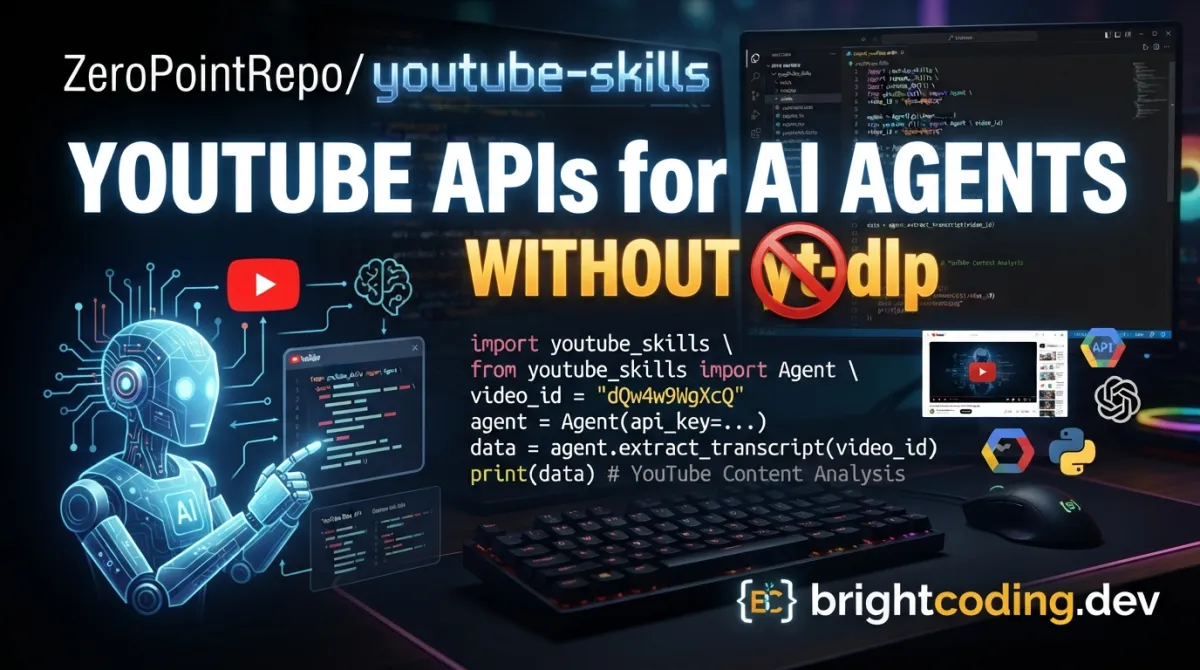
ZeroPointRepo/youtube-skills: YouTube APIs for AI Agents Without yt-dlp
Developers building AI agents face a recurring headache: getting reliable YouTube data without fighting IP blocks, headless browser complexity, or Google's API quota limits. The standard tooling—yt-dlp, Selenium, Puppeteer—breaks in cloud environments where YouTube aggressively blocks datacenter IPs. Meanwhile, the official YouTube Data API requires Google Cloud projects, OAuth flows, and strict quota management that doesn't scale for agent workloads.
ZeroPointRepo/youtube-skills solves this with a clean abstraction: 12 modular skills that let AI agents fetch transcripts, search videos, browse channels, and extract playlists through a single REST API. No binaries to install, no browser automation, no Google credentials. The project sits at 331 GitHub stars with 31 forks, MIT licensed, and last committed on 2026-05-20.
This article breaks down how it works, why the architecture matters, and how to integrate it into your agent stack.
What is ZeroPointRepo/youtube-skills?
ZeroPointRepo/youtube-skills is a skill pack for AI agents built on the Agent Skills specification. It provides structured tool definitions that agents can discover and invoke—effectively giving LLMs typed, documented access to YouTube operations without custom prompt engineering or fragile scraping code.
The project is maintained by ZeroPointRepo and powered by TranscriptAPI, the same backend running YouTubeToTranscript.com. The API claims 15M+ transcripts served monthly with 99.9% uptime. This isn't a side project scraping HTML—it's a commercial-grade API with a free tier, wrapped in a format that multiple agent frameworks understand.
The skills are framework-agnostic where possible. The README documents explicit support for OpenClaw (ClawdBot/Moltbot), Hermes Agent from Nous Research, Claude Code, Cursor, Antigravity, Cline, Codex, and mentions broader compatibility with Goose, AMP, Kiro, Roo, OpenCode, Gemini, and GitHub Copilot. The common thread: all support the Agent Skills format or can consume MCP servers.
The repository's primary language is listed as "Unknown" in GitHub metadata, which suggests the skill definitions are likely declarative (YAML/JSON) rather than compiled code—consistent with the Agent Skills spec's design of portable, language-agnostic tool manifests.
Key Features
Transcript extraction with timestamps. The core capability: given any YouTube URL, return the full transcript with timing data. This works for videos with auto-generated or manually uploaded captions. The API handles language detection and can return specific language tracks.
Video search without Google API quotas. Search YouTube by keyword with structured results including titles, thumbnails, view counts, and publish dates. Returns up to 50 results per query. This replaces the search.list endpoint from Google's Data API without quota anxiety.
Channel browsing and @handle resolution. Resolve YouTube @handles to channel IDs, list uploads with pagination (100 videos per page), and filter by recency. The "latest uploads" operation is free (zero credits).
Playlist extraction. Fetch complete playlist contents with metadata for each video. Enables bulk operations like "transcribe every video in this playlist."
12 modular skills with granular installs. Rather than one monolithic package, you install only what your agent needs:
youtube-full— everything in one skill (recommended default)transcript,captions,subtitles— transcript variants with different naming conventions so agents find the right tool regardless of phrasingyoutube-search,youtube-channels,youtube-playlist— focused single-purpose skillsyoutube-data,youtube-api— lightweight metadata accesstranscriptapi— full raw API accessvideo-transcript,yt— convenience aliases
This design recognizes a real agent engineering constraint: context window budget. Smaller skills mean less prompt surface area when the agent only needs one capability.
Automatic API key provisioning. On first run, the agent walks users through email signup with TranscriptAPI, OTP verification, and persistent key storage across shell configs and agent-specific secret stores. No manual .env editing required, though it's supported.
Use Cases
Research and Content Analysis
An ML engineer building a paper-reading agent can feed it YouTube lecture URLs: "Summarize this NeurIPS keynote and extract all cited papers." The agent fetches the transcript, chunks it, and processes it through the LLM's context window. Without transcript access, the agent would need video understanding models—orders of magnitude more expensive.
Competitive Intelligence
A product team tracking competitor channels asks: "What has [Company X] published about their API this quarter?" The agent searches the channel, filters by date, fetches transcripts, and synthesizes product announcements. The channel search + transcript pipeline replaces manual monitoring or expensive social listening tools.
Educational Content Curation
A developer educator building course materials: "Find the top 5 Rust async tutorials, get transcripts, and identify which covers tokio::select! most thoroughly." Search finds candidates, transcripts enable semantic comparison without watching hours of video.
Accessibility Pipelines
Teams needing text alternatives for video content can bulk-process playlists: "Get English transcripts for all videos in this conference playlist." The playlist skill iterates, the transcript skill extracts, and the agent formats output for downstream processing.
Agent-Driven Media Monitoring
Journalists or analysts configure agents with scheduled prompts: "Show me NASA's latest uploads and flag any mentioning Mars sample return." The channel browsing + search-within-channel capabilities make this a single natural language request rather than a custom scraper maintenance burden.
Installation & Setup
The README provides exact commands per agent framework. Reproduce them precisely:
OpenClaw (ClawdBot/Moltbot)
npx clawhub@latest install youtube-full
This installs the full skill via OpenClaw's package manager. The npx prefix ensures you use the latest version without global installation.
Hermes Agent
hermes skills install skills-sh/ZeroPointRepo/youtube-skills/skills/youtube-full
Hermes uses a GitHub-based skill registry. The path points to the specific skill directory within the repository.
Claude Code / Cursor / Antigravity / Cline / Codex
npx skills add ZeroPointRepo/youtube-skills --skill youtube-full
The npx skills CLI is the common interface for these editors. The --skill flag selects a specific skill; omit it to install all 12.
Install All Skills at Once
npx skills add ZeroPointRepo/youtube-skills
Use this if you want maximum flexibility and aren't context-window constrained.
Manual Installation (Git Clone)
git clone https://github.com/ZeroPointRepo/youtube-skills.git
cp -r youtube-skills/skills/youtube-full ~/.claude/skills/
This bypasses package managers entirely. The ~/.claude/skills/ path is Claude Code's skill directory; adjust for your agent's convention.
Non-Developer Onboarding
The README includes a prompt users can paste directly into any agent:
Install the youtube skills from this GitHub repo: https://github.com/ZeroPointRepo/youtube-skills
I want to be able to get YouTube transcripts, search YouTube, and browse channel videos from my agent.
Set everything up for me.
This is a genuine accessibility feature—no CLI comfort required.
API Key Setup (Automatic)
On first invocation, the agent:
- Prompts for your email address
- Registers you with TranscriptAPI
- Sends an OTP to your email
- Requests the OTP code
- Saves the verified key to your shell config and agent store
The key persists across sessions in locations documented in the README:
| Runtime | Storage Location |
|---|---|
| OpenClaw/Moltbot | ~/.openclaw/openclaw.json or ~/.clawdbot/moltbot.json |
| Hermes Agent | Secret store via required_environment_variables |
| macOS | ~/.zshenv, ~/.zprofile |
| Linux | ~/.profile, ~/.bashrc, ~/.zshenv |
| Fish | ~/.config/fish/config.fish |
| Fallback | ~/.transcriptapi (mode 600) |
Manual API Key Setup
If you prefer control:
export TRANSCRIPT_API_KEY="sk_your_key_here"
Or store it via agent prompt: "My TranscriptAPI key is sk_... — store it so it persists across sessions."
Real Code Examples
The README's documentation style is command-oriented rather than code-heavy—consistent with a tool designed for natural language agent interaction. Below are the concrete invocation patterns provided, with explanation.
Example 1: Transcript Extraction (Natural Language Invocation)
After installing youtube-full or transcript, you prompt your agent:
"Get the transcript for this video: https://youtube.com/watch?v=VIDEO_ID"
The agent maps this to the appropriate skill, calls TranscriptAPI, and returns structured transcript data with timestamps. You then chain follow-up operations:
"Summarize the key points from that transcript"
"Translate the transcript to Spanish"
"Extract all timestamps where the speaker mentions 'neural networks'"
This is the intended interaction model: no explicit API calls in user-facing code. The skill abstraction handles parameter extraction, validation, and error recovery.
Example 2: Bulk Playlist Processing
For playlist operations, the agent handles pagination internally:
"Get transcripts for all videos in this playlist: [URL]"
The agent:
- Calls
youtube-playlistto fetch video IDs - Iterates through results (handling pagination if >100 videos)
- Calls
transcriptper video - Returns aggregated results or stores them per your instruction
This pattern would require significant orchestration code with raw APIs. The skill pack collapses it to one sentence.
Example 3: Channel Search with Filtering
"Search the TED channel for 'artificial intelligence'"
The agent:
- Resolves "TED" to channel ID via
youtube-channels - Performs scoped search
- Returns filtered results with metadata
The README notes channel resolution and "latest uploads" are free operations (zero credits), making monitoring workflows cost-efficient.
Example 4: Framework-Specific Skill Installation
The installation commands themselves are the primary "code" in this repository. For Hermes Agent specifically:
hermes skills install skills-sh/ZeroPointRepo/youtube-skills/skills/youtube-full
This demonstrates the Agent Skills registry convention: skills-sh/ prefix, GitHub org/repo path, and explicit skill subdirectory. Understanding this structure matters if you're publishing your own skills or debugging installation failures.
Note: The README does not contain traditional library-style code examples (Python↗ Bright Coding Blog/TypeScript imports, function calls). This reflects the tool's architecture: it's an agent capability layer, not a client library. Developers seeking programmatic HTTP access should use the MCP Server or TranscriptAPI directly.
Advanced Usage & Best Practices
Skill granularity for context efficiency. If your agent has tight context limits, prefer focused skills over youtube-full. The README explicitly recommends this: "smaller context = better agent performance for specific tasks." Install transcript alone if you only need captions, youtube-search alone for discovery tasks.
Credit budgeting. The free tier provides 100 credits. Most operations cost 1 credit; channel resolve and latest uploads are free. For high-volume workflows, the Starter plan at $5/month (1,000 credits) or $54/year annual plan offers predictable costs versus Google's API quota model where overages can be expensive and opaque.
Key rotation and security. The automatic key storage uses mode-600 files and agent-specific secret stores. For team deployments, consider explicitly setting TRANSCRIPT_API_KEY in your orchestration environment rather than per-user agent stores—this ensures consistency across CI/CD or shared agent instances.
Fallback to MCP. If your agent framework doesn't support Agent Skills natively, the youtube-mcp repository provides the same capabilities via Model Context Protocol, compatible with Claude Desktop, ChatGPT, and other MCP consumers.
Error handling expectations. The README notes YouTube blocks "all major cloud IPs" for yt-dlp—this is why the API-first architecture exists. However, API availability depends on TranscriptAPI's infrastructure. For critical paths, implement retry logic at your orchestration layer and monitor the status page (implied by the 99.9% uptime claim, though no explicit status URL is provided).
Comparison with Alternatives
| Tool | Approach | Best For | Key Trade-off |
|---|---|---|---|
| ZeroPointRepo/youtube-skills | Managed API via Agent Skills format | AI agent integration, no scraping maintenance | Requires TranscriptAPI credits; not self-hosted |
| yt-dlp | Direct YouTube extraction | Full control, zero external dependencies | Blocked on cloud IPs; requires local execution; maintenance burden |
| Google YouTube Data API v3 | Official Google API | Enterprise compliance, maximum quota | Complex OAuth; strict quota limits; no transcript access (separate caption API) |
| youtube-transcript-api (Python) | Unofficial Python library | Quick Python scripts | Same IP blocking as yt-dlp; no search/channel features |
yt-dlp remains the gold standard for personal, local extraction where you control the network environment. It fails for cloud-deployed agents, which is exactly the gap ZeroPointRepo/youtube-skills targets.
Google's official API offers search and metadata but requires a Google Cloud project, OAuth consent screen for some operations, and separates caption access into a different endpoint with its own restrictions. The transcript quality (auto-generated vs. manual) is identical—both source the same YouTube data—but the operational overhead differs dramatically.
youtube-transcript-api (the Python library, unrelated to this project) provides similar transcript access but suffers the same infrastructure constraints as yt-dlp and lacks the agent-native packaging.
The honest assessment: if you're building a personal script on your home network, yt-dlp is probably sufficient. If you're building agent infrastructure that must run anywhere, ZeroPointRepo/youtube-skills removes an entire class of operational failures.
FAQ
Do I need a Google Cloud project or YouTube Data API key? No. TranscriptAPI replaces Google's API for the operations covered. No OAuth, no quota dashboards, no project creation.
What happens when I run out of free credits? The Starter plan is $5/month for 1,000 credits. Most operations cost 1 credit; channel resolve and latest are free.
Can I self-host the API? The README does not mention self-hosting. This is a managed API service; source code covers skill definitions, not the backend infrastructure.
Why does GitHub show "Unknown" primary language? Skill definitions in the Agent Skills format are typically declarative (YAML/JSON manifests), not compiled code. This is expected for specification-compliant skill repositories.
Is the MIT license for the skills or the API? The repository is MIT licensed. TranscriptAPI's service terms govern API usage; check transcriptapi.com for commercial terms.
What if my agent framework isn't listed?
Any Agent Skills-compatible framework should work. The MCP server alternative broadens compatibility further. Test with npx skills add if your framework supports the skills CLI.
How current is the data? The README claims 99.9% uptime and 15M+ monthly transcripts. Real-time latency isn't specified; expect near-real-time for most operations.
Conclusion
ZeroPointRepo/youtube-skills occupies a specific, well-defined niche: YouTube data access for AI agents in environments where traditional scraping fails. The 331-star repository delivers exactly what it documents—no more, no less. It's not a general-purpose YouTube client library, nor a self-hosted alternative to Google's infrastructure. It's a pragmatic abstraction layer that moves operational complexity (IP blocking, API maintenance, credential management) to a managed service, packaged in a format modern agents can consume natively.
This tool fits best if you're: building agent workflows that need YouTube data; deploying to cloud or containerized environments; prioritizing reliability over zero-cost operation; and working within the OpenClaw, Hermes, Claude Code, Cursor, or broader Agent Skills ecosystem.
The free tier removes friction for evaluation. The modular skill design respects context window constraints. The automatic onboarding reduces setup to a single natural language prompt.
If that matches your constraints, start at the repository: https://github.com/ZeroPointRepo/youtube-skills
For related reading on agent tool design patterns, see [INTERNAL_LINK: building-mcp-servers-for-llm-agents].
Outils recommandés
Explore on the BrightCoding network
Hand-picked resources from our other sites.
Stop Flying Blind in Claude Code: This Powerline Exposes Everything
Transform Claude Code from a black box into a glass cockpit with claude-powerline. Real-time usage tracking, deep git integration, context window intelligence,...
elvismdev/claude-wordpress-skills: WordPress Code Reviews in Claude
elvismdev/claude-wordpress-skills adds professional WordPress engineering capabilities to Claude Code, with wp-performance-review available now and security, Gu...
Pantheon-Security/medusa: AI-First Security Scanner for 40,000+ Threat Patterns
Pantheon-Security/medusa is an AI-first security scanner with 40,000+ detection patterns for AI/ML applications, LLM agents, and MCP servers. Features zero-setu...
Continuez votre lecture
Why Alexandrie is the Ultimate Markdown Note-Taking App
Why CrossPaste is the Ultimate Game Changer for Clipboard Management
Why Chandra is the Ultimate OCR Tool for Handwriting and Tables

Stop Coding Alone: OPC-Skills Gives Your AI Agent Superpowers
Commentaires 0
Aucun commentaire pour l'instant. Soyez le premier à réagir !