Aero Hand Open: Build a 7-DoF Robotic Hand for $314
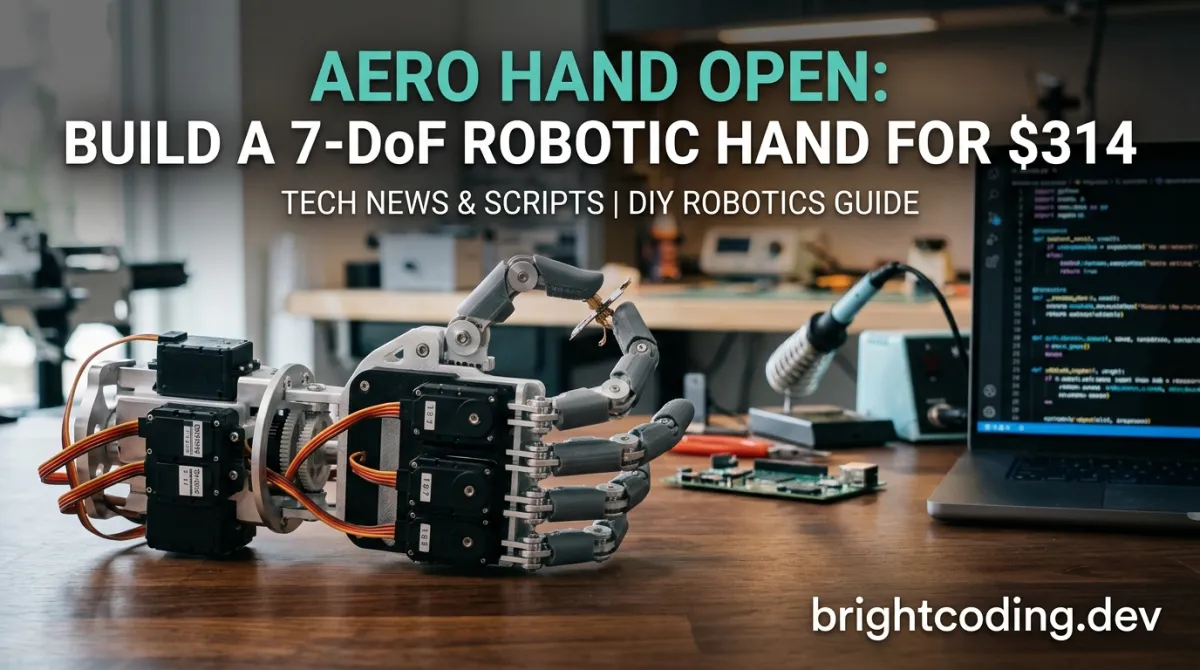
Aero Hand Open: Build a 7-DoF Robotic Hand for $314
What if I told you that the same robotic hand technology powering million-dollar research labs could sit on your desk for the price of a gaming console? Not a toy. Not a stripped-down demo. A real, tendon-driven, 7-degree-of-freedom manipulator that can pinch, grasp, gesture, and integrate with ROS2, MuJoCo simulation, and reinforcement learning pipelines.
Here's the painful truth most roboticists learn the hard way: dexterous manipulation remains the final frontier of robotics, and the hardware gatekeeping this field is absurd. Shadow Robot's Dexterous Hand? $100K+. Allegro Hand? $15K and still proprietary. For graduate students, indie researchers, and hackers, these price tags don't just hurt—they kill projects before they start.
Enter Aero Hand Open from TetherIA, a company quietly upending the economics of robotic manipulation. At 389 grams and $314 USD for the complete kit, this open-source tendon-driven hand delivers 16 joints across 5 fingers with the kind of mechanical sophistication that used to require aerospace budgets. The secret? Clever engineering that trades bloated markups for 3D-printed modularity, off-the-shelf electronics, and community-driven iteration.
Stop dreaming about robot hands. Start building one.
What Is Aero Hand Open?
Aero Hand Open is an open-source, tendon-driven robotic hand designed and developed by TetherIA specifically for dexterous manipulation research. Unlike the proprietary black boxes dominating the market, Aero Hand Open prioritizes simplicity, reliability, and accessibility through deliberate design choices: standard 3D printing, readily available electronic components, and fully transparent documentation.
The project emerged from a clear market failure. TetherIA recognized that manipulation research was bifurcating into two unhealthy extremes: toy-grade hobby servos incapable of meaningful research, and industrial-grade systems priced beyond academic reach. Aero Hand Open occupies the radical middle—professional-grade kinematics at maker-scale economics.
Each joint leverages tendon actuation for mechanical efficiency, enabling smooth, biomimetic motion while maintaining an extraordinarily lightweight and compact footprint. The entire hand weighs less than a can of soda. This matters enormously for mobile manipulation, where every gram at the end-effector amplifies arm dynamics and power requirements.
The project is trending now because it arrives at a convergence point: 3D printing tolerances have matured, BLDC servo prices have collapsed, and reinforcement learning frameworks like MuJoCo Playground have democratized policy training. Aero Hand Open isn't just hardware—it's a complete research ecosystem spanning physical build, simulation, and deployment pipelines.
Critically, TetherIA supports commercial integration. Purchase units from their store, and you're explicitly licensed to embed them in products you sell. This isn't hobbyist virtue-signaling; it's a genuine commercial pathway for robotics startups.
Key Features That Change the Game
Let's dissect what makes Aero Hand Open technically remarkable—and why experienced roboticists are paying attention.
7 Degrees of Freedom Across 5 Fingers (16 Joints Total)
The kinematic arrangement provides independent control of thumb opposition, finger flexion, and coordinated grasp patterns. With 16 joints achieving 7 effective DoFs, the hand balances mechanical complexity against control tractability. You're not drowning in 20+ actuators; you're getting the right actuators in the right places for meaningful manipulation research.
Tendon-Driven Architecture
Tendon transmission offers three decisive advantages over direct-drive or linkage systems: remote actuation (motors live in the palm/forearm, reducing distal mass), compliance (inherent shock absorption protects both hand and manipulated objects), and kinematic elegance (cable routing enables anthropomorphic joint axes impossible with gears). The trade-off—tension maintenance—is addressed through TetherIA's guided assembly process and accessible adjustment points.
Fully 3D-Printed, Modular Structure
Every structural component prints on standard FDM hardware. The recommended profile—Bambu X1C, 0.4mm nozzle, 0.2mm layer height, tree supports on build plate only—yields production-quality results. Modularity means fingers detach independently for maintenance, experimentation, or iterative redesign. Swap a broken tendon in minutes, not hours.
389 Grams Total Mass
This is insane for a 5-fingered manipulator. For context, the Shadow Dexterous Hand exceeds 4 kg. The Allegro Hand hits 800g with fewer functional capabilities. Aero Hand Open's mass efficiency translates directly to: faster arm dynamics, reduced power consumption, safer human interaction, and dramatically lower cost of transport for mobile platforms.
$314 Complete Kit Price
Not a typo. The BOM totals approximately three hundred fourteen dollars, sourced from standard vendors. This isn't subsidized; it's structurally inexpensive through design intelligence. The implications for educational accessibility and swarm robotics experimentation are profound.
Independent Python↗ Bright Coding Blog SDK + ESP32 + ROS2 Compatibility
TetherIA provides a native Python SDK for direct control, ESP32 firmware for embedded operation, and ROS2 Humble integration for full robotics stack deployment. This triple-layer architecture supports everything from classroom demos to production autonomous systems.
MuJoCo Simulation + Reinforcement Learning Tools
The sim_rl/ directory contains simulation assets and training pipelines built on MuJoCo Playground. Train policies in simulation, deploy to physical hardware through the ROS2 bridge. This sim-to-real pathway—historically requiring months of infrastructure—is now pre-configured and documented.
Real-World Use Cases Where Aero Hand Open Dominates
Academic Manipulation Research
Graduate labs worldwide struggle to replicate published results because they lack comparable hardware. Aero Hand Open democratizes reproducibility. A PhD student can build three variants for under $1000, run ablation studies on finger configurations, and publish with confidence that peers can replicate. The open CAD files enable mechanical hypothesis testing: What if we modify the thumb opposition axis? Print and find out.
Educational Robotics Programs
University courses on manipulation, mechatronics, or humanoid robotics previously relied on simulation-only or single expensive platform shared across classes. Now every student builds their own hand, gaining intimate familiarity with tendon routing, tension calibration, and closed-loop control. The assembly process itself teaches more than any lecture.
Prosthetics and Assistive Technology Development
The lightweight, anthropomorphic form factor and accessible electronics make Aero Hand Open viable for prosthetic research. Modify finger lengths, adjust tendon compliance, experiment with myoelectric interfaces—all without licensing negotiations or minimum order quantities. The CC BY-NC-SA license permits non-commercial medical research freely.
Reinforcement Learning Policy Development
The pre-built MuJoCo integration and documented sim-to-real pipeline enable rapid RL iteration. Train grasp policies in simulation with domain randomization, validate on physical hardware, iterate. The ROS2 deployment examples in ros2/ mean your trained policy isn't a paperweight—it controls real fingers within hours.
Low-Cost Swarm Manipulation
At $314 per unit, multi-hand experiments become feasible. Study coordinated bimanual manipulation, ensemble grasping, or competitive/cooperative hand interactions without six-figure budgets. The ESP32 control layer supports wireless coordination for distributed systems.
Step-by-Step Installation & Setup Guide
Hardware Assembly
Prerequisites: Bambu X1C or equivalent FDM printer (≥200×200mm bed), PLA filament, basic electronics tools.
Print Settings (Critical):
Nozzle: 0.4mm
Layer height: 0.2mm
Supports: Tree, build plate only
Orientation: Follow provided files exactly
Print orientation optimization is non-negotiable—TetherIA tuned these for surface finish and dimensional tolerance. Deviating risks interference fits failing.
Assembly Flow:
- Print all components from
hardware/CAD/or access the Onshape live model - Source electronics per
hardware/Assembly/BOM.csv—motors, tendons, bearings, fasteners, ESP32 variant - Assemble finger modules independently following the step-by-step guide
- Route tendons with careful tension management—this is where patience pays
- Mount fingers to palm and connect electronics per PCB documentation
- Flash firmware and verify joint motion
Each finger module assembles standalone then attaches to the palm. This modularity enables parallel builds and hot-swappable maintenance.
Software SDK Installation
# Clone the repository
git clone https://github.com/TetherIA/aero-hand-open.git
cd aero-hand-open

# Navigate to SDK directory
cd sdk

# Install Python dependencies (typically)
pip install -r requirements.txt

# Configure serial port for your ESP32 connection
# Edit configuration or pass port argument per SDK docs
Refer to sdk/README.md and the SDK documentation for platform-specific details.
ROS2 Humble Setup
# Navigate to ROS2 workspace
cd ros2

# Build with colcon
colcon build --packages-select aero_hand_ros2

# Source workspace
source install/setup.bash

# Launch teleoperation or policy deployment
ros2 launch aero_hand_ros2 aero_hand.launch.py
Complete instructions in the ROS2 documentation and ros2/ directory.
Simulation Setup (MuJoCo)
# Navigate to simulation assets
cd sim_rl/simulation

# Install MuJoCo dependencies per your environment
# Load MJCF/URDF models into MuJoCo

# For RL training
cd ../mujoco_playground
# Follow framework-specific setup for policy training
REAL Code Examples from the Repository
Example 1: Running the Sequencing Demo
The SDK includes pre-built gesture sequences demonstrating coordinated multi-finger control. This is your hello world for biomimetic motion.
# Navigate to SDK examples directory
cd sdk/examples

# Execute pre-defined motion sequence
python run_sequence.py
What's happening under the hood: run_sequence.py loads timed joint trajectories from the SDK's sequence library, interpolates between keyframes, and streams position commands to the ESP32 firmware via serial. The firmware handles low-level PID control of each tendon-actuated joint, translating abstract angles into precise motor commands with tension compensation.
The sequencing system abstracts complex coordination into declarative gesture definitions. Rather than manually commanding 7+ DoFs at 50Hz, you define "pinch thumb-index over 0.5 seconds, hold 1 second, release" and the sequencer handles synchronization. This architecture separates what (high-level gesture intent) from how (real-time motor control), enabling rapid experimentation without embedded systems expertise.
Example 2: ROS2 Launch for Teleoperation
The ROS2 integration enables sophisticated control architectures including teleoperation, visual servoing, and learned policy deployment.
# From your ROS2 workspace after building
source install/setup.bash

# Launch complete hand stack with teleoperation interface
ros2 launch aero_hand_ros2 aero_hand.launch.py
Architecture insight: This launch file instantiates multiple ROS2 nodes: a hardware interface node managing ESP32 communication, a joint state publisher for RViz visualization, a controller manager loading position/effort controllers, and optionally a teleoperation node mapping human input (gamepad, motion capture, or vision) to joint targets.
The ROS2 layer transforms Aero Hand Open from embedded device to robotics subsystem. It publishes sensor_msgs/JointState for monitoring, subscribes to trajectory_msgs/JointTrajectory for commanded motion, and exposes FollowJointTrajectory action interfaces for MoveIt integration. Your hand becomes a first-class citizen in any ROS2 ecosystem.
Example 3: Simulation Model Loading (MuJoCo)
import mujoco
import numpy as np

# Load Aero Hand Open MJCF model
model = mujoco.MjModel.from_xml_path('sim_rl/simulation/aero_hand.xml')
data = mujoco.MjData(model)

# Initialize simulation
mujoco.mj_resetData(model, data)

# Example: set target joint positions (radians)
# Joint ordering follows URDF convention: thumb_base, thumb_prox, ...
target_qpos = np.array([0.0, 0.5, 0.3, 0.0, 0.0, 0.0, 0.0])
data.qpos[:7] = target_qpos

# Forward kinematics to update body positions
mujoco.mj_forward(model, data)

# Access fingertip positions for grasp analysis
thumb_tip = data.body('thumb_tip').xpos
index_tip = data.body('index_tip').xpos
print(f"Thumb-index distance: {np.linalg.norm(thumb_tip - index_tip):.3f}m")
Simulation-to-reality bridge: This snippet demonstrates loading the physics model, commanding joint configurations, and extracting geometric information. The identical joint ordering and kinematic structure between simulation and physical hardware means policies trained with this code transfer directly to the real hand through the ROS2 deployment pipeline.
The MuJoCo model includes realistic tendon routing, contact geometries for grasp simulation, and inertial properties derived from the actual 3D-printed components. This fidelity is crucial for sim-to-real transfer—coarse approximations fail when policies exploit simulation artifacts nonexistent in reality.
Example 4: Reinforcement Learning Training Scaffold
# Navigate to RL training directory
cd sim_rl/mujoco_playground

# Configure training environment for grasp task
# Edit config to specify: reward function, observation space, action space

# Launch distributed training
python train.py --config configs/aero_hand_grasp.yaml --num_envs 1024
Training architecture: This leverages MuJoCo Playground's massive parallelism—thousands of simulated hands learning simultaneously. The environment exposes proprioceptive observations (joint positions, velocities, tendon tensions) and visual observations (optional camera rendering), with actions as target joint positions or tendon length changes.
The trained policy exports to a format loadable by the ROS2 deployment node, creating a complete learning-to-deployment pipeline: simulate, train, export, deploy to physical hardware. The ros2/ directory contains examples of this final bridge step.
Advanced Usage & Best Practices
Tension Calibration Ritual: Tendon-driven systems live or die by proper tensioning. After assembly, run the SDK's calibration routine with incremental adjustments. Too loose: backlash and imprecision. Too tight: excessive friction, motor strain, premature wear. The sweet spot emerges through systematic iteration—document your values for reproducibility.
Thermal Management: Continuous operation at high gains heats motors and electronics. Monitor ESP32 temperature via telemetry. For sustained grasping, implement duty cycling or reduce holding currents using the SDK's compliance modes.
Print Material Selection: PLA offers optimal strength-to-printability for structural components. For high-humidity environments, consider PETG for palm housing. Never use brittle materials for tendon guides—layer adhesion failures cascade into catastrophic jams.
Version Control Your Modifications: The Onshape live model enables parametric variants. Fork the design, modify finger lengths or joint axes, export STLs, document changes. This is open-source hardware working as intended—evolution through community experimentation.
Sim-to-Real Gap Bridging: When deploying RL policies, start with domain randomization in simulation (varying friction, mass, tendon stiffness). The MuJoCo model supports these perturbations natively. Validate on hardware progressively: single finger, then coordinated motion, then full grasp sequences.
Comparison with Alternatives
| Feature | Aero Hand Open | Shadow Dexterous Hand | Allegro Hand | InMoov Hand |
|---|---|---|---|---|
| Price (complete) | $314 | ~$100,000+ | ~$15,000 | ~$500 (self-sourced) |
| Mass | 389g | ~4,200g | ~800g | ~600g |
| DoFs | 7 (16 joints) | 20 | 16 | 5-10 (configurable) |
| Actuation | Tendon-driven | Tendon-driven | Direct drive | Servo/printed gears |
| Open Source | Full (HW+SW) | Proprietary | Partial | Full |
| 3D Printable | Yes | No | No | Yes |
| ROS2 Native | Yes | ROS1/2 available | ROS available | Community only |
| RL/Sim Tools | Pre-built (MuJoCo) | Limited | None | None |
| Commercial Use | Licensed via purchase | Licensed | Licensed | Open |
| Assembly Time | ~8-12 hours | N/A (purchased) | N/A (purchased) | ~20+ hours |
Why Aero Hand Open wins: It occupies a unique design point—professional kinematics and software integration at maker economics. Shadow and Allegro remain superior for industrial applications requiring absolute reliability, but their cost structures exclude research exploration. InMoov pioneered open-source hands but lacks the integrated simulation, RL tools, and refined mechanics that make Aero Hand Open research-ready out of the box.
FAQ
Q1: Can I really build this for $314? What's the catch?
A: The BOM total is genuine for self-sourced components. If you lack a 3D printer, add printing service costs (~$50-100). The $314 assumes you print yourself and already have basic tools. No hidden licensing fees for personal or academic use.
Q2: How does tendon durability compare to gear-driven systems?
A: Tendons require periodic inspection and tension adjustment—budget 15 minutes monthly for active use. The trade-off is superior compliance, lower distal mass, and mechanical simplicity. TetherIA uses standard high-strength fishing line / Dyneema; replacements cost pennies.
Q3: What's the control latency? Can it do real-time grasping?
A: The ESP32 firmware runs control loops at 1kHz with serial communication typically at 115-921kbps. End-to-end latency from Python command to joint motion is ~5-10ms, sufficient for closed-loop visual servoing at 30-60Hz camera rates.
Q4: Is ROS2 Humble mandatory, or can I use other versions?
A: Humble is officially supported and tested. Rolling or Iron may work with minor package adjustments. ROS1 Noetic would require bridge nodes or direct SDK usage. The Python SDK operates independently for non-ROS applications.
Q5: Can I modify the design for my specific research needs?
A: Absolutely—the Onshape model enables parametric editing. The CC BY-NC-SA license permits non-commercial modifications with attribution. For commercial derivatives or manufacturing, contact TetherIA for licensing.
Q6: What's the grasp force? Can it hold everyday objects?
A: Exact force depends on motor selection (specified in BOM) and tendon tension. Typical configurations achieve 2-5N fingertip forces—sufficient for eggs, cups, tools, and most manipulation research objects. Power grasps with palm contact increase effective load capacity substantially.
Q7: How do I get help if my build doesn't work?
A: TetherIA maintains GitHub Discussions for build help, Discord for live debugging, and documentation for reference. For bugs, use GitHub Issues.
Conclusion
The robotics community has waited too long for capable manipulation hardware that doesn't require grant funding or corporate sponsorship. Aero Hand Open delivers—through intelligent mechanical design, mature ecosystem integration, and genuine open-source commitment.
At $314 and 389 grams, this isn't a compromise product. It's a deliberate reimagining of what's possible when engineering priorities align with accessibility. The tendon-driven architecture provides biomimetic performance. The ROS2 and MuJoCo integration enables serious research. The 3D-printed modularity invites continuous improvement.
Whether you're a graduate student pursuing manipulation research, an educator building hands-on curriculum, or a startup prototyping the next generation of service robots, Aero Hand Open removes the hardware barrier that's stalled progress for decades.
Stop waiting for permission to build. The future of robotic manipulation is open, affordable, and available now.
👉 Get the complete kit at TetherIA's shop
👉 Clone the repository and start building
👉 Join the Discord community for live support
The hand you need is the hand you can build. Start today.
© 2025 TetherIA Inc. All rights reserved. Project page: https://tetheria.github.io/aero-hand-open/
Outils recommandés
Explore on the BrightCoding network
Hand-picked resources from our other sites.
flowful-ai/cad-skill: Natural Language to Parametric 3D Prints
flowful-ai/cad-skill is a Claude Code skill that generates parametric 3D-printable models using CadQuery. It produces editable Python scripts from natural langu...
jazwa/rackstack: A Modular 3D-Printable Mini Rack for Home Labs
jazwa/rackstack is an MIT-licensed, OpenSCAD-based modular mini rack system for 3D printing. Designed for SBCs, mini PCs, and small networking gear, it features...
fogleman/sdf: Python SDF Mesh Generation for 3D Printing
fogleman/sdf is a Python library for generating 3D meshes from signed distance functions using a concise, operator-driven API. MIT licensed with 1,994+ stars, i...
Continuez votre lecture
Commentaires 0
Aucun commentaire pour l'instant. Soyez le premier à réagir !