Car Diagnostics 101: Understanding OBD-II and Check Engine Codes
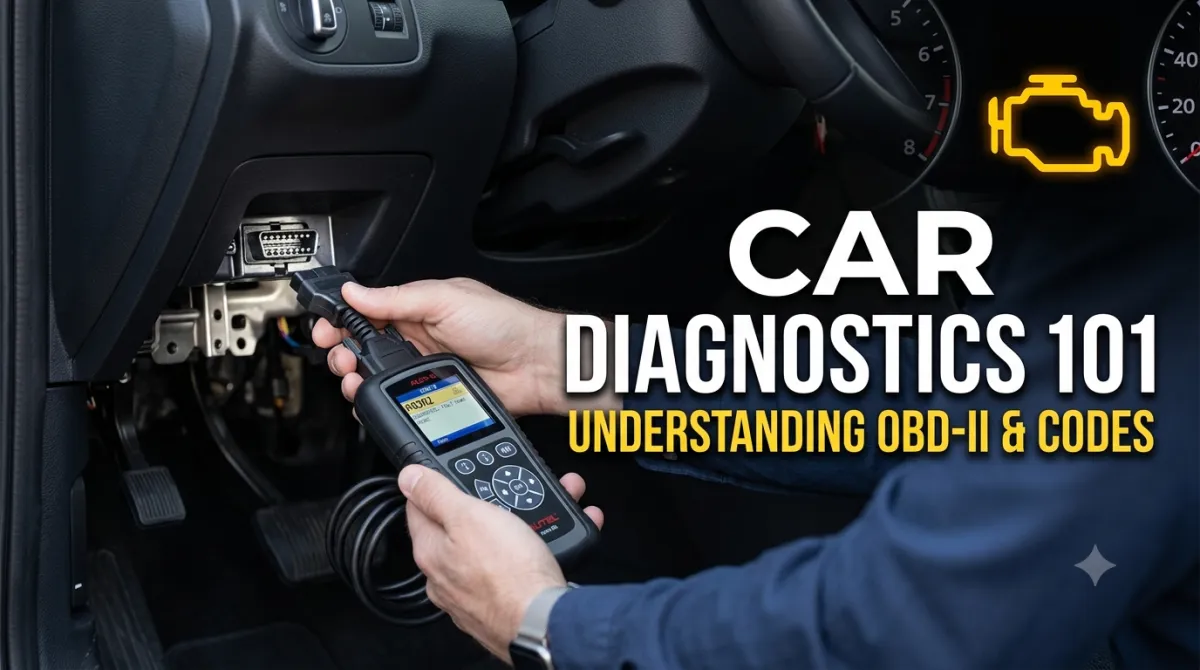
Your check engine light comes on. You panic, call a garage, and get quoted for a "diagnostic." Before you pay, know this: the code is free to read, and understanding it can save you hundreds — sometimes thousands — of dollars. Here's everything you need to know about OBD-II and error codes.
TL;DR
- OBD-II is the standard diagnostic system in cars since 1996. Every car has a port you can plug a scanner into.
- Error codes are five characters (e.g. P0301): a letter for the system, then numbers for the type, subsystem and fault.
- A cheap scanner or phone app reads the code — no garage needed to at least know what the light means.
- Codes describe symptoms, not always the faulty part. Diagnose before you replace.
- Some codes are minor (EVAP, O2 sensors); misfires and low oil pressure deserve immediate attention.
Use our free OBD-II code decoder to look up any code in seconds, with causes and fixes.
What is OBD-II?
OBD-II (On-Board Diagnostics, generation two) is a standard that every petrol and diesel car sold since 1996 has to comply with. It connects a diagnostic port (usually under the dashboard, near the steering column) to the car's computers — the ECU/PCM and other modules.
Plug in a scanner and the car tells you, in a standardized way, what it thinks is wrong. The result is a Diagnostic Trouble Code (DTC): five characters like P0301 or P0420.
How to read the code structure
Every code follows the same pattern:
- First character = system: Powertrain, Body, Chassis, U Network
- Second character = type: 0 = generic/standard, 1 = manufacturer-specific, 3 = enhanced manufacturer
- Third character = subsystem: e.g. 3 = ignition/misfire, 1 = fuel & air, 4 = emissions
- Last two = the specific fault
So P0301 = Powertrain · Generic · Ignition/misfire · Cylinder 1. The decoder on our OBD-II page breaks this down live for any code you type.
Which codes are common?
The most-reported codes across all brands:
- P0300–P0304 — misfires (spark plugs, ignition coils, injectors)
- P0171/P0174 — mixture too lean (vacuum leaks, MAF sensor)
- P0420/P0430 — catalytic converter efficiency
- P0442/P0455 — EVAP system leaks (fuel cap, hoses)
- P0401 — EGR flow insufficient
- P0101 — MAF sensor range/performance
- P0128 — thermostat not reaching temperature
- U0100 — lost communication with the engine computer
Many brands have their own codes too — BMW, Mercedes, VW/Audi, Peugeot, Renault, Toyota, Ford and GM each have quirks. We built brand-specific pages with the codes owners actually see: BMW, Mercedes, VW & Audi, Peugeot & Citroën, Renault, Toyota & Lexus, Ford and GM.
Do I need a professional scanner?
For most drivers, no. A basic OBD-II reader costs $15–40, and an ELM327 Bluetooth adapter + phone app works for about $10. These read codes, pending codes and freeze-frame data — enough to know what you're dealing with.
Professional scanners add live data graphing, bi-directional tests and module-level access. Get one if you're a serious DIYer; otherwise start cheap.
The golden rule: diagnose, don't shotgun
A code tells you which circuit or system is involved — not always which part to buy. For example, P0301 (cylinder 1 misfire) can be caused by a spark plug, an ignition coil, an injector or a vacuum leak.
Smart approach: read the freeze-frame data, swap the coil with another cylinder (if the misfire moves, it's the coil), inspect wiring, and only then buy the part. This is exactly why every entry in our code dictionary includes both causes and fixes.
When to act immediately
- Flashing check engine light — active misfire. Stop driving: it can destroy the catalytic converter.
- P0300 series misfires — diagnose soon to avoid engine damage.
- P0520 oil pressure / overheating codes — stop and check immediately.
- U0100 network codes — check battery and grounds first; often electrical.
FAQ
Will the light reset itself? Some codes clear if the condition disappears over several drive cycles. Others stay until erased with a scanner.
Can I pass inspection with the light on? In most regions, no — and clearing the code just before inspection rarely works because the system needs clean drive cycles.
Is it safe to drive with the light on? A solid (non-flashing) light with normal drivability is usually safe short-term. A flashing light means pull over.
Do I still need a mechanic if I read the code? You'll know more going in, and you can decide: fix it yourself or give the garage the exact diagnosis to avoid "diagnostic fees" for things you can identify.
Conclusion
Reading an OBD-II code is one of the highest-value skills a car owner can learn. It turns the scary check-engine light into an actionable list of causes and fixes. Start with our free decoder, look up your brand in the brand pages, and you'll walk into any garage — or any parts store — knowing exactly what to ask for.
Continuez votre lecture




Commentaires 0
Aucun commentaire pour l'instant. Soyez le premier à réagir !